Ally is the correct English word when you mean a supporter, partner, or someone who helps and cooperates with you.
Have you ever wondered whether the correct word is ally or Allie? These two words look almost identical, but they have very different uses.
The good news is that the difference is easy to understand.
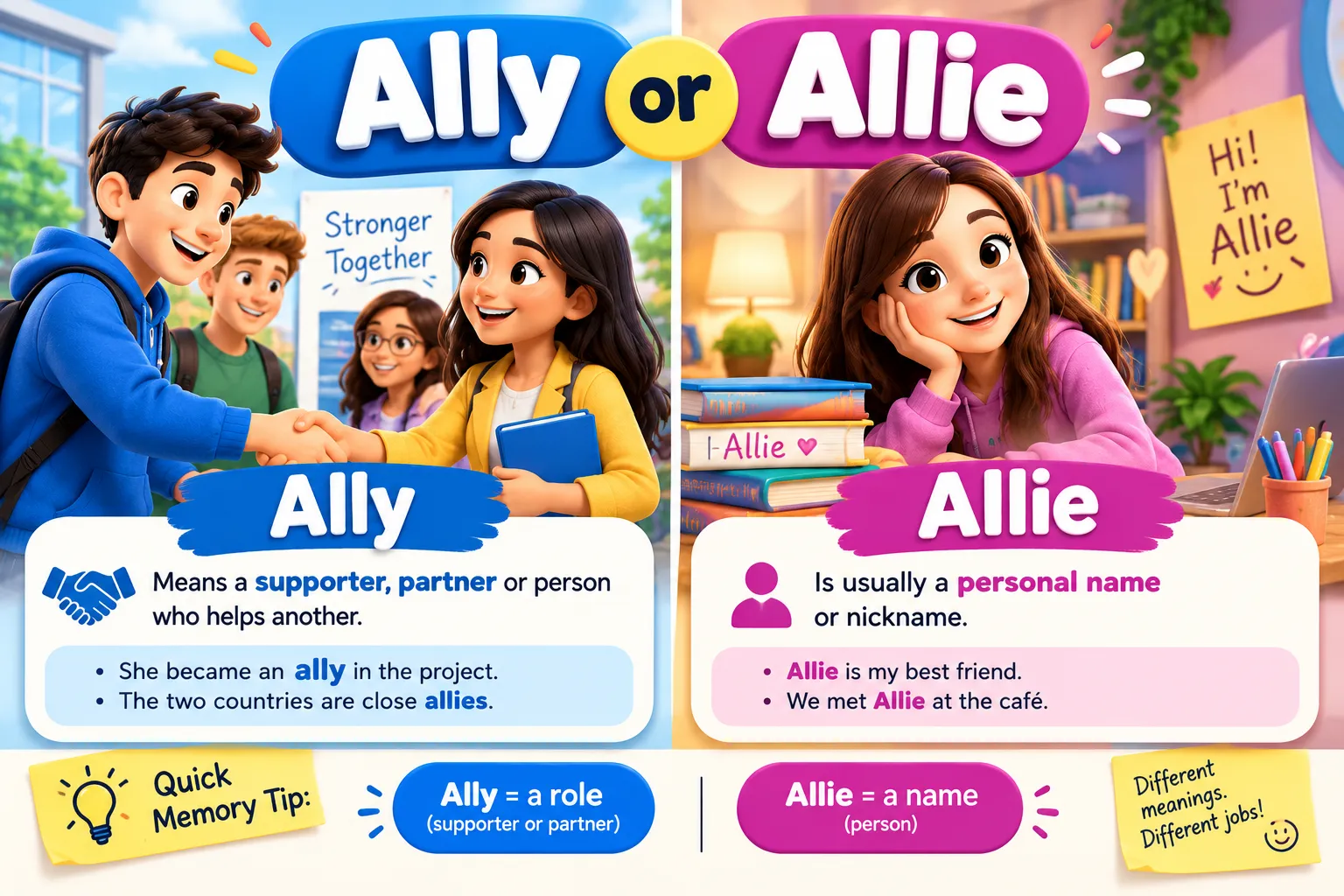
Ally is a standard English word. It means a supporter, partner, or person who helps another person or group.
Allie is usually a personal name or nickname. It is not normally used as a replacement for the English word ally.
For example:
- She is my ally. → She supports me.
- Allie is my sister. → Allie is a person’s name.
So, if you are talking about support, friendship, cooperation, or partnership, use ally. If you are referring to someone named Allie, use Allie.
Ally or Allie: Quick Answer
Ally
Ally is a noun or verb.
As a noun, it means a person, group, or country that supports or cooperates with another.
Example:
My best friend has always been my ally.
As a verb, ally means to join or connect with someone or something for a shared purpose.
Example:
The two organizations decided to ally with each other.
Allie
Allie is generally used as a personal name or nickname.
Example:
Allie is coming to the party tonight.
Easy rule
Ally = supporter or partner
Allie = person’s name
This simple rule will help you choose the correct spelling in most situations.
What Does “Ally” Mean?
Ally is a common English word that refers to someone who supports, helps, or cooperates with another person or group.
It can describe:
- a supportive friend
- a helpful person
- a partner
- a supporting organization
- a country that cooperates with another country
- someone who supports a particular cause
Examples of “ally” as a noun
- Sarah became an important ally during the project.
- My brother is my strongest ally.
- The two countries are close allies.
- Good communication can turn a colleague into an ally.
In each sentence, ally describes someone who provides support or works together with another person or group.
Ally as a verb
Ally can also be used as a verb.
It means to join, connect, or cooperate with another person or group.
Examples:
- The two companies allied to develop the new product.
- Several organizations allied against the proposed changes.
- The smaller group allied with a larger organization.
The verb is less common in everyday conversation than the noun, but it is still a standard English word.
What Does “Allie” Mean?
Allie is generally a personal name.
It may be someone’s first name or a nickname. Because it is a name, it is normally written with a capital letter.
Examples
- Allie is my new classmate.
- I called Allie yesterday.
- Allie helped me with my homework.
- Have you met Allie?
Here, Allie identifies a specific person.
This is the biggest difference between ally and Allie.
Ally has a dictionary meaning related to support and cooperation.
Allie is normally a person’s name.
Ally vs. Allie: What’s the Difference?
The spelling difference is only one letter, but the meaning changes completely.
| Word | Meaning | Type | Example |
|---|---|---|---|
| ally | A supporter or partner | Common noun / verb | She is my closest ally. |
| Allie | A person’s name or nickname | Proper noun | Allie lives next door. |
The capitalization also matters.
Lowercase: ally
Use ally when you mean a supporter or partner.
He became an ally during a difficult time.
Capitalized: Allie
Use Allie when it is someone’s name.
Allie called me this morning.
Remember that capitalization is not the only difference. The meaning and context are important too.
When Should You Use “Ally”?
Use ally when you are talking about someone who supports, helps, or cooperates with another person or group.
Example 1
My sister has always been my ally.
Here, ally means someone who supports the speaker.
Example 2
We need an ally who understands our goals.
The word describes a supportive partner.
Example 3
The two countries became allies.
Here, the plural form allies refers to countries that cooperate or support one another.
Example 4
She decided to ally with the local organization.
Here, ally is being used as a verb.
When Should You Use “Allie”?
Use Allie when you are referring to a person whose name is Allie.
Examples
Allie is studying English.
I met Allie at school.
Can you ask Allie to call me?
Allie and Emma went shopping together.
In these sentences, replacing Allie with ally would change the meaning.
For example:
Allie is my friend.
This means a person named Allie is your friend.
But:
Ally is my friend.
This could mean a person named Ally is your friend, because Ally can also be used as a personal name. Context and capitalization matter.
However, when the intended meaning is supporter or partner, the standard common noun is ally.
Is “Allie” a Correct English Word?
Yes, Allie is used in English, but its usual role is different from ally.
Allie is generally a personal name or nickname.
For example:
Allie is coming over later.
It would be incorrect to replace the name with ally if the person is actually named Allie.
However, if you want to describe someone as a supporter, use ally.
She became an important ally.
Not:
She became an important Allie.
The second sentence would suggest that Allie is being treated as a person’s name rather than the common noun meaning “supporter.”
Ally, Allies, Allied, and Alliance
If you are learning the word ally, it helps to understand its related forms.
1. Ally
Ally is the singular noun.
He is a trusted ally.
It can also function as a verb.
The groups decided to ally with one another.
2. Allies
Allies is the plural form of ally.
They became close allies.
The spelling changes from ally to allies.
Spelling rule
When a word ends in a consonant + y, the y usually changes to ies when forming the plural.
So:
ally → allies
Similar examples include:
- baby → babies
- city → cities
- country → countries
- party → parties
This is an important spelling pattern for English learners.
3. Allied
Allied is another related form.
It can mean connected, associated, or joined with another person or group.
The two organizations are closely allied.
4. Alliance
An alliance is a relationship or agreement in which people, groups, or countries cooperate.
The companies formed an alliance.
The word family can therefore be remembered as:
ally → allies → allied → alliance
Common Mistakes With Ally and Allie
Because the words look and sound similar, they are easy to confuse.
Here are some common mistakes.
Mistake 1: Using “Allie” when you mean “supporter”
❌ She became my Allie during the difficult project.
If you mean that she supported you, the better spelling is:
✅ She became my ally during the difficult project.
Mistake 2: Using “ally” instead of someone’s name
Suppose someone’s name is Allie.
❌ I spoke to ally yesterday.
If Allie is the person’s name, write:
✅ I spoke to Allie yesterday.
Mistake 3: Forgetting capitalization
Names normally begin with a capital letter.
✅ Allie is my friend.
But a common noun is normally lowercase.
✅ She is an ally.
Mistake 4: Confusing “ally” with “allies”
Use ally for one supporter.
He is my ally.
Use allies for more than one.
They are my allies.
The spelling changes:
ally → allies
Ally or Allie in a Sentence
Let’s compare the two words side by side.
Ally
My teacher was an ally when I struggled with the assignment.
Meaning: The teacher supported or helped me.
Allie
Allie helped me with my assignment.
Meaning: Allie is the person’s name.
Another comparison
We need an ally for this project.
This means you need a supportive partner.
We need Allie for this project.
This means you need a particular person named Allie.
The context makes the difference clear.
Examples of “Ally”
Here are more natural examples of ally:
- She became an important ally at work.
- My parents have always been my allies.
- He found an ally in his new colleague.
- The organization is working with several allies.
- A good friend can become a valuable ally.
- The two groups decided to ally with each other.
- They remained strong allies for many years.
- She knew she had an ally in her teacher.
These examples show that ally is connected with support, cooperation, and partnership.
Examples of “Allie”
Here are examples where Allie is used as a name:
- Allie is my best friend.
- I saw Allie at the library.
- Allie sent me a message.
- Have you talked to Allie?
- Allie is learning Spanish.
- We invited Allie to dinner.
- Allie helped me finish the project.
- I have known Allie for several years.
In every example, Allie refers to a person.
A Simple Memory Trick
Still confused?
Use this easy memory trick:
Ally = a role
An ally is someone who supports you.
Allie = a name
Allie is usually the name of a person.
Think of it this way:
Ally helps you. Allie is someone you know.
This is not a strict rule for every possible name spelling, but it is a useful way to remember the difference when writing ordinary English.
Why Do Ally and Allie Cause Confusion?
The confusion comes mainly from their similar spelling and pronunciation.
The words are only one letter apart:
Ally
Allie
There is also another reason for confusion: Ally can itself be used as a personal name.
For example:
Ally is my sister.
Here, Ally is a name.
But:
She is an ally.
Here, ally is a common noun meaning supporter or partner.
So you cannot always determine the meaning from spelling alone. Context and capitalization matter.
Ally or Allie: Quick Comparison
| Feature | Ally | Allie |
|---|---|---|
| Main use | Supporter or partner | Personal name or nickname |
| Word type | Common noun / verb | Proper name |
| Usually capitalized? | No | Yes, when used as a name |
| Plural | Allies | Names normally do not follow this pattern |
| Example | She is my ally. | Allie is my friend. |
| Main idea | Support | Person’s name |
Frequently Asked Questions
Is “ally” or “Allie” correct?
Both can be correct, but they have different uses.
Ally is the standard English word for a supporter, partner, or person who cooperates with another.
Allie is generally a personal name or nickname.
Is Allie a word or a name?
Allie is generally used as a personal name or nickname.
For example:
Allie is coming to school today.
If you mean a supporter or partner, use ally.
What is the plural of ally?
The plural of ally is allies.
One ally
Two allies
The spelling changes from y to ies.
Is “Ally” also a name?
Yes. Ally can also be used as a personal name.
That means context is important.
Compare:
Ally is my friend.
Here, Ally may be someone’s name.
She is my ally.
Here, the word means supporter or partner.
What is the difference between ally and allies?
Ally is singular, while allies is plural.
She is an ally.
They are allies.
The spelling changes because of the English plural spelling rule:
ally → allies
Can ally be a verb?
Yes.
As a verb, ally means to join, connect, or cooperate with another person or group.
Example:
The two organizations decided to ally with each other.
Is “Allie” a correct spelling of “ally”?
No, not when you mean supporter or partner.
The standard spelling of the common English word is:
ally
Allie is generally used as a person’s name or nickname.
How can I remember ally and Allie?
Use this simple memory trick:
Ally = supporter
Allie = name
If you are talking about someone who supports you, choose ally.
If you are writing someone’s name, use the spelling that person uses, such as Allie.
Ally or Allie: Final Answer
The difference between ally and Allie is simple once you focus on meaning.
Ally is the standard English word for a supporter, partner, or person who cooperates with another.
Allie is generally a personal name or nickname.
Remember:
Ally = supporter or partner
Allie = person’s name
Also remember that Ally can itself be a person’s name, so capitalization and context are important.
If you are writing about teamwork, support, cooperation, or partnership, ally is usually the word you need.
If you are referring to someone named Allie, use Allie.
Once you understand the meaning behind each spelling, choosing the right word becomes much easier.
Readmore

I’m Daniel sultan, an English language writer and SEO content specialist with experience researching spelling, grammar, vocabulary, and English usage. Through SpellComparison.com, I create clear, accurate, and well-researched guides that help readers understand commonly confused words, spelling differences, and grammar rules with confidence.
Every article I write is based on trusted language references, established style guides, and real-world usage to ensure it is accurate, practical, and easy to understand. My goal is to make learning English simple and reliable by providing fact-checked content, clear explanations, and real-life examples that students, writers, educators, and professionals can trust.