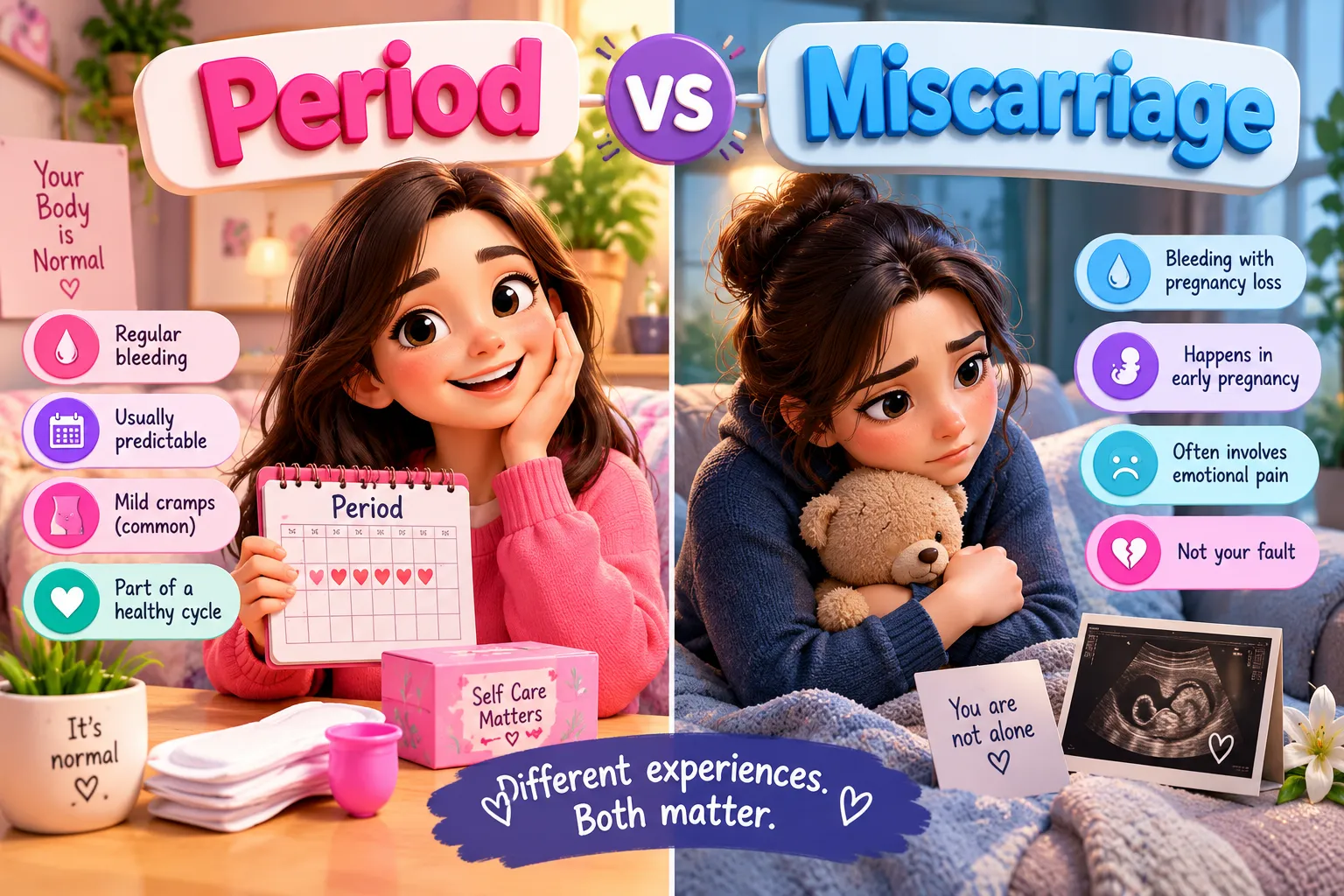
A period is the normal shedding of the uterine lining when pregnancy has not occurred, while a miscarriage is the loss of a pregnancy. Bleeding can happen with both, so bleeding alone cannot always tell you which one is happening
A period is the normal shedding of the uterine lining when pregnancy has not occurred, while a miscarriage is the loss of a pregnancy. Bleeding can happen with both, so bleeding alone cannot always tell you which one is happening
Have you ever noticed bleeding at a time when you were not sure whether your period had started or something else was happening?
I have seen this question cause a lot of worry, especially when pregnancy is possible. The confusion makes sense. A period and an early miscarriage can both involve vaginal bleeding and cramps. The amount of blood can also vary from person to person.
The key difference is pregnancy. A menstrual period happens as part of the normal menstrual cycle when pregnancy has not occurred. A miscarriage means that a pregnancy has ended.
Still, you should not try to diagnose a miscarriage from bleeding alone. Some people have light bleeding during early pregnancy and do not miscarry. Others may have a miscarriage with little or no warning. Medical professionals may use an ultrasound, pregnancy testing, and blood tests for human chorionic gonadotropin (hCG) to help confirm what is happening.
Let’s break down the difference in simple terms.
Period or Miscarriage Quick Answer
A period, also called menstruation, is part of the menstrual cycle. It occurs when the uterine lining is shed because pregnancy has not occurred during that cycle.
A miscarriage is the loss of a pregnancy. Medical sources use slightly different week-based definitions depending on the health system. For example, ACOG describes early pregnancy loss as pregnancy loss before 13 completed weeks, while other medical sources commonly use before 20 weeks.
For example:
- A period may arrive around the time you normally expect monthly bleeding.
- A miscarriage can cause bleeding during a confirmed or possible pregnancy.
The difficult part is that both can cause cramps and bleeding. That is why symptoms alone may not provide a definite answer.
The Background: What Is a Period?
A period is the bleeding phase of the menstrual cycle.
During a typical cycle, the body prepares the uterus for a possible pregnancy. The uterine lining becomes thicker. If pregnancy does not occur, hormone levels change and the lining is shed.
This produces menstrual bleeding.
A period can include:
- Vaginal bleeding
- Lower abdominal cramps
- Back discomfort
- Bloating
- Breast tenderness
- Mood changes
- Tiredness
The exact pattern is different for each person.
The first day of menstrual bleeding is generally counted as day one of the menstrual cycle. Periods commonly last several days, although cycle length and bleeding patterns can vary.
What is a miscarriage?
A miscarriage is different because a pregnancy has already started.
ACOG states that early pregnancy loss is common and occurs in about 10 out of 100 known pregnancies. Many early pregnancy losses happen because the embryo does not develop normally, often because of chromosome problems.
A miscarriage may involve bleeding, cramping, passing tissue, or fluid. However, some miscarriages have few or no obvious symptoms and are discovered during an ultrasound.
Period or Miscarriage Explained: Key Differences
Here is a simple comparison:
| Term | Meaning | Common Signs | Context |
| Period | Normal shedding of the uterine lining | Bleeding and menstrual cramps | No ongoing pregnancy |
| Miscarriage | Loss of a pregnancy | Bleeding, cramps, possible tissue or fluid | Pregnancy has ended |
| Early pregnancy bleeding | Bleeding during early pregnancy | Spotting or bleeding, sometimes with pain | May have several causes |
| Threatened miscarriage | Bleeding in pregnancy where miscarriage may be possible but has not been confirmed | Bleeding, sometimes cramps | Requires medical assessment |
One important point is easy to miss: bleeding during pregnancy does not automatically mean miscarriage.
ACOG says bleeding during the first trimester occurs in about 15 to 25 out of 100 pregnancies. Several causes are possible, including implantation, infection, early pregnancy loss, and ectopic pregnancy.
Example of a period
Someone who is not pregnant may have bleeding around the expected time of their menstrual cycle. The bleeding may be accompanied by their usual menstrual cramps.
Example of possible miscarriage
Someone who has a confirmed pregnancy may develop vaginal bleeding with stronger cramps and pass tissue or fluid. Those symptoms require medical assessment rather than self-diagnosis.
Which Situation Should You Consider?
The most useful question is not simply, “How much am I bleeding?”
Ask whether pregnancy is possible or already confirmed.
If pregnancy is not possible
Bleeding that follows your usual menstrual pattern is more likely to be a period.
However, unusual bleeding can have other causes. A healthcare professional can help if your cycle suddenly changes or the bleeding concerns you.
If pregnancy is possible
A pregnancy test may help answer an important first question.
Home pregnancy tests look for hCG, a hormone produced during pregnancy. Testing is generally more reliable after the first day of a missed period.
If pregnancy has already been confirmed
Do not assume that bleeding is simply a period.
A true menstrual period does not occur during an ongoing pregnancy. Bleeding in pregnancy has several possible causes, and some require urgent treatment.
If you are pregnant and have bleeding, contact your pregnancy care provider for advice.
Common Mistakes About Period or Miscarriage
1. Assuming every pregnancy bleed is a miscarriage
Mistake: “I am bleeding, so I must be miscarrying.”
Better understanding: Bleeding can happen for several reasons during early pregnancy. A healthcare professional may need an ultrasound or hCG testing to determine what is happening.
2. Assuming heavy bleeding is always a period
Mistake: “The bleeding looks like my period, so it must be my period.”
Better understanding: If pregnancy is possible, bleeding should not automatically be treated as menstruation.
3. Thinking cramps prove a miscarriage
Mistake: “I have cramps, so I have lost the pregnancy.”
Better understanding: Cramping can occur with normal menstruation and with several pregnancy-related conditions. Symptoms alone are not enough to confirm a miscarriage.
4. Ignoring a positive pregnancy test
Mistake: “I had bleeding after a positive test, so the pregnancy test must have been wrong.”
Better understanding: A pregnancy test detects hCG. After pregnancy loss, hCG may remain in the body for some time, so a positive test does not by itself explain the bleeding.
5. Waiting despite severe symptoms
Mistake: “I will wait and see even though I have severe pain or very heavy bleeding.”
Better understanding: Severe pain, fainting, shoulder pain, or heavy bleeding can require urgent medical attention. Ectopic pregnancy is one serious possibility that healthcare professionals need to rule out.
Period or Miscarriage in Real-World Situations
Professional email
“I am experiencing unexpected bleeding during early pregnancy and would like advice on whether I should be assessed today.”
This wording is useful because it gives the healthcare team the key information without trying to diagnose the problem yourself.
News article
“Doctors advise pregnant patients to seek medical advice for unexplained vaginal bleeding.”
A news report may discuss miscarriage, but it should distinguish pregnancy loss from other causes of bleeding.
Social media post
“I was unsure whether the bleeding was my period or something related to pregnancy, so I contacted my healthcare provider.”
Personal experiences vary. One person’s symptoms cannot reliably predict another person’s situation.
Formal medical report
“The patient reported vaginal bleeding and pelvic cramping during early pregnancy and was referred for further assessment.”
Medical professionals use examination, pregnancy history, ultrasound, and laboratory testing when needed.
Period or Miscarriage Data, Trends & Usage
The strongest available data here are medical statistics, rather than ordinary keyword search-volume numbers.
ACOG reports that early pregnancy loss occurs in about 10% of known pregnancies. It also notes that first-trimester bleeding occurs in roughly 15% to 25% of pregnancies, showing why bleeding alone cannot be used to identify a miscarriage.
Mayo Clinic similarly reports that about 10% to 20% of known pregnancies end in miscarriage, while noting that the actual number may be higher because some very early losses happen before pregnancy is recognized.
What this means for search intent
The search “period or miscarriage” is mainly informational and health-related.
People commonly want to understand:
- Whether bleeding could be a period
- Whether pregnancy is possible
- Which symptoms can occur with miscarriage
- When to take a pregnancy test
- When to contact a doctor
- When emergency care may be necessary
Exact monthly search-volume figures from Ahrefs, Semrush, or Google Keyword Planner are not available in the sources used for this article, so it would be misleading to invent a number.
The medical data are more useful here because the question is about recognizing a potentially serious health situation, not simply comparing two search terms.
Standalone Comparison Table
| Term/Variant | Meaning | Region/Context | Best Used When |
| Period | Menstrual bleeding | Menstrual cycle | Pregnancy has not occurred |
| Miscarriage | Loss of a pregnancy | Pregnancy care | Pregnancy has ended naturally |
| Spotting | Small amounts of vaginal bleeding | Menstrual or pregnancy context | Describing light bleeding without assuming its cause |
| Early pregnancy loss | Medical term for an early pregnancy that has ended | Clinical context | Speaking with healthcare professionals |
| Ectopic pregnancy | Pregnancy developing outside the uterus | Emergency pregnancy care | Considering serious causes of early pregnancy pain or bleeding |
This table highlights an important distinction: spotting describes the amount or pattern of bleeding, while miscarriage describes a pregnancy outcome.
When Should You Seek Medical Help?
If you are pregnant and have vaginal bleeding, contact your healthcare professional for advice.
Seek urgent medical care if bleeding is heavy or you have severe pain, fainting, dizziness, or shoulder pain. These symptoms can sometimes indicate a serious condition, including ectopic pregnancy.
ACOG advises contacting an ob-gyn for symptoms of early pregnancy loss, including vaginal bleeding or spotting, particularly when it is accompanied by pain.
After a confirmed miscarriage, very heavy bleeding, fever, chills, or severe pain also require medical attention.
Do not try to confirm a miscarriage by comparing blood alone with pictures or descriptions online. Medical evaluation is safer and more reliable.
FAQs About Period or Miscarriage
Q: What does “period or miscarriage” mean?
A: The phrase usually describes uncertainty about whether vaginal bleeding is normal menstruation or pregnancy loss. A period occurs as part of the menstrual cycle, while miscarriage means a pregnancy has ended.
Q: Can a miscarriage look like a period?
A: Yes. Early miscarriage can cause bleeding and cramping that may resemble menstrual symptoms. The bleeding may also be heavier or include tissue, but appearance alone cannot confirm a miscarriage.
Q: Can you have a period while pregnant?
A: A true menstrual period does not occur during an ongoing pregnancy. However, vaginal bleeding can happen during pregnancy and may have several causes, so it can sometimes be mistaken for a period.
Q: How can you tell the difference between a period and miscarriage?
A: Timing, pregnancy status, symptoms, pregnancy tests, ultrasound, and sometimes hCG blood tests can help. There is no reliable rule based only on the color or amount of blood.
Q: Is bleeding in early pregnancy always a miscarriage?
A: No. ACOG reports that first-trimester bleeding occurs in about 15% to 25% of pregnancies. Some causes are not pregnancy loss, but bleeding during pregnancy should still be discussed with a healthcare professional.
Q: Where does the term “period” come from?
A: In everyday health language, “period” refers to menstruation, the recurring phase when the uterine lining is shed. “Menstruation” is the more formal medical term.
Q: Can a pregnancy test help distinguish a period from a miscarriage?
A: A pregnancy test can detect hCG and help show whether pregnancy hormones are present. However, a positive result does not by itself confirm that a pregnancy is continuing normally, so further medical assessment may be needed.
Conclusion: Period or Miscarriage?
Knowing the difference between a period or miscarriage can help you understand what your body may be telling you, but symptoms alone cannot always provide the answer.
A period is part of the normal menstrual cycle. A miscarriage is the loss of a pregnancy. Both can involve bleeding and cramps, which explains why the two are sometimes confused.
The biggest clue is pregnancy status. If you could be pregnant, do not automatically assume that bleeding is your period. A pregnancy test can provide useful information, while an ultrasound and hCG testing may be needed to assess a possible pregnancy loss.
Remember, too, that early pregnancy bleeding does not always mean miscarriage. Some people experience bleeding and continue with a healthy pregnancy.
If you have heavy bleeding, severe pain, fainting, dizziness, or shoulder pain, seek urgent medical care.
When pregnancy may be involved, getting professional advice is safer than trying to diagnose the cause from bleeding alone. Bookmark this guide so you know what questions to ask if the situation ever arises.
Read More:
Kindergarten vs. Kindergarden: Correct Spelling Explained

I’m an English language educator and content writer with more than 10 years of experience helping learners improve their English skills. I specialize in spelling differences, grammar, vocabulary, synonyms, commonly confused words, and English usage. My goal is to create accurate, easy-to-understand articles that make learning English simple, practical, and enjoyable for students, writers, and professionals around the world.










