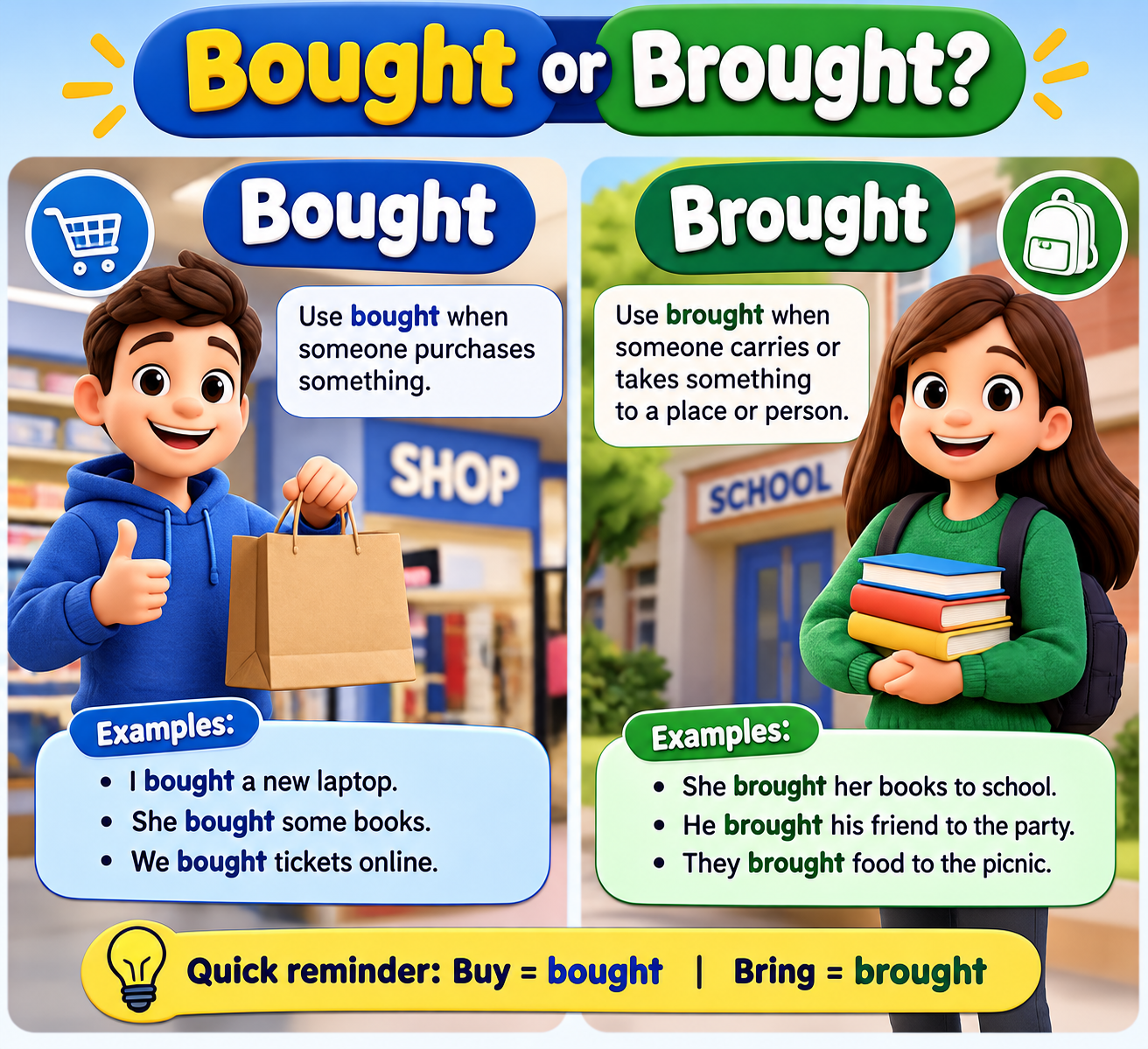
Bought is the past tense and past participle of buy, while brought is the past tense and past participle of bring.
Have you ever written “I brought a new phone” when you meant “I bought a new phone”? This is one of those small English mistakes that can change the meaning of a whole sentence.
I have seen learners make this mix-up often. The words bought and brought look almost the same. They also sound similar when spoken quickly. Yet they come from two different verbs and describe two different actions.
The difference becomes much easier when you connect each word to its base verb. Bought comes from buy. Brought comes from bring. One is about getting something by paying for it. The other is about carrying or taking something to a place or person.
This guide will help you understand the difference without memorizing a complicated grammar rule. You will learn the meanings, word origins, correct sentence patterns, common mistakes, real-world examples, and a simple memory trick. By the end, you should be able to choose the right word with confidence.
Bought or Brought Quick Answer
Use bought when you mean that someone purchased something.
I bought a new notebook yesterday.
Use brought when you mean that someone carried or took something with them to a person or place.
She brought her notebook to class.
A quick way to remember the difference is:
Buy → Bought → paid for something
Bring → Brought → carried or took something somewhere
According to Cambridge Dictionary, bought is the past tense and past participle of buy, while brought is the past tense and past participle of bring.
The Origin and Background of Bought and Brought
The two words look related, but their histories are different.
Where does bought come from?
Bought is the past form of buy.
The word buy has Old English roots. Etymonline traces it to Old English bycgan, meaning “to get by paying for.” Over time, the spelling and pronunciation changed into the modern English forms buy and bought.
So:
buy → bought
The vowel change may seem strange, but English has many irregular verbs that do not form the past tense by simply adding -ed.
For example:
- go → went
- take → took
- see → saw
- buy → bought
Where does brought come from?
Brought is the past form of bring.
Etymonline traces bring to Old English bringan, meaning to carry, bring, or produce. Its past form developed into brought.
So:
bring → brought
This explains why bought and brought are so easy to confuse. Both are irregular past-tense forms. Both contain -ought. Yet they belong to different verbs.
In linguistics, these are not homophones in standard pronunciation because bought and brought have different sounds in many varieties of English. They are better described as commonly confused words.
Bought or Brought Explained Key Differences
The most useful question is simple:
Did you pay for it, or did you carry/take it somewhere?
Bought = purchased
Use bought when money is exchanged for something.
Daniel bought a new laptop.
Daniel paid for the laptop.
Other examples:
- We bought some fresh fruit.
- Maria bought a ticket online.
- They bought new furniture.
- I bought a gift for my sister.
Brought = carried or took something
Use brought when someone moves something toward a person, place, or situation.
Daniel brought his laptop to work.
Daniel did not necessarily purchase the laptop. He carried it with him.
More examples:
- Sara brought some snacks to the meeting.
- Please bring your passport tomorrow.
- He brought his children to the park.
- She brought the documents to my office.
The key comparison
| Term | Meaning | When to Use | Region/Context |
| bought | Purchased something | Someone paid to get it | Standard English |
| brought | Carried or took something to a place/person | Something was moved | Standard English |
| buy | Purchase | Present or base form | Standard English |
| bring | Carry or take toward a destination/person | Present or base form | Standard English |
Compare these two sentences:
I bought flowers.
You paid for the flowers.
I brought flowers.
You carried the flowers to a person or place.
You can even use both words in one sentence:
I bought some flowers and brought them home.
That sentence shows the difference perfectly.
Which Version Should You Use?
Your choice depends on the action you want to describe.
For students
Look at the base verb first.
If the base verb is buy, use bought for the past.
I buy → I bought
If the base verb is bring, use brought.
I bring → I brought
This method is easier than trying to remember the two words separately.
For English learners
Ask yourself:
Was money involved in getting the thing?
If yes, bought is probably the word you need.
She bought a dress.
Then ask:
Did someone carry or take something to another place or person?
If yes, use brought.
She brought the dress home.
For professional and formal writing
Choose the word based on the actual action.
For example:
The company bought new equipment.
This means the company purchased it.
But:
The manager brought the equipment into the meeting room.
This means the manager moved it there.
The same object can work with both words because the verbs describe different actions.
Common Mistakes With Bought and Brought
1. Writing brought when you mean purchased
Wrong:
I brought a new computer last week.
Correct:
I bought a new computer last week.
Why? The sentence describes a purchase.
2. Writing bought when you mean carried
Wrong:
She bought some documents to the office.
Correct:
She brought some documents to the office.
The documents were carried to the office. The sentence does not say she purchased them.
3. Mixing up buy and bring
Wrong:
Please buy your homework tomorrow.
Correct:
Please bring your homework tomorrow.
You are asking the student to carry the homework with them.
4. Using bought after bring
Wrong:
He bring a gift yesterday.
Correct:
He brought a gift yesterday.
The word yesterday shows that the action happened in the past.
5. Using brought after buy
Wrong:
I buy a new jacket yesterday.
Correct:
I bought a new jacket yesterday.
The past form of buy is bought, not buyed.
Bought and Brought in Real World Examples
These words appear in everyday communication, school writing, business messages, and online posts.
Professional email
I bought the supplies yesterday and brought them to the office this morning.
The first action involves payment. The second involves movement.
News headline
Local School Bought New Computers for Students
Here, the school purchased the computers.
Social media post
My brother brought home the most amazing cake today!
The word describes the movement of the cake to the speaker’s home.
Formal report
The department bought additional equipment and brought it into service during the following month.
The two verbs describe separate actions.
Everyday conversation
“Did you buy the milk?”
“Yes, and I brought it home.”
This short exchange is a great way to see the difference.
Bought or Brought Data, Trends & Usage
The confusion between these words is mainly an informational grammar and spelling issue. People search for the pair when they want to understand which word fits a sentence.
Exact monthly search volumes for “bought or brought” can vary widely between SEO tools and countries. Google Trends is useful for comparing relative search interest, but it does not provide exact monthly search counts. Search interest also changes over time.
Dictionary evidence shows why both words remain useful. Bought is the past form of buy, while brought is the past form of bring. Both are common irregular verbs in everyday English.
Corpus tools such as the Google Books Ngram Viewer can compare word frequency in published books, but frequency alone does not tell you which word is correct in a particular sentence.
The bigger lesson is that context matters more than spelling similarity.
This topic also matters for ESL learners because irregular verbs can be harder to predict than regular verbs. Grammar and spelling tools may flag the wrong form, but you still need to understand what the sentence means.
The search intent is therefore mainly:
- Informational — learning the difference
- Educational — improving grammar
- Practical — checking a sentence before publishing or sending it
Bought vs. Brought A Simple Comparison
| Term/Variant | Meaning | Region/Context | Best Used When |
| buy | Pay for something | Standard English | Talking about the present or general action |
| bought | Paid for something in the past | Standard English | Describing a completed purchase |
| bring | Carry or take something toward a place/person | Standard English | Talking about movement |
| brought | Carried or took something in the past | Standard English | Describing completed movement |
| buying | Paying for something now or as an activity | Standard English | Continuous or gerund use |
| bringing | Carrying or taking something now or as an activity | Standard English | Continuous or gerund use |
Notice that bought and brought are not different spellings of the same word.
They are two different verbs:
BUY → BOUGHT
BRING → BROUGHT
That is the rule worth remembering.
A Memory Trick That Actually Works
Try this:
Bought = Buy = Money
Think of a shopping bag.
If you paid for something, you bought it.
Brought = Bring = Movement
Think of carrying a bag through a door.
If you carried something to a place, you brought it.
You can also remember this sentence:
I bought it at the store, then brought it home.
First, you buy it.
Then, you bring it somewhere.
This two-step example can make the difference stick in your memory.
Frequently Asked Questions
Q: What does bought mean?
A: Bought is the past tense and past participle of buy. It describes getting something by paying for it. Cambridge Dictionary lists bought as the past form of buy.
Q: What does brought mean?
A: Brought is the past tense and past participle of bring. It refers to carrying, taking, or moving someone or something toward a particular place or person.
Q: What is the difference between bought and brought?
A: Bought comes from buy and relates to purchasing. Brought comes from bring and relates to carrying or taking something somewhere.
Q: Is bought correct in formal writing?
A: Yes. Bought is standard English and is suitable for formal documents, academic work, business writing, and everyday speech.
Q: Is brought correct in formal English?
A: Yes. Brought is also a standard English word. Use it when the sentence describes carrying or moving something or someone to a place or person.
Q: Which is correct: “I bought it” or “I brought it”?
A: Both can be correct, but they communicate different actions. I bought it means you purchased it, while I brought it means you carried or took it to the relevant place.
Q: Where do bought and brought come from?
A: Both forms have Old English roots, but they come from different verbs. Buy traces to Old English bycgan, while bring traces to Old English bringan.
Q: Can bought and brought appear in the same sentence?
A: Absolutely. A sentence can describe both actions. For example, someone can purchase an item and later carry that item to another place. The two verbs describe different parts of the event.
Conclusion: Bought or Brought?
Bought and brought may look almost identical, but their meanings are easy to separate once you connect them to their base verbs.
Bought comes from buy. Use it when someone purchases something.
Brought comes from bring. Use it when someone carries or takes something to a person or place.
The simplest test is to ask what happened. Was something purchased? Choose bought. Was something carried or taken somewhere? Choose brought.
Remember the useful sentence: You buy something, then you can bring it somewhere. That single idea can help you avoid the mistake in many everyday situations.
These verbs are also a good reminder that English has many irregular forms. Their spellings cannot always be guessed from the base verb. Learning the connection between the base verb and past form is often much more useful than memorizing isolated words.
Now you know the difference. Save this guide, practice the two verbs in your own sentences, and you will be much less likely to confuse bought and brought again.
Readmore

I’m **Rubab Naaz**, an English language content writer with over 10 years of experience creating educational and SEO-focused articles. I specialize in spelling comparisons, grammar, vocabulary, synonyms, commonly confused words, and English usage. My passion is helping students, writers, and professionals improve their language skills through accurate, well-researched, and easy-to-understand content. Every article I write is designed to make learning English simple, practical, and engaging.










