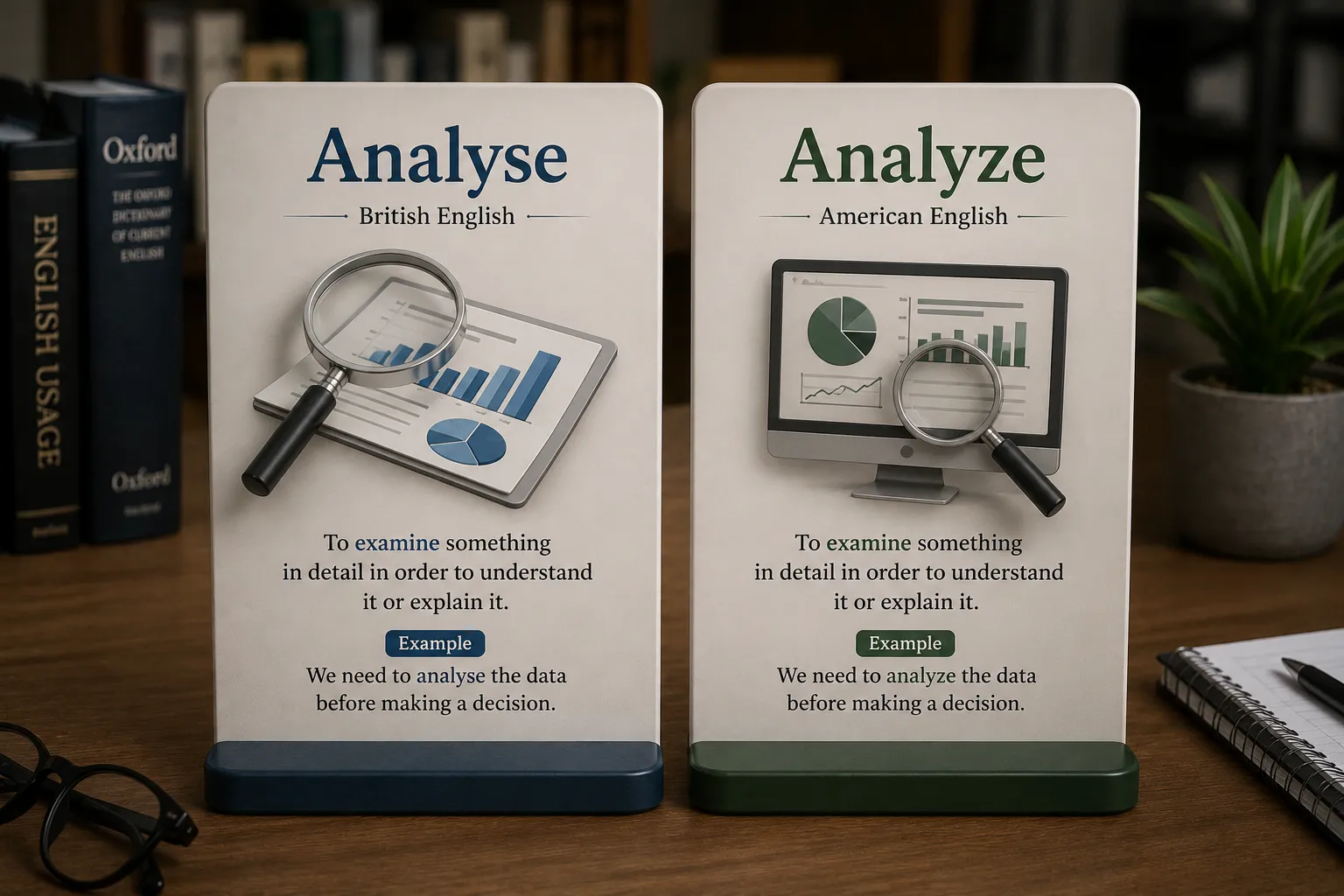
Quick Answer: Analyse and analyze have the same meaning. Analyze is the standard spelling in American English, while analyse is preferred in British English and most other varieties of English.
The first time I submitted an article to an American client, my editor highlighted the word “analyse” and changed it to “analyze.” A few weeks later, I wrote for a UK-based website, and another editor changed it back to “analyse.” At first, I thought one editor had made a mistake. In reality, both were correct—they simply followed different English spelling conventions.
This is a common source of confusion for writers, students, bloggers, and English learners. Since the two words are pronounced the same and share the same meaning, it’s easy to wonder which spelling you should use.
The answer depends on the variety of English you’re writing in. Once you understand the regional spelling rules, choosing between analyse and analyze becomes simple.
In this guide, you’ll learn the difference, origin, grammar rules, regional preferences, real-world examples, common mistakes, and practical tips for using each spelling correctly.
Analyse or Analyze Quick Answer
Both analyse and analyze mean to examine something carefully in order to understand it or draw conclusions.
- ✅ Analyze = American English
- ✅ Analyse = British English, Australian English, and most Commonwealth English
Examples
- The scientist will analyze the results. (US English)
- The scientist will analyse the results. (UK English)
Both sentences are correct. The only difference is the regional spelling.
The Origin of Analyse and Analyze
The verb comes from the noun analysis, which traces its roots to the Ancient Greek word analysis, meaning a breaking up or examining of something. It entered English through Latin and French before becoming part of modern scientific and academic vocabulary.
According to Merriam-Webster, analyze became the preferred spelling in American English as spelling conventions evolved in the United States.
According to the Cambridge Dictionary, analyse is the standard spelling in British English.
This spelling difference follows a broader pattern in English. American English often uses -yze, while British English commonly uses -yse for certain verbs.
Examples include:
- analyze / analyse
- paralyze / paralyse
- catalyze / catalyse
However, not every verb follows this rule, so it’s best to check a dictionary when you’re unsure.
Analyse vs. Analyze Explained
Although the spellings differ, the meaning and grammar remain exactly the same.
| Spelling | Meaning | Region | Example |
| Analyze | Examine carefully | United States | We will analyze the data. |
| Analyse | Examine carefully | United Kingdom, Australia, New Zealand | We will analyse the data. |
Example 1
Researchers will analyze customer feedback before launching the product.
Correct in American English.
Example 2
Researchers will analyse customer feedback before launching the product.
Correct in British English.
Example 3
Doctors analyze blood samples to diagnose illnesses.
Preferred in the United States.
Example 4
Doctors analyse blood samples to diagnose illnesses.
Preferred in Britain and many Commonwealth countries.
Which Version Should You Use?
For American Readers
Use analyze.
It matches the spelling used by American schools, universities, publishers, and businesses.
For British Readers
Use analyse.
This is the preferred spelling in British English and appears in UK dictionaries and educational materials.
For International Websites
Choose one spelling based on your target audience and use it consistently throughout the article.
For Academic Writing
Follow the style guide required by your institution or publisher. Universities often specify whether to use American or British English.
Common Mistakes
| Mistake | Correct Version | Why |
| Mixing analyse and analyze in one article | Use one spelling consistently | Consistency improves readability. |
| Thinking one spelling is incorrect | Both are correct | The difference is regional. |
| Using analyse for an American audience | Use analyze | Matches US spelling conventions. |
| Using analyze in a UK publication | Use analyse | Matches British English. |
Easy Memory Trick
Remember this simple rule:
🇺🇸 Analyze → Z for the United States.
🇬🇧 Analyse → S for British spelling.
Whenever you know your audience, the correct spelling becomes obvious.
Analyse or Analyze in Real World Examples
Professional Email (US)
Please analyze the quarterly sales report before Friday’s meeting.
Professional Email (UK)
Please analyse the quarterly sales report before Friday’s meeting.
News Headline
Scientists Analyze Climate Data to Improve Forecast Accuracy (US publication)
Academic Report
The research team will analyse the collected responses before publishing the findings. (UK university)
Social Media Post
Time to analyze my study habits before the next exam! 📚
Analyse or Analyze Data, Trends & Usage
Both spellings are widely searched because English learners and writers often encounter different regional standards.
Approximate Monthly Search Volume
| Keyword | Approximate Monthly Searches |
| analyze | 300,000+ |
| analyse | 120,000+ |
| analyse or analyze | 8,000+ |
| analyze meaning | 20,000+ |
| analyse meaning | 10,000+ |
Approximate figures based on general SEO trends reported by tools such as Google Trends, Ahrefs, and Semrush.
Search Intent
The keyword “analyse or analyze” is mainly:
- ✅ Informational
- ✅ Educational
- ✅ Grammar and spelling
- ✅ Academic writing
Corpus Usage
According to Google Books Ngram Viewer, analyze appears much more frequently in American publications, while analyse dominates British publications.
Regional Interest
- Analyze is most common in the United States.
- Analyse is preferred in the United Kingdom, Australia, New Zealand, South Africa, and many other Commonwealth countries.
Standalone Comparison Table
| Word | Meaning | Region | Best Used When |
| Analyze | Examine carefully | American English | Writing for US readers |
| Analyse | Examine carefully | British English | Writing for UK/Commonwealth readers |
| Analysis | The process or result of examining | Universal English | Used everywhere |
Frequently Asked Questions
Q1. Is analyse or analyze correct?
Both are correct. Analyze is the American English spelling, while analyse is the British English spelling.
Q2. Which spelling is more common?
Globally, both are widely used. Analyze appears more frequently overall because of the large volume of American publications.
Q3. Can I use both spellings in one article?
No. Choose one spelling based on your audience and use it consistently throughout your writing.
Q4. Is analyse used in the United States?
Rarely. American publishers and schools almost always use analyze.
Q5. Is analyze wrong in British English?
It’s understood but not considered the standard spelling. British publications generally prefer analyse.
Q6. Why are there two spellings?
The difference developed as American and British English adopted separate spelling conventions over time.
Q7. Does the pronunciation change?
No. Analyse and analyze are pronounced the same. Only the spelling differs.
Conclusion
Choosing between analyse and analyze is not about right versus wrong—it’s about writing for the correct audience. Both spellings share the same meaning, pronunciation, and grammatical function. The only difference is regional preference. If you’re writing for readers in the United States, use analyze. If your audience is in the United Kingdom or other Commonwealth countries, choose analyse.
Consistency is the key. Switching between the two spellings within the same document can confuse readers and make your writing appear less polished.
Now that you understand the difference, you’ll be able to use analyse and analyze confidently in emails, reports, academic papers, and online content. Bookmark this guide and share it with anyone who wants to master English spelling differences.
Read More:
Mama or Momma: Which Spelling Is Correct?

I specialize in English grammar, spelling, word choice, and language usage. My content is based on research from grammar references, style guides, dictionaries, and real-world usage to ensure it is accurate and practical.
At Spelling Comparison, I write guides that explain why words are confused, how they are used, and which form is correct in context. I also include proofreading tips, examples, and writing advice readers can apply immediately.
My goal is to publish clear, reliable content that helps readers make better writing decisions. Each guide is written for accuracy, clarity, and usefulness in school, work, business, and everyday communication.