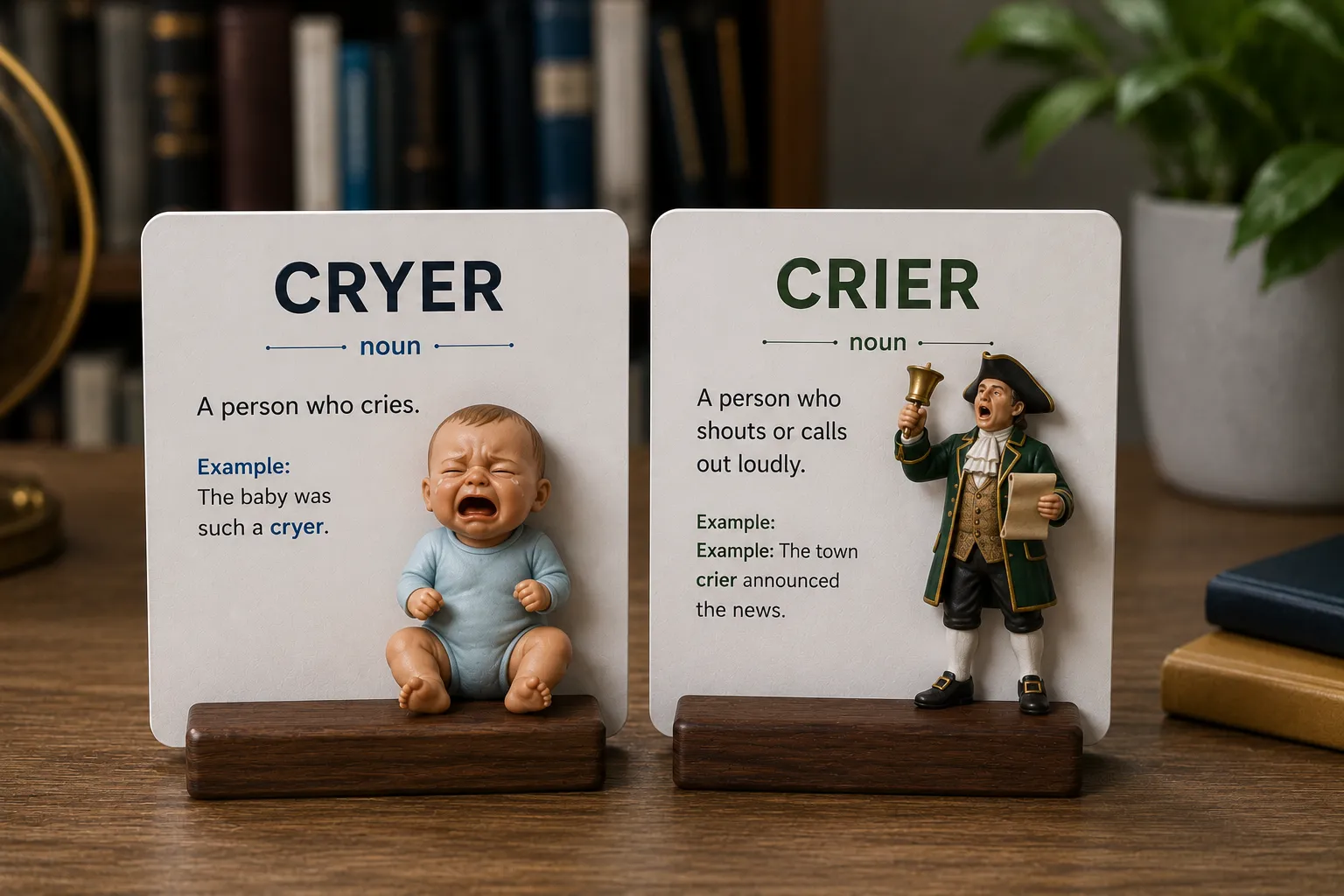
Quick Answer: Crier is the correct spelling for someone who cries or makes public announcements, such as a town crier. Cryer is usually a surname (family name) and is rarely used as a common English noun.
A few years ago, I was proofreading a local history article that mentioned a town cryer. At first, nothing seemed unusual because the word sounded perfectly natural. But after checking the spelling, I realized the article contained a common mistake. The correct term is town crier, not town cryer.
This confusion happens because crier and Cryer sound exactly the same. Many people assume both spellings are interchangeable, but they are not. One is a standard English word found in dictionaries, while the other is primarily used as a surname.
If you’ve ever wondered whether to write crier or cryer, this guide will explain the difference, their origins, examples, common mistakes, and when each spelling should be used.
Cryer or Crier Quick Answer
Crier is the correct English noun. It refers to someone who cries or a person who makes public announcements, such as a town crier.
Cryer is generally a surname, not the standard spelling of the common noun.
Examples
- The town crier announced the festival.
- The baby is a loud crier.
- Jon Cryer is an American actor.
The Origin of Crier and Cryer
According to Merriam-Webster, crier comes from the verb cry, meaning to shout, call out, or weep. The suffix -er forms a noun meaning a person who performs an action.
The famous town crier dates back to medieval England. Before newspapers and the internet, town criers walked through streets ringing a bell and announcing important news.
The spelling Cryer, however, is primarily a family name. It appears in historical records as an English surname and is not recognized by major dictionaries as the standard noun meaning someone who cries.
Because both words are pronounced the same, they are often confused in writing.
Crier vs. Cryer Explained
| Term | Meaning | When to Use | Context |
| Crier | Someone who cries or announces news publicly | Standard English | Grammar, history, everyday writing |
| Cryer | A surname | Proper names | People, family names |
Example 1
The town crier rang a bell before making the announcement.
Correct because it refers to the historical public messenger.
Example 2
Emma has always been a quiet baby, not a frequent crier.
Correct because it means someone who cries.
Example 3
Jon Cryer won praise for his television performances.
Correct because Cryer is part of the person’s name.
Which Version Should You Use?
For Everyday English
✅ Use crier.
For Historical Writing
Always write town crier.
For Academic Writing
Use crier whenever referring to someone who cries or announces information publicly.
When Referring to a Person’s Name
Use Cryer only if it is the person’s actual surname.
Example:
- Jon Cryer
- Ann Cryer
Common Mistakes
| Mistake | Correct Version | Why |
| Town cryer | Town crier | Standard English spelling |
| Loud cryer | Loud crier | Dictionary form |
| Jon Crier | Jon Cryer | Proper surname |
| Every cryer is a surname | Only Cryer is a surname | Different meanings |
Easy Memory Trick
Think of crier as:
cry + er = crier
The -er ending creates nouns for people who perform an action, such as:
- writer
- runner
- singer
- reader
- crier
If you’re talking about a person’s last name, it may be Cryer.
Crier in Real World Examples
Professional Email
The museum is hiring a historical town crier for its annual festival.
News Headline
Town Crier Announces Start of Annual Heritage Celebration
Social Media
My toddler is definitely not a quiet crier. 😄
Historical Report
Every morning, the town crier informed residents of new laws and royal announcements.
Cryer or Crier Data, Trends & Usage
Approximate search behavior from SEO tools such as Google Trends, Semrush, and Ahrefs suggests:
| Keyword | Approximate Monthly Searches |
| town crier | 15,000+ |
| crier | 8,000+ |
| cryer | 5,000+ |
| cryer or crier | 1,000+ |
Searches for Cryer are often related to people with that surname, especially actor Jon Cryer, while searches for crier usually concern spelling, history, or vocabulary.
Search intent is mainly informational.
Standalone Comparison Table
| Word | Meaning | Part of Speech | Best Used When |
| Crier | Someone who cries or announces news | Noun | General English |
| Town Crier | Official public announcer | Noun | Historical contexts |
| Cryer | Family name | Proper noun | Referring to someone’s surname |
Frequently Asked Questions
Q1. Is cryer or crier correct?
Crier is the correct common English word. Cryer is mainly a surname.
Q2. What is a town crier?
A town crier was an official messenger who publicly announced news before newspapers became common.
Q3. Is cryer in the dictionary?
Major dictionaries recognize Cryer primarily as a surname rather than the standard noun.
Q4. Why do people spell crier as cryer?
Because both words are pronounced the same, many writers assume the spellings are interchangeable.
Q5. Can crier mean someone who cries a lot?
Yes. A crier can refer to someone, especially a baby, who cries frequently.
Q6. Is town cryer ever correct?
No. The accepted historical term is town crier.
Q7. Is Cryer a common last name?
Yes. Cryer is an established English surname and appears in many English-speaking countries.
Conclusion
Although crier and Cryer sound identical, they are not interchangeable. Crier is the standard English noun used for someone who cries or makes public announcements, while Cryer is primarily a surname. If you’re writing about history, grammar, or everyday English, crier is almost always the correct choice.
When in doubt, remember the famous phrase “town crier.” It has been the accepted spelling for centuries and appears in dictionaries and historical records.
Bookmark this guide so you’ll never confuse “crier” and “Cryer” again, and share it with anyone who loves improving their English.
Read More:
Mama or Momma: Which Spelling Is Correct?

I’m **Rubab Naaz**, an English language content writer with over 10 years of experience creating educational and SEO-focused articles. I specialize in spelling comparisons, grammar, vocabulary, synonyms, commonly confused words, and English usage. My passion is helping students, writers, and professionals improve their language skills through accurate, well-researched, and easy-to-understand content. Every article I write is designed to make learning English simple, practical, and engaging.