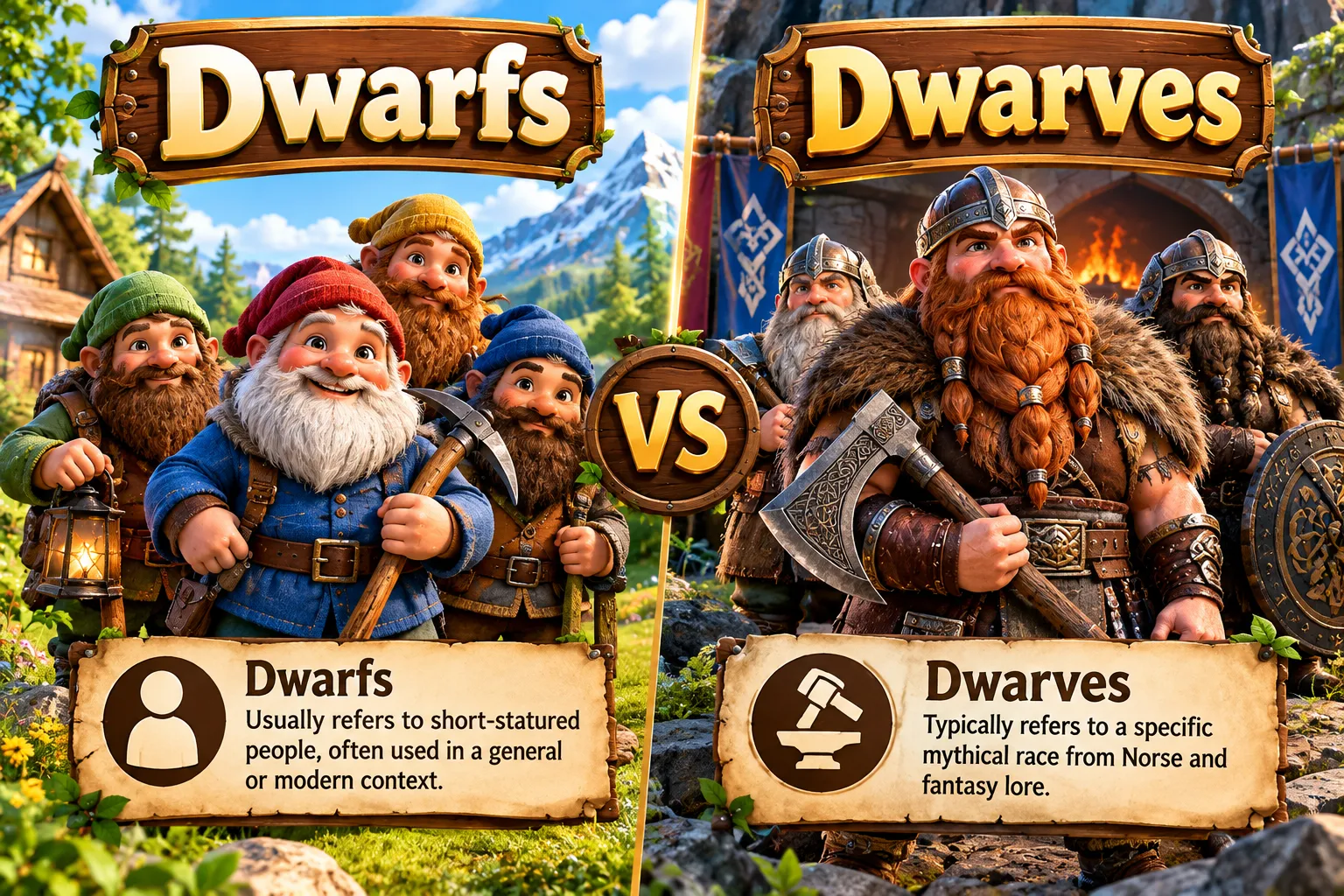
Dwarfs and dwarves are both accepted plural forms of dwarf. Dwarves is especially common for fantasy or folklore characters, while dwarfs is also widely used in general, scientific, and traditional contexts.
I often pause when I write the plural of dwarf because both dwarfs and dwarves look correct. I have noticed this confusion especially when reading fantasy stories, discussing astronomy, or checking English writing. The change from -f to -ves seems small, but it can make you wonder which form belongs in your sentence.
What makes this word unusual is that both plurals are accepted. Cambridge Dictionary lists dwarfs and dwarves as plural forms of dwarf.
The choice often depends on context. If you are writing about fictional beings, dwarves may feel more natural. If you are talking about stars, plants, or other scientific subjects, dwarfs is common.
The story behind these two forms is also interesting. Dwarves became strongly associated with fantasy literature, especially through the work of J. R. R. Tolkien. Yet dwarfs has a much longer history as the regular plural form.
In this guide, I’ll explain when to use dwarfs, when to use dwarves, why both forms exist, and how to avoid common mistakes.
Dwarfs or Dwarves Quick Answer
Both dwarfs and dwarves can be used as the plural of dwarf. Major dictionaries such as Cambridge and Collins recognize both forms.
The difference is mainly about context and established usage, rather than one form being simply correct and the other incorrect.
Simple examples
- The astronomers observed several white dwarfs.
- The fantasy novel features a kingdom ruled by dwarves.
A simple memory rule is:
Dwarfs = common in science and general contexts.
Dwarves = strongly associated with fantasy and folklore.
This is a useful guide, but it is not an absolute grammar rule. Both forms remain legitimate plurals.
The Origin and Background of Dwarfs and Dwarves
| Topic | Details |
|---|---|
| Word Origin | The word dwarf has a very old history and comes from Old English forms such as dweorh and dweorg. |
| Original Meaning | These Old English forms referred to a very short person and a supernatural being of small size. |
| Germanic Connections | The word is related to forms found in several Germanic languages, including Old Norse and Old High German. |
| Early Plural | The Old English plural dweorgas developed into Middle English forms such as dwarrows. |
| Development of “Dwarfs” | Over time, these forms eventually developed into the modern plural dwarfs. |
| History of “Dwarfs” | Dwarfs is not a modern invention. It has a long history in the English language. |
| Origin of “Dwarves” | The -ves spelling became strongly associated with fictional and legendary dwarfs. |
| Tolkien’s Influence | Etymonline notes that J. R. R. Tolkien helped popularize dwarves for the legendary race in modern English. |
| Modern Usage | This history helps explain why modern readers often associate dwarves with fantasy, while dwarfs has broader traditional and scientific uses. |
Dwarfs vs. Dwarves: Key Differences
Here is the easiest way to compare the two forms:
| Term | Meaning | When to Use | Region/Context |
| Dwarf | One dwarf | Singular reference | All English varieties |
| Dwarfs | More than one dwarf | General, scientific, astronomical, and some traditional contexts | General English |
| Dwarves | More than one dwarf | Fantasy, folklore, and fictional races | Especially common in fantasy |
| Dwarf | A very small variety of something | Plants and animals | Scientific/general |
| Dwarfs | More than one small variety or object | Plants, animals, stars, etc. | Scientific/general |
When to use dwarfs
Dwarfs is common when the word is used in scientific or general contexts.
For example:
- Astronomers study white dwarfs.
- The garden contains several dwarf plants.
- Scientists observed different types of dwarf stars.
Collins lists dwarfs and dwarves as plural forms, while its dictionary entries also use terms such as dwarf star and dwarf shrubs.
When to use dwarves
Dwarves is strongly associated with fictional and legendary beings.
For example:
- The dwarves protected the underground kingdom.
- The story follows a group of dwarves who live beneath the mountain.
- The game includes elves, humans, and dwarves.
This association became particularly strong because of Tolkien’s use of dwarves in his fantasy writing. Etymonline specifically connects the modern popularity of this form with Tolkien.
Which Version Should You Use?
Your subject should guide your choice.
For fantasy writing → dwarves
If you are writing about fictional races, fantasy worlds, or folklore characters, dwarves is usually the natural choice.
This is especially true when your writing follows modern fantasy conventions.
For astronomy → dwarfs
Use dwarfs in established astronomical terms such as:
- white dwarfs
- red dwarfs
- brown dwarfs
Collins identifies dwarf as a term used for certain relatively small stars, including white dwarf and red dwarf.
For plants and animals → dwarfs
When dwarf describes something that is much smaller than the usual size of its kind, dwarfs is a natural plural.
For example:
The nursery sells several dwarf varieties of fruit trees.
If you need the plural noun itself, dwarfs fits this scientific or descriptive use.
For a specific fictional world → follow its style
Fantasy authors and franchises may have their own naming conventions. If you are writing about an established fictional world, check the spelling used by that work and keep it consistent.
Consistency matters more than switching between forms without a reason.
Common Mistakes With Dwarfs and Dwarves
1. Treating dwarves as the only correct plural
Incorrect idea: Dwarfs is always wrong.
Better: Both dwarfs and dwarves are recognized plural forms.
The context helps determine which one sounds appropriate.
2. Using dwarves for every scientific term
Less natural: Several white dwarves were detected.
Preferred: Several white dwarfs were detected.
Established astronomical terminology commonly uses white dwarf and white dwarfs.
3. Assuming dwarfs is wrong in fantasy
Not necessary: The fantasy characters must be called dwarfs.
Natural fantasy usage: The fantasy characters are dwarves.
Both forms are accepted, but dwarves has a strong modern association with fantasy literature.
4. Using dwarves as a verb
Incorrect: The mountain dwarves the nearby hill.
Correct: The mountain dwarfs the nearby hill.
This is an important grammar point. Dwarfs can also be the third-person singular form of the verb dwarf. Collins lists dwarfs as the third-person singular present form.
5. Changing an official title
If a work, title, or established name uses Dwarfs, do not automatically change it to Dwarves.
For example, Snow White and the Seven Dwarfs is the established title of the famous story and film. Cambridge uses that title in its dictionary example.
Dwarfs or Dwarves in Real-World Examples
Professional email
Subject: Astronomy Project Update
Our team has completed the section on white dwarfs and their properties.
Here, dwarfs is used in an astronomical context.
News headline
Scientists Study Distant White Dwarfs
The plural dwarfs fits the scientific subject.
Social media post
I just finished a fantasy novel filled with dragons, elves, and dwarves. The world-building was amazing!
Here, dwarves clearly refers to fictional fantasy characters.
Formal document
The report examines several dwarf plant varieties that require less growing space than standard forms.
Here, dwarf works as a modifier rather than as the plural noun.
Dwarfs or Dwarves Data, Trends and Usage
The search intent for dwarfs or dwarves is mainly informational. Readers usually want to know which plural is correct and whether the spelling changes with context.
Exact monthly search-volume figures from tools such as Ahrefs or Semrush are not available in the supplied source material, so it would be misleading to invent a number.
Dictionary evidence gives us a clearer point: both forms are established in modern English. Cambridge explicitly lists dwarfs or dwarves as the plural of dwarf. Collins does the same.
There is also a clear contextual pattern:
- Dwarfs appears in established scientific terms.
- Dwarves is strongly connected with fantasy and folklore.
- Dwarfs remains part of traditional titles and general usage.
- Both forms can refer to fictional beings.
The word has also developed uses outside fantasy. Dictionaries record dwarf in astronomy and as a modifier for small plants and animals.
This makes the topic useful for more than fantasy writing. The correct choice can matter in academic, scientific, creative, and everyday English.
Dwarfs vs. Dwarves: Standalone Comparison Table
| Term/Variant | Meaning | Region/Context | Best Used When |
| Dwarf | Singular form | General English | Talking about one |
| Dwarfs | Plural form | Science, astronomy, general English | Talking about multiple real-world or scientific subjects |
| Dwarves | Plural form | Fantasy and folklore | Talking about fictional or legendary races |
| Dwarfs | Verb form | General English | Meaning “makes something seem small” |
| Dwarf | Modifier | Science, gardening, biology | Describing a smaller variety |
One detail is easy to miss: dwarfs can be both a plural noun and a verb.
For example:
The astronomers studied several white dwarfs.
Here, dwarfs is a plural noun.
The tall building dwarfs the surrounding houses.
Here, dwarfs is a verb.
The meaning comes from the sentence.
Frequently Asked Questions
Q: Is dwarfs or dwarves the correct plural of dwarf?
A: Both dwarfs and dwarves are accepted plural forms. Cambridge and Collins both list the two forms.
Q: Should I use dwarfs or dwarves in fantasy writing?
A: Dwarves is strongly associated with fantasy and folklore, so it is often the natural choice for fictional races. This usage was helped by Tolkien’s influential fantasy writing.
Q: Is dwarfs correct for astronomy?
A: Yes. Established terms such as white dwarfs and red dwarfs commonly use dwarfs. Collins lists these astronomical uses under dwarf.
Q: Why are there two plurals of dwarf?
A: English has developed more than one established plural form for this word. Dwarfs has a long historical record, while dwarves became especially prominent in modern fantasy.
Q: Did Tolkien invent the word dwarves?
A: No. Tolkien did not invent the form from nothing. The form existed in English, but Tolkien’s use of dwarves for his fictional race helped make it much more prominent in modern fantasy.
Q: Is dwarves acceptable in formal writing?
A: Yes, when the context calls for it. It is a recognized plural form, especially suitable when discussing fictional or legendary dwarves.
Q: Is the word dwarf offensive when referring to a person?
A: Some dictionary sources flag this use as offensive or outdated. When discussing real people, use respectful terminology preferred by the person or community, rather than assuming that dwarf is appropriate. Cambridge and Collins both include usage warnings for certain human references.
Conclusion
Choosing between dwarfs and dwarves does not have to be difficult. Both are accepted plural forms of dwarf, but they often appear in different settings.
Use dwarfs when you are writing about scientific subjects, astronomy, plants, animals, or general contexts where that form is established. Terms such as white dwarfs and red dwarfs are familiar examples.
Use dwarves when you are talking about fantasy characters or legendary races. The form has become strongly linked with modern fantasy, partly because of Tolkien’s influential use of it.
Remember that neither spelling should be treated as automatically wrong. The context tells you which form will sound most natural.
One final tip: if you are writing about a specific book, game, film, or fictional world, follow its established spelling.
Now you know why dwarfs and dwarves both exist. Bookmark this guide so you never have to second-guess the plural of dwarf again.
Read More:
Council or Counsel: Easy Guide to the Difference

I’m **Rubab Naaz**, an English language content writer with over 10 years of experience creating educational and SEO-focused articles. I specialize in spelling comparisons, grammar, vocabulary, synonyms, commonly confused words, and English usage. My passion is helping students, writers, and professionals improve their language skills through accurate, well-researched, and easy-to-understand content. Every article I write is designed to make learning English simple, practical, and engaging.