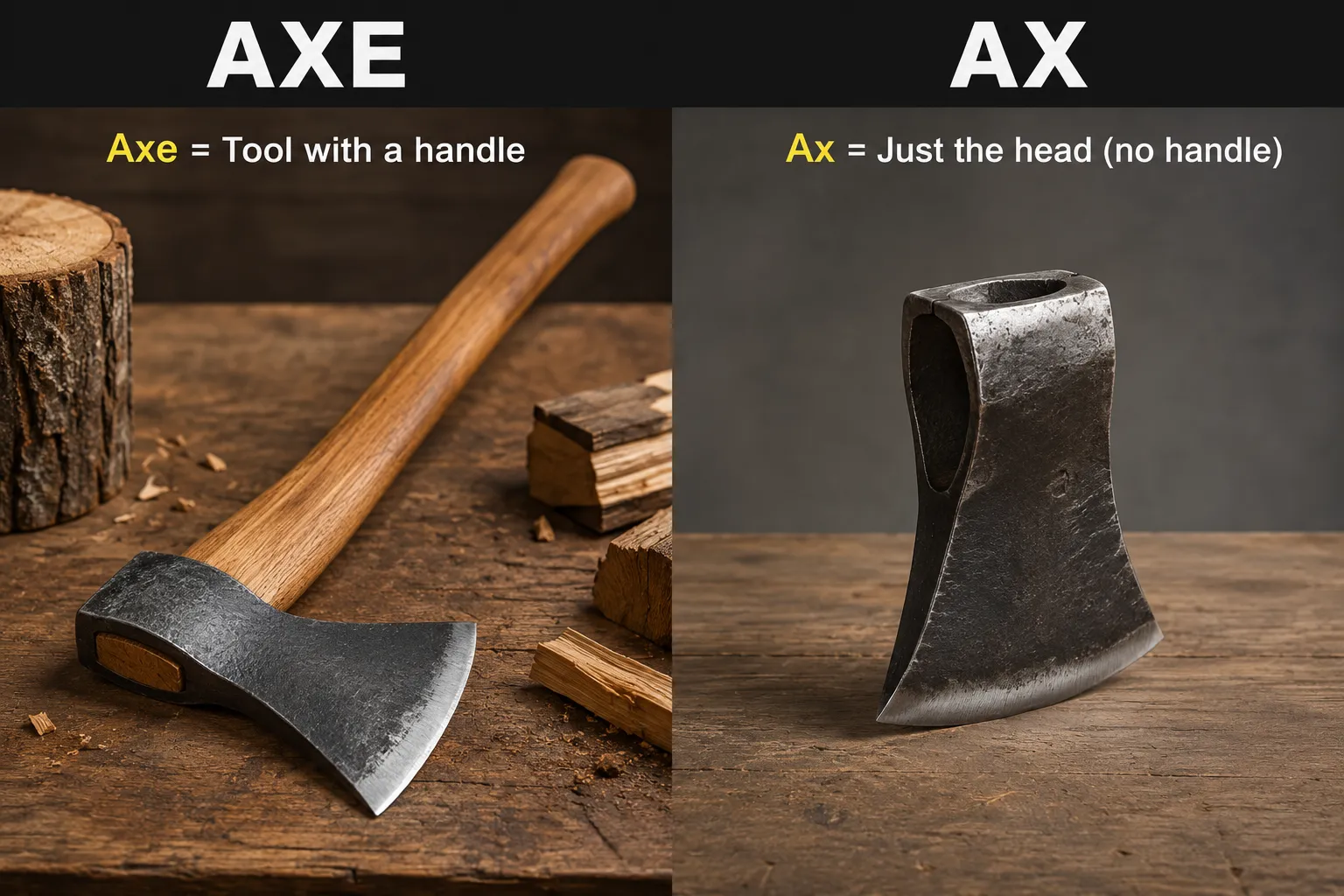
Quick Answer: Axe and ax are both correct spellings. Axe is more common in British English, while ax is more common in American English.
The first time I edited a news article, I saw one version that said the company would axe a project and another that said it would ax it. Both looked right, but I wanted to be sure which spelling was correct. After checking a few style guides, I learned that both forms are acceptable, depending on the variety of English being used.
Many people wonder whether axe or ax is correct because the two spellings sound exactly the same when spoken aloud. Since English often keeps different spellings for different regions, it is easy to see why this word causes confusion.
The good news is that both spellings are standard. Once you know which version is preferred in British English and which is preferred in American English, you can use the word confidently in essays, emails, reports, and everyday writing.
In this guide, you’ll learn the difference between axe and ax, where the word comes from, how to use it correctly, common mistakes to avoid, and real-world examples.
Axe or Ax – Quick Answer
Both axe and ax are correct.
- Axe is more common in British English
- Ax is more common in American English
Simple examples
- He used an axe to chop wood.
- He used an ax to chop wood.
- The company decided to axe the project.
- The company decided to ax the project.
Both spellings are correct, but the first pair is more typical in British English and the second pair is more typical in American English.
The Origin and Background of Axe or Ax
The word axe comes from Old English and has been part of the language for centuries. Historically, the spelling varied, but the pronunciation stayed the same.
Over time, British English kept the spelling axe, while American English gradually favored the shorter spelling ax. This simplification fits a broader pattern in American spelling reforms, many of which were influenced by Noah Webster.
The word can be used as both:
- a noun: a tool with a handle and blade
- a verb: to cut, remove, or cancel something
Examples:
- Noun: He carried an axe into the forest.
- Verb: The editor decided to axe the extra paragraph.
Axe or Ax Explained Key Differences
The difference is mainly about regional spelling preference, not meaning.
| Term | Meaning | When to Use | Region/Context |
| Axe | A cutting tool; to cut, remove, or cancel | Standard spelling in British English | UK, Commonwealth, international British-style writing |
| Ax | A cutting tool; to cut, remove, or cancel | Standard spelling in American English | US, American-style writing |
Examples of Axe
- He sharpened the axe before chopping firewood.
- The manager decided to axe the outdated policy.
- The film studio may axe the sequel.
Examples of Ax
- He sharpened the ax before chopping firewood.
- The manager decided to ax the outdated policy.
- The film studio may ax the sequel.
Which Version Should You Use?
The answer depends on your audience and writing style.
For students
If your teacher or textbook uses British English, write axe. If your class follows American English, write ax.
For professionals
Match the spelling to your workplace, publication, or audience.
- British audience → axe
- American audience → ax
For everyday writing
Use whichever spelling feels natural for your region. Both are correct.
For international readers
If you’re writing for a global audience, axe is often the safer choice because it is widely recognized in British English and many international publications. However, ax is perfectly correct in American English.
Common Mistakes with Axe or Ax
| Mistake | Correct Version | Why It Happens |
| Using axe in American-style writing when ax is preferred | ax | Regional spelling preference |
| Using ax in British-style writing when axe is preferred | axe | Regional spelling preference |
| Mixing axe and ax in the same document | Choose one spelling and stay consistent | Style inconsistency |
| Assuming one spelling is wrong | Both are correct | English has regional spelling variants |
| Thinking axe only refers to the tool | Axe can also be a verb | The word has more than one use |
Axe or Ax in Real-World Examples
Professional Email
“We may need to ax the final section to keep the report concise.”
News Headline
“Council Plans to Axe the Old Building”
Social Media Post
“I finally bought a new axe for camping this weekend!”
Formal Report
“The committee decided to axe the outdated policy after reviewing the budget.”
Axe or Ax Data, Trends & Usage
Many people search for axe or ax because English spelling changes depending on region.
Most common search intent
- Informational
- Spelling help
- English usage
- Regional differences
- Vocabulary clarification
- Writing improvement
Regions with high interest
- United States
- United Kingdom
- Canada
- Australia
- India
Why this topic matters now
Clear writing matters in business, education, journalism, and online communication. Using the correct regional spelling helps your writing look polished and professional, while staying consistent prevents confusion.
Comparison Table
| Term/Variant | Meaning | Region/Context | Best Used When |
| Axe | A cutting tool or the act of cutting/canceling | British English and many international contexts | Writing for UK audiences or using British style |
| Ax | A cutting tool or the act of cutting/canceling | American English | Writing for US audiences or using American style |
| Axe’s | Belonging to one axe | Worldwide | Singular possessive form |
| Ax’s | Belonging to one ax | Worldwide | Singular possessive form in American spelling |
Frequently Asked Questions
Q: What does axe mean?
A: Axe can refer to a tool used for chopping wood, or it can mean to cut, remove, or cancel something.
Q: What does ax mean?
A: Ax has the same meaning as axe. It is the preferred spelling in American English.
Q: Axe vs ax what’s the difference?
A: The meaning is the same. The difference is mainly regional spelling: axe is more common in British English, while ax is more common in American English.
Q: Is ax correct in formal writing?
A: Yes. Ax is correct in formal American English writing.
Q: Is axe correct in American English?
A: Yes. Axe is understood in American English, though ax is usually preferred in U.S. style.
Q: Which version is correct axe or ax?
A: Both are correct. The best choice depends on your audience and the style of English you are using.
Q: Can I use axe and ax interchangeably?
A: Yes, but it is best to stay consistent within one piece of writing and match the variety of English you are using.
Q: Why do some people spell ax as axe?
A: Because the pronunciation is the same, many writers choose the spelling they are most familiar with from their region.
Q: Is axe the older spelling?
A: Yes. Axe is the older and more traditional spelling in English, while ax became more common in American English.
Q: Which spelling is better for SEO?
A: It depends on your audience. If you are targeting American readers, ax may perform better. If you are targeting British or international readers, axe may be more familiar.
Conclusion
Choosing between axe or ax is simple once you know the rule. Both spellings are correct, but axe is more common in British English and ax is more common in American English.
Remember these key points:
- Axe is correct.
- Ax is correct.
- Use axe for British English.
- Use ax for American English.
- Stay consistent with the style of your audience.
With this simple rule, you’ll never second-guess the spelling again. Bookmark this guide so you always remember the difference between “axe” and “ax,” and share it with anyone learning English spelling or improving their writing.
Read More:
Gage or Gauge: The Complete Guide to the Correct Spelling

I’m an English language educator and content writer with more than 10 years of experience helping learners improve their English skills. I specialize in spelling differences, grammar, vocabulary, synonyms, commonly confused words, and English usage. My goal is to create accurate, easy-to-understand articles that make learning English simple, practical, and enjoyable for students, writers, and professionals around the world.