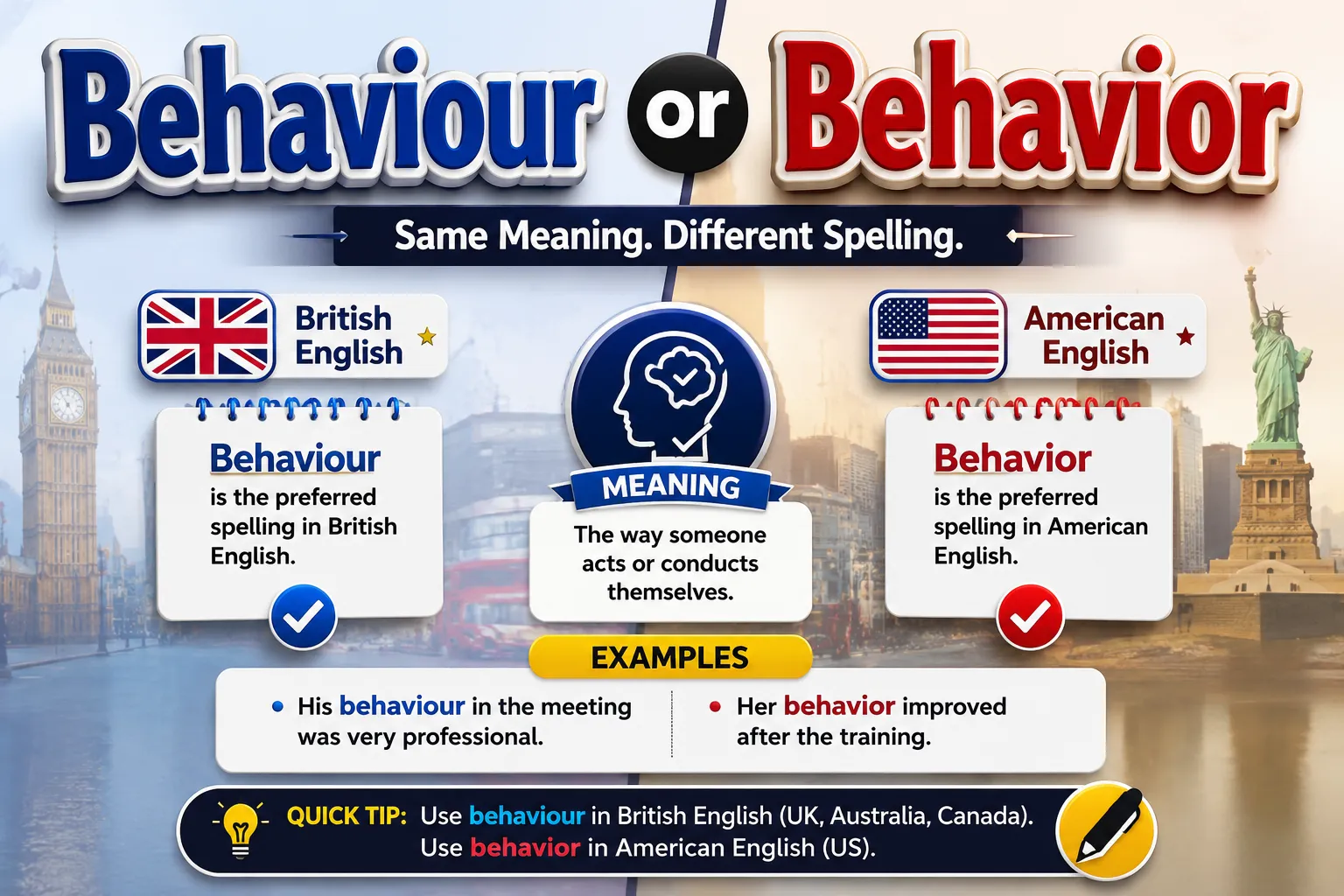
Both “behaviour” and “behavior” are correct. The difference is regional: “behaviour” is used in British English, while “behavior” is used in American English.
If you have ever written behaviour in a document and then later noticed behavior in another source, you may have paused and wondered which spelling is actually right. The truth is simple: both spellings are correct. They refer to the same word and carry the same meaning. The only difference is regional spelling preference.
This variation exists because English is used across many countries, and over time, different regions developed their own spelling conventions. The most important distinction is between British English and American English.
In this guide, we will break down the meaning of the word, explain why two spellings exist, show real examples, and help you decide which version to use depending on your audience.
The Correct Word: Behaviour / Behavior
The word refers to the way someone or something acts. It is commonly used in everyday conversation, education, psychology, and professional writing.
It can describe:
- How a person acts in a situation
- How animals respond or react
- Social conduct or manners
- Psychological patterns or habits
Examples:
- His behaviour was very polite. (British English)
- His behavior was very polite. (American English)
- The dog’s behavior changed after the move.
- Good behaviour is expected in school.
In all these cases, the meaning remains identical. Only the spelling changes.
Behaviour or Behavior Quick Answer
To make it easy:
- Behaviour = British English
- Behavior = American English
Both are correct, but you should match your spelling to your audience or writing style guide.
Why Are There Two Spellings?
The difference between behaviour and behavior comes from historical changes in English spelling.
1. British English tradition
British English tends to preserve older spellings influenced by Latin and French. This is why many words include the letter “u”:
- behaviour
- colour
- favour
- honour
These spellings reflect older European linguistic influences that shaped English over centuries.
2. American English simplification
American English spelling was influenced heavily by Noah Webster, a lexicographer who wanted to simplify English spelling in the 18th and 19th centuries.
He believed English should be:
- easier to learn
- more phonetic
- more consistent
As a result, many words were simplified by removing silent or unnecessary letters:
- behavior (instead of behaviour)
- color (instead of colour)
- favor (instead of favour)
- honor (instead of honour)
This reform became standard in the United States and remains widely used today.
Meaning of Behaviour / Behavior
Despite the spelling difference, the meaning is always the same.
1. Human actions
- “Her behavior at the meeting was professional and calm.”
2. Animal actions
- “The cat’s behaviour changed after moving to a new home.”
3. Social conduct
- “Good behavior is rewarded in school systems.”
4. Scientific or psychological context
- “The study analyzed human behavior under stress conditions.”
Behaviour vs Behavior Comparison Table
| Word | Region | Meaning | Example |
| behaviour | British English | Conduct or actions | Her behaviour was calm. |
| behavior | American English | Conduct or actions | Her behavior was calm. |
Which One Should You Use?
The correct spelling depends entirely on your audience and writing context.
Use “behaviour” if:
- You are writing for the UK, Australia, or other Commonwealth countries
- You are following British English style guides
- Your school, university, or publisher requires UK spelling
Use “behavior” if:
- You are writing for the United States
- You are using American English conventions
- Your audience is primarily global or US-based (especially online content)
For global writing
If you are unsure, choose one style and remain consistent throughout your document. Consistency is more important than the specific choice.
Common Mistakes with Behaviour and Behavior
Even though both forms are correct, writers often make consistency errors.
Mistake 1: Mixing both spellings in one document
❌ The child’s behaviour and behavior were recorded.
✅ The child’s behavior was recorded. (or behaviour, but stay consistent)
Mistake 2: Thinking one spelling is wrong
❌ “Behavior is incorrect spelling.”
✅ Both spellings are correct depending on region.
Mistake 3: Switching spelling mid-text
❌ The report uses both behaviour and behavior.
✅ Choose one spelling style and stick to it throughout.
Behaviour / Behavior in Real-World Usage
British English example
The teacher praised the student’s behaviour in class.
American English example
The teacher praised the student’s behavior in class.
Academic writing example
The research examined human behavior under different stress levels.
Everyday conversation
“I didn’t like his behaviour yesterday.”
Behaviour or Behavior in Data & Usage Trends
While exact search volume numbers vary depending on tools, regions, and time periods, general usage patterns are well established.
- “behavior” is more common globally, largely due to the influence of American English in digital content, media, and technology platforms.
- “behaviour” remains standard in the UK, Australia, New Zealand, and many Commonwealth countries.
Dictionaries reflect this clear division:
- Cambridge Dictionary uses behaviour in British English entries
- Merriam-Webster Dictionary uses behavior in American English entries
Both forms are fully accepted in their respective systems and are not considered incorrect.
Memory Trick to Remember
A simple way to remember the difference:
“U is for UK”
- behaviour = British English
- behavior = American English (no “u”)
This trick works for many similar word pairs as well.
Standalone Comparison: Behaviour vs Behavior
| Word | Correctness | Region | Usage Context |
| behaviour | ✅ Correct | UK / British EN | UK writing |
| behavior | ✅ Correct | US / American EN | US writing |
Frequently Asked Questions
Q: Is “behaviour” correct?
A: Yes. Behaviour is correct in British English and widely used in the UK and Commonwealth countries.
Q: Is “behavior” correct?
A: Yes. Behavior is correct in American English and is the standard spelling in the United States.
Q: Which spelling is better?
A: Neither is better. Both are correct. The best choice depends on your audience and writing style.
Q: Why does British English use “behaviour”?
A: British English preserves older spellings influenced by Latin and French linguistic traditions.
Q: Can I mix both spellings?
A: No. You should avoid mixing them in the same document. Consistency is essential for professional writing.
Conclusion
The difference between behaviour and behavior is not about correctness it is about regional spelling conventions.
Both words mean exactly the same thing:
- Behaviour = British English
- Behavior = American English
The most important rule is consistency. Once you choose a spelling style, you should stick with it throughout your writing to maintain clarity and professionalism.
Whether you are writing an essay, report, email, or article, using the correct regional spelling helps your writing feel polished and appropriate for your audience.
Read More:
Fazed or Phased: What’s the Difference?

I specialize in English grammar, spelling, word choice, and language usage. My content is based on research from grammar references, style guides, dictionaries, and real-world usage to ensure it is accurate and practical.
At Spelling Comparison, I write guides that explain why words are confused, how they are used, and which form is correct in context. I also include proofreading tips, examples, and writing advice readers can apply immediately.
My goal is to publish clear, reliable content that helps readers make better writing decisions. Each guide is written for accuracy, clarity, and usefulness in school, work, business, and everyday communication.