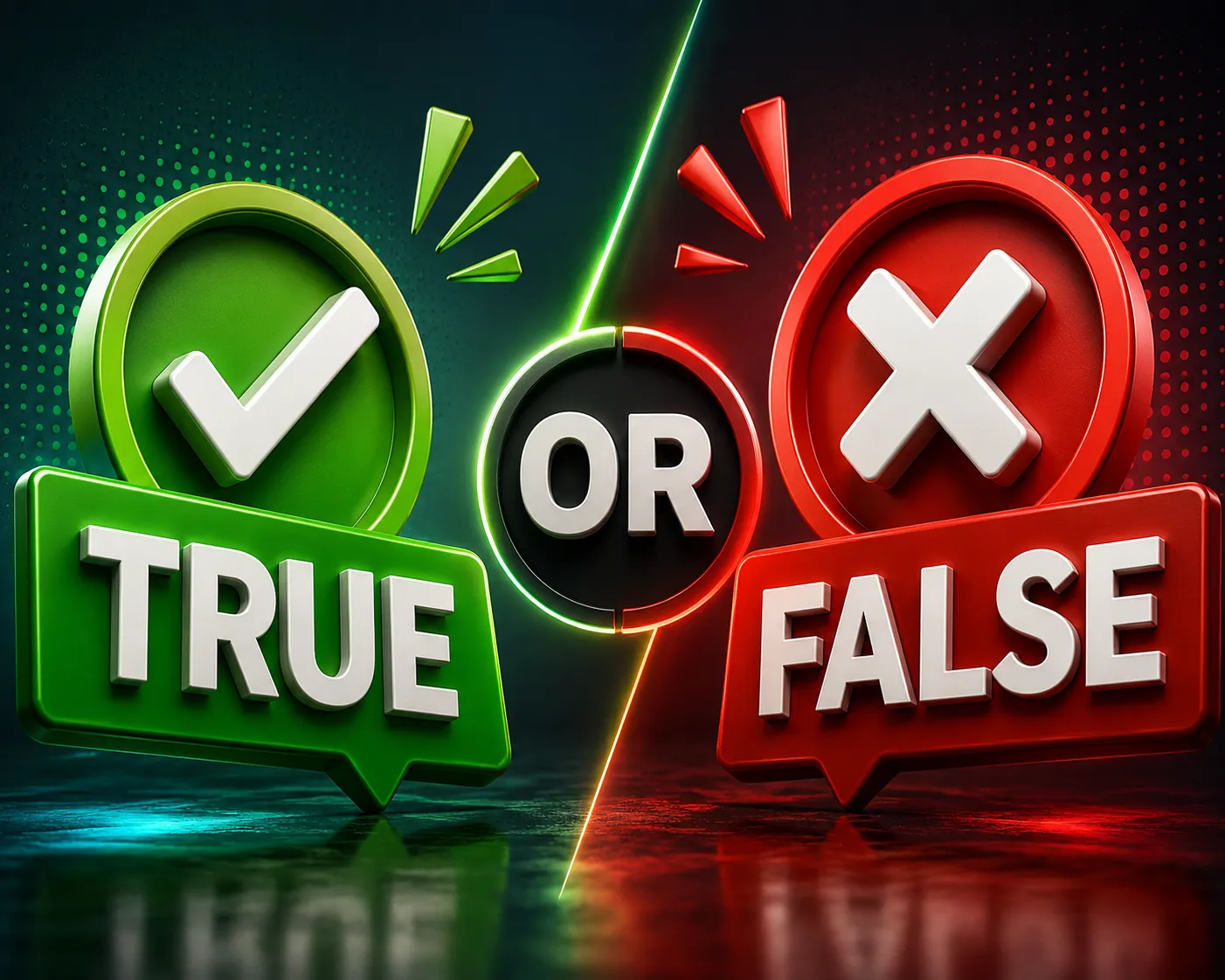
“True or flase” is incorrect. The correct phrase is “true or false,” with the letters A and L in that order.
Have you ever typed “true or false”, looked at it twice, and wondered which letter came first? This tiny spelling mistake is easy to make, especially when you are typing fast.
I have noticed this error often when checking English exercises, online quizzes, and student writing. The meaning is usually clear. Still, one small letter swap can make your writing look less polished.
The correct spelling is false. So the correct phrase is “true or false.” The form flase is not a standard English word. It is simply a misspelling of false.
This confusion is easy to fix once you know what causes it. You also need to understand how true and false work in a sentence.
In this guide, you will learn the difference between true, false, and flase, the history of the two correct words, common mistakes, useful examples, and a simple memory trick. Let’s start with the basic answer.
True or Flase Quick Answer
The correct spelling is true or false.
False means that something is not true, correct, or accurate. True means that something agrees with the facts or is correct. Cambridge Dictionary gives true the sense of being right or correct and false the sense of being not correct or true.
For example:
- True or false: The Earth moves around the Sun.
- True or false: A square has three sides.
The first statement is true. The second is false.
The important spelling point is simple:
false ✅
flase ❌
The letters A-L must stay in that order.
The Origin and Background of True and False
The words true and false have very different histories.
The Online Etymology Dictionary traces true to Middle English treu and Old English forms such as triewe and treowe. Its early meanings were linked with being faithful, trustworthy, and honest. The meaning connected with agreeing with facts is recorded from around the 12th century.
False has a different route. Etymonline traces it through Old French fals or faus to Latin falsus. Its early English meanings included ideas such as intentionally untrue, deceitful, and mistaken.
The phrase true-false has a more specific history. Etymonline records it as a type of test question by 1923.
This is why true or false is now strongly associated with quizzes and tests.
Why Does “Flase” Happen?
Flase is not an alternative spelling. It is a letter-order mistake.
The correct spelling is:
F-A-L-S-E
The incorrect version is:
F-L-A-S-E
The A and L have changed places.
This kind of error can happen because of:
- Fast keyboard typing
- Writing from memory
- Lack of proofreading
- Confusion about letter order
The mistake does not change the intended meaning, but it should be corrected in polished English.
True or Flase Explained: Key Differences
There are three forms worth separating.
| Term | Meaning | When to Use | Region/Context |
| true | Correct, factual, or accurate | When something agrees with facts | Standard English |
| false | Not true, correct, or accurate | When something does not agree with facts | Standard English |
| flase | Misspelling of false | Never in standard edited English | Nonstandard |
What Does “True” Mean?
True is commonly used as an adjective.
It can describe something that is correct, factual, genuine, or accurate. Cambridge Dictionary defines it, in one core sense, as right and not wrong, especially when referring to facts or statements.
Examples:
- Her explanation is true.
- The story is true.
- That information is true.
The word can also have other meanings.
For example, a true friend means a loyal or genuine friend. So context matters.
What Does “False” Mean?
False is also an adjective.
It can mean not true or not correct. Cambridge Dictionary also lists meanings related to things that are not real or are made to look real.
Examples:
- The statement is false.
- The report contained false information.
- She gave a false name.
The word can also describe something artificial, such as false teeth or false eyelashes.
What Does “Flase” Mean?
In standard English, flase has no established meaning.
It is simply a misspelling of false.
That means you should not use it as a noun, verb, adjective, or another part of speech.
Which Version Should You Use?
The recommendation is straightforward.
For Students
Use true or false in:
- Exams
- Homework
- Worksheets
- Classroom quizzes
- Online tests
Correct spelling matters because teachers and exam systems expect standard English.
For Professional Writers
Always write false.
For example:
The company rejected the false claim.
Using flase in a report, email, or article can make the writing appear careless.
For ESL Learners
Memorize the spelling rather than relying only on pronunciation.
The word sounds roughly like “fawls” in common English pronunciation, so hearing it does not tell you where the A and L belong.
For Global English
Use false.
There is no British-versus-American spelling difference here. False is the standard form in both major varieties of English.
Common Mistakes with True or Flase
Here are several errors you may see.
| Mistake | Correction | Why It Happens |
| true or flase | true or false | A and L are reversed |
| flase answer | false answer | The word is misspelled |
| the statement is flase | the statement is false | Typing error |
| true or fals | true or false | Final E is missing |
| tru or false | true or false | The word true is incomplete |
The biggest problem is flase because the two middle letters are in the wrong order.
A Quick Proofreading Tip
When you write false, pause for one second.
Say the letters in your head:
F-A-L-S-E
Then check the middle:
A before L.
That tiny habit can prevent the error.
Easy Trick to Remember False
Try this visual pattern:
FA + LSE = FALSE
The first two letters are FA.
Not FL.
So:
FA-LSE ✅
FL-ASE ❌
Another useful trick is to connect false with the opposite word true. When you write a “true or false” question, remember that false contains A before L.
If you often type the wrong form, your browser’s spell checker can also help flag flase.
True or Flase in Real-World Examples
The phrase appears in many settings. Here are fresh examples for different types of writing.
Professional Email
Please let me know whether the information in the attached file is true or false.
This works well when you need a colleague to verify information.
News Article
Officials said the viral claim was false after reviewing the available evidence.
Here, false describes a claim that is not supported by the facts.
Social Media Post
True or false? Your brain uses more energy while you sleep than when you are awake.
This is a natural way to create an educational quiz post.
Formal Report
The review concluded that the figures presented in the original document were false.
The adjective false works naturally in formal writing.
Classroom Exercise
Mark each statement as true or false.
This is one of the most common instructions in educational material.
True or Flase Data, Trends & Usage
The search intent behind “true or flase” is mainly informational. A person using this query is likely checking spelling, meaning, or the correct form of the phrase.
Search Volume
Exact monthly search volume for “true or flase” versus “true or false” changes by country, language, and SEO platform. Without a current Ahrefs, Semrush, or Google Ads dataset for a defined market, giving an exact monthly figure would create false precision.
So the safest conclusion is qualitative: “true or false” is the established English phrase, while “true or flase” represents a misspelled search query.
Google may still understand a misspelled query and return results for the intended phrase. That does not make the spelling flase correct.
Corpus and Dictionary Evidence
Dictionary evidence strongly supports false as the standard form.
Cambridge Dictionary records false as an adjective meaning not correct or true and even gives a “True or false?” question as an example.
Etymological evidence also confirms the long history of true and false as established English words.
By contrast, flase is not presented as a standard English word in these authoritative dictionary sources.
Regional Usage
There is no recognized British or American spelling called flase.
Both British and American English use:
false
The pronunciation may differ slightly between varieties, but the spelling remains the same.
Why This Search Matters
Spelling searches like this are especially useful for:
- ESL learners
- Students
- Teachers
- Content writers
- Bloggers
- Quiz creators
- People writing professional emails
A spell checker may catch flase, but knowing why it is wrong helps you remember the correct form.
Standalone Comparison: True, False, and Related Words
| Term/Variant | Meaning | Region/Context | Best Used When |
| true | Correct or factual | Standard English | A statement agrees with facts |
| false | Not correct or true | Standard English | A statement conflicts with facts |
| flase | Misspelling | Nonstandard | Never use in edited writing |
| untrue | Not true | Standard English | You want to directly negate true |
| incorrect | Not correct | Formal and general English | Discussing answers or information |
| inaccurate | Not fully correct or exact | Formal/professional English | Discussing data, measurements, or descriptions |
| fake | Not genuine or authentic | Informal/general English | Talking about objects, products, or identities |
These words are related, but they are not perfect synonyms.
For instance, incorrect is useful for an answer, while fake often refers to something presented as genuine when it is not. Inaccurate can be a better choice when information contains errors but is not necessarily deliberately deceptive.
Frequently Asked Questions
Q: Is “true or flase” correct?
A: No. True or false is the correct phrase. Flase is a misspelling of false.
Q: What does “true or false” mean?
A: It asks you to decide whether a statement is correct or incorrect. The answer true indicates agreement with the facts, while false indicates that the statement is not correct. Cambridge gives this exact type of usage in its definition of false.
Q: How do you spell false correctly?
A: Spell it F-A-L-S-E. The key point is that A comes before L.
Q: Is flase an English word?
A: No, flase is not a standard English word. It is normally a typographical or spelling error for false.
Q: Is false spelled differently in British English?
A: No. British and American English both use false. There is no standard regional variant spelled flase.
Q: What is the difference between false and untrue?
A: Both can describe something that is not true. False has a wider range of uses and can also describe something artificial, misleading, or not genuine, while untrue focuses more directly on a lack of truth.
Q: Where does the word false come from?
A: Etymonline traces false through Old French fals or faus to Latin falsus. The word has been used in English for centuries with meanings connected to being untrue, deceptive, mistaken, or contrary to fact.
Q: Can I use “true or false” in formal writing?
A: Yes. The phrase is perfectly acceptable in formal contexts when you are asking someone to classify a statement. It is especially common in tests, surveys, educational material, and verification tasks.
Conclusion
The spelling problem is simple once you focus on the middle letters. False is the correct word, while flase is a spelling mistake. Therefore, the standard phrase is “true or false.”
Remember that true describes something that is correct, factual, or genuine in the relevant context. False can mean not true or not correct, and it can also describe something that is not real or genuine. Cambridge Dictionary lists these different uses of false.
The history of these words also explains why they are so well established. True has roots in Old English and Middle English, while false entered English through Old French from Latin.
Most importantly, there is no special British or American spelling to remember. Use false everywhere standard English is required.
Keep this simple pattern in mind:
F-A-L-S-E = FALSE
F-L-A-S-E = FLASE ❌
Now you can write the phrase with confidence. Bookmark this guide and share it with someone who keeps mixing up the letters.
Read More:
Behaviour or Behavior: Which Is Correct? ✅

I specialize in English grammar, spelling, word choice, and language usage. My content is based on research from grammar references, style guides, dictionaries, and real-world usage to ensure it is accurate and practical.
At Spelling Comparison, I write guides that explain why words are confused, how they are used, and which form is correct in context. I also include proofreading tips, examples, and writing advice readers can apply immediately.
My goal is to publish clear, reliable content that helps readers make better writing decisions. Each guide is written for accuracy, clarity, and usefulness in school, work, business, and everyday communication.