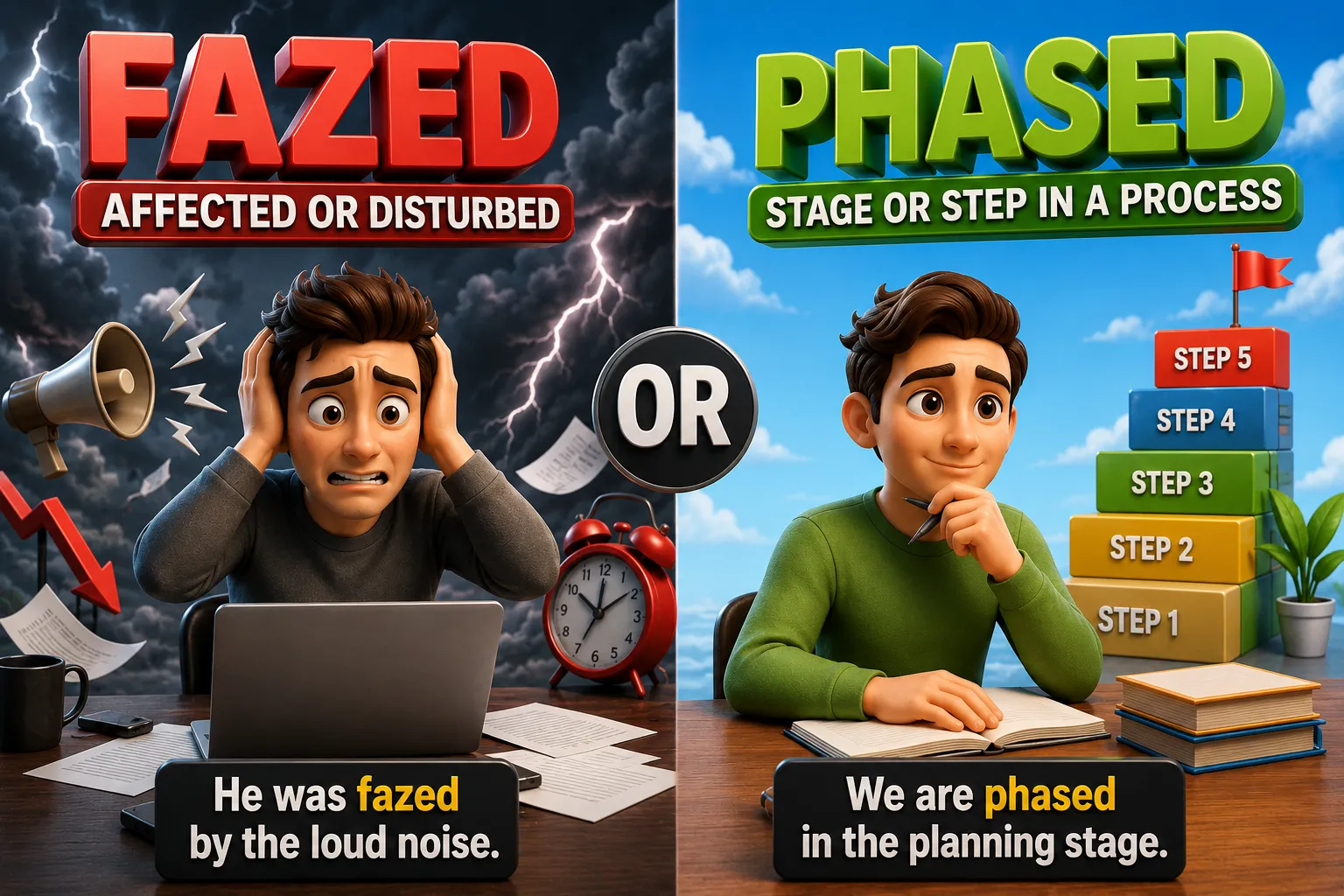
“Fazed” means disturbed or affected emotionally, while “phased” relates to stages or steps in a process. The correct word depends on context.
I remember coming across the words fazed and phased while reviewing a piece of writing and having to stop for a moment to make sure the correct one had been used. They look almost identical and sound the same, but their meanings are completely different. It is an easy mistake to make, especially when writing quickly.
The confusion happens because fazed and phased are homophones they sound alike but have different spellings and meanings. Fazed describes an emotional reaction, usually when someone is bothered, worried, or unsettled by something. Phased, on the other hand, refers to arranging, introducing, or carrying out something in stages.
A simple spelling difference can change the entire meaning of a sentence. For example, saying “She wasn’t fazed by the criticism” means she remained calm and unaffected. But “The company phased in the new system” means the system was introduced gradually.
In this guide, I’ll explain the meanings, origins, grammar, and correct usage of fazed and phased. You’ll also see clear examples and learn an easy memory trick to help you avoid this common mistake.
By the end, you’ll know exactly when to use fazed and when to use phased.
Fazed or Phased Quick Answer
Use fazed when you mean that someone is disturbed, worried, surprised, embarrassed, or emotionally affected by something. It describes a person’s reaction to a situation, event, comment, or experience.
Use phased when you mean that something is introduced, completed, or organized in separate stages or steps. It is commonly used when talking about projects, plans, programs, systems, or changes that happen gradually rather than all at once.
For example:
- She was not fazed by the criticism.
- He looked fazed when he heard the unexpected news.
- The new policy will be phased in over three months.
- The company phased out the old software gradually.
A simple way to remember the difference is:
Fazed = emotionally affected or bothered.
Phased = done in stages or steps.
So, if you are describing how a person feels or reacts, choose fazed. If you are describing a process that happens gradually, choose phased.
Phased = done in stages
The Origin and Background of Fazed and Phased
Although they sound identical, fazed and phased come from very different origins.
Fazed
The word faze is believed to be a variant of the older word feeze, which meant to frighten or disturb. Over time, faze developed the meaning of unsettling or disturbing someone emotionally.
Today, fazed is commonly used in informal and conversational English to describe someone who is not easily shaken.
Phased
The word phase comes from the Greek phásis, meaning appearance or stage. In English, it developed into a noun meaning a stage in a process.
As a verb, to phase means to introduce or carry out something in stages.
This is why we use phased approach, phased rollout, or phased implementation in business, technology, and planning contexts.
Fazed or Phased Explained
The Difference Between Fazed and Phased
The key difference between fazed and phased is their meaning and usage, not simply their spelling. Although they sound exactly the same in most varieties of English, they describe completely different ideas.
1. Fazed
Fazed means emotionally disturbed, worried, surprised, bothered, or affected by something. It is usually used when talking about a person’s reaction to a difficult, unexpected, stressful, or challenging situation.
The word often appears in the expression “not fazed,” which means someone remains calm and does not seem bothered by what is happening.
Characteristics of “fazed”:
- Describes a person’s emotional reaction
- Often relates to stress, pressure, criticism, or surprise
- Common in everyday and informal English
- Frequently used in conversations, stories, and personal writing
- Usually refers to how someone responds to a situation
Examples:
- He was not fazed by the loud noise.
- She seemed completely fazed by the criticism.
- The unexpected question did not faze the experienced speaker.
- Despite the difficult situation, Maria remained unfazed.
- Nothing seemed to faze him during the competition.
In these examples, fazed is connected to a person’s emotional state or reaction. Someone who is not fazed stays calm even when something might normally cause worry, embarrassment, fear, or surprise.
A useful related word is unfazed, which means calm and unaffected.
For example:
The student was unfazed by the challenging exam.
This means the difficult exam did not make the student nervous or upset.
2. Phased
Phased means done, introduced, changed, or completed gradually in separate steps or stages. Unlike fazed, it has nothing to do with emotions.
The word phased is commonly used when describing plans, projects, programs, systems, policies, or changes that happen over a period of time rather than all at once.
Characteristics of “phased”:
- Describes a process, plan, or development
- Refers to stages or steps
- Common in business and professional writing
- Frequently used in government, technology, construction, and project management
- Often appears with in or out
Examples:
- The new system will be phased in over six months.
- The company phased out the old software.
- The new rules will be phased in gradually.
- The construction project will be completed in phased stages.
- The organization has phased out several outdated procedures.
Here, phased describes how something happens over time. The focus is on organization, timing, and progression rather than a person’s feelings.
Phased In vs. Phased Out
Two especially common expressions are phased in and phased out.
Phased in means something is introduced gradually.
The school will phase in the new curriculum over two years.
Phased out means something is gradually removed or discontinued.
The company is phasing out its older products.
These expressions are very common in professional and formal English.
An Easy Way to Remember
If you are talking about a person’s feelings or reaction, use fazed.
If you are talking about a process that happens in stages, use phased.
Fazed = emotionally affected.
Phased = completed or introduced in stages.
For example:
She was not fazed by the difficult question.
Here, fazed describes her reaction.
The new policy will be phased in over several months.
Here, phased describes a gradual process.
Once you connect fazed with feelings and phased with phases or stages, the difference becomes much easier to remember..
Comparison Table
| Word | Meaning | Context | Example Use |
| fazed | Emotionally disturbed | Informal | Not affected by stress |
| phased | Done in stages | Formal/technical | Gradual rollout of a plan |
Which Version Should You Use?
The correct word depends entirely on meaning.
For emotions or reactions
Use:
fazed
Example:
She was not fazed by the challenge.
For processes or stages
Use:
phased
Example:
The changes will be phased in over time.
In professional writing
Use phased when discussing plans, systems, or implementation.
Use fazed when describing human reactions or emotions.
Common Mistakes with Fazed and Phased
Mistake 1: Using “phased” for emotions
❌ He was not phased by the insult.
✅ He was not fazed by the insult.
Mistake 2: Using “fazed” for processes
❌ The project will be fazed in gradually.
✅ The project will be phased in gradually.
Mistake 3: Confusing pronunciation with meaning
Because both words sound the same, writers often choose the wrong spelling. Always check meaning, not sound.
Mistake 4: Assuming they are interchangeable
❌ They are not interchangeable.
Each word has a completely different definition.
Fazed or Phased in Real-World Examples
Emotional context (fazed)
The athlete was not fazed by the pressure of the final match.
Here, the focus is emotional resilience.
Business context (phased)
The company will phase the new policy in over three stages.
Here, the focus is structured implementation.
Everyday conversation (fazed)
“I thought the test would be hard, but I wasn’t fazed at all.”
Technical writing (phased)
The software update will be phased across all devices.
News writing (phased)
The government announced a phased reopening of schools.
Fazed or Phased Usage Insights
From a language perspective, these two words are a classic example of homophones—words that sound the same but have different meanings and spellings.
A simple memory trick helps:
- Fazed = feelings (emotions)
- Phased = phases (stages)
This association makes it easier to choose the correct word quickly.
Standalone Comparison: Fazed vs Phased at a Glance
| Word | Meaning | Usage Type | Best Used When |
| fazed | Emotionally affected | Informal | Describing reactions |
| phased | Done in stages | Formal | Describing processes |
Frequently Asked Questions
Q: What does “fazed” mean?
A: Fazed means emotionally disturbed, surprised, or affected by something.
Q: What does “phased” mean?
A: Phased means something is done gradually in stages or steps.
Q: Is it “not fazed” or “not phased”?
A: The correct phrase is not fazed when referring to emotions.
Q: Can “phased” mean emotional?
A: No. Phased is only used for processes, not emotions.
Q: Why do people confuse fazed and phased?
A: They are homophones, meaning they sound the same but have different meanings and spellings.
Q: Is “phased out” correct?
A: Yes. Phased out means something is gradually removed or discontinued.
Conclusion
The difference between fazed and phased is simple once you understand their meanings.
Fazed refers to emotional reactions—being disturbed, surprised, or unaffected.
Phased refers to structured steps or stages in a process.
They may sound identical, but they belong to completely different parts of English usage.
If you remember one simple rule, make it this:
Fazed = feelings. Phased = phases.
Once you keep that in mind, you will always choose the correct word with confidence.
Bookmark this guide so you never confuse “fazed” and “phased” again.
Read More:
Valentines or Valentine’s: The Easy Guide

I’m **Rubab Naaz**, an English language content writer with over 10 years of experience creating educational and SEO-focused articles. I specialize in spelling comparisons, grammar, vocabulary, synonyms, commonly confused words, and English usage. My passion is helping students, writers, and professionals improve their language skills through accurate, well-researched, and easy-to-understand content. Every article I write is designed to make learning English simple, practical, and engaging.