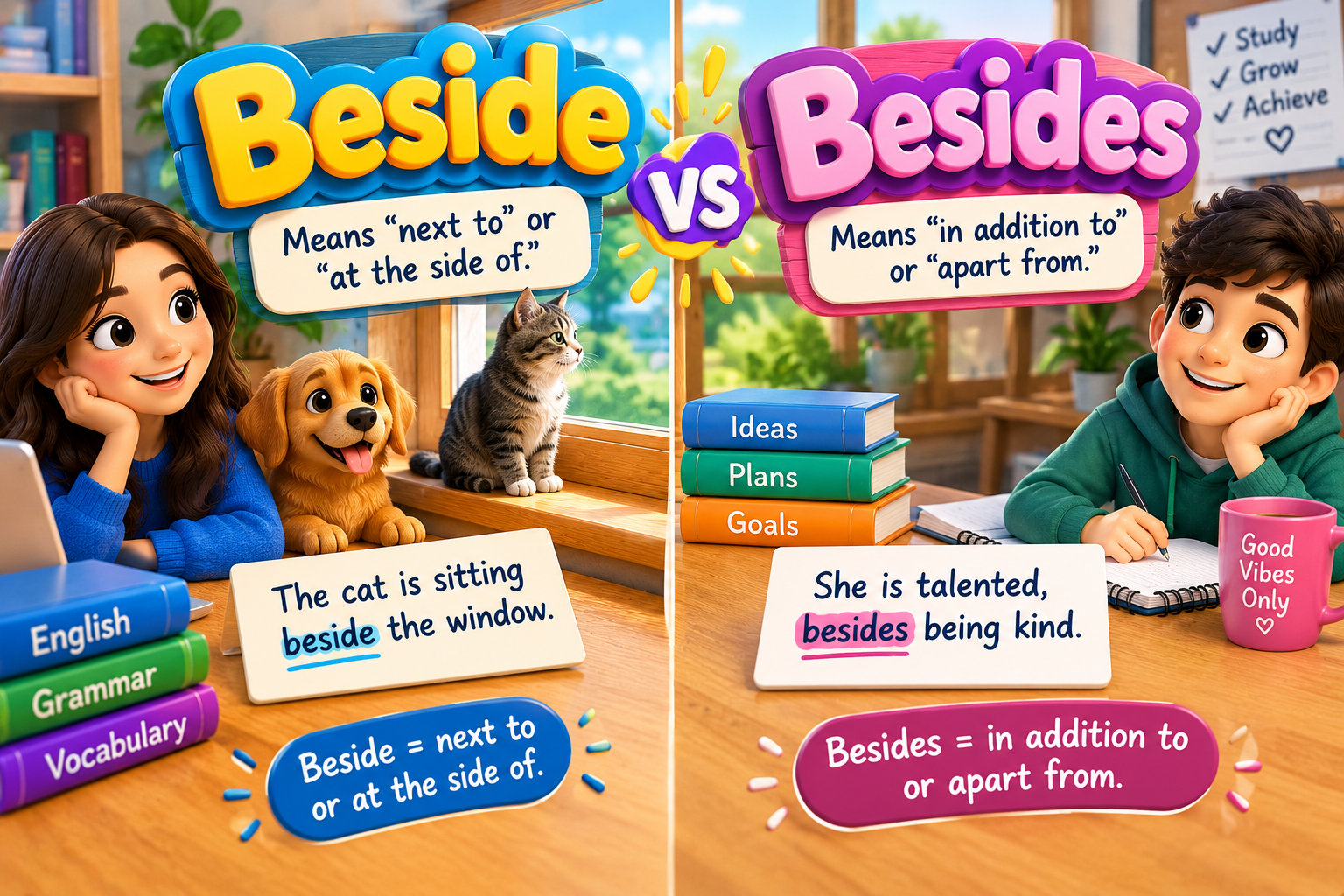
Beside or besides? Use beside when you mean “next to,” and use besides when you mean “in addition to” or “also.”
I’ve lost count of how many times I’ve written a sentence with beside and then paused to ask myself, “Wait, should this be besides?”
It’s one of those small English questions that can catch me off guard because the two words look so similar. I’ve always found it easy to understand why people mix them up. They begin with the same letters, sound almost the same when spoken, and are closely related historically. The only obvious difference is that little s at the end, but that one letter can change the meaning of the sentence.
I’ve noticed this confusion in my own writing, especially when I’m writing quickly. I might mean next to, but besides comes to mind simply because it looks familiar. When I stop and think about what I’m actually trying to say, the right choice usually becomes clear.
That’s what finally helped me understand the difference: don’t focus on the extra “s”—focus on the meaning.
If I’m talking about something being next to something else, I use beside. If I’m adding another point or meaning in addition to, I use besides.
Once I started looking at the meaning instead of the spelling, the difference became much easier to remember. In this guide, I’ll walk through beside or besides, their meanings, how they’re used, and the mistakes I’ve seen people make with these two easily confused words.
Beside or Besides Quick Answer
Beside and besides are both correct English words, but they usually have different meanings.
Beside means next to or at the side of something or someone.
- The lamp is beside the sofa.
- Maya sat beside her friend.
Besides usually means in addition to, apart from, or also.
- Besides English, he studies Chinese.
- Besides, we have another problem to solve.
Cambridge Dictionary classifies beside as a preposition meaning “at the side of” or “next to.” It also records a comparison use, as in comparing one thing with another.
Cambridge defines besides as a preposition or adverb meaning “in addition to” or “also.”
The fastest test
Ask yourself:
Can I replace the word with “next to”?
If yes, use beside.
Can I replace it with “in addition to” or “also”?
If yes, use besides.
That one test solves most cases.
The Origin and Background of Beside and Besides
The close spelling of these words is not an accident. They have a shared history.
The etymology of beside goes back to Old English be sidan, meaning “by the side of.” Etymonline records beside as a single word by about 1200, used as both a preposition and an adverb.
Besides has a related history. Etymonline records it from around 1200 and explains that it developed from beside plus an adverbial -s. Historically, besides shared many of the meanings of beside. Modern English later narrowed its main uses.
This is a useful lesson in linguistics.
English words do not always keep exactly the same meaning over time. A word may begin with several related uses and later develop more specific functions.
That happened here.
Today, the distinction is clear enough for everyday writing:
- beside → position or comparison
- besides → addition or an additional reason
The words are therefore related, but they are not normally interchangeable.
Beside or Besides Explained: Key Differences
The simplest way to understand the pair is to look at the job each word performs.
| Term | Meaning | When to Use | Region/Context |
| beside | next to; at the side of | Describing position | Standard English |
| besides | in addition to | Adding another person or thing | Standard English |
| besides | also; furthermore | Adding another fact or reason | Standard English |
| beside | compared with | Making a comparison | Standard English |
1. Beside means “next to”
Use beside when one person or thing is at the side of another.
The bicycle was parked beside the garage.
Here, you could replace beside with next to:
The bicycle was parked next to the garage.
The meaning stays almost the same.
Other examples include:
- The nurse stood beside the patient.
- A small table sat beside the armchair.
- He left his shoes beside the door.
Cambridge gives the same core meaning: beside means “at the side of” or “next to.”
2. Besides means “in addition to”
Use besides when you want to add another person, thing, activity, or idea.
Besides mathematics, Sara enjoys history.
This means Sara enjoys history in addition to mathematics.
Try the replacement:
In addition to mathematics, Sara enjoys history.
The meaning still works.
That is a strong sign that besides is correct.
3. Besides can mean “furthermore”
Besides can also work as an adverb. In this use, it adds another reason or point.
I do not want to take the bus. Besides, it is already late.
The word introduces an extra reason.
Cambridge Grammar explains that besides can be used at the beginning of a clause to add a fact or reason that strengthens what has already been said.
4. Beside can also mean “compared with”
There is one useful meaning that learners sometimes miss.
The new model looks impressive beside the older version.
Here, beside does not mean that the two objects are physically next to each other. It means that one is being considered in comparison with the other.
Cambridge Dictionary lists this comparative use as well.
Which Version Should You Use?
Different writing situations call for slightly different choices.
For students and ESL learners
Use beside when you are describing a place or position.
The teacher stood beside the board.
Use besides when you are adding information.
Besides biology, he studies chemistry.
A simple substitution test can help you check your answer before submitting an assignment.
For professional writing
Think about the relationship between the ideas.
If you are describing location:
Please place the signed form beside the computer.
If you are adding another consideration:
Besides the price, we should consider delivery time.
Both words are perfectly standard. The important issue is the meaning.
For formal or neutral English
When besides means “also,” you may sometimes prefer also, in addition, or furthermore, depending on your sentence.
Cambridge notes that besides and also overlap in meaning but are used differently. It recommends alternatives such as also or in addition when the goal is simply to add information.
For example:
The report covers costs. In addition, it discusses staffing.
This can sound more direct in formal prose.
Common Mistakes with Beside or Besides
Mistake 1: Using “beside” when you mean “in addition to”
❌ Beside English, I speak Urdu.
✅ Besides English, I speak Urdu.
Why? Urdu is an additional language. It is not a location.
Mistake 2: Using “besides” for physical location
❌ The notebook is besides the keyboard.
✅ The notebook is beside the keyboard.
Why? The notebook is next to the keyboard.
Mistake 3: Leaving out the “s” before an extra reason
❌ Beside, the weather is getting worse.
✅ Besides, the weather is getting worse.
Why? The second sentence adds another reason.
Mistake 4: Treating the words as homophones
They look almost identical, but they are not exact homophones.
Beside is pronounced /bɪˈsaɪd/.
Besides is pronounced /bɪˈsaɪdz/.
The final sound in besides is different.
That means reading your sentence aloud can sometimes help you notice the distinction, although meaning remains the best test.
Mistake 5: Assuming every “apart from” sentence needs “besides”
Besides can mean “apart from” in some contexts, but the meaning depends on the sentence.
Nobody besides Omar knew the answer.
Here, besides Omar identifies someone outside the group being described.
So do not replace besides automatically with except. Check what the sentence is trying to say.
Beside or Besides in Real-World Examples
The difference becomes clearer when you see each word in practical writing.
Professional email
Please place the revised contract beside the printer before the courier arrives.
The word describes a physical location.
News headline
New Health Center Opens Beside the Central Library
The headline uses beside to identify where the building is located.
Social media post
Besides coffee, my morning now starts with a ten-minute walk.
The writer is adding one activity to another.
Formal report
Besides the project’s financial cost, the committee examined its environmental impact.
The word introduces an additional factor.
Everyday conversation
I cannot join you tonight. Besides, I have an early meeting tomorrow.
Here, besides introduces another reason.
Beside or Besides Data, Trends and Usage
Exact monthly search-volume figures for “beside or besides” vary by SEO platform, country, database, and date. Public search results do not provide a dependable current figure that can honestly be presented as a universal monthly volume.
For that reason, it is better not to invent a number.
The available web evidence does show that beside vs. besides is treated as a common English usage question across language-learning resources. Current grammar references consistently focus on the same core distinction: beside relates to position, while besides adds information or an additional reason.
Corpus tools offer a different kind of evidence.
Google Books Ngram Viewer allows researchers to examine the frequency of words and phrases in its book collections over time. Its current interface provides English corpora covering periods from 1800 through 2019.
Ngram data should not be confused with Google Search data. A word appearing often in books does not mean that it receives the same number of monthly searches.
For this topic, the search intent is clearly informational. People usually want to solve a specific language problem:
- Which spelling should I use?
- What does each word mean?
- Is beside a preposition?
- Can besides start a sentence?
- Which one belongs in my sentence?
- Does the extra s change the meaning?
The topic also matters for students, ESL learners, editors, teachers, bloggers, and professionals who want their writing to be clear.
A Standalone Beside or Besides Comparison
| Term/Variant | Meaning | Region/Context | Best Used When |
| beside | at the side of | General English | You mean “next to” |
| besides | in addition to | General English | You are adding an item |
| besides | furthermore; additionally | General English | You are adding a reason or point |
| apart from | except for or in addition to | British and American English | The exact context makes the meaning clear |
| alongside | next to or together with | General English | You mean physical closeness or working together |
Alongside is worth knowing because it can sometimes replace beside when the meaning is “next to” or “together with.” Cambridge defines it as meaning “next to” or “together with.”
For example:
The new team worked alongside experienced engineers.
That does not mean the team was simply standing next to the engineers. It suggests that they worked together.
Frequently Asked Questions About Beside or Besides
Q: What does “beside” mean?
A: Beside usually means “next to” or “at the side of.” It can also be used to compare one person or thing with another.
Q: What does “besides” mean?
A: Besides commonly means “in addition to” or “also.” It can also introduce another reason or point in a sentence.
Q: Which is correct: beside or besides?
A: Both are correct. The choice depends on your meaning. Choose beside for “next to” and besides for “in addition to,” “also,” or an extra reason.
Q: Is “besides” acceptable in formal writing?
A: Yes. Besides is a standard English word. In formal writing, however, also, in addition, or furthermore may sometimes fit the style more naturally.
Q: Can “beside” mean “compared with”?
A: Yes. English dictionaries record a comparative use of beside. For example, something can seem less impressive when considered beside another thing.
Q: Where do “beside” and “besides” come from?
A: Both have roots in older English forms connected with the idea of being “by the side.” Etymonline traces beside to Old English be sidan and besides to beside plus an adverbial -s.
Q: Can “besides” be used at the beginning of a sentence?
A: Yes. It can introduce an additional reason or point. For example: “The plan is expensive. Besides, we do not have enough time.” Cambridge Grammar specifically describes this use.
Q: Is “beside” the same as “alongside”?
A: They can overlap when both describe something being next to another thing. Alongside can also suggest working or existing together, so the exact context matters.
Conclusion
The choice between beside or besides becomes much easier once you focus on meaning rather than spelling.
Use beside when you mean next to, at the side of, or sometimes in comparison with. Use besides when you mean in addition to, also, or furthermore.
Their similar appearance makes sense because the two words share a historical connection. Beside developed from an Old English expression meaning “by the side of,” while besides later developed from beside with an added adverbial -s.
When you are unsure, use the replacement test:
Next to? → beside.
In addition to? → besides.
Furthermore? → besides.
You can also remember that beside describes where something is, while besides often tells you that there is something extra.
That small distinction is enough to prevent most mistakes.
Bookmark this guide so you never have to second-guess “beside” or “besides” again.
Read More:
Modeling or Modelling: Which Spelling Is Correct

I specialize in English grammar, spelling, word choice, and language usage. My content is based on research from grammar references, style guides, dictionaries, and real-world usage to ensure it is accurate and practical.
At Spelling Comparison, I write guides that explain why words are confused, how they are used, and which form is correct in context. I also include proofreading tips, examples, and writing advice readers can apply immediately.
My goal is to publish clear, reliable content that helps readers make better writing decisions. Each guide is written for accuracy, clarity, and usefulness in school, work, business, and everyday communication.










