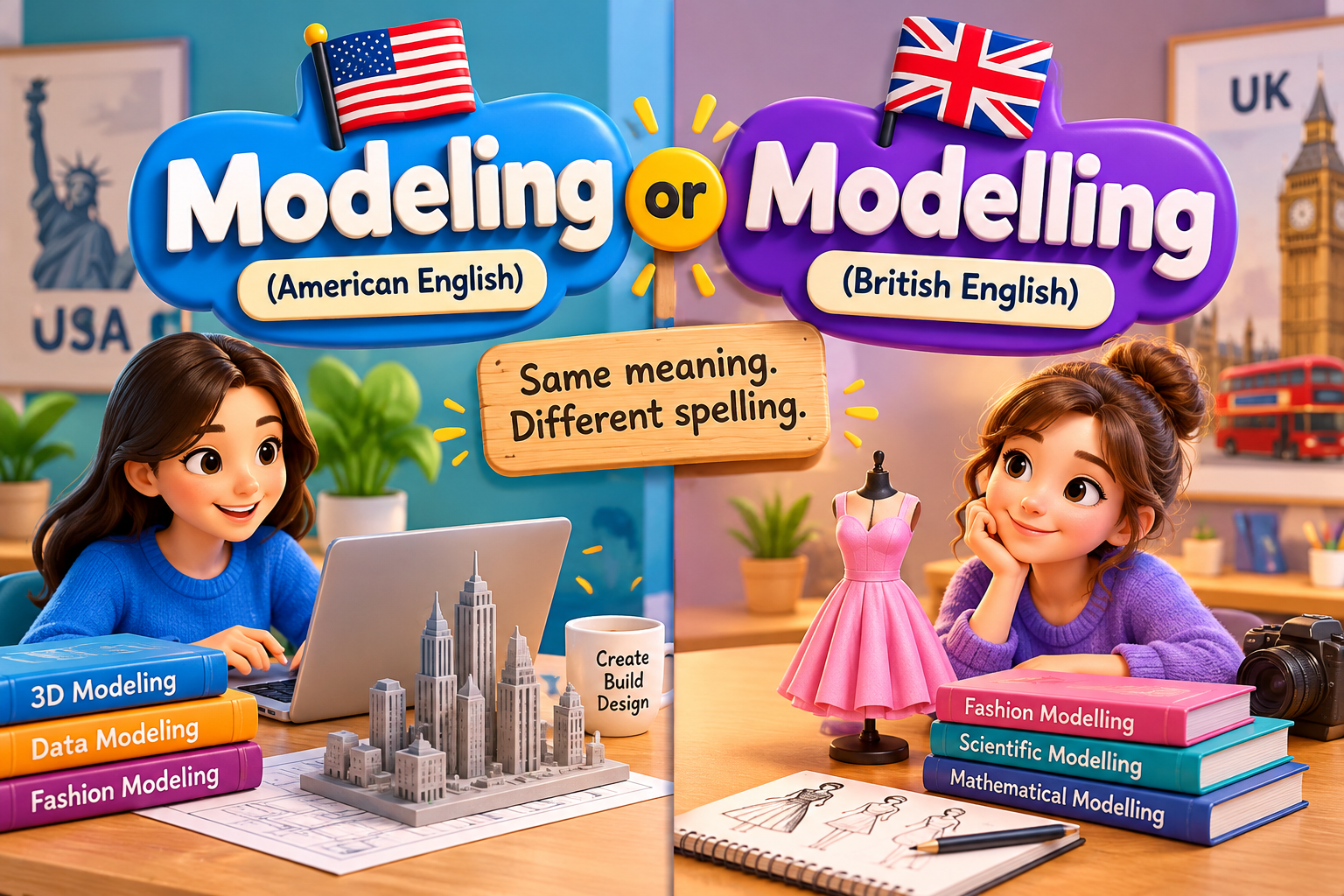
Modeling and modelling have the same meaning, but modeling is the usual American spelling, while modelling is the usual British spelling.
I remember the first few times I typed modeling and noticed my spell checker suggesting modelling instead. I would pause for a second and wonder which spelling was actually correct. The difference seemed so small that I sometimes checked the word again just to be sure. Since both forms look almost identical, I found it surprisingly easy to become unsure about that extra l.
As I came across the word more often in different types of writing, I realized that both spellings are correct. The difference mainly comes down to the variety of English being used.
When I write in American English, I use modeling, while British English normally uses modelling. I’ve also noticed the same pattern with modeled and modelled. Once I understood the regional difference, the spelling became much easier for me to remember.
I’ve found that the most important thing is to choose one form based on my audience and use it consistently. If I’m following American English, modeling feels natural. If I’m following British English, modelling is the expected form. The spelling may be different, but the meaning remains the same.
In this guide, I’ll explain my understanding of modeling vs. modelling, where these spellings come from, how I decide which one to use, the mistakes I’ve seen people make, and some simple examples that can make the difference easier to remember.
Modeling or Modelling Quick Answer
Modeling and modelling are two regional spellings of the same word.
- Modeling → mainly American English
- Modelling → mainly British English
Both can refer to creating or using a model. They can also describe the work of a fashion model. Cambridge Dictionary lists modeling as the US form and modelling as the UK form.
For example:
- The scientist is working on a new modeling technique.
- The scientist is working on a new modelling technique.
The meaning stays the same. Only the spelling changes.
The Origin and Background of Modeling
The word comes from model, a much older English word.
According to Etymonline, model entered English in the 16th century from French modelle and Italian modello. These forms trace further back to Latin modulus, meaning a small measure or standard.
The noun modeling, also spelled modelling, is recorded from the 17th century. Its early sense was connected with bringing something into a desired form. Later, it developed senses involving the making of physical models and the work of fashion models.
This history also helps explain why the word has several modern meanings.
Today, modeling/modelling can refer to:
- Creating a physical model.
- Using mathematics to represent a system.
- Building a computer model.
- Working as a fashion model.
- Showing a behavior that others can copy.
This is a good example of polysemy, where one word has several related meanings.
It is not a homophone issue. Modeling and modelling sound the same in normal use. The difference is mainly in spelling and regional writing conventions.
Modeling vs Modelling Key Differences
The main difference is regional spelling, not meaning.
| Term | Meaning | When to Use | Region/Context |
| Modeling | Creating or using a model; work as a model | American-style writing | US English |
| Modelling | Same basic meanings | British-style writing | UK English |
| Modeling | Technical or scientific modeling | US academic and technical writing | American English |
| Modelling | Technical or scientific modelling | UK academic and technical writing | British English |
Cambridge gives the same regional distinction for meanings such as fashion work, mathematics, and computing.
Examples of the difference
American English:
The company uses computer modeling to test new designs.
British English:
The company uses computer modelling to test new designs.
Another difference appears in the verb:
- US: modeled
- UK: modelled
For example:
The researcher modeled the expected results.
British English would normally write:
The researcher modelled the expected results.
Cambridge specifically identifies the pattern as UK -ll- | US -l- for model in these forms.
Which Version Should You Use?
The best choice depends on your target audience and style guide.
For American readers
Use modeling.
This is the normal form in American English:
- data modeling
- financial modeling
- 3D modeling
- climate modeling
- fashion modeling
For British readers
Use modelling.
It fits British spelling conventions:
- data modelling
- financial modelling
- 3D modelling
- climate modelling
- fashion modelling
For international writing
Choose one spelling and stay consistent.
Consistency is often more important than trying to mix regional forms. If your website follows American English, use modeling throughout. If it follows British English, use modelling throughout.
Do not write modeling in one paragraph and modelling in another unless you are discussing the spelling difference itself.
Common Mistakes with Modeling or Modelling
1. Treating one spelling as incorrect
Mistake: “Modelling is wrong.”
Correction: Modelling is a standard British spelling.
The same applies to modeling in American English.
2. Mixing regional spellings
Mistake: Using modeling in one section and modelled in another without a reason.
Correction: Match your spelling system.
American English generally uses modeling / modeled. British English generally uses modelling / modelled.
3. Adding the extra “l” in American English
Mistake: The report discusses financial modelling.
Correction: The report discusses financial modeling.
The first form is not normally used in standard American spelling.
4. Removing the extra “l” in British English
Mistake: The report discusses climate modeling.
Correction: The report discusses climate modelling.
British style normally keeps the double l.
5. Changing the meaning
Mistake: Assuming modeling and modelling describe different activities.
Correction: They normally describe the same activity. The spelling reflects the variety of English being used.
Modeling or Modelling in Real-World Examples
The word appears in many fields, not just fashion.
Professional email
Our team has completed the financial modeling for the next project.
A British-English version would normally use modelling.
News writing
New computer modeling shows how the system could perform under different conditions.
The spelling can change to modelling when a publication follows British English.
Social media
I have started learning 3D modeling, and the results are getting better every week!
For a British audience, 3D modelling would normally be used.
Formal report
The study uses mathematical modelling to examine possible changes in rainfall patterns.
The choice should match the report’s regional style.
Modeling or Modelling Data, Trends & Usage
Exact monthly search-volume figures for “modeling” and “modelling” vary by country, platform, date, and keyword tool. Public sources do not provide one universal number that can safely represent all English users, so invented search-volume figures should be avoided.
There is, however, useful evidence about written usage and current interest.
Google Books Ngram
Google Books Ngram Viewer measures how words and phrases occur in its book corpus over time. Its documentation explains that the tool can compare terms across English-language corpora and different years.
This makes Ngram useful for studying the historical presence of modeling and modelling, although it should not be treated as a direct measure of today’s Google search volume.
Google search interest
Google has also reported rising interest in the related terms “Marketing Mix Modelling” and “Marketing Mix Modeling.” Its 2025 analysis of global Google Trends data found that interest in both spellings increased over the previous decade.
That is useful context, but it concerns the specific phrase marketing mix modeling/modelling, not every use of the standalone word.
Search intent
People searching modeling or modelling usually have an informational intent. They want to know:
- Which spelling is correct?
- Is modeling American or British?
- Is modelling acceptable?
- Why does the spelling change?
- Which version should I use?
The topic is especially useful for students, editors, ESL learners, bloggers, and people writing for international audiences.
Standalone Comparison Table
| Term/Variant | Meaning | Region/Context | Best Used When |
| Modeling | The act or process of making or using a model | US English | Writing for American readers |
| Modelling | Same meaning as modeling | UK English | Writing for British readers |
| Modeled | Past tense of model | US English | Describing a completed action |
| Modelled | Past tense of model | UK English | British-style past tense |
| Modeler | A person who creates or uses models | US English | Referring to a person |
| Modeller | A person who creates or uses models | UK English | British spelling |
Cambridge lists modeller as the UK spelling of modeler, showing that the same regional pattern extends beyond the main word.
Related Words You May Also Search
The modeling/modelling difference belongs to a larger group of British and American spelling variations.
You may also see:
- color / colour
- behavior / behaviour
- center / centre
- realize / realise
- traveling / travelling
These differences are part of English orthography, the system of conventions used to write words.
They are not grammar errors. They are spelling differences linked to regional standards and style traditions.
FAQ: Modeling or Modelling
Q: What does modeling or modelling mean?
A: It can mean creating or using a model, such as a mathematical or computer model. It can also describe the work of a fashion model.
Q: Is modeling or modelling the correct spelling?
A: Both are correct. Modeling is the usual American spelling, while modelling is the usual British spelling.
Q: Which is better for American English?
A: Use modeling. American English normally uses one l in this form.
Q: Which spelling should I use in British English?
A: Use modelling. British English normally keeps the double l.
Q: Is modelling acceptable in formal writing?
A: Yes. Modelling is a standard form in British English and appears in formal, academic, scientific, and professional contexts. Cambridge lists it as the UK form.
Q: Where does the word modeling come from?
A: It comes from model, which entered English through French and Italian and ultimately traces to Latin modulus. The noun modeling is recorded from the 17th century.
Q: Can I use modeling in a scientific paper?
A: Yes. The word is common in scientific and technical writing. Choose modeling for American English and modelling for British English.
Conclusion
The choice between modeling and modelling is much simpler than it first appears. Both forms are standard. Both carry the same basic meaning. The key difference is regional spelling.
Use modeling when you are following American English. Choose modelling when your writing follows British English. The same pattern affects related forms such as modeled/modelled and modeler/modeller.
Your main goal should be consistency. If your article, report, or website uses American English, keep the single l form throughout. If it follows British English, keep the double l form.
The word itself has a long history and now appears across fashion, science, computing, mathematics, engineering, and business.
So, the next time you pause over that extra l, check your audience rather than the dictionary for a single “winner.”
Bookmark this guide so you never second-guess “modeling” or “modelling” again.
Read More:
Vertical or Horizontal: Easy Guide to the Difference

I’m **Rubab Naaz**, an English language content writer with over 10 years of experience creating educational and SEO-focused articles. I specialize in spelling comparisons, grammar, vocabulary, synonyms, commonly confused words, and English usage. My passion is helping students, writers, and professionals improve their language skills through accurate, well-researched, and easy-to-understand content. Every article I write is designed to make learning English simple, practical, and engaging.