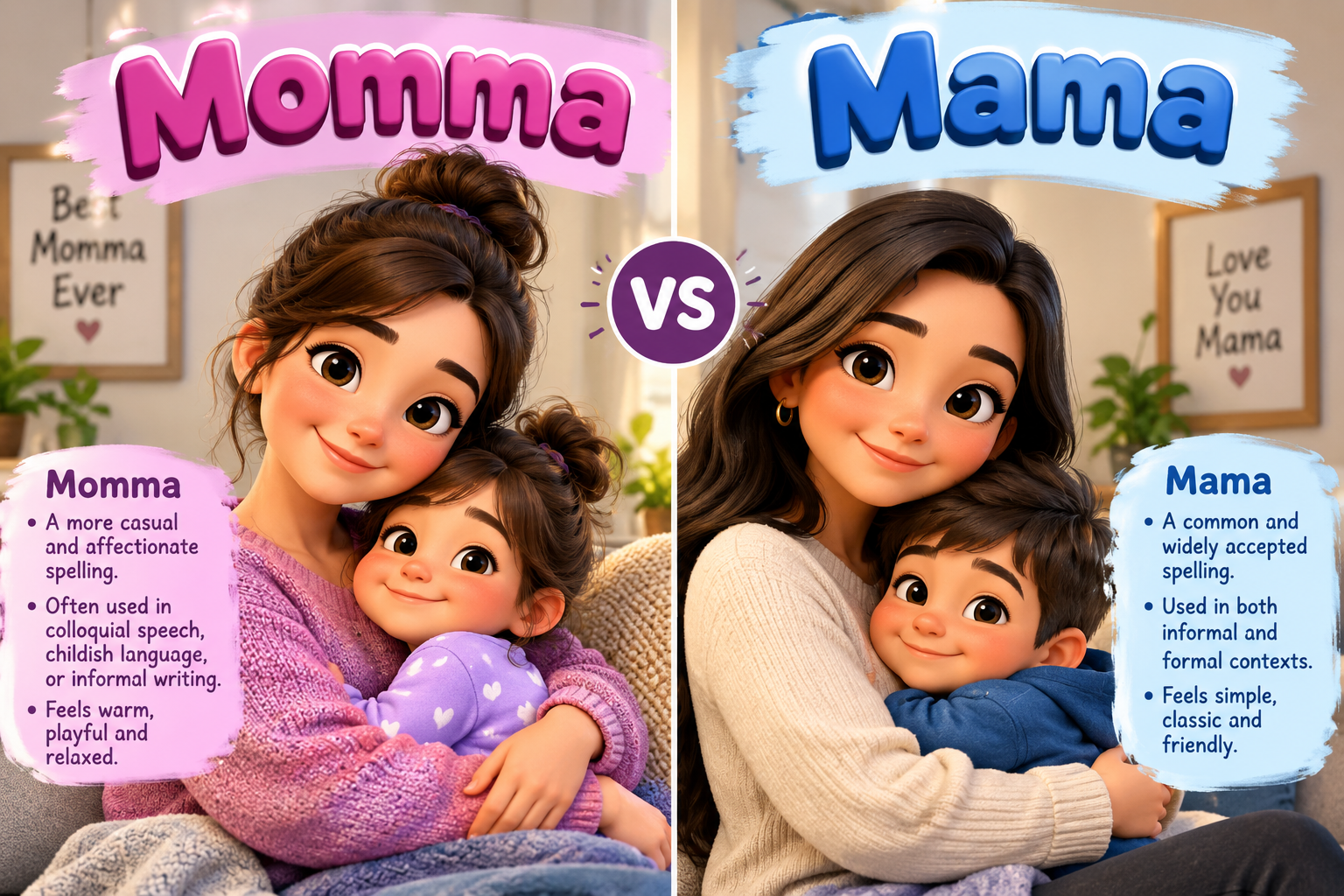
Mama and momma both mean “mother” in informal English, but mama is the more widely used form, while momma is especially associated with informal American English.
I’ve always found mama and momma interesting because the difference is so small. When I first started paying attention to the two spellings, I sometimes wondered whether one was a mistake. The extra m in momma looks minor, but it can make a writer stop and think.
I’ve also noticed that the choice often depends on the kind of English being used and the feeling the writer wants to create. Mama can sound warm, familiar, and natural. Momma can feel even more informal and personal, especially in American speech, family writing, songs, stories, and dialogue.
That is why searching for mama or momma can lead to confusing answers. Both forms are real English words. Neither is simply a spelling error.
Cambridge Dictionary defines mama as an informal or childlike word for “mother,” while momma is listed as an informal American word for “mother”.
In this guide, I’ll explain how I understand the difference, where these words came from, when I would use each one, common mistakes to avoid, and how the two forms appear in everyday writing.
Mama or Momma Quick Answer
When I need a familiar word for mother, I can use either mama or momma.
The main difference is usage and tone, not basic meaning.
- Mama is widely recognized and can be used in informal speech, family writing, stories, and personal messages.
- Momma is an informal American variant and often has a warm, conversational, or regional feel.
- Mother is usually the safer choice for formal or academic writing.
- Mom is a common informal American term for a mother.
For example:
“Mama, can you help me with this?”
Or:
“His momma always saved a place for him at the table.”
Both sentences use a form that refers to a mother. The second one has a more distinctly informal voice.
Cambridge lists momma as a US informal term and gives mama as one of its related forms.
The Origin and Background of Mama and Momma
The history of these words is older and more interesting than their simple appearance suggests.
According to the Online Etymology Dictionary, mamma, meaning “mother,” was recorded in English in the 1570s. It describes the word as a form connected with the repeated ma- sound found in many languages and often associated with early baby speech.
The spelling mama appeared later. Etymonline dates this English spelling to 1707 as a variant of mamma. The same source dates momma to 1810 as an American English variant of mamma.
That history helps explain why these words look and sound so closely related.
There is also a useful linguistic point here. Words such as mama, mamma, mom, momma, mum, and mommy developed as familiar ways of referring to a mother. They belong to a broader group of family terms that often begin in childhood speech.
The word mother has a different historical path. Etymonline traces it through Middle English moder and Old English modor to Proto-Germanic and an older Indo-European root.
So, while mama and mother share the same basic family meaning, their histories are not identical.
Mama Explained Meaning, Use, and Tone
I usually think of mama as the simpler and more widely recognizable spelling.
Cambridge Dictionary defines mama as a mother and notes that it can be informal in US English and old-fashioned in UK English. Its learner dictionary describes it as a child’s word for “mother.”
You may see mama in:
- Family conversations
- Personal messages
- Children’s speech
- Fiction and storytelling
- Songs and creative writing
- Social media posts
- Informal forms of address
For example:
“Mama packed my lunch before I left.”
Here, mama is simply a familiar name for the speaker’s mother.
The word can also carry an emotional or affectionate tone. That is one reason it appears often in personal writing and dialogue.
There is another meaning worth knowing. Cambridge also records mama in US slang for a woman, particularly an attractive woman. That sense is different from the family meaning and depends heavily on context.
Momma Explained Meaning, Use, and Tone
Momma means the same basic thing as mama when it refers to a mother.
The important difference is that momma is strongly associated with informal American English. Cambridge labels it US informal, and Collins likewise describes it as an informal American term and a variant of mama.
I would expect momma more often in:
- Casual American speech
- Family conversations
- Children’s language
- Fictional dialogue
- Personal storytelling
- Social media
- Regional or emotional writing
For example:
“Her momma taught her how to make that recipe.”
The spelling helps create a particular voice. It can make dialogue sound more conversational or regional.
That does not mean momma is incorrect. It simply has a more marked informal style than mother.
Mama vs. Momma: Key Differences
| Term | Meaning | When to Use | Region/Context |
| mama | Mother | Informal, affectionate, family use | Widely recognized; US informal and UK old-fashioned |
| momma | Mother | Casual, personal, or expressive writing | Mainly US informal |
| mother | Female parent | Formal, neutral, academic writing | Standard English |
| mom | Mother | Everyday informal use | Mainly US English |
| mum | Mother | Everyday informal use | Mainly UK English |
The key point is that mama and momma are not different people or different relationships. They are different forms used in different contexts.
Which One Should You Use?
When I’m choosing between mama and momma, I first think about my audience and the tone of the sentence.
For general or international readers
I would usually choose mama if I specifically want a familiar term for mother. It is easy to recognize across many varieties of English.
For American informal writing
Momma can work well when the writing is deliberately casual or personal.
It can also fit naturally into dialogue when you want the character’s speech to sound informal.
For academic writing
I would normally choose mother.
For example:
The mother attended the parent-teacher meeting.
That sentence sounds neutral and professional.
For fiction and dialogue
Either mama or momma may work. Here, the character’s voice matters more than strict formality.
For a family nickname
Use the form that the family actually uses. Personal names and family terms do not always follow textbook rules.
Common Mistakes With Mama and Momma
1. Thinking momma is simply misspelled
Mistake: “Momma” must be wrong because it has an extra m.
Correction: Momma is a recognized English word.
Cambridge and Collins both list it as an informal term for mother.
2. Using either word in formal writing
Less suitable: “The momma attended the official hearing.”
Better: “The mother attended the official hearing.”
The informal forms can sound out of place when the context requires a formal tone.
3. Assuming the two forms have completely different meanings
Mistake: Treating mama and momma as separate concepts.
Correction: When they refer to a mother, their basic meaning is the same.
The difference is mainly spelling, regional usage, and tone.
4. Mixing styles without a reason
If you are writing a story and one character consistently says mama, suddenly switching to momma may look accidental.
Choose the spelling that fits your intended voice and keep it consistent.
5. Confusing mama with mamma
Mama, momma, and mamma are related, but they are not always interchangeable in every context.
Interestingly, Cambridge also lists mamma as a specialized anatomical term meaning a breast or similar organ in an animal.
Context matters.
Mama or Momma in Real-World Examples
Seeing the words in different settings makes the distinction easier to understand.
Professional email
“My mother will be attending the meeting with me.”
For a professional email, mother keeps the tone neutral.
News-style headline
Local Momma Organizes Food Drive for Neighborhood Families
Here, momma can create an informal or human-centered voice. A formal news story might instead use mother.
Social media post
“So grateful for my mama today. ❤️”
The informal and affectionate tone makes mama a natural choice.
Formal report
“The mother provided written consent before the procedure.”
The formal context calls for mother rather than either informal family term.
Fictional dialogue
“Mama said we should wait until morning.”
This sounds natural when mama is part of the character’s everyday speech.
Mama or Momma Data, Trends & Usage
Usage data gives some useful clues, but it needs to be handled carefully.
I did not find a reliable public source that provides a current, exact monthly Google search-volume figure for “mama” versus “momma.” Some online articles publish numerical Google Trends claims, but those figures are not consistently backed by a directly accessible Google Trends report, so I would not treat those numbers as hard facts.
There is, however, useful corpus evidence.
A study using the British National Corpus reported 88 written-text occurrences of “mama” in 30 texts in the specific dataset it examined, compared with 4 occurrences of “momma” in 2 texts. That is not a measure of all modern English, but it illustrates how much more established mama can be than momma in a British English corpus.
Another linguistic study working with child-directed speech combined forms such as “Mom,” “mama,” and “momma” when analyzing vocabulary frequency. This is a useful reminder that researchers may group closely related family terms rather than treating every spelling as a completely separate concept.
What does this mean for search intent?
The search “mama or momma” is mainly informational.
People usually want to know:
- Which spelling is correct?
- Do the two words mean the same thing?
- Is momma a real word?
- Which form sounds more natural?
- Which spelling should I use in writing?
- Is one spelling American or British?
This kind of question matters even more for multilingual writers and English learners because informal family words vary across regions.
It also matters when writers use grammar or spelling tools. A checker may flag an informal or less common word without meaning that the word itself is incorrect.
Standalone Comparison: Mama, Momma, and Related Forms
| Term/Variant | Meaning | Region/Context | Best Used When |
| Mama | Mother | Informal, widely recognized | You want a warm, familiar family term |
| Momma | Mother | Mainly US informal | You want a casual or personal American voice |
| Mother | Female parent | Formal and neutral | You need professional or academic wording |
| Mom | Mother | US informal | You want an everyday American term |
| Mum | Mother | UK informal | You are following British usage |
| Mamma | Mother in older/child usage; also an anatomical term | Historical, specialized, or context-dependent | The surrounding context clearly supports the form |
Frequently Asked Questions
Q: What does mama mean?
A: Mama is an informal or childlike word for “mother.” Cambridge lists it as a familiar term and notes its use in US English and older UK usage.
Q: Is momma a real word?
A: Yes. Momma is a recognized English word. Cambridge and Collins both describe it as an informal term for mother, particularly in US English.
Q: Is mama or momma more correct?
A: Both can be correct when used to mean “mother.” Your choice depends on regional usage, personal preference, and the tone of your writing.
Q: Is momma American English?
A: It is strongly associated with informal American English. Cambridge labels it “US” and “informal,” while Collins also identifies it as an American variant of mama.
Q: Can I use mama in formal writing?
A: You can, but mother is usually more neutral for formal documents, academic work, and professional communication. Mama works better when the relationship or personal voice is relevant.
Q: Where does the word mama come from?
A: Etymonline dates mama in English to 1707 as a spelling variant of mamma. It traces mamma to a repeated ma- form associated with early speech and related forms across several languages.
Q: Is mamma the same as mama?
A: They are historically related, but context matters. Mamma has an older or specialized history, and in modern dictionaries it can also refer to a breast in anatomical terminology.
Final Thoughts on Mama or Momma
After looking closely at mama and momma, I find the choice much less confusing than it first seemed. Both forms can refer to a mother, but they carry slightly different signals about region and tone.
The spelling mama is widely recognizable and works well in affectionate, informal, and family-focused writing. Momma has a stronger informal American flavor and can be useful when a writer wants a more conversational or personal voice.
For formal writing, I would normally choose mother. For everyday American conversation, mom is also very common. If you are writing dialogue or a personal story, however, mama or momma may feel much more natural.
The history is also worth remembering. Mamma is the older recorded English form, mama appeared later as a variant, and momma developed as an American variant.
So, when you see mama or momma, don’t automatically assume one is a spelling mistake. Look at the audience, the region, and the tone first.
Bookmark this guide so you can quickly check the difference whenever you find yourself second-guessing these two familiar words.
Read More:
Defence or Defense: The Easy Spelling Guide

I’m an English language educator and SEO content writer having experience creating clear, accurate, and engaging English learning content. I specialize in spelling differences, grammar, vocabulary, synonyms, commonly confused words, and English usage. My goal is to publish well-researched, easy-to-understand articles that help students, writers, educators, and professionals improve their English with confidence through practical explanations and real-world examples.










