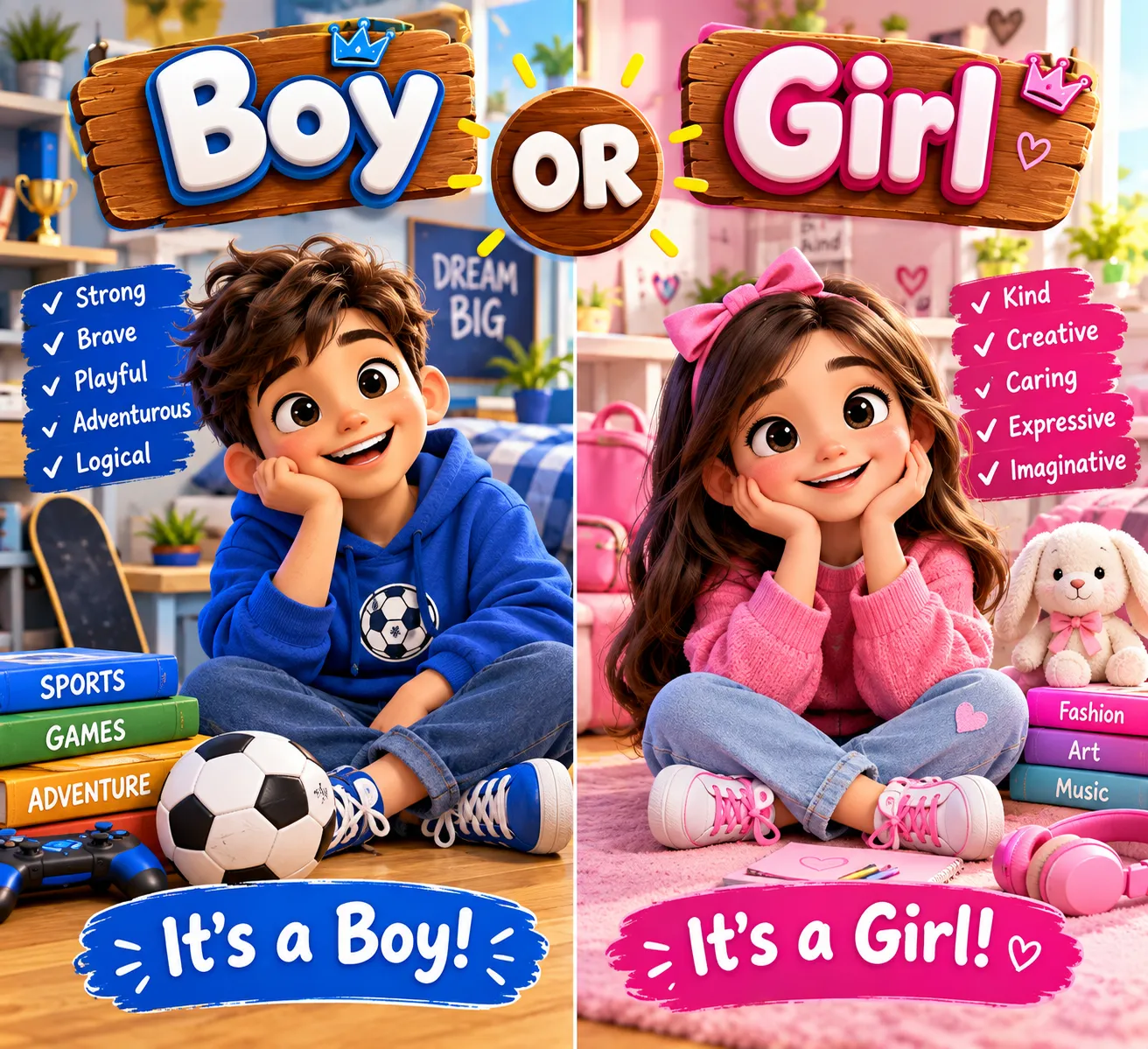
Boy usually refers to a male child or young male, while girl usually refers to a female child or young female. Both are common nouns used to describe children and young people.
I have noticed that boy or girl is one of those simple English questions that can become confusing when you look closely at the words. Most people learn boy and girl very early, often as a basic pair of opposite terms. Yet their meanings, grammar, history, and everyday use are more interesting than they first appear.
I have also seen learners use these words in situations where child, son, daughter, young man, or young woman would be more suitable. The issue is not usually grammar. It is choosing the word that fits the person’s age and the context.
According to Cambridge Dictionary, boy means a male child or, more generally, a male of any age. Girl commonly means a female child or young woman, and it can also mean a daughter.
There is also an important point about modern language. When talking about people, sex, gender, age, and personal identity are not always the same concept. So context matters.
In this guide, you will learn what boy or girl means, how the two words differ, where they came from, how to use them naturally, and which alternatives may work better in formal writing.
Boy or Girl Quick Answer
A boy is generally a male child or young male. A girl is generally a female child or young female. Cambridge lists both as nouns and gives these basic meanings.
For example:
- The boy is playing football outside.
- The girl is reading a book.
The two words are often paired when talking about children:
- The school has both boys and girls.
- They have two children, a boy and a girl.
The broader word child can refer to either a boy or a girl. Cambridge defines a child as a boy or girl from birth until adulthood, or a son or daughter of any age.
The Origin and Background of Boy and Girl
The history of these two everyday words is surprisingly different.
Where does boy come from?
The word boy appeared in Middle English. Etymonline dates early forms such as boie to the mid-13th century. The word had several early meanings, including servant, commoner, and young male. Its specific meaning of a male child developed later. The exact origin of boy remains uncertain.
This is a good example of semantic change, where a word develops or changes its meaning over time.
Today, the meaning is much clearer. Cambridge defines boy as a male child or, more generally, a male of any age.
Where does girl come from?
The history of girl is even more unusual.
Etymonline records girl from around 1300, when gyrle meant a child or young person, and it could refer to either sex, although it was more often associated with females. The specific meaning “female child” developed later. The ultimate origin of the word remains uncertain.
So the modern meanings of boy and girl were not always exactly the same as their earliest meanings.
That is a useful lesson in etymology. Common words can change meaning as speakers use them across centuries.
Boy or Girl Explained: Key Differences
The simplest distinction is based on the conventional meanings of the words.
| Term | Meaning | When to Use | Region/Context |
| Boy | Male child or young male | When referring to a male child or young person | Standard English |
| Girl | Female child or young female | When referring to a female child or young person | Standard English |
| Child | A young person of either sex | When sex is unknown, irrelevant, or you want a neutral term | Standard English |
| Son | A male child in relation to a parent | When describing family relationships | Standard English |
| Daughter | A female child in relation to a parent | When describing family relationships | Standard English |
Boy
Boy is a noun.
It can refer to a male child or, depending on context, a young male. Cambridge also notes that boy can sometimes mean a son.
Examples:
- The boy won the school competition.
- That boy is my younger brother.
- Her son is a cheerful boy.
The word can also have informal uses. For example, the boys can refer to a group of male friends. Cambridge lists this as an informal use.
Girl
Girl normally refers to a female child or young woman. Cambridge also lists daughter as one of its meanings.
Examples:
- The girl is waiting for her mother.
- She was a bright girl at school.
- Their youngest daughter is still a girl.
There is an important usage point here. Cambridge notes that many adult women may consider being called girls by other people offensive, especially when used to describe adult women in a professional or general context.
That means age and context both matter.
Boy or Girl: Which Word Should You Use?
Choosing between boy and girl is usually easy when the meaning is clear.
When talking about a male child
Use boy.
Example:
The boy is waiting near the school gate.
When talking about a female child
Use girl.
Example:
The girl won the spelling competition.
When sex is not relevant
Use child.
Example:
Every child deserves access to a good education.
This can be more natural than repeatedly using boy or girl.
When discussing a family relationship
Use son or daughter.
For example:
- My son starts school next year.
- Their daughter loves drawing.
These words tell the reader about the relationship, not simply the person’s sex.
In formal writing
Choose the most precise term for your purpose. If age matters, child or young person may be better. If a family relationship matters, son or daughter is usually clearer.
Common Mistakes with Boy or Girl
1. Using boy for every male person
Less suitable:
The boy gave a speech at the conference.
If the person is an adult, man or another age-appropriate term may be more accurate.
2. Using girl for every female person
Less suitable:
The girl presented the company’s annual report.
If the person is an adult, woman may be more appropriate.
3. Confusing child with boy or girl
Child is a broader term.
A child can be a boy or a girl.
So:
child → broader category
boy/girl → more specific description
4. Using girl for adult women without considering context
Calling adult women girls can sound informal, old-fashioned, or disrespectful in some situations. Cambridge specifically highlights this usage concern.
5. Assuming boy and girl are the only choices
English has many useful alternatives, including:
- child
- kid
- young person
- young man
- young woman
- son
- daughter
The best choice depends on the sentence.
Boy or Girl in Real-World Examples
Professional email
The boy’s parents have confirmed that he will attend the school meeting.
This is suitable when discussing a male child.
News article
Police are searching for a missing girl who was last seen near the town center.
Here, girl clearly identifies a female child or young person.
Social media post
My little boy took his first steps today, and I could not be more proud.
The word has a warm and personal tone in this context.
Formal document
The study included children from several age groups, including both boys and girls.
Here, children is the broader category, while boys and girls provides additional detail.
School setting
The teacher asked the boys and girls to return to their seats.
Both words work naturally when referring to children in a school environment.
Boy or Girl Data, Trends & Usage
The search intent behind boy or girl is mainly informational. People may search the phrase to understand the difference between the words, choose the right term, learn related vocabulary, or discuss whether a child is male or female.
Exact monthly search-volume figures for the phrase “boy or girl” would require a live SEO database such as Ahrefs, Semrush, or Google Keyword Planner. The dictionary and linguistic sources reviewed here do not provide reliable monthly search-volume data, so it would be misleading to present an invented figure.
The dictionary evidence is clearer.
Cambridge classifies boy and girl as common nouns and gives their core meanings in relation to children and young people.
There is also interesting historical evidence. Etymonline dates early forms of boy to the mid-13th century, while girl appears around 1300 with a broader early meaning connected to a child or young person.
Modern usage also shows that girl can have meanings beyond “female child.” Cambridge lists daughter as another meaning and notes informal uses for groups of female friends.
This makes the topic useful for English learners because a basic vocabulary pair can contain several layers of meaning.
Boy or Girl and Gender: A Useful Distinction
When discussing boy or girl, it helps to separate everyday vocabulary from broader discussions about sex and gender.
In ordinary English, boy and girl are commonly used for male and female children. That is the basic dictionary meaning.
However, conversations about gender can involve identity, social roles, and personal experience. Therefore, in sensitive or formal contexts, it is better to use the terminology that fits the subject and the person’s own stated identity.
For simple English learning, the main rule remains easy:
Boy = male child or young male.
Girl = female child or young female.
Child = general term for a young person.
Boy or Girl: Standalone Comparison Table
| Term/Variant | Meaning | Region/Context | Best Used When |
| Boy | Male child or young male | General English | Referring to a male child |
| Girl | Female child or young female | General English | Referring to a female child |
| Child | Young person of either sex | Neutral/general | Sex is unknown or not relevant |
| Kid | Informal word for a child | Casual English | Friendly or informal conversation |
| Young man | Male who is no longer best described as a child | General/formal English | Referring to an older adolescent or young adult |
| Young woman | Female who is no longer best described as a child | General/formal English | Referring to an older adolescent or young adult |
| Son | Male child in relation to a parent | Family context | Talking about family relationships |
| Daughter | Female child in relation to a parent | Family context | Talking about family relationships |
Frequently Asked Questions
Q: What does boy mean?
A: Boy usually means a male child or young male. Cambridge also records broader uses, including references to males more generally and, in some contexts, a son.
Q: What does girl mean?
A: Girl commonly means a female child or young woman. It can also mean a daughter, while some informal uses refer to a group of female friends.
Q: What is the difference between a boy and a girl?
A: In ordinary English, boy refers to a male child or young male, while girl refers to a female child or young female. The appropriate term can depend on age and context.
Q: Is child a better word than boy or girl?
A: Not always. Child is broader and does not specify whether the child is male or female. Use it when that distinction is unknown, unnecessary, or intentionally left unspecified.
Q: Where did the word boy come from?
A: The origin of boy is uncertain. Etymonline records Middle English forms from the 13th century and several early meanings before the modern sense became established.
Q: Where did the word girl come from?
A: Girl appears in English around 1300 as gyrle, meaning a child or young person. Its ultimate origin is uncertain, and its specific female-child sense developed later.
Q: Can girl refer to an adult woman?
A: It can in some informal expressions, such as when women refer to their female friends as the girls. However, Cambridge notes that some adult women may find the term offensive when others use it to address or describe them.
Conclusion
The difference between boy or girl looks simple, and in most everyday situations it is.
A boy generally means a male child or young male. A girl generally means a female child or young female. If you need a broader term, child can refer to either.
The history of these words is more surprising. Boy has been linked to several Middle English meanings, while girl originally had a broader sense that could refer to a child or young person of either sex. Their modern meanings developed over time.
Context also matters. Son and daughter are better when you are describing a family relationship. Young man and young woman may be more suitable for older people. Child is useful when the person’s sex is not relevant.
Finally, remember that everyday vocabulary and modern discussions of gender are not always the same thing. In sensitive situations, choose language carefully and respectfully.
Now you know how boy, girl, child, son, and daughter differ. Bookmark this guide so you can choose the right word with confidence whenever the context matters.
Read More:
Indica or Sativa: The Real Differences Explained

I’m Daniel sultan, an English language writer and SEO content specialist with experience researching spelling, grammar, vocabulary, and English usage. Through SpellComparison.com, I create clear, accurate, and well-researched guides that help readers understand commonly confused words, spelling differences, and grammar rules with confidence.
Every article I write is based on trusted language references, established style guides, and real-world usage to ensure it is accurate, practical, and easy to understand. My goal is to make learning English simple and reliable by providing fact-checked content, clear explanations, and real-life examples that students, writers, educators, and professionals can trust.










