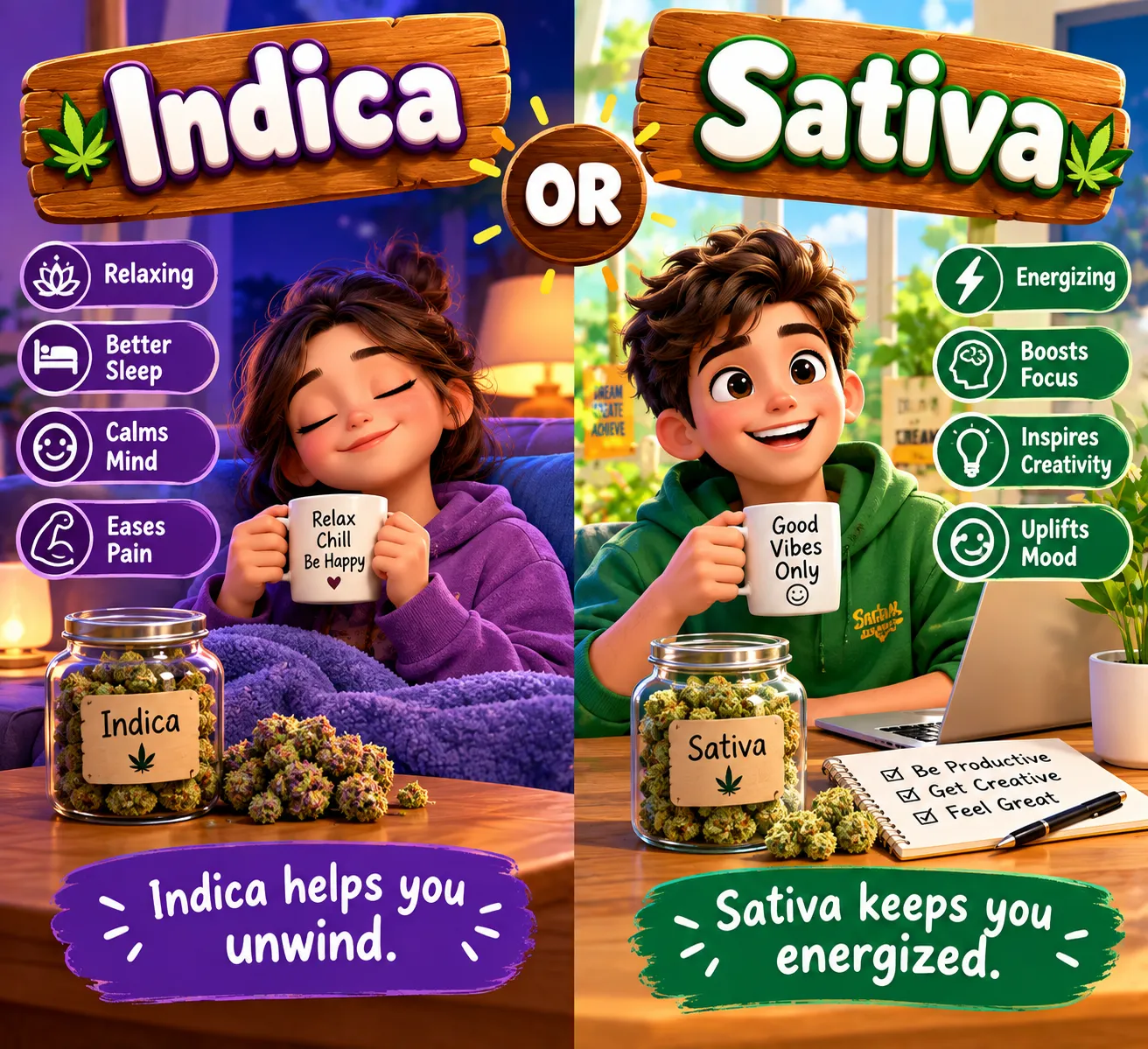
Indica and sativa are traditional cannabis labels linked to plant traits, but they do not reliably predict how a product will affect you. Cannabinoid and terpene profiles are more useful for understanding differences between cannabis products.
I first became interested in the indica or sativa question after noticing how often people used these labels as if they were simple effect categories. One person would say that indica means relaxing, while another would describe sativa as energizing. The more I looked into cannabis terminology, the more I realized that the popular explanation is much simpler than the science behind it.
The confusion makes sense. Cannabis products are often described with labels such as indica, sativa, and hybrid. These terms can sound like clear scientific categories. They may also appear on product menus, packaging, and strain descriptions.
But there is an important detail many basic guides leave out.
Modern cannabis research shows that indica and sativa labels do not neatly predict a plant’s genetics, chemical profile, or effects. Research on more than 100 cannabis samples found that samples labeled “sativa” and “indica” were genetically indistinct at a genome-wide level.
So, if you want to understand the difference, you need to look beyond the label. Let’s break it down in simple terms.
Indica or Sativa Quick Answer
Indica and sativa are traditional terms used to describe different cannabis types and traits.
Historically, the labels were associated with differences in plant appearance and geographic origins. Indica-type plants were commonly described as shorter, broader-leaved, and earlier flowering. Sativa-type plants were traditionally described as taller, more slender, and later flowering.
Today, however, the terms are often used as shorthand for expected effects:
- Indica → often marketed as relaxing or calming
- Sativa → often marketed as uplifting or stimulating
- Hybrid → generally presented as a combination of the two
Those descriptions can be useful as consumer language, but they should not be treated as precise scientific rules. Extensive hybridization has blurred the traditional categories.
The Origin and Background of Indica and Sativa
The history of indica vs. sativa is more complicated than the simple labels suggest.
Cannabis classification has changed over time. Scientists and botanists have debated whether different cannabis forms should be treated as separate species, subspecies, varieties, or types.
A major review of cannabis systematics explains that the words sativa and indica have developed both scientific and popular meanings. In everyday cannabis culture, the terms became associated with physical traits such as leaf shape, plant size, and flowering time.
Traditional descriptions often looked something like this:
Indica-type plants:
- Shorter growth
- Broader leaflets
- More compact structure
- Earlier maturation
Sativa-type plants:
- Taller growth
- Narrower leaflets
- More open structure
- Later maturation
However, modern cultivation has changed the picture.
Cannabis has been extensively bred and hybridized. As a result, many modern cultivars contain genetic backgrounds associated with both traditional categories. One scientific review notes that commercially available cannabis is often hybridized and that the traditional distinction has become difficult to use as a precise classification system.
That is why the old indica = relaxing / sativa = energetic formula should be treated cautiously.
Indica vs. Sativa: Key Differences
The easiest way to understand the terms is to separate traditional plant traits from modern effect labels.
| Term | Traditional Description | Common Consumer Meaning | Scientific Limitation |
| Indica | Shorter, broader-leaved, compact plants | Relaxing or calming | Does not reliably predict effects |
| Sativa | Taller, narrower-leaved plants | Energizing or uplifting | Does not reliably predict effects |
| Hybrid | Crosses between cannabis types | A blend of expected effects | Modern hybrids make simple categories difficult |
| Chemovar | Classification based more on chemical profile | Helps describe cannabinoid and terpene composition | More useful for chemical comparison |
Indica
The word indica is commonly used for cannabis products marketed as more relaxing or physically calming.
That description is widespread in popular cannabis culture. However, scientific literature does not support using the label alone as a reliable prediction of subjective effects.
The traditional term is more closely connected to plant morphology and historical classification than to a guaranteed experience.
Sativa
Sativa is commonly associated with cannabis described as uplifting, stimulating, or mentally active.
Again, this is mainly a modern consumer shorthand. It should not be treated as a fixed pharmacological rule.
A cannabis product labeled sativa can have a chemical profile that overlaps considerably with products labeled indica.
Hybrid
Hybrid generally means a cannabis cultivar produced through breeding different genetic backgrounds.
Modern cannabis is full of hybrids. This makes the old two-box system even harder to apply.
Instead of asking only, “Is this indica or sativa?” a more useful question is:
What is actually in the product?
That means checking its THC, CBD, other cannabinoids, and terpene profile when reliable information is available.
Why Indica Does Not Always Mean Relaxing
This is one of the biggest misconceptions surrounding the topic.
People often learn a simple rule:
Indica = body effects
Sativa = mental effects
It sounds easy. But cannabis chemistry is far more complex.
A 2021 study published in Nature Plants analyzed more than 100 cannabis samples. Researchers found that samples carrying sativa and indica labels were genetically indistinct on a genome-wide scale. The researchers also examined cannabinoid and terpene information.
Another review explains that cannabis contains many different chemical compounds, including cannabinoids, terpenes, flavonoids, and alkaloids. More than 500 constituents have been reported in cannabis.
That chemical diversity matters.
Two products with different indica or sativa labels can have overlapping chemical profiles. Likewise, two products carrying the same label can differ substantially.
So the label alone cannot tell you exactly how a product will affect you.
Which Approach Should You Use?
If you are simply learning cannabis terminology, the traditional distinction is useful.
If you are trying to understand a specific product, however, look beyond the label.
For beginners
Treat indica and sativa as broad consumer categories rather than exact predictions.
For people comparing products
Look for:
- THC concentration
- CBD concentration
- Other listed cannabinoids
- Terpene profile
- Laboratory testing information
- Product formulation and dose
For scientific or medical discussions
Use more precise terms such as cannabinoid profile, terpene profile, chemovar, or specific chemical constituents when the information is available.
Researchers have argued that cannabis may be better described through its chemical fingerprint rather than relying only on the traditional indica-sativa distinction.
Common Mistakes About Indica or Sativa
1. Assuming indica always causes relaxation
Mistake: “Every indica product will make you sleepy.”
Better understanding: Indica is a traditional classification and a common marketing label. It does not guarantee a particular effect.
2. Assuming sativa always gives energy
Mistake: “Sativa always makes people energetic.”
Better understanding: Individual responses can vary, and the chemical composition of products also varies.
3. Treating the labels as exact species
Mistake: “Indica and sativa are always two completely separate types.”
Better understanding: Cannabis taxonomy is more complicated, and scientists have debated the best way to classify cannabis. Modern hybridization further blurs the categories.
4. Ignoring cannabinoids
Mistake: Choosing a product based only on the word indica or sativa.
Better understanding: Cannabinoid content is one of the key pieces of information used to characterize cannabis chemistry.
5. Ignoring terpenes
Terpenes contribute to the aroma and flavor of cannabis and are part of its chemical profile. Research has explored their role in distinguishing different cannabis varieties.
Indica or Sativa in Real-World Examples
Product description
The product is labeled as an indica-dominant hybrid and lists its cannabinoid and terpene profile on the package.
This example shows how the traditional label can appear alongside more specific chemical information.
News article
Researchers continue to question whether indica and sativa labels accurately describe the chemistry of modern cannabis.
Here, the terms refer to the classification debate rather than a guaranteed effect.
Social media post
I was surprised to learn how much modern cannabis has been hybridized.
This uses the topic in a casual discussion without making a medical claim.
Formal report
The analysis compared cannabinoid and terpene profiles rather than relying solely on indica and sativa labels.
This is a more scientific way to describe the comparison.
Indica or Sativa Data, Trends & Usage
There is strong public interest in indica vs. sativa, but exact current monthly search-volume figures require access to a live SEO platform such as Ahrefs, Semrush, or Google Ads Keyword Planner. The scientific sources reviewed here do not provide reliable monthly Google search-volume figures, so it would be misleading to invent them.
The research itself provides more useful evidence.
A 2021 study examined more than 100 cannabis samples and found that sativa and indica labeled samples were genetically indistinct at the genome-wide level.
Research also shows how chemically complex cannabis is. One major review reported more than 500 compounds, including cannabinoids, terpenes, flavonoids, and alkaloids.
A newer analysis of commercial cannabis reported a database containing more than 6,000 chemical constituents, illustrating just how complex cannabis chemistry can be.
These findings explain why the simple question “indica or sativa?” may not provide enough information.
The search intent behind this topic is mainly informational. People typically want to know:
- What indica means
- What sativa means
- How they differ
- Whether one is more relaxing
- Whether one is more energizing
- What hybrid means
- Why different cannabis products feel different
For a more evidence-based comparison, the chemical profile is often more informative than the category name alone.
What Matters More Than the Label?
If you want to understand why cannabis products differ, several factors deserve attention.
Cannabinoids
Cannabinoids are chemical compounds found in cannabis.
Important examples include:
- THC
- CBD
- CBG
- CBC
- CBN
THC is the main psychoactive cannabinoid discussed in cannabis research, while CBD is another widely studied cannabinoid.
Terpenes
Terpenes are compounds that contribute to the smell and flavor of cannabis.
Examples include myrcene, limonene, pinene, linalool, and beta-caryophyllene. Cannabis research has identified many different terpenes and examined their distribution across varieties.
Genetics
Genetics can help explain differences between plants, but commercial labels do not always provide enough information to establish a precise genetic identity.
This is another reason not to treat the words indica and sativa as complete scientific descriptions.
Product composition
Two products can share the same broad label but have different cannabinoid and terpene concentrations.
That chemical difference may be more meaningful than the label itself.
Indica vs. Sativa: Standalone Comparison Table
| Term/Variant | Meaning | Region/Context | Best Used When |
| Indica | Traditional cannabis classification and modern consumer label | Common in cannabis retail and popular culture | Discussing traditional categories |
| Sativa | Traditional cannabis classification and modern consumer label | Common in cannabis retail and popular culture | Discussing traditional categories |
| Hybrid | Cannabis produced through crossing different genetic backgrounds | Common in modern cultivation and retail | Describing mixed ancestry |
| Chemovar | A classification focused on chemical characteristics | Scientific and analytical contexts | Comparing cannabinoid and terpene profiles |
| Cannabinoid profile | The mix and concentration of cannabinoids | Scientific, medical, and laboratory contexts | Comparing product chemistry |
| Terpene profile | The mixture of terpene compounds | Scientific and product-analysis contexts | Comparing aroma and chemical composition |
This distinction is useful because chemovar and chemical profiles can provide information that a simple indica or sativa label cannot.
Frequently Asked Questions
Q: What is the main difference between indica and sativa?
A: Traditionally, the terms describe different cannabis types based partly on physical traits and historical classification. Today, they are also used as consumer labels for products associated with different expected effects, but those effect categories are not scientifically reliable on their own.
Q: Does indica always make you sleepy?
A: No. The word indica alone cannot guarantee a particular effect. Product chemistry, including cannabinoids and terpenes, is more complicated than the traditional label suggests.
Q: Does sativa always make you energetic?
A: No. Sativa is often marketed with stimulating or uplifting descriptions, but the label does not provide a reliable prediction of individual effects.
Q: Are indica and sativa different species?
A: Cannabis taxonomy is debated. Some scientific frameworks distinguish Cannabis sativa and Cannabis indica, while other researchers treat cannabis as one highly variable species.
Q: What is a hybrid?
A: A hybrid generally refers to cannabis produced by crossing different genetic backgrounds. Because extensive breeding has occurred, many modern cannabis varieties have mixed ancestry.
Q: What should I look at instead of indica or sativa?
A: When reliable information is available, examine the product’s cannabinoid and terpene profile. These details provide more specific information about its chemical composition than the broad label alone.
Q: Why are indica and sativa labels still used?
A: They remain familiar terms in cannabis culture and commerce. They are easy for consumers to understand, even though modern scientific research shows that they do not fully describe cannabis genetics or chemistry.
Conclusion
The indica or sativa debate is not as simple as the labels make it seem.
Indica and sativa have a long history in cannabis classification. Traditional descriptions linked them with differences in plant shape, leaf structure, growth, and flowering. Over time, popular cannabis culture also began using the terms to suggest different effects.
That is where things become confusing.
Modern cannabis is heavily hybridized, and scientific research shows that the traditional labels do not reliably predict genetics or chemical composition. A study of more than 100 samples found that cannabis labeled indica and sativa was genetically indistinct at the genome-wide level.
So, if you are comparing cannabis products, do not rely on the label alone. Look at the cannabinoid profile, terpene profile, laboratory information, and other available product details.
The simplest takeaway is this: indica and sativa are useful traditional labels, but they are not complete scientific descriptions of a cannabis product.
Use the terms when discussing cannabis culture or traditional classifications, but look deeper when accurate chemical information matters. Bookmark this guide so you can explain the difference between indica and sativa with confidence.
Read More:
Truely or Truly: The Easy Spelling Guide

I specialize in English grammar, spelling, word choice, and language usage. My content is based on research from grammar references, style guides, dictionaries, and real-world usage to ensure it is accurate and practical.
At Spelling Comparison, I write guides that explain why words are confused, how they are used, and which form is correct in context. I also include proofreading tips, examples, and writing advice readers can apply immediately.
My goal is to publish clear, reliable content that helps readers make better writing decisions. Each guide is written for accuracy, clarity, and usefulness in school, work, business, and everyday communication.










