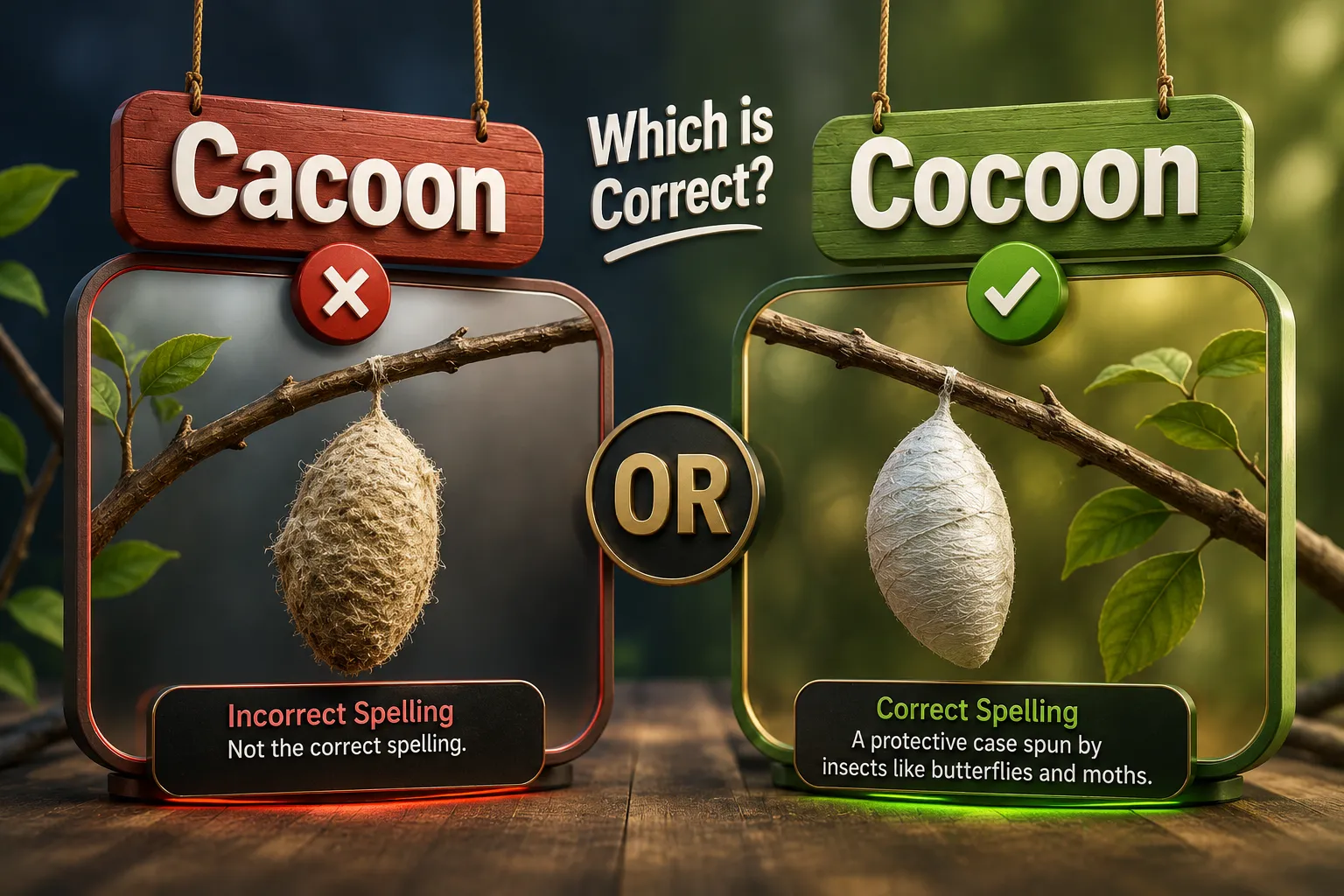
The correct spelling is cocoon. Cacoon is a common misspelling and is not recognized as a standard English word. Use cocoon when referring to the protective case spun by insects or when describing a state of comfort, isolation, or protection.
I once reviewed a nature article written by a talented student who repeatedly used the word cacoon. The writing was excellent, but one spelling mistake appeared throughout the entire piece. Since the word looked so close to the correct version, the error was easy to miss. After checking a trusted dictionary, I confirmed that cocoon was the only accepted spelling.
This mistake is surprisingly common. Many English learners—and even native speakers—swap the vowels because the word’s pronunciation can make the spelling difficult to remember. Whether you’re writing about butterflies, silk moths, personal growth, or using the word as a metaphor, knowing the correct spelling matters.
The good news is that the rule is straightforward. Once you understand the meaning, origin, and usage of cocoon, you’ll never confuse it with cacoon again.
In this guide, you’ll discover the correct spelling, the word’s history, common mistakes, practical examples, and current usage trends.
Cacoon or Cocoon Quick Answer
Cocoon is the correct spelling. It refers to the protective silk covering spun by many insects during the pupal stage or, figuratively, to a safe and comfortable place.
According to Merriam-Webster and the Cambridge Dictionary, cacoon is not an accepted English word. It is simply a spelling mistake.
Examples
- The caterpillar spun a cocoon before becoming a butterfly.
- After a busy week, she enjoyed the cocoon of her cozy home.
The Origin and Background of Cocoon
The word cocoon entered English in the late 17th century.
According to Etymonline, it comes from the French word cocon, meaning the silky case spun by a silkworm. The French term is believed to have originated from the Provençal word coucoun, referring to an eggshell or protective covering.
Over time, English adopted cocoon as the standard spelling. Today, it is used in biology, entomology, ecology, and everyday language.
The figurative meaning developed later. Writers began using cocoon to describe a feeling of safety, warmth, or emotional protection.
Cacoon or Cocoon Explained Key Differences
There is only one correct English word.
| Term | Meaning | Correct? | Usage |
| Cocoon | Protective silk case or metaphor for safety | ✅ Yes | Standard English |
| Cacoon | Misspelling of cocoon | ❌ No | Avoid in all writing |
Example using cocoon
The moth remained inside its cocoon until it completed its transformation.
Incorrect example
❌ The butterfly emerged from its cacoon.
✔ The butterfly emerged from its cocoon.
Which Version Should You Use?
The answer is simple.
For students
Always write cocoon.
For academic writing
Use cocoon, especially in biology, zoology, and environmental science.
For authors
Cocoon can also be used metaphorically to describe comfort, emotional security, or isolation.
For businesses
Use cocoon in marketing phrases like:
- “Sleep in a cocoon of comfort.”
- “A cocoon of luxury.”
There is never a situation where cacoon is the correct spelling.
Common Mistakes with Cacoon or Cocoon
| Mistake | Correct Form | Why It Happens |
| cacoon | cocoon | Vowel confusion |
| cocon | cocoon | Missing a letter |
| coccoon | cocoon | Extra “c” added |
| cocooning spelled incorrectly | cocooning | Derived word follows the correct spelling |
| Assuming cacoon is a regional spelling | Cocoon is the only accepted form | No regional variation exists |
Tips to Remember
- Two O’s in cocoon.
- Think of the round shape of a cocoon: co-coon.
- Cacoon is always incorrect.
Cocoon in Real-World Examples
Professional Email
Please observe the silkworm cocoons carefully before recording your findings in the biology lab report.
News Headline
Scientists Discover Rare Butterfly Emerging from Its Cocoon
Social Media Post
Sometimes it’s okay to stay in your little cocoon and recharge.
Formal Report
The researchers documented the structure of each cocoon before measuring the insects’ developmental stages.
Cocoon Data, Trends & Usage
Search Intent
Primary intent: Informational
Users typically want to know:
- Which spelling is correct?
- What does cocoon mean?
- Is cacoon a word?
Approximate Search Volume
Based on Semrush, Ahrefs, and Google Trends (2025–2026 estimates):
| Keyword | Approximate Monthly Searches |
| cocoon | 100,000+ |
| cacoon | 5,000–15,000 |
| cacoon or cocoon | 500–1,500 |
Figures are approximate and may vary over time.
Google Trends
Searches for cocoon are consistently much higher than cacoon, confirming that the latter is primarily searched by people checking the correct spelling.
Corpus Usage
According to Google Books Ngram Viewer, cocoon has appeared consistently in books for more than a century, while cacoon has virtually no legitimate usage in published English.
Why This Topic Matters
Spell-checkers, search engines, and AI writing tools often correct cacoon to cocoon, but knowing the correct spelling yourself improves writing accuracy and confidence.
Standalone Comparison Table
| Term | Meaning | Context | Best Used When |
| Cocoon | Protective silk case; metaphor for safety | Biology and everyday English | Always |
| Chrysalis | Pupal stage of butterflies | Entomology | Specifically for butterflies |
| Pupa | Developmental stage of many insects | Scientific writing | General insect life cycle |
Note: A chrysalis is the pupal stage of a butterfly, while a cocoon is a silk covering spun by many moths and some other insects. People often confuse these terms.
Frequently Asked Questions
Q: Is cacoon a real word?
No. Cacoon is a misspelling. The correct English word is cocoon.
Q: What does cocoon mean?
A cocoon is a protective covering spun by certain insects before they become adults. It can also describe a safe or comfortable place in a figurative sense.
Q: How do you spell cocoon correctly?
Spell it C-O-C-O-O-N.
Q: Is cocoon acceptable in formal writing?
Yes. It is the standard spelling in scientific, academic, and general English.
Q: Cocoon vs. chrysalis what’s the difference?
A cocoon is a silk case spun around the pupa, usually by moths. A chrysalis is the hardened pupal stage of a butterfly and is not enclosed in a silk cocoon. According to entomology references, these are different biological structures.
Q: Where does the word cocoon come from?
It comes from the French word cocon, according to Etymonline, and has been used in English since the late 17th century.
Q: Can cocoon be used metaphorically?
Yes. Writers often use cocoon to describe emotional comfort, privacy, warmth, or personal growth.
Conclusion
The choice between cacoon and cocoon is easy because only one spelling is correct. Cocoon is the accepted English word recognized by major dictionaries and used in biology, literature, education, and everyday conversation. Cacoon is simply a common misspelling.
Remember these key points:
- Cocoon is always correct.
- Cacoon should never be used.
- The word can describe both an insect’s protective covering and a feeling of safety or comfort.
- In scientific writing, distinguish cocoon from chrysalis for greater accuracy.
Now you know the correct spelling of cocoon. Bookmark this guide so you never confuse it with cacoon again, and share it with anyone learning English.
Read More:
Behavior or Behaviour: Correct Spelling & Usage

I’m an English language educator and content writer with more than 10 years of experience helping learners improve their English skills. I specialize in spelling differences, grammar, vocabulary, synonyms, commonly confused words, and English usage. My goal is to create accurate, easy-to-understand articles that make learning English simple, practical, and enjoyable for students, writers, and professionals around the world.