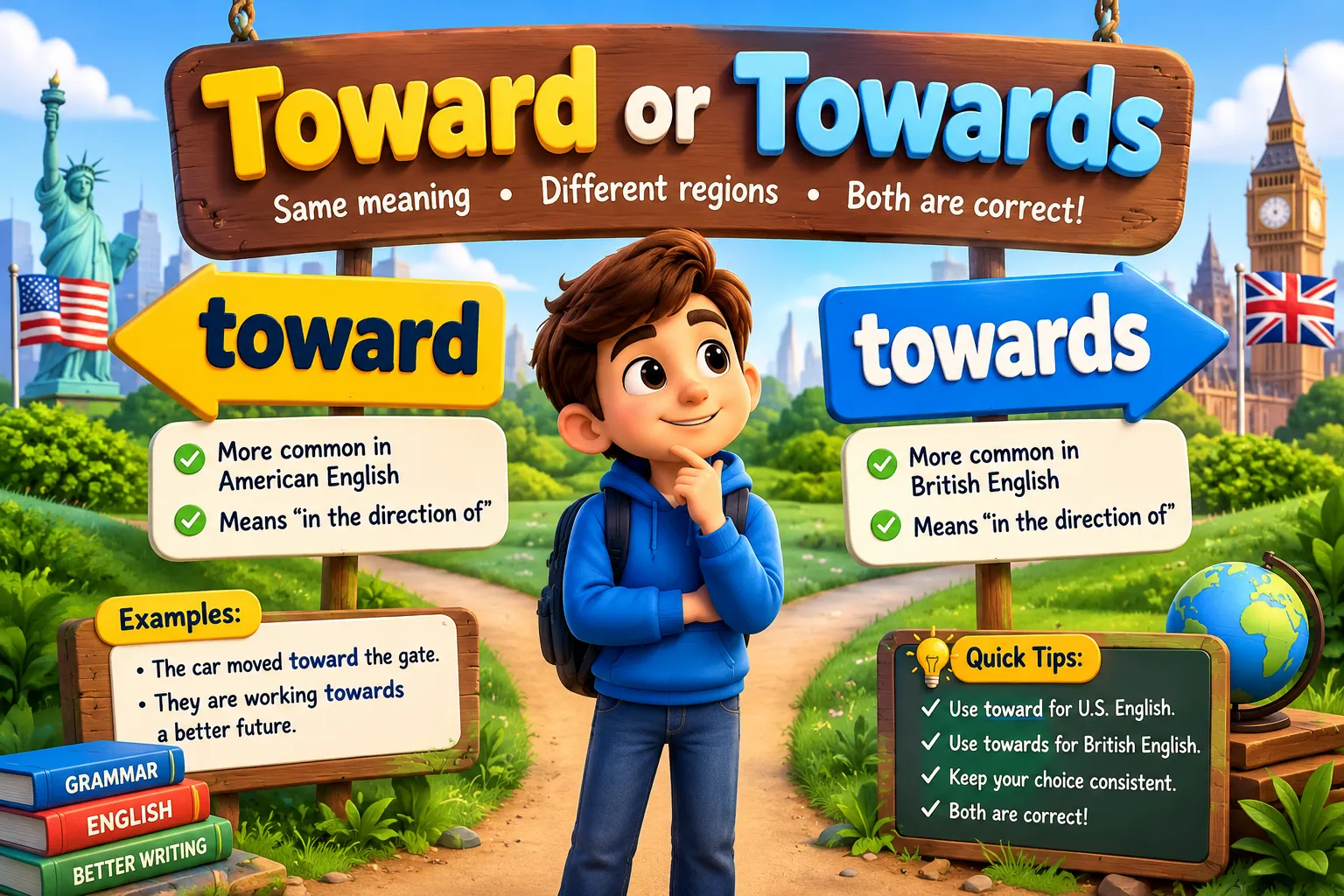
Toward and towards have the same meaning: they show movement, direction, or an attitude in relation to something. Toward is more common in American English, while towards is more common in British English.
If you have ever paused while writing “She walked toward the door” and wondered whether “towards” would be better, you are not alone. This is one of those English questions that can make even confident writers stop and check.
I have seen this issue often when helping learners polish everyday writing. The good news is that there is no major difference in meaning between toward and towards. Both can describe movement in a direction, a relationship, or an attitude.
The real question is usually about style and regional English.
American writers often prefer toward. British writers often use towards. Both forms are standard English, and neither is simply a spelling mistake.
That small difference matters when you are writing for school, work, a website, or an international audience. Choosing one form and using it consistently can make your writing look more polished.
So, should you write toward or towards? Let us make the answer simple.
Toward or Towards Quick Answer
Toward and towards are both correct. They work as a preposition and can express movement, direction, or a figurative relationship.
For example:
- “The child ran toward the playground.”
- “The team is working towards a better result.”
The choice often depends on regional English and personal style. Toward is especially common in American English, while towards is widely used in British English.
According to Cambridge Dictionary, both forms can be used to describe movement or direction. Merriam-Webster also recognizes toward as the standard form, with towards used as a variant.
The Origin and Background of Toward
The story behind toward is older than modern American and British English.
According to Etymonline, toward developed from older English forms meaning roughly “in the direction of” or “to.” The word is linked to the older form to combined with a suffix related to direction.
Over time, English speakers developed both toward and towards.
This is a useful example of how English changes naturally. A small ending can vary without changing the core meaning.
The same pattern appears in other English words. You may also notice differences such as:
- among / amongst
- while / whilst
- amid / amidst
- backward / backwards
- forward / forwards
These pairs can look like different words, but they often share the same basic function.
From a linguistics point of view, toward is not a homophone of towards. They simply represent two accepted forms of the same directional word.
Toward vs. Towards: Key Differences
The biggest difference is regional preference, not meaning.
| Term | Meaning | When to Use | Region/Context |
| toward | In the direction of; in relation to | Direction, time, attitude, or relationship | Very common in American English |
| towards | Same basic meaning as toward | Direction, time, attitude, or relationship | Very common in British English |
| forward | Toward the front or ahead | Movement or progress | Common across English varieties |
1. Movement
Both forms can describe physical movement.
- “The dog moved toward the gate.”
- “The cyclist turned towards the bridge.”
There is no major difference in meaning.
2. Attitude or relationship
Toward and towards can also describe how someone feels or behaves.
- “She has a positive attitude toward learning.”
- “His feelings towards the project changed.”
Here, the word does not describe physical movement. It shows a relationship or attitude.
3. Time
You can also use these words when talking about a point in time.
- “The weather became colder toward evening.”
- “Sales increased towards the end of the year.”
Again, both versions work.
Which Version Should You Use?
Your choice should depend mainly on your audience.
For American English
Choose toward if you are writing for a mainly American audience.
It is common in:
- American school writing
- U.S. business communication
- American news writing
- Academic writing in the United States
For British English
Choose towards if your audience mainly uses British English.
It is common in:
- UK school writing
- British publications
- UK business communication
- Many Commonwealth varieties of English
For global or neutral writing
Toward is a safe choice for international writing because it is short, clear, and widely understood.
However, consistency matters more than choosing one form over the other. If your document uses towards throughout, there is usually no reason to replace every instance with toward.
Common Mistakes with Toward or Towards
Mistake 1: Thinking “towards” is wrong
Wrong idea:
“Towards is incorrect English.”
Better:
“Towards is a standard English variant.”
The form is especially common in British English.
Mistake 2: Treating them as different in meaning
Incorrect assumption:
“Toward means movement, but towards means attitude.”
Correct:
Both can express movement, direction, attitude, and other relationships.
Mistake 3: Mixing regional styles without a reason
You might write toward in one paragraph and towards in the next.
This is not normally a grammar error. Still, consistent style can make your writing look cleaner.
Mistake 4: Using “toward” only for physical movement
The word has broader uses.
For example, you can say:
“The company is moving toward a new business model.”
No physical movement is involved. The word shows progress or direction.
Mistake 5: Assuming one form is always more formal
Neither word is automatically more formal.
The better choice depends on your variety of English, audience, and style guide.
Toward or Towards in Real World Examples
Seeing the words in different settings makes the difference easier to understand.
Professional email
“We are moving toward a final decision and will update everyone soon.”
News writing
“The market moved towards recovery after several difficult months.”
Social media post
“Taking one small step toward my goal every day.”
Formal report
“The findings point towards a need for further research.”
Notice something important: each sentence works naturally with the other form too.
That is why meaning alone cannot tell you which version to choose.
Toward or Towards Data, Trends & Usage
There is an important limitation with exact search-volume claims: public search tools do not provide one universal, permanent monthly number for every keyword. Results also change by country, device, language, and date.
For that reason, it would be misleading to invent a current Ahrefs, Semrush, or Google search-volume figure for “toward or towards.”
What usage data tells us
Corpus and dictionary evidence show that both forms are established in English.
American English tends to favor toward, while British English has a strong preference for towards. This regional split is more useful to writers than a raw global search-volume number.
Google Trends can also be used to compare regional search interest, but its index represents relative interest, not an exact number of searches.
Search intent
The query “toward or towards” is mainly informational.
People searching it usually want to know:
- Which form is correct?
- Is towards grammatically correct?
- Is toward American English?
- Which version should I use?
- Is there a difference in meaning?
This matters for students, ESL learners, editors, bloggers, and anyone writing for an international audience.
Toward vs. Towards: Standalone Comparison Table
| Term/Variant | Meaning | Region/Context | Best Used When |
| toward | In the direction of or in relation to | Strong American English preference | Writing for U.S. readers |
| towards | Same core meaning | Strong British English preference | Writing for UK readers |
| forward | Toward the front or ahead | Broad international use | Talking about physical or figurative progress |
| backward | Toward the back or past | Common in American English | Describing reverse direction or movement |
| backwards | Same basic meaning as backward | Common in British English | British-style writing |
The extra examples show that -ward and -wards patterns appear in several English direction words.
Related Words You May Also Confuse
English has many small variations that can create the same doubt.
You may also want to check:
- among or amongst
- anyway or anyways
- forward or forwards
- backward or backwards
- while or whilst
- among or between
- toward or to
These pairs are not always identical in grammar or usage, so it is worth checking the context instead of assuming every pair works the same way.
FAQ: Toward or Towards
Q: What does “toward” mean?
A: Toward means in the direction of, but it can also describe an attitude, relationship, goal, or point in time. For example, someone can move toward a building or work toward a goal.
Q: Is “towards” grammatically correct?
A: Yes. Towards is a standard English form. It is especially common in British English, while American English often prefers toward.
Q: Is “toward” American English?
A: It is strongly associated with American English, although it is not limited to the United States. English speakers in other regions also use it.
Q: Is “towards” British English?
A: Yes. Towards is very common in British English. It is also used in other varieties of English influenced by British usage.
Q: Is there a difference between toward and towards?
A: Usually, no meaningful difference exists. Both can express direction, movement, attitude, or relation. The main distinction is regional and stylistic preference.
Q: Which is better in formal writing, toward or towards?
A: Either can be formal and correct. Follow the English variety and style guide used by your school, workplace, publisher, or client.
Q: Can I use “toward” when talking about a goal?
A: Yes. English commonly uses toward for progress or movement toward an objective. The movement can be literal or figurative.
Final Verdict: Toward or Towards?
So, which one should you choose?
Both are correct.
The real difference is mostly about English variety and style.
Remember these three simple points:
- Toward is especially common in American English.
- Towards is especially common in British English.
- Both can describe direction, movement, attitude, progress, and time.
If you write for a U.S. audience, toward is often the natural choice. If your readers use British English, towards may sound more familiar.
Most importantly, do not treat towards as a spelling mistake. It is a legitimate form with a long history in English.
Once you understand the regional difference, this word pair becomes much easier. You no longer need to stop every time you write about moving toward a goal or working towards a result.
Bookmark this guide so you never second-guess “toward or towards” again.
Readmore

I’m an English language educator and SEO content writer having experience creating clear, accurate, and engaging English learning content. I specialize in spelling differences, grammar, vocabulary, synonyms, commonly confused words, and English usage. My goal is to publish well-researched, easy-to-understand articles that help students, writers, educators, and professionals improve their English with confidence through practical explanations and real-world examples.










