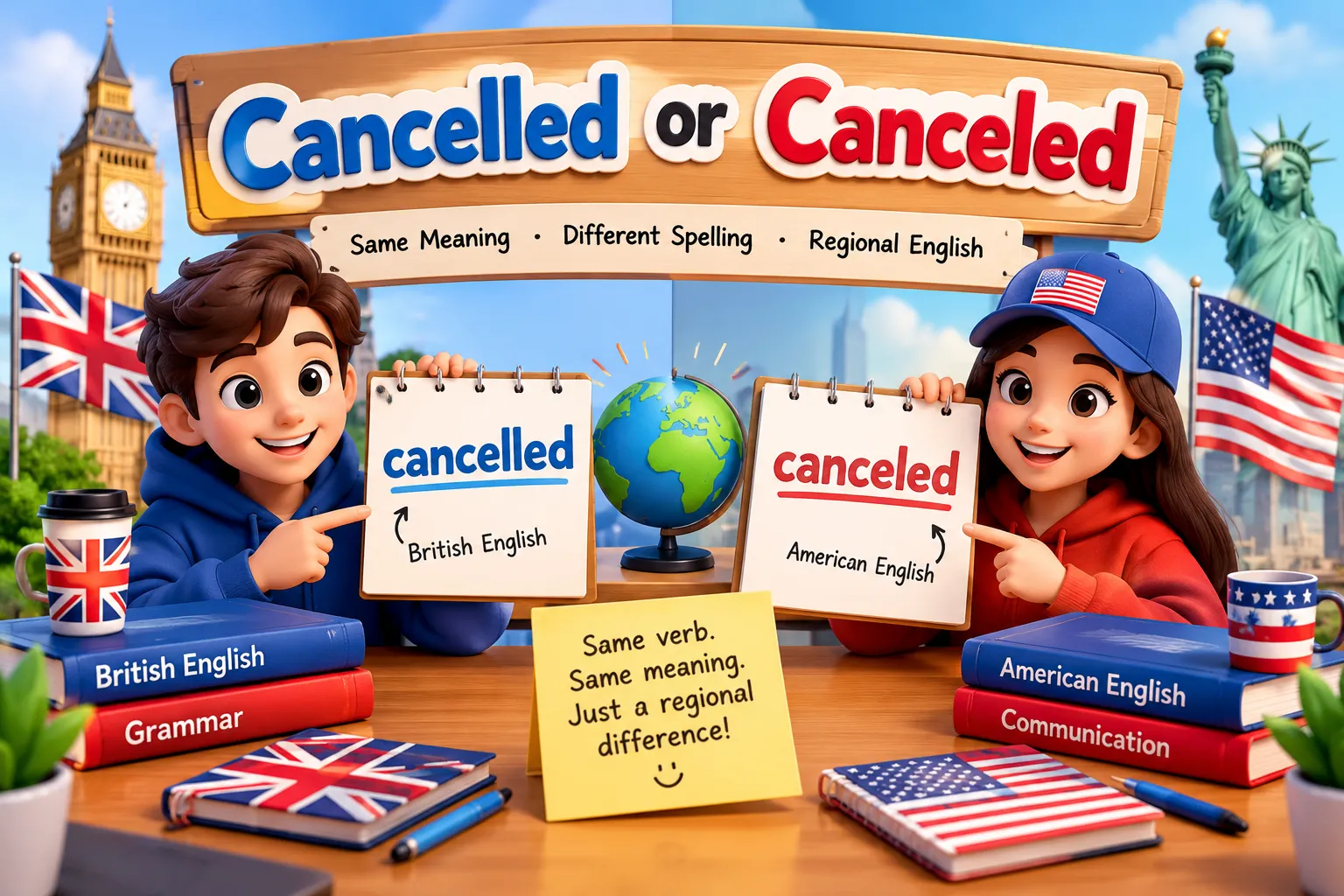
Cancelled and canceled have the same meaning; cancelled is standard in British English, while canceled is standard in American English.
Have you ever typed cancelled, then stared at the screen and wondered if that extra l was a mistake? I have seen this small spelling question cause surprising confusion, especially when editing work written for an international audience.
The problem is easy to understand. English has two major spelling traditions, and this is one of the places where they differ. A British website may say an event was cancelled, while an American website may say it was canceled. Both readers understand the sentence perfectly.
So, is one spelling wrong? No.
The difference is mainly about regional English, not meaning. Oxford lists cancelled as the standard British form and canceled as the American form. Cambridge also shows the same regional pattern.
In this guide, you will learn when to use each spelling, where the difference came from, how the forms work in grammar, and how to choose the right version for school, work, websites, and formal writing.
Cancelled or Canceled Quick Answer
Cancelled and canceled are both past-tense and past-participle forms of the verb cancel.
The main difference is regional:
- Cancelled → British English
- Canceled → American English
For example:
- British English: The flight was cancelled because of heavy rain.
- American English: The flight was canceled because of heavy rain.
The meaning does not change. In both sentences, the flight will not take place.
Oxford’s dictionary gives cancelled as the British form and canceled as the US form. It also lists cancelling and canceling as the corresponding -ing forms So, when you see either spelling, do not assume one is a spelling mistake.
The Origin and Background of Cancelled
The story begins with the base verb cancel.
According to Etymonline, cancel entered English in the late 14th century. It came through Anglo-French and Old French from Latin cancellare, meaning roughly to make like a lattice. The Latin word was connected with crossed bars or a grid.That old idea of crossing something out helps explain the modern meaning.
When you cancel something, you effectively remove it from the plan or make it no longer valid.
By the middle of the 15th century, cancel had developed the figurative sense of making an obligation or similar thing ineffective.Over time, English developed different spelling conventions in different regions. American English often keeps a single l when adding endings to words such as cancel. British English generally doubles the l.
This creates pairs such as:
- canceled / cancelled
- canceling / cancelling
- traveled / travelled
- labeled / labelled
- modeled / modelled
This is an issue of orthography, or the way words are spelled. It is not a difference in pronunciation or basic meaning.
Cancelled vs. Canceled Key Differences
Here is the simplest way to remember the difference:
| Term | Meaning | When to Use | Region/Context |
| cancelled | Past form of cancel | British-style writing | UK and many Commonwealth varieties |
| canceled | Past form of cancel | American-style writing | United States |
| cancelling | Present participle/gerund | British-style writing | UK and related varieties |
| canceling | Present participle/gerund | American-style writing | United States |
Cambridge identifies -ll- as the British pattern and -l- as the usual US pattern What does each form mean?
Both forms can describe something that was stopped, withdrawn, or called off.
Cancelled:
The company cancelled the morning meeting.
Canceled:
The company canceled the morning meeting.
The grammar is the same. Only the spelling convention changes.
What about “cancel”?
The base verb stays the same in both varieties:
Please cancel my reservation.
You do not write cancell as the base form.
Which Version Should You Use?
Your choice should depend on your audience and your chosen style of English.
For British English
Use cancelled.
This is the natural choice for writing aimed at readers in the UK and for many contexts that follow British spelling conventions.
Examples include:
- school assignments using British English
- UK business documents
- British publications
- many Commonwealth contexts
For American English
Use canceled.
This is the usual American spelling and is especially suitable for US-focused:
- business writing
- academic work
- websites
- newspapers
- professional emails
Oxford’s American dictionary gives canceled as the American past-tense and past-participle form. For a global audience
Pick one style and stay consistent.
Do not write:
The event was canceled, but the next meeting was cancelled.
If both words describe the same grammatical form, switching spelling styles can make your writing look inconsistent.
Instead, choose either:
The event was canceled, but the next meeting was also canceled.
or:
The event was cancelled, but the next meeting was also cancelled.
Consistency matters more than choosing one form as universally “correct.”
Common Mistakes with Cancelled or Canceled
1. Treating “canceled” as a spelling error
Mistake:
The concert was canceled. ❌
Correction:
The concert was canceled. ✅
This is correct American English. Oxford lists canceled as the US form.
2. Treating “cancelled” as wrong
Mistake:
The meeting was cancelled. ❌
Correction:
The meeting was cancelled. ✅
This is standard British English.
3. Mixing regional styles
Mistake:
The flight was canceled, but the hotel booking was cancelled.
Better:
The flight was canceled, but the hotel booking was canceled.
Or:
The flight was cancelled, but the hotel booking was cancelled.
4. Adding two Ls to the base verb
Mistake:
Please cancell the appointment.
Correct:
Please cancel the appointment.
The extra l appears when certain endings are added. It is not part of the base verb.
5. Confusing “cancelled” with “cancellation”
The noun is cancellation.
Do not write:
The cancelation caused problems.
In standard modern usage, cancellation with two ls is the safer choice. Cambridge lists cancellation as the noun form.
Cancelled or Canceled in Real World Examples
Professional email
We regret to inform you that the training session has been cancelled due to unexpected scheduling changes.
News headline
Local Festival Cancelled After Severe Weather Warning
Social media post
Tonight’s event has been canceled. We will share the new date soon.
Formal document
The agreement was cancelled following written notice from both parties.
The examples above deliberately use different contexts. The correct spelling depends on the English variety used by the publication or organization.
Cancelled or Canceled Data, Trends & Usage
There is no single worldwide spelling frequency that tells you which form is “correct.” Regional corpora show why.
A historical comparison reported from the Corpus of Contemporary American English (COCA) found 3,746 occurrences of canceled versus 640 of cancelled in the dataset cited in the discussion. In the British National Corpus, the same source reported 1,194 occurrences of cancelled versus just 1 of canceled. These figures come from an older corpus comparison, so they should not be treated as current search-volume measurements.
Google Books’ Ngram Viewer also shows the two spellings following different historical patterns in its American English corpus. The published-book data shows both forms across the period covered, with canceled becoming more prominent in later American English.
More recent corpus work also shows that the double-L form remains present in American writing, even though canceled is the usual US spelling.
What about search volume?
Exact monthly Google search volumes for “cancelled or canceled” are not publicly provided by Google in a stable, universal figure. SEO platforms can also show different estimates depending on country, database, and date.
That means it would be misleading to invent a precise monthly search number.
The search intent, however, is clear: people searching this phrase usually want to know which spelling fits their English variety.
Why does the topic still matter?
Modern writing crosses borders constantly.
You may write an email for a US client while studying in a country that follows British spelling. You may also use a grammar checker set to a different regional dictionary.
That makes spelling consistency especially useful for:
- ESL learners
- students
- bloggers
- editors
- remote workers
- international businesses
- website owners
Cancelled or Canceled: A Standalone Comparison
| Term/Variant | Meaning | Region/Context | Best Used When |
| cancelled | Past form of cancel | British English | Writing in British style |
| canceled | Past form of cancel | American English | Writing in American style |
| cancelling | -ing form of cancel | British English | Describing an action in progress |
| canceling | -ing form of cancel | American English | Describing an action in progress |
| cancellation | Noun for the act/result of canceling | Broad English use | Referring to the event or act itself |
This table shows an important point: the difference is part of a larger spelling pattern, not a special rule that applies only to cancel.
FAQs About Cancelled or Canceled
Q: What does cancelled mean?
A: Cancelled means that something planned will no longer happen, or that an arrangement has been stopped. It is the standard British spelling of the past form of cancel.
Q: How do you use cancelled correctly?
A: Use cancelled when writing in British English. For example, you could say that a scheduled appointment was cancelled because the person could not attend.
Q: Is canceled or cancelled correct?
A: Both are correct. American English normally uses canceled, while British English uses cancelled. The choice is based on regional spelling, not a change in meaning.
Q: Is cancelled acceptable in formal writing?
A: Yes. Cancelled is fully acceptable in formal British English. If your document follows American English, use canceled instead.
Q: Where does the word cancel come from?
A: Cancel entered English in the late 14th century through Anglo-French and Old French from Latin cancellare. Its early sense involved crossing out writing, while the modern sense of nullifying something developed later.
Q: Is “canceling” or “cancelling” correct?
A: Both forms are used. Canceling is the usual American spelling, while cancelling is the usual British spelling. Cambridge and Oxford both document this regional difference.
Q: Can I use cancelled in an American English document?
A: It may be understood, and it does appear in American writing, but canceled is the usual US form. For a consistent American style, choose canceled throughout the document.
Conclusion
The choice between cancelled and canceled is much simpler than it first appears.
Both words come from the same verb. Both have the same meaning. The main difference is regional spelling.
Use cancelled when you are following British English. Use canceled when you are following American English. The same pattern appears in cancelling/canceling, so keeping your spelling style consistent can help your writing look polished.
Remember one more useful point: cancellation normally keeps the double l regardless of which regional style you use.
You do not need to worry when you see the “other” spelling. It is not automatically an error. Check the variety of English you are using, choose the matching form, and stay consistent.
Now you know exactly why both spellings exist. Bookmark this guide so you never have to second-guess cancelled or canceled again.
Readmore

I am an English language specialist with over 10 years of experience writing about grammar, spelling differences, and language usage. Dedicated to helping writers communicate with confidence, my detailed guides break down complex rules into clear, real-world advice. At Spelling Comparison, my focus is on providing actionable proofreading tips and vocabulary deep-dives to ensure your writing is always accurate, clear, and impactful.










