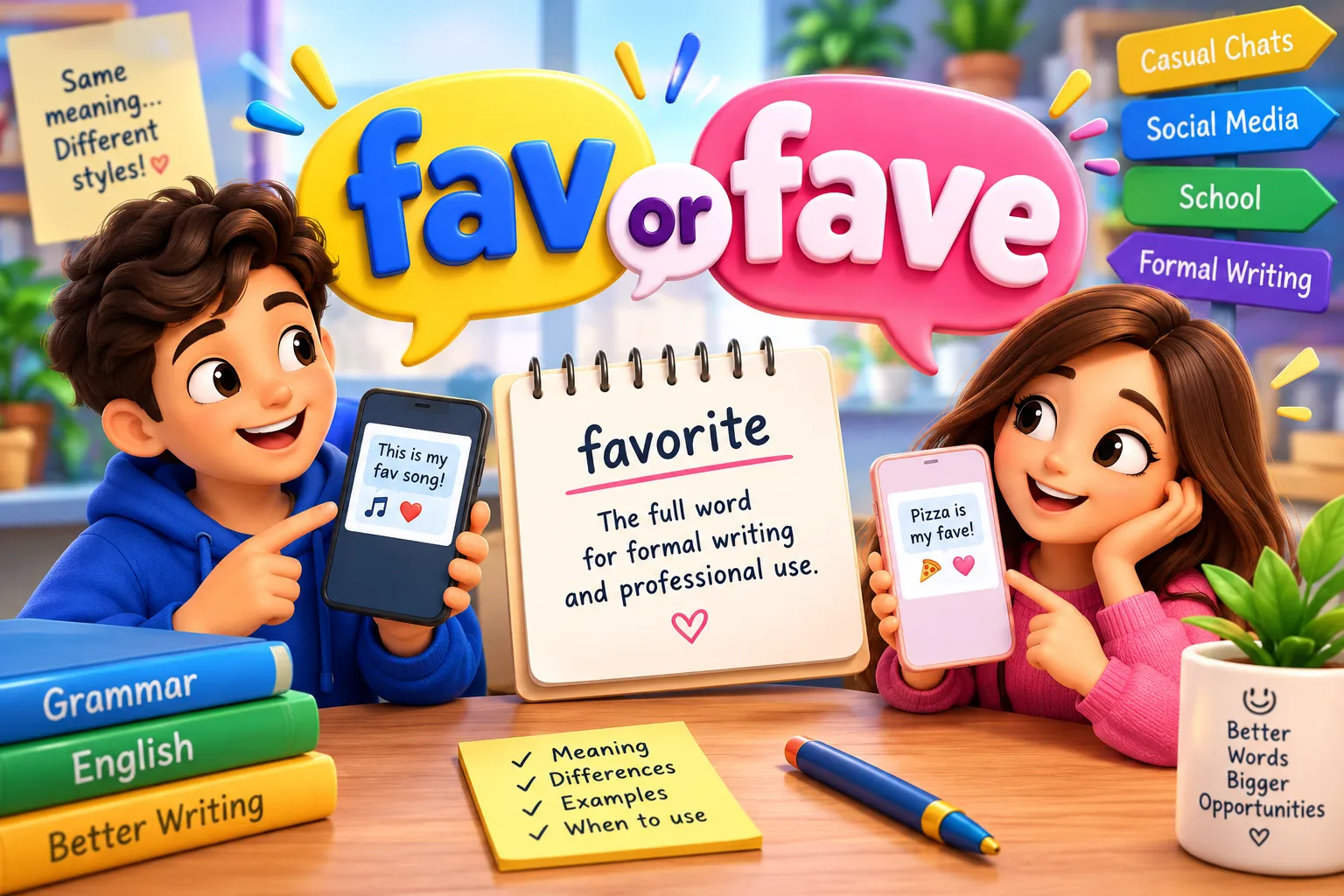
Fav and fave both mean a favorite person or thing, but fav is a shorter form, while fave is a common informal word used in everyday English.
Have you ever typed a quick message and stopped at “my fav”? Then you may have wondered, “Should I write fav or fave?” I have seen this small spelling choice confuse English learners because both forms appear often online.
The confusion makes sense. English loves shortening words, especially in texts, chats, and social media. Favorite can become fav or fave, and both can sound natural in casual speech and writing.
But they are not used in exactly the same way.
If you are writing to a friend, posting on Instagram, or leaving a quick comment, either form may work. Formal writing is different. There, favorite is usually the safer choice.
This guide explains the meaning, history, differences, grammar, common mistakes, and real-world use of fav and fave. You will also learn which form fits different situations.
Fav or Fave Quick Answer
Fav and fave are informal short forms of favorite.
- Fav is common in texting, chats, captions, and online posts.
- Fave is also informal and often feels more like a spoken nickname for favorite.
- Favorite is the standard form for formal or professional writing.
Simple examples
This is my fav song.
That restaurant is my fave.
Both sentences are understandable. The choice mainly depends on your style and context.
The Origin and Background of Fav and Fave
The full word favorite has a much longer history than either short form.
According to Merriam-Webster, favorite refers to a person or thing regarded with special liking or preference. The word can work as both a noun and an adjective.
The word came into English through French and ultimately traces back to Latin favor, meaning approval or goodwill. Etymonline also connects favorite with this history of favor and preference.
Fav and fave are much newer informal shortenings. They belong to a common process in linguistics called clipping. Clipping happens when a longer word is shortened while keeping its basic meaning.
English has many examples:
- ad → advertisement
- lab → laboratory
- info → information
- demo → demonstration
- fav → favorite
Fave uses a different-looking ending, but it serves the same basic purpose: it gives favorite a shorter, casual form.
These forms became especially useful as informal communication grew through texting, forums, social media, and online chat.
Fav vs Fave Explained Key Differences
The main difference is not meaning. Both forms point to something you like or prefer.
The difference is mainly style and form.
| Term | Meaning | When to Use | Region/Context |
| fav | Short form of favorite | Texts, chats, captions | Very informal |
| fave | Informal form of favorite | Casual speech and writing | Informal English |
| favorite | Person or thing preferred above others | Formal and informal writing | Standard English |
When to use fav
Fav is very common in quick digital communication.
For example:
Which movie is your fav this year?
It can also appear before a noun:
I wore my fav jacket today.
The form feels short, quick, and internet-friendly.
When to use fave
Fave can sound slightly more word-like than fav.
For example:
Pizza is still my fave food.
You may also see it used as a noun:
She is one of my faves.
Here, faves means favorite people or things.
When to use favorite
Use favorite when you want standard English.
For example:
Blue is my favorite color.
This works well in school assignments, reports, business writing, and formal documents.
Which Version Should You Use?
Your audience should guide your choice.
For friends and casual chats
Use fav or fave.
Both are easy to understand.
For social media
Either fav or fave can work.
Your choice depends on your personal style.
For students
Use favorite in essays and school assignments unless your teacher specifically asks for informal language.
For professional writing
Choose favorite.
A business email, report, résumé, or formal document usually benefits from standard vocabulary.
For global or neutral English
Favorite is the safest option.
There is another spelling point to remember. Favorite is the usual American spelling, while favourite is used in British English and many other varieties of English.
So you may see:
My favorite book.
or:
My favourite book.
Both are standard. Fav and fave do not replace these formal spellings.
Common Mistakes with Fav or Fave
Small words can create surprisingly common errors.
1. Using “fav” in formal writing
Mistake:
My fav subject is history.
Better:
My favorite subject is history.
Why? Fav is informal.
2. Thinking “fave” is the standard spelling
Mistake:
Fave is the formal version of favorite.
Correction:
Fave is an informal shortened form of favorite.
It is useful in casual language, but it is not the standard formal spelling.
3. Writing “favs” when the context needs the full word
Casual:
These are my summer favs.
Formal:
These are my favorite choices for summer.
The plural favs is fine in casual writing. It simply does not fit every setting.
4. Confusing “fav” with a new word
Mistake:
Fav has a completely different meaning from favorite.
Correction:
Fav normally carries the same basic meaning as favorite. It is simply a shortened informal form.
5. Using informal forms without considering your audience
A message to a close friend can be relaxed.
A job application should be more polished.
Always ask yourself:
“Who am I writing for?”
That one question can solve many word-choice problems.
Fav or Fave in Real World Examples
Different types of writing call for different choices.
Professional email
My favorite option is the second proposal because it meets the project requirements.
Here, favorite keeps the tone professional.
News-style writing
The author named the novel as one of her favorite books of the year.
A news article normally uses the standard form.
Social media post
Finally tried the new café, and the chocolate cake is my fave! 🍰
The informal form suits the platform.
Formal report
The survey showed that the blue design was the participants’ favorite choice.
The full word is appropriate for a formal report.
Casual text
Send me your fav playlist.
This is a natural setting for the shortened form.
Fav or Fave Data, Trends & Usage
There is a key problem with exact numbers for fav vs fave: public search tools do not always provide stable, freely accessible monthly search-volume figures.
Search volume can also change by country, language, device, and time. For that reason, exact figures from private SEO platforms such as Ahrefs or Semrush should not be presented as fixed facts without access to their current datasets.
What broader language data tells us
The full form favorite is the standard dictionary entry. Dictionaries such as Cambridge Dictionary, Merriam-Webster, and Collins Dictionary document favorite as standard English.
Short forms such as fav and fave belong mainly to informal communication.
Google Trends can be useful for comparing relative search interest over a selected period, but it does not provide absolute monthly search volume. Its numbers are normalized rather than raw search counts.
Search intent
People searching “fav or fave” are usually looking for informational help.
They may want to know:
- Which spelling is correct?
- Does fav mean favorite?
- Is fave a real word?
- Can I use fav in formal writing?
- Is favourite different from favorite?
The rise of texting, social media, and online communication makes these questions more common. Short forms now appear across many digital spaces.
Fav or Fave: A Second Comparison
The following table adds context by including the full British spelling.
| Term/Variant | Meaning | Region/Context | Best Used When |
| fav | Informal short form of favorite | Digital, casual | Texts and quick posts |
| fave | Informal short form of favorite | Casual English | Chats, captions, speech |
| favorite | Standard form | American English | Formal or neutral writing |
| favourite | Standard form | British English and related varieties | Formal writing in those varieties |
The key point is simple: fav and fave are informal forms, while favorite/favourite are standard forms.
FAQs About Fav or Fave
Q: What does fav mean?
A: Fav is an informal shortening of favorite. It usually means a person or thing you like or prefer most.
Q: What does fave mean?
A: Fave is another informal form of favorite. It can be used as a noun or in casual expressions.
Q: Is fav or fave correct?
A: Both can be correct in informal English. They are not usually the best choice for formal writing, where favorite or favourite is preferred.
Q: Is fave more correct than fav?
A: No. Neither is the formal version of favorite. They are informal alternatives with slightly different stylistic feels.
Q: Can I use fav in a school essay?
A: It is better to use favorite in a school essay unless your teacher wants casual language. Formal school writing generally favors standard vocabulary.
Q: Is fave a real English word?
A: Yes. Major dictionaries and established usage sources recognize fave as an informal form of favorite.
Q: What is the British spelling of favorite?
A: The British spelling is favourite. It has the same basic meaning as American favorite.
Q: Can fav be plural?
A: Yes. In informal writing, you can write favs for multiple favorites. For example, someone might talk about their favorite songs as their “summer favs.”
Conclusion
The choice between fav and fave is mostly about style, not meaning. Both are informal ways to shorten favorite.
Use fav when you want something quick and compact. It works well in texts, comments, and short social posts. Choose fave when you prefer a more word-like casual form. Both can sound natural in friendly conversation.
For schoolwork, professional emails, reports, and other formal writing, stick with favorite. If you use British English, favourite is the standard spelling.
The most useful rule is simple: match the word to your audience. Informal language has its place, and so does standard English.
Now you know the difference between fav and fave. Use the short forms when the setting is relaxed, and choose the full form when your writing needs a polished tone. Bookmark this guide so you never second-guess the choice again.
Readmore

I’m Daniel sultan, an English language writer and SEO content specialist with experience researching spelling, grammar, vocabulary, and English usage. Through SpellComparison.com, I create clear, accurate, and well-researched guides that help readers understand commonly confused words, spelling differences, and grammar rules with confidence.
Every article I write is based on trusted language references, established style guides, and real-world usage to ensure it is accurate, practical, and easy to understand. My goal is to make learning English simple and reliable by providing fact-checked content, clear explanations, and real-life examples that students, writers, educators, and professionals can trust.










