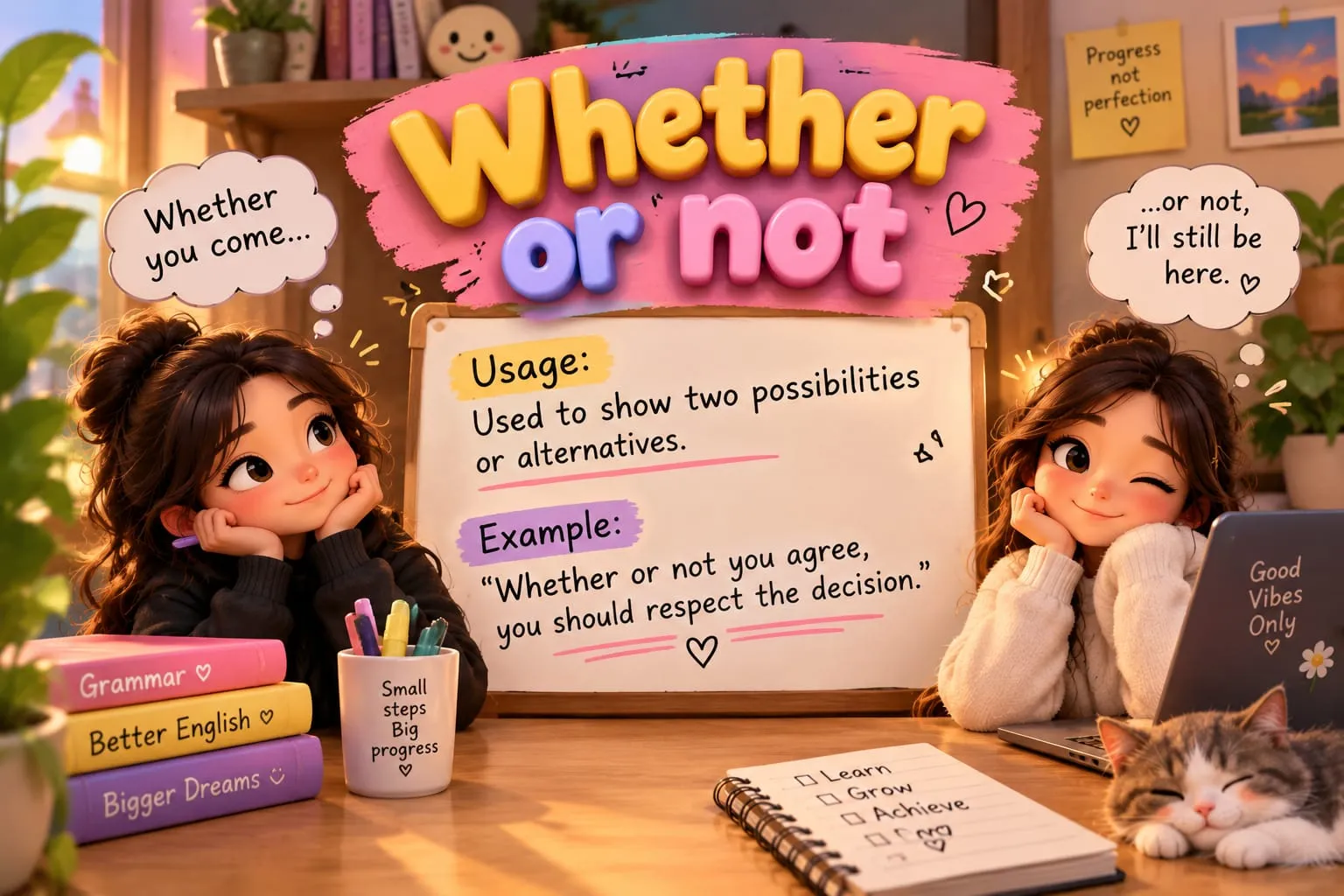
Whether or not introduces two possible conditions or choices and means “if something is true or not.”
Have you ever written a sentence with whether or not, then stopped and wondered, “Do I really need the or not?”
I have seen this question many times when helping English learners polish their writing. The phrase looks simple, but it can cause small doubts. Should you write whether I go or whether or not I go? Is whether or not formal? Can it appear at the start of a sentence? And is it different from if?
The good news is that the basic idea is easy.
Whether or not presents two possibilities. One possibility is that something happens. The other is that it does not happen. In many sentences, whether alone can express the same idea. However, adding or not can make the two choices more explicit.
This guide explains the meaning, grammar, history, differences from if, common mistakes, real-world examples, and practical usage of whether or not.
Whether or Not Quick Answer
Whether or not is used when you are considering two possible outcomes: something happening or not happening.
For example:
- I will attend the meeting whether or not my manager comes.
- She needs to decide whether or not she wants the job.
The phrase can work as a subordinating conjunction in sentences that present alternatives. Cambridge Dictionary defines whether as a word used when expressing a choice between two possibilities.
In simple terms, think of it as:
whether X or not = if X happens or if X does not happen
The Origin and Background of Whether or Not
The word whether has a long history in English.
According to the Online Etymology Dictionary, whether comes from Old English hwæþer, meaning “which of two.” It is related to the idea of choosing between alternatives.
That older meaning helps explain its modern use.
When you say:
I don’t know whether he will come.
You are thinking about two possible answers:
- He will come.
- He will not come.
Adding or not makes the second possibility more visible:
I don’t know whether or not he will come.
The phrase has remained useful because English often needs a clear way to present alternatives.
Why does it sometimes feel confusing?
The confusion usually comes from the fact that whether can often stand alone.
Compare:
- I don’t know whether she will agree.
- I don’t know whether or not she will agree.
Both are grammatical. The second version places more emphasis on the two possible outcomes.
Whether or Not Explained: Key Differences and Variations
The main question is not usually whether whether or not is correct. It is.
The real question is when you need it.
| Term | Meaning | When to Use | Region/Context |
| whether | Shows a choice or uncertainty between possibilities | When the alternatives are clear | Standard English |
| whether or not | Shows that something may happen or may not happen | When you want to state both possibilities clearly | Standard English |
| if | Introduces a condition or possible situation | Often used for conditions and some indirect questions | Very common in everyday English |
Whether
Use whether when you are considering alternatives.
We need to decide whether the plan is practical.
Whether or not
Use whether or not when you want to make the negative alternative clear.
We will continue whether or not the plan receives approval.
Here, the action will continue in either case.
If
If often focuses on a condition.
We will leave if the weather improves.
This means good weather is a condition for leaving.
But:
We will leave whether or not the weather improves.
This means the weather does not decide whether you will leave.
That distinction is useful.
Which Version Should You Use?
Your choice depends on what you want the sentence to mean.
For beginners
Use whether or not when you want to make both possibilities obvious.
It is easy to understand and usually leaves little doubt about your meaning.
For formal writing
Whether and whether or not are both acceptable in formal English.
Choose whether when the sentence is already clear without the extra words.
Choose whether or not when you want to stress that the result is the same in either situation.
For global or neutral English
Both forms are widely understood.
For example:
The company will review the application whether or not the applicant responds.
This makes the meaning direct and clear.
A useful test
Ask yourself:
“Am I talking about two possible outcomes?”
If yes, whether may fit.
If you want to clearly state both “yes” and “no” possibilities, whether or not is often the clearer choice.
Common Mistakes With Whether or Not
1. Using “weather” instead of “whether”
Wrong:
I don’t know weather he will arrive.
Correct:
I don’t know whether he will arrive.
Why?
Weather refers to conditions such as rain, wind, or sunshine. Whether introduces alternatives.
2. Treating whether and weather as homophones
In many varieties of English, whether and weather are pronounced the same or very similarly.
That makes them easy to confuse in writing.
Remember:
- whether = a choice or possibility
- weather = atmospheric conditions
3. Using “whether or not” when you mean a simple condition
Consider:
Call me if you need help.
This gives a condition.
Now compare:
Call me whether or not you need help.
The second sentence changes the meaning. It says you should call in either situation.
4. Adding unnecessary words
Sometimes writers use whether or not even when whether is enough.
For example:
She is deciding whether or not to apply.
This is correct.
But:
She is deciding whether to apply.
is also correct and more concise.
Neither version is automatically wrong. The choice depends on emphasis and style.
5. Forgetting the correct structure
After whether, you can use a clause:
I wonder whether he knows.
You can also use whether or not:
I wonder whether or not he knows.
The key is to keep the sentence structure clear.
Whether or Not in Real World Examples
Seeing the phrase in different settings can make its use much easier to understand.
Professional email
Please let me know whether or not you can attend the meeting on Friday.
This clearly asks for either a positive or negative response.
News article
Officials said the project would continue whether or not additional funding was approved.
The phrase shows that the project has two possible funding outcomes but the stated action remains the same.
Social media post
I’m going hiking this weekend whether or not my friends join me.
This sounds natural in an informal setting.
Formal document
The policy applies whether or not an employee has completed the optional training.
The phrase makes the scope of the policy explicit.
Whether or Not Data, Trends & Usage
Exact monthly search volume for whether or not changes by country, search engine, device, and time period. Public keyword tools can also produce different estimates, so search-volume figures should not be treated as exact counts without access to the relevant paid database.
For language usage, corpus tools are more useful than search volume alone. The Google Books Ngram Viewer can show how often words and phrases appear across its book corpus over time.
The phrase also has strong practical value because it appears in many kinds of English:
- academic writing
- business communication
- everyday conversation
- legal and policy writing
- news reporting
- ESL learning materials
The search intent behind whether or not is mainly informational. People commonly want to understand its meaning, grammar, difference from if, and whether the phrase is correct.
Why does this matter today?
Digital writing has made small grammar choices more visible. Emails, workplace messages, school assignments, and online posts are often written quickly.
That makes clear phrases such as whether or not useful. They help writers show exactly what they mean without relying on context.
Whether or Not: A Second Comparison Table
| Term/Variant | Meaning | Region/Context | Best Used When |
| whether | Presents alternatives or uncertainty | Standard English | The alternatives are already clear |
| whether or not | Covers both a positive and negative possibility | Standard English | You want to emphasize both outcomes |
| if | Expresses a condition or possibility | Standard English | One event depends on another |
| if not | Means “if the opposite is not true” | Standard English | You are referring to a negative alternative |
Notice the difference
Tell me whether you agree.
This asks about your position.
Tell me whether or not you agree.
This makes both possible answers explicit.
Tell me if you agree.
This can also be natural, especially in everyday English, but whether is often preferred when presenting a choice or alternative.
FAQ About Whether or Not
Q: What does whether or not mean?
A: Whether or not means that there are two possible outcomes: something can happen, or it can fail to happen. The phrase often shows that the result applies in either case.
Q: How do you use whether or not correctly?
A: Place it before a clause or another structure that presents the two possibilities. For example, you can write, “We will go whether or not the store is open.”
Q: Is whether or not formal English?
A: Yes. Whether or not is standard English and can be used in formal writing. It is also common in everyday speech.
Q: Is whether or not better than if?
A: Neither is always better. Whether is useful for alternatives, while if often introduces a condition. Choose the word that matches your intended meaning.
Q: Can whether be used without or not?
A: Yes. Whether can stand alone in many sentences. For instance, “I cannot decide whether to stay” is completely grammatical.
Q: Where does whether come from?
A: The word traces back to Old English hwæþer, which carried the sense of “which of two.” Its history is linked to choosing between alternatives.
Q: Can whether or not be used at the beginning of a sentence?
A: Yes. For example, “Whether or not you agree, the decision has been made.” The opening phrase sets up two possible situations.
Conclusion: Master Whether or Not With Confidence
Whether or not is a simple phrase once you understand the idea behind it.
It presents two possibilities. Something may happen, or it may not. The phrase can make both outcomes clear, especially when the result remains the same in either case.
You should also remember that whether does not always need or not. In many sentences, whether alone is enough. The choice depends on clarity, emphasis, and the structure of your sentence.
Do not confuse whether with weather. They may sound alike, but their meanings are completely different. Also watch the difference between whether and if. One often presents alternatives, while the other commonly introduces a condition.
Once you learn these small differences, the phrase becomes much easier to use.
Now you know how whether or not works—try it in your next sentence and write with confidence.
Readmore

I’m **Rubab Naaz**, an English language content writer with over 10 years of experience creating educational and SEO-focused articles. I specialize in spelling comparisons, grammar, vocabulary, synonyms, commonly confused words, and English usage. My passion is helping students, writers, and professionals improve their language skills through accurate, well-researched, and easy-to-understand content. Every article I write is designed to make learning English simple, practical, and engaging.