Caramel is the standard spelling for the sweet food, flavor, or cooked sugar. Carmel is usually a proper name, although some dictionaries record lowercase carmel as a disputed American variant.
I have often seen people hesitate over carmel and caramel, especially when writing about food, desserts, coffee, or sweet sauces. At first glance, the two spellings look almost the same, and their pronunciation can sound very similar in some forms of English. It is easy to wonder whether the extra a really matters.
It does.
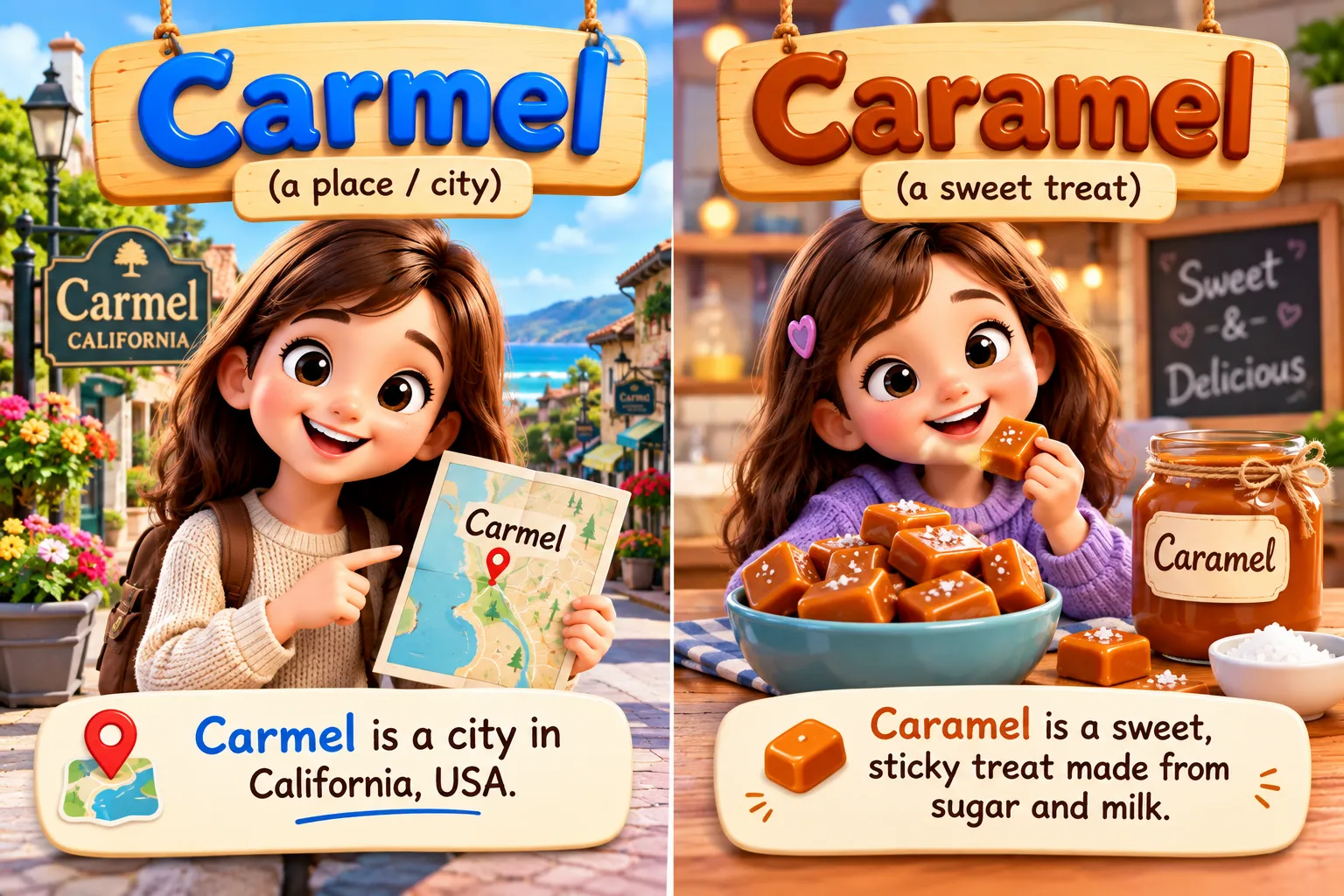
When you mean the sweet substance made by heating sugar, caramel is the standard spelling. You will see it in recipes, menus, product names, and descriptions of desserts and drinks. Carmel, on the other hand, is commonly used as a proper name for people, places, and organizations. Collins also records lowercase carmel as a disputed American variant of caramel, which adds another layer to the confusion.
In this guide, I will break down the difference between carmel and caramel, explain why they are often confused, and show you which form to choose in everyday and formal writing.
Carmel or Caramel Quick Answer
The choice depends on meaning and context.
Use caramel when you mean:
- A sweet substance made by heating sugar
- A chewy candy
- A dessert flavor
- A sauce or topping
- A cooking ingredient
- A brown or golden color associated with caramel
Use Carmel when it is part of a proper name, such as a place, person, or organization.
For example:
- Caramel sauce makes the dessert richer.
- They moved to Carmel last year.
Cambridge defines caramel as cooked or burnt sugar used to give food flavor and color. It also uses the word for a sticky brown sweet made with heated sugar and ingredients such as milk, butter, or cream.
So, if your sentence is about food, caramel is normally the spelling you want.
The Origin and Background of Caramel
The spelling becomes easier to understand when you look at its etymology, or word history.
According to Etymonline, caramel entered English in 1725 with the meaning “burnt sugar.” The word came through French caramel from Old Spanish caramel, with a more uncertain earlier history that may connect to Medieval Latin.
That history has nothing to do with the proper name Carmel.
Etymonline traces Carmel, the name of the mountain in northern Israel, through Latin and Greek to Hebrew karmel, meaning “garden” or “fertile field.”
This gives you an interesting distinction:
caramel developed as a food-related English noun, while Carmel has a separate history as a proper name.
The two forms later became easy to confuse because their written shapes and pronunciations are close.
Why Does Carmel Sound Like Caramel?
Pronunciation is a major part of the problem.
Cambridge gives more than one pronunciation for caramel. Its British pronunciation includes three syllables, while its American pronunciation includes a shorter form that can sound close to Carmel.
Cambridge gives Carmel its own pronunciation, with two syllables in both its UK and US entries.
That means you cannot always rely on sound alone.
English has many cases where spelling and pronunciation do not match perfectly. The same problem appears with other commonly confused words and homophones. When you hear a word, context often gives you the best clue.
Carmel vs. Caramel: Key Differences
The main difference is not grammar. Both can function as nouns, but they usually point to different things.
Caramel is a common noun. It describes a type of cooked sugar, candy, flavor, ingredient, or related color.
Carmel is commonly a proper noun. It may identify a place, person, religious reference, or organization.
There is one useful exception. Collins lists lowercase carmel in American English as a disputed variant of caramel. So it is too simple to claim that every appearance of carmel is automatically impossible. Still, caramel is the safer standard spelling when you mean the food.
| Term | Meaning | When to Use | Region/Context |
| caramel | Cooked sugar, candy, flavor, or ingredient | Food, recipes, desserts, drinks | Standard English |
| Carmel | A proper name | Places, people, organizations, religious names | Context-specific |
| carmel | Disputed variant of caramel | Rare or nonstandard food usage | American English, disputed |
| caramelized | Changed by heating until browned | Cooking and food writing | Standard English |
| caramelize | To turn something into caramel or make it caramelized | Cooking process | Standard English |
The key lesson is simple: meaning determines the spelling.
Examples of Caramel
Use caramel for food and related descriptions:
- The recipe needs a smooth caramel sauce.
- He added caramel syrup to his coffee.
- The bakery sells soft caramel candies.
- The dessert has a deep caramel flavor.
- The fabric has a warm caramel shade.
Examples of Carmel
Use Carmel when it is part of a proper name:
- They planned a trip to Carmel.
- Mount Carmel has a long historical and religious connection.
- Carmel is her first name.
- The school is called Carmel Academy.
In proper names, always check the official spelling. A person’s name or an organization’s name should not be changed simply because another spelling is more common.
Which Version Should You Use?
The safest choice depends on what you are writing.
For recipes and food writing
Use caramel.
This is the clearest option for:
- Recipes
- Menus
- Food blogs
- Product descriptions
- Restaurant reviews
- Baking instructions
- Dessert guides
If you write caramel sauce, readers immediately understand that you mean a sweet food product.
For formal or academic writing
Use caramel when referring to the food or substance.
Although Collins records carmel as a disputed American variant, the standard spelling caramel avoids uncertainty and is the better choice for professional writing.
For names and locations
Use Carmel when that is the established proper name.
Do not change a person’s name or an official place name to caramel.
For example, if a document refers to Carmel, preserve that spelling.
For global English
Choose caramel when you mean the food.
It is the clearest choice for an international audience because it matches the standard dictionary spelling used by major English dictionaries. Cambridge lists caramel as the English noun for the cooked sugar product and candy.
Common Mistakes With Carmel and Caramel
1. Writing “carmel sauce”
Mistake:
The cake was covered with carmel sauce.
Correction:
The cake was covered with caramel sauce.
The writer usually drops the middle a because of pronunciation.
2. Writing “caramel” for a place
Mistake:
They spent the weekend in Caramel.
Correction:
They spent the weekend in Carmel.
If the official place name is Carmel, keep the proper spelling.
3. Assuming pronunciation controls spelling
You may hear caramel pronounced in a way that sounds like Carmel. That does not mean the spelling should change.
Cambridge recognizes different pronunciations of caramel, including UK and US forms.
4. Writing “carmelized”
Mistake:
The onions were carmelized.
Correction:
The onions were caramelized.
The standard cooking verb is caramelize, with the extra a retained.
5. Treating Carmel as always wrong
This is too broad.
Carmel can be completely correct when it is a proper name. Collins also records lowercase carmel as a disputed American variant of caramel.
The context tells you which form you need.
Carmel or Caramel in Real-World Examples
Seeing the words in different types of writing can make the distinction easier to remember.
Professional email
The catering team confirmed that the dessert will include a caramel topping.
Here, caramel refers to a food ingredient.
News headline
Local bakery launches new salted caramel dessert range
The word describes a flavor and food product.
Social media post
I finally tried the new caramel coffee, and it was incredibly rich!
Again, caramel refers to flavor.
Formal report
The sample developed a darker caramel color after heating.
Here, caramel describes the resulting color.
Place reference
The conference will take place in Carmel next spring.
Here, Carmel is part of a proper name, so the capital letter matters.
These examples show why you should not choose between the two forms by sound alone. First identify what the word means.
Carmel or Caramel Data, Trends & Usage
Exact monthly search volume for “carmel” and “caramel” changes over time and depends on the SEO platform, country, language, and keyword database. Without a current Google Trends, Ahrefs, or Semrush export, it would be misleading to invent precise monthly numbers.
There is, however, useful evidence from dictionary and corpus resources.
Cambridge states that its English dictionaries are based on the Cambridge English Corpus, which contains more than 2 billion words. Its dictionary examples show caramel used across food, drinks, desserts, flavor descriptions, and related contexts.
The search intent for “carmel or caramel” is mainly informational. People usually want to know:
- Which spelling is correct?
- Why do the words sound similar?
- How is caramel pronounced?
- Is carmel a word?
- When should I capitalize Carmel?
- How do I spell caramel sauce or caramelized?
This makes the topic especially useful for English learners, students, editors, recipe writers, and anyone checking spelling before publishing.
The strongest practical insight is that pronunciation creates the confusion, but context solves it.
Standalone Carmel vs. Caramel Comparison
| Term/Variant | Meaning | Region/Context | Best Used When |
| Caramel | Cooked sugar, candy, sauce, flavor, or color | British and American English | Writing about food or flavor |
| Carmel | Proper name | Places, people, organizations, religious references | Referring to an established name |
| carmel | Disputed variant of caramel | American English | Only when a source or style specifically permits it |
| caramelize | To turn food brown through caramelization | Cooking | Describing a cooking process |
| caramelized | Made brown or developed through caramelization | Recipes and food writing | Describing cooked ingredients |
This table adds an important point: Carmel and caramel are not simply interchangeable spelling variants. Their capitalization and context can change their role.
Frequently Asked Questions
Q: What does caramel mean?
A: Caramel is cooked sugar used for flavor and color. It can also mean a sticky sweet made from heated sugar and ingredients such as milk, butter, or cream.
Q: Is Carmel a correct spelling of caramel?
A: For standard food writing, caramel is the safest spelling. Collins does record lowercase carmel as a disputed American variant, but Carmel is also correctly used as a proper name.
Q: Why do some people say caramel like Carmel?
A: English speakers use different pronunciations of caramel. Cambridge lists both longer and shorter pronunciations, which helps explain why the spoken word can resemble Carmel.
Q: Is caramel acceptable in formal writing?
A: Yes. Caramel is the standard dictionary spelling for the food substance, candy, flavor, and related uses. Cambridge lists it as a noun in both British and American English.
Q: Where does the word caramel come from?
A: Etymonline dates the English word to 1725 and traces it through French caramel and Old Spanish caramel. The deeper origin is uncertain.
Q: Should I write caramel or carmelized?
A: Write caramelized when you mean food that has developed a browned, sweet caramel character through heating. The spelling keeps the a after “car.”
Q: Is Carmel always a place name?
A: No. Carmel can also be a personal name or part of the name of an organization or institution. The correct spelling depends on the official name being used.
Final Thoughts on Carmel or Caramel
The Carmel or caramel question looks small, but it is a good example of how English spelling can become tricky when pronunciation enters the picture.
When you mean a sweet food, sauce, flavor, candy, or cooked sugar, choose caramel. That is the standard form used in ordinary food and culinary writing. Cambridge also recognizes the word in both British and American English.
When you see Carmel, check the context. It may be a place, person’s name, organization, or another proper noun. Capitalization can be an important clue.
There is also a useful dictionary nuance. Collins records lowercase carmel as a disputed American variant of caramel. That means the form exists in documented usage, but it is not the safest choice when you want clear, standard English.
My practical rule is simple:
Food or flavor → caramel.
Name or place → Carmel.
Once you connect the spelling to the meaning, this confusing pair becomes much easier. Bookmark this guide so you never have to second-guess Carmel or caramel again.
Read More:
Who’s vs Whose: How to Use Them Correctly

I specialize in English grammar, spelling, word choice, and language usage. My content is based on research from grammar references, style guides, dictionaries, and real-world usage to ensure it is accurate and practical.
At Spelling Comparison, I write guides that explain why words are confused, how they are used, and which form is correct in context. I also include proofreading tips, examples, and writing advice readers can apply immediately.
My goal is to publish clear, reliable content that helps readers make better writing decisions. Each guide is written for accuracy, clarity, and usefulness in school, work, business, and everyday communication.