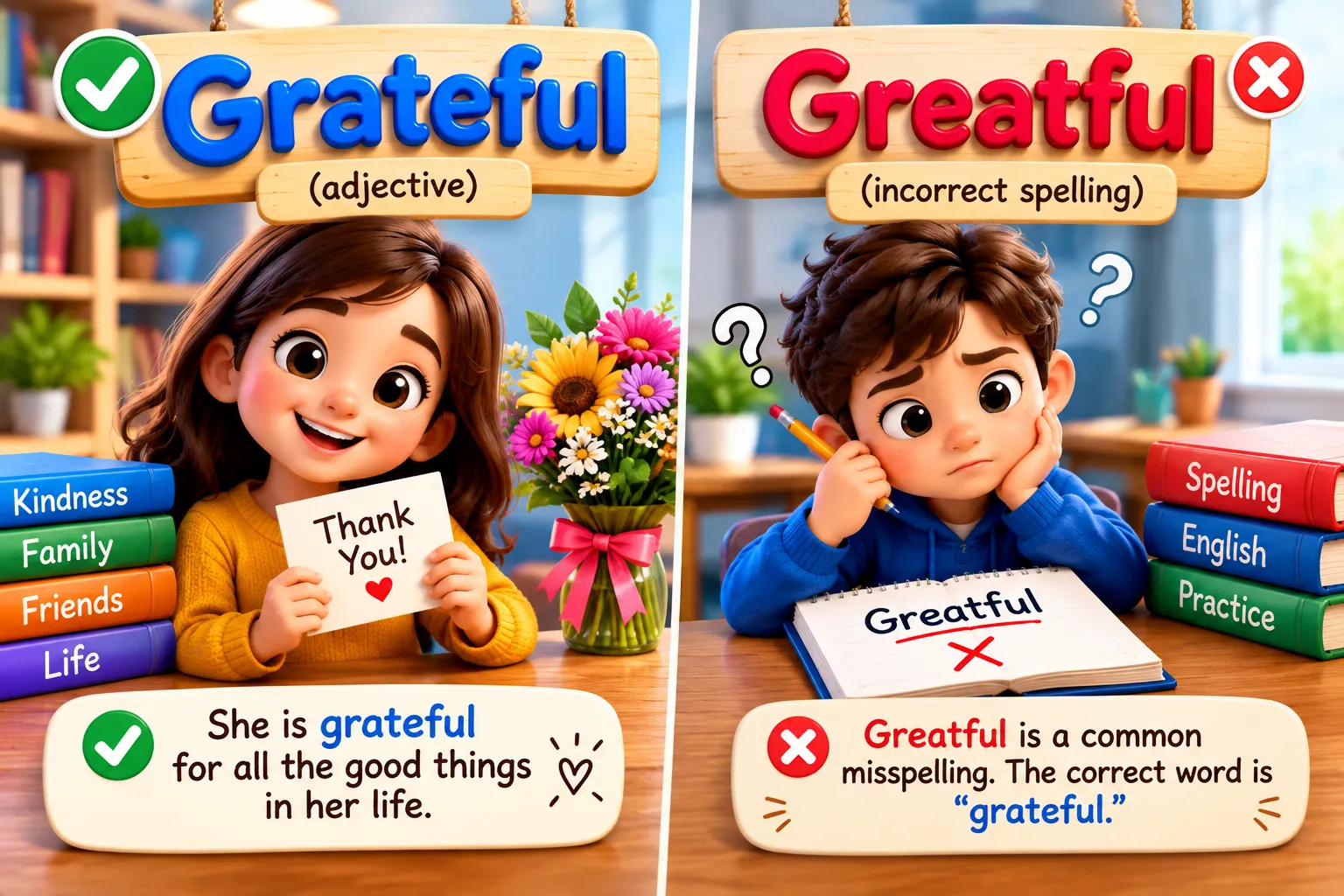
Grateful is the correct spelling for someone who feels or shows thanks. Greatful is a common misspelling and is not the standard form.
I have come across the spelling greatful many times while reading emails, social media posts, and everyday writing. At first, it is easy to understand why someone might choose it. The word great is familiar, and adding -ful seems to make sense. But there is one small problem: greatful is not the correct spelling.
The correct word is grateful.
I have also noticed that this mistake can be surprisingly easy to make because grateful and greatful look almost identical. When you are writing quickly, that extra t can easily slip into the wrong place. The confusion becomes even stronger because both forms may seem to suggest the idea of being “full of great feelings.”
In this guide, I will explain the difference between grateful and greatful, including their meanings, correct spelling, grammar, word history, and everyday usage. You will also see simple examples and an easy memory trick to help you remember grateful the next time you write it.
By the end, you will know exactly which spelling to use and why greatful is a common mistake rather than an accepted alternative.
Grateful or Greatful Quick Answer
If you are choosing between grateful and greatful, use grateful.
Grateful is an adjective that means thankful, appreciative, or pleased because of something kind or helpful. Cambridge defines it as showing or expressing thanks, especially to another person.
Greatful is a common spelling mistake. It is not the standard spelling of the word meaning thankful.
For example:
- ✅ I am grateful for your support.
- ❌ I am greatful for your support.
The confusion is easy to understand. The word great appears to be sitting inside grateful, so it is tempting to think the word is simply great + -ful.
It is not.
The correct spelling is linked to gratitude, not great. Once you remember that connection, this spelling becomes much easier.
Why I Used to See “Greatful” So Often
I have come across greatful many times in emails, student writing, thank-you messages, and online posts. What makes this mistake interesting is that it does not look completely random.
At first glance, greatful seems logical. English has many words that use the suffix -ful, such as helpful, careful, and hopeful. So a writer may naturally see great and add -ful.
There is another problem. When you say grateful, the pronunciation does not clearly remind you that the spelling starts with grat-. Cambridge gives the pronunciation as /ˈɡreɪt.fəl/ in both its UK and US entries.
That means your ears are not much help here.
I have found that the easiest solution is not to memorize a complicated spelling rule. Instead, connect grateful with gratitude.
Both begin with grat-.
That small connection can prevent the mistake in seconds.
The Origin and Background of “Grateful”
The spelling of grateful becomes clearer when you look at its etymology, or word history.
Etymonline traces grateful to the 1550s. It came from the older adjective grate, meaning pleasing or agreeable, and ultimately from Latin gratus, meaning pleasing or thankful.
Collins also gives the word origin as the older form grate, from Latin gratus, plus -ful.
So the word was not created from the modern English adjective great.
That explains the spelling:
grate + ful → grateful
Not:
great + ful → greatful
The suffix -ful has an even older history. Etymonline traces it to Old English -full, which developed into the modern suffix used in many English adjectives.
This is a useful example of how linguistics can explain an everyday spelling problem. Modern English spelling often preserves pieces of older word history that are no longer obvious to modern speakers.
The related noun gratitude also has a long history. Etymonline traces it to Middle English usage through Medieval Latin gratitudo, from Latin gratus.
So grateful and gratitude belong to the same historical family.
Grateful Explained: Meaning, Grammar, and Usage
Grateful is an adjective.
You use it to describe a person who feels or expresses thanks.
What does grateful mean?
In simple English:
Grateful = thankful or appreciative
You might feel grateful when someone:
- gives you useful help
- supports you during a difficult time
- offers you an opportunity
- does something kind
- gives you something valuable
- helps you solve a problem
For example:
I am grateful for your advice.
Here, grateful describes the speaker’s feeling.
Collins defines grateful as being thankful or appreciative for something someone has given or done.
Grateful for
Use grateful for when you are talking about the thing, action, benefit, or situation you appreciate.
Examples:
We are grateful for the opportunity.
She felt grateful for the extra time.
He was grateful for the thoughtful gift.
Grateful to
Use grateful to when you name the person you appreciate.
Examples:
I am grateful to my teacher.
She is grateful to her parents.
We are grateful to everyone who volunteered.
You can use both structures in the same sentence:
I am grateful to my mentor for the valuable advice.
This gives you a simple grammar pattern:
grateful to + person
grateful for + thing or action
Grateful vs Greatful: Key Differences
There is no genuine spelling choice between these two forms.
| Term | Meaning | When to Use | Region/Context |
| grateful | Thankful or appreciative | Use when expressing thanks | Standard English |
| greatful | Common misspelling | Do not use for “thankful” | Nonstandard |
| gratitude | The feeling of being thankful | Use as a noun | Standard English |
| gratefully | In a thankful way | Use as an adverb | Standard English |
| thankful | Thankful or relieved | Use when expressing thanks or relief | Standard English |
The key point is simple: grateful is the standard spelling.
There is also no British-versus-American spelling difference here. Collins lists grateful in both British and American English.
That makes this different from spelling pairs such as:
- color / colour
- favorite / favourite
- center / centre
Those have recognized regional forms.
Grateful / greatful does not.
Grateful vs Thankful: Are They the Same?
Grateful and thankful are close in meaning, and dictionaries often list them as synonyms.
However, there can be a small difference in use.
Cambridge explains that grateful is commonly used when someone has been kind or has done you a favor. Thankful is often used when someone feels relieved that something unpleasant or dangerous did not happen.
Compare these:
I am grateful for your kindness.
Here, the focus is appreciation for another person’s action.
Now consider:
I am thankful that nobody was hurt.
Here, the focus is relief about a situation.
The two words can overlap, so this is not an absolute grammar rule. It is mainly a useful difference in meaning and tone.
Which Version Should You Use?
Your choice is actually very easy.
For students
Use grateful in:
- essays
- assignments
- exams
- school emails
- applications
- presentations
If you write greatful, it may be marked as a spelling error.
For professional writing
Choose grateful in:
- business emails
- reports
- formal letters
- workplace messages
- thank-you notes
- professional documents
It is the standard form and works well in both formal and everyday writing.
For casual communication
Use grateful here too.
You might write a quick message such as:
Feeling grateful for all the support today.
The tone can be casual. The spelling does not change.
For international English
Choose grateful.
You do not need a different form for American, British, Canadian, or Australian readers.
Common Mistakes With Grateful
1. Writing “greatful”
❌ I am greatful for your kindness.
✅ I am grateful for your kindness.
This happens because writers connect the word with great.
Remember gratitude, not great.
2. Writing “gratefull”
❌ She was gratefull for the opportunity.
✅ She was grateful for the opportunity.
The standard suffix is -ful, with one l at the end.
3. Writing “greatfull”
❌ We are greatfull for your help.
✅ We are grateful for your help.
This version combines two spelling mistakes.
4. Using “grateful” and “gratitude” as the same part of speech
❌ I gratitude for your help.
✅ I am grateful for your help.
Or:
✅ I want to express my gratitude for your help.
Grateful is an adjective.
Gratitude is a noun. Cambridge defines gratitude as the feeling or quality of being grateful.
5. Using “grateful of”
A common learner error is:
❌ I am grateful of your help.
A more natural standard structure is:
✅ I am grateful for your help.
When naming the person, use to:
I am grateful to my friend for the help.
A Simple Trick to Remember “Grateful”
Here is the easiest memory trick:
Think “gratitude,” not “great.”
Write these together:
GRATITUDE → GRATEFUL → GRATEFULLY
All three begin with grat-.
You can also remember:
GRATeful = full of GRATitude
This works better than trying to connect the word with great.
Another useful test is to ask yourself:
Am I trying to say “thankful”?
If yes, write:
GRATEFUL
Not:
GREATFUL
That one-second check can save you from the most common mistake.
Grateful in Real-World Examples
Professional email
I would be grateful if you could review the attached proposal before Friday.
This is a polite and professional way to make a request.
News article
The family said they were grateful to the local volunteers who helped during the emergency.
Here, the adjective describes the family’s appreciation.
Social media post
Today I am feeling grateful for the people who continue to encourage me.
This works naturally in an informal setting.
Formal report
The research team is grateful to all participants who contributed their time to the project.
This style is common in formal acknowledgments.
Personal message
I’m truly grateful to you for standing by me when I needed support.
This expresses strong personal appreciation.
Grateful Data, Trends & Usage
The search intent behind greatful or grateful is clearly informational. Most people searching this pair want to check spelling, meaning, pronunciation, or correct usage.
Exact current monthly search volumes for grateful and greatful would require a live SEO database such as Ahrefs, Semrush, or Google Keyword Planner. Without that data, giving a precise number would be misleading.
There is still useful evidence about the error.
Dictionary.com specifically lists greatful as a common misspelling of grateful and recommends connecting the correct spelling with gratitude.
The spelling error also appears in academic research on learner English. A University of Malta doctoral thesis identifies greatful among common spelling errors found in student writing.
This gives us a useful insight:
The problem is not limited to casual internet writing. Learners can carry the spelling mistake into formal academic work.
That is why learning the word family matters.
For broader written usage, Collins links its grateful entry to Google Books Ngram Viewer trends. The dictionary’s entry also records standard British and American forms and related words such as gratefully and gratefulness.
The search intent can be summarized as:
- Primary: Informational
- Main question: Which spelling is correct?
- Secondary questions: What does grateful mean? How do I use it? Is it different from thankful?
- Likely audience: Students, English learners, writers, and people checking a message before sending it
This topic also matters because spelling tools can correct a mistake, but understanding why the spelling is correct helps you remember it without depending on autocorrect.
Standalone Comparison Table
| Term/Variant | Meaning | Region/Context | Best Used When |
| grateful | Feeling or showing thanks | All major varieties of standard English | You appreciate help, kindness, or a benefit |
| greatful | Misspelling of grateful | Nonstandard | Avoid it |
| gratitude | The feeling of being thankful | Standard English | You need a noun |
| gratefully | In a thankful manner | Standard English | You need an adverb |
| gratefulness | The quality of being grateful | Standard English, less common | Discussing the state or quality of gratitude |
| thankful | Feeling thankful or relieved | Standard English | Appreciation or relief |
| appreciative | Showing recognition of value or kindness | Standard English | Emphasizing appreciation |
This table shows that grateful has a small but useful word family.
Learning the related forms can help you avoid spelling mistakes and choose the right part of speech.
FAQs About Grateful or Greatful
Q: What does “grateful” mean?
A: Grateful means thankful or appreciative. It often describes how you feel after someone helps you, supports you, or does something kind for you.
Q: Is “greatful” a correct English word?
A: Greatful is not the standard spelling when you mean thankful. Use grateful instead.
Q: How do you spell grateful?
A: The correct spelling is G-R-A-T-E-F-U-L. A useful memory clue is the related noun gratitude, which begins with grat-.
Q: Is grateful formal or informal?
A: Grateful works in both formal and informal English. You can use it in a friendly message, a school assignment, a business email, or a formal letter.
Q: Should I say “grateful to” or “grateful for”?
A: Use grateful to when naming the person you appreciate. Use grateful for when naming the thing, action, or benefit you appreciate.
Q: Is grateful different in British and American English?
A: The spelling grateful is used in both British and American English. The pronunciation can have small accent differences, but the spelling remains the same.
Q: What is the difference between grateful and thankful?
A: Both words can express appreciation. Grateful often focuses on kindness or help received, while thankful can also express relief that something bad did not happen.
Q: Where does grateful come from?
A: Etymonline traces grateful to the 1550s and connects it with the older word grate and Latin gratus. The history is one reason grateful is not spelled greatful.
Q: Can I use grateful in a professional email?
A: Yes. Grateful is completely suitable for professional communication. For example, you can use it when thanking someone or making a polite request. Cambridge specifically gives formal examples using the structure grateful if.
Conclusion: Choose Grateful Every Time
The choice between greatful and grateful is much easier once you understand what is behind the spelling.
Grateful is the standard English adjective. It means thankful or appreciative. Greatful is a common misspelling caused by the tempting connection with the familiar word great.
The best way to remember the correct form is to connect grateful with gratitude. Both begin with grat-. That simple word-family connection is more reliable than trying to spell the word by sound.
It also helps to remember the common grammar patterns. Use grateful to for the person you appreciate and grateful for for the thing or action you appreciate. When you need the noun, choose gratitude. When you need the adverb, choose gratefully.
You can use grateful in academic, professional, personal, and casual writing. The spelling does not change between British and American English.
So, if you ever stop and wonder whether the word is greatful or grateful, choose grateful.
Remember: GRATitude → GRATeful.
Bookmark this guide and share it with someone who still writes greatful.
Read More:
Carmel or Caramel: Easy Spelling & Usage Guide

I’m Daniel sultan, an English language writer and SEO content specialist with experience researching spelling, grammar, vocabulary, and English usage. Through SpellComparison.com, I create clear, accurate, and well-researched guides that help readers understand commonly confused words, spelling differences, and grammar rules with confidence.
Every article I write is based on trusted language references, established style guides, and real-world usage to ensure it is accurate, practical, and easy to understand. My goal is to make learning English simple and reliable by providing fact-checked content, clear explanations, and real-life examples that students, writers, educators, and professionals can trust.










