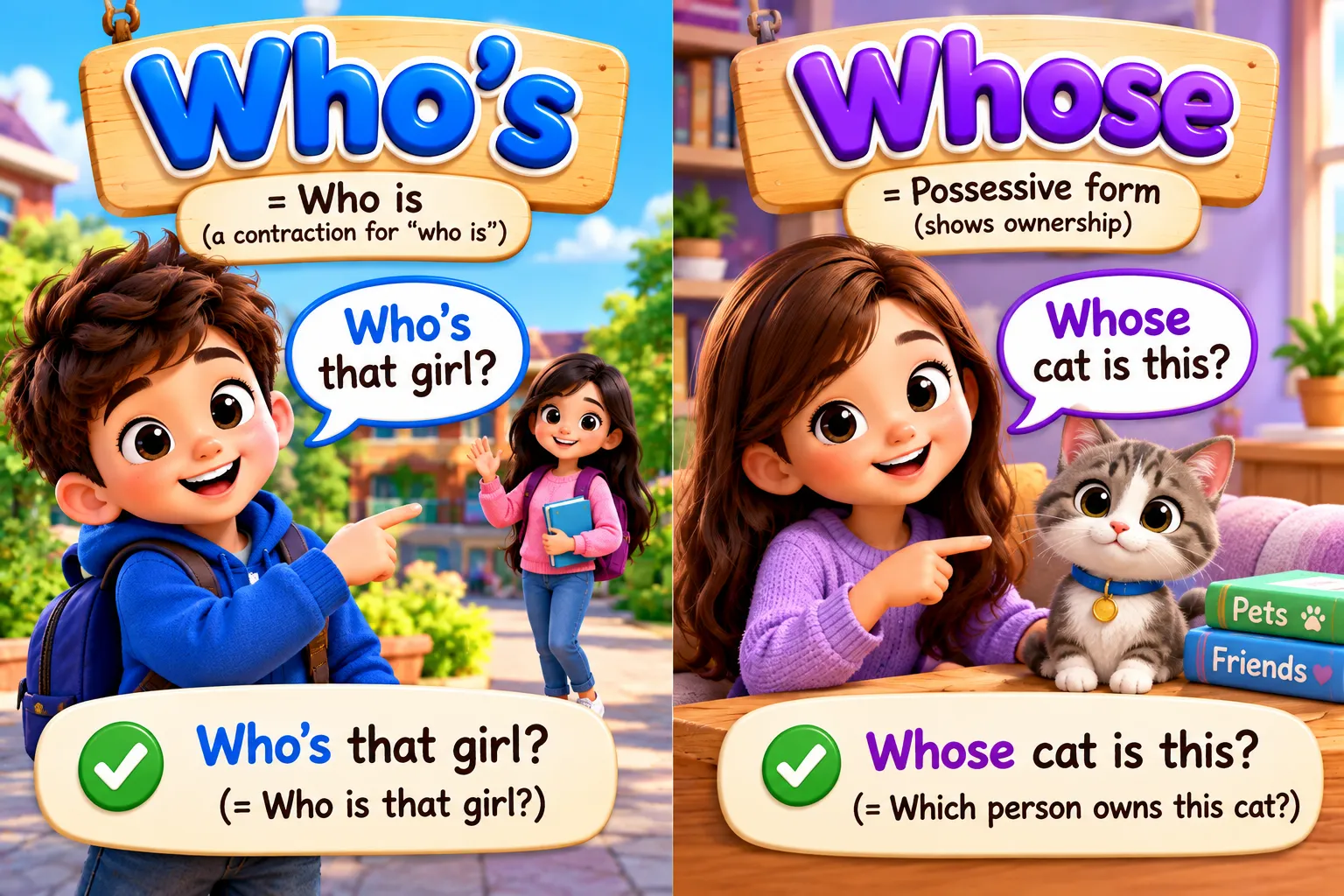
Who’s means “who is” or “who has,” while whose shows ownership, connection, or possession.
I have often seen writers pause over a tiny apostrophe and ask, “Should I write who’s or whose?” The two words sound the same in most English accents, so the confusion is understandable. Yet their jobs in a sentence are very different.
I remember noticing this mistake most often in questions. A writer might type Who’s bag is this? because the sentence sounds like whose. Another person may write Whose coming to the meeting? because they hear the same sound as who’s. These errors are small, but they can change the grammar of a sentence.
The easiest way to solve the problem is to stop listening for the sound. Instead, look at the meaning.
If you can replace who’s with who is or who has, the apostrophe belongs there. If you are asking about ownership or showing a connection, use whose.
Once you learn this simple test, the difference becomes much easier to spot. Let’s break it down with clear rules, examples, and practical tips.
Who’s or Whose Quick Answer
Who’s is a contraction. It is a shortened form of who is or who has. Whose is used when you ask who owns something or when you show a relationship or connection.
For example:
- Who’s waiting outside? → Who is waiting outside?
- Who’s finished the assignment? → Who has finished the assignment?
- Whose jacket is this? → Who does this jacket belong to?
Cambridge Dictionary confirms that who’s can mean who is or who has. It also defines whose as a word used to ask about ownership or connection.
A quick test can save you from many mistakes:
Who’s = who is / who has
Whose = ownership or connection
The Origin and Background of Who’s and Whose
The difference between who’s and whose comes from two separate grammatical functions.
The word who is an interrogative pronoun and a relative pronoun. We use it when referring to people, especially when asking questions or adding information about someone. Cambridge describes who as a wh-word used to ask about people and to introduce relative clauses.
The word whose developed as the possessive form connected with who. In modern English, it can work as a pronoun or determiner.
For example:
Whose phone is ringing?
Here, whose asks about the person connected to the phone.
It can also introduce a relative clause:
I met a student whose brother works here.
In this sentence, whose connects student with brother. Cambridge explains that whose can introduce relative clauses that show possession or a relationship.
The apostrophe in who’s tells you something different. It marks a contraction. The word combines who with either is or has.
This is the same basic idea you see in contractions such as:
- it’s = it is / it has
- she’s = she is / she has
- they’re = they are
- we’ve = we have
So the apostrophe is not showing ownership. It is showing that letters have been removed.
Who’s or Whose Explained Key Differences
The easiest way to understand these words is to look at their grammar.
| Term | Meaning | When to Use | Region/Context |
| who’s | who is / who has | Use as a contraction | Standard English |
| whose | belonging to whom; connected with whom | Use for possession or relationships | Standard English |
| who | a person or people | Use for questions and relative clauses | Standard English |
| whom | object form of who | Mostly formal writing | Formal English |
1. Who’s = Who Is
Use who’s when you can expand it to who is.
Who’s calling you?
You can rewrite it:
Who is calling you?
The meaning stays the same.
Another example:
Do you know who’s responsible?
That means:
Do you know who is responsible?
Cambridge lists this as one of the main meanings of who’s.
2. Who’s = Who Has
Who’s can also be short for who has.
Who’s taken my notebook?
This means:
Who has taken my notebook?
Here, who’s is followed by a past participle, taken.
Another example:
I wonder who’s already finished.
You can expand it to:
I wonder who has already finished.
3. Whose = Ownership
Use whose when you want to know who owns something.
Whose keys are these?
The question asks about the owner of the keys.
You can think of whose as asking:
“Who does this belong to?”
Cambridge gives examples such as “Whose bag is this?” to show this possessive use.
4. Whose = Connection
Whose is not limited to physical ownership.
It can also show a relationship or connection.
She is the writer whose books I enjoy.
The books belong to, or are associated with, the writer.
Cambridge notes that whose can refer to people, animals, and, in some formal contexts, things.
Which Version Should You Use?
Your choice depends on what you mean.
For students
Use who’s when you mean who is or who has.
Use whose when you are asking about ownership or showing a relationship.
This simple distinction works well in school assignments and exams.
For professional writing
Check every who’s carefully.
Replace it mentally with who is or who has. If the expanded version sounds correct, who’s is probably right.
For example:
The manager who’s leading the project will speak first.
This means:
The manager who is leading the project will speak first.
For formal writing
Both who’s and whose can appear in formal writing when they perform their correct grammatical roles.
You do not need to avoid who’s simply because it contains an apostrophe. Contractions can be perfectly normal. However, some very formal styles may prefer expanded forms such as who is.
For global English
There is no major British-versus-American spelling difference here.
Who’s and whose are standard in both varieties of English. The key issue is meaning, not region.
Common Mistakes with Who’s or Whose
Mistake 1: Using “who’s” for possession
Wrong: Who’s phone is on the desk?
Correct: Whose phone is on the desk?
Why? The sentence asks who owns the phone. It does not mean who is phone or who has phone.
Mistake 2: Using “whose” instead of “who’s”
Wrong: Whose coming to dinner?
Correct: Who’s coming to dinner?
Why? You mean:
Who is coming to dinner?
The contraction needs an apostrophe.
Mistake 3: Thinking the apostrophe means ownership
This is one of the most common traps.
English often uses apostrophes for possession, such as:
Sarah’s book
But who’s is different.
Its apostrophe marks a contraction, not possession.
Mistake 4: Writing “whose” when you mean “who has”
Wrong: Whose been using my computer?
Correct: Who’s been using my computer?
Expand it:
Who has been using my computer?
That makes the answer clear.
Mistake 5: Treating sound as the rule
Who’s and whose are pronounced alike in standard English.
That means pronunciation cannot reliably tell you which spelling to choose.
Instead, check the meaning and grammar.
Who’s or Whose in Real-World Examples
The words appear in many types of writing. Here are fresh examples from everyday contexts.
Professional Email
Could you confirm who’s responsible for sending the final report?
Here, who’s means who is.
News Headline
Whose Decision Will Shape the Company’s Next Step?
The headline asks about responsibility or ownership of a decision.
Social Media Post
Guess who’s joining us for the weekend!
The word means who is.
Formal Report
The committee interviewed several applicants whose experience matched the role.
Here, whose shows a relationship between the applicants and their experience.
Everyday Conversation
Whose umbrella did you leave by the door?
The question asks who owns the umbrella.
Workplace Conversation
Do you know who’s handling the customer request?
The meaning is who is handling.
Who’s or Whose Data, Trends & Usage
The search intent behind “who’s or whose” is strongly informational. People usually search this phrase because they want to settle a spelling or grammar question.
Exact monthly search-volume figures change across SEO platforms and countries. Without a live Ahrefs, Semrush, or Google Keyword Planner dataset, it would be misleading to present a specific monthly number as fact.
The stronger evidence comes from established dictionaries and grammar references. Cambridge gives separate entries for who’s and whose, which reflects the key grammatical distinction between them.
There is also a useful lesson in the search itself. Both words have the same common pronunciation, /huːz/, according to Cambridge’s dictionary entries. That makes this a spelling-and-grammar problem rather than a simple pronunciation problem.
Why this distinction still matters
Digital writing has made short grammar questions easy to search. Students, ESL learners, professionals, and everyday writers can quickly check a word when a sentence does not look right.
Grammar-checking tools can help, but they may not explain why a form is correct. Understanding the rule gives you more control.
A useful habit is to expand the contraction:
who’s → who is / who has
If neither expansion works, consider whose.
Standalone Comparison: Who’s vs. Whose
| Term/Variant | Meaning | Region/Context | Best Used When |
| who’s | who is | All major English varieties | You need a contraction |
| who’s | who has | All major English varieties | Who has can replace it |
| whose | belonging to whom | All major English varieties | You ask about ownership |
| whose | connected with whom | Standard English | You describe a relationship |
| who | which person | Standard English | You ask about a person |
| whom | object form of who | Formal writing | The person is the object |
Notice that who’s has two meanings, while whose has a possessive or relational role.
That distinction is more useful than trying to memorize the spelling alone.
A Simple Memory Trick
Try this three-step test whenever you hesitate.
Step 1: Look at “who’s”
Ask:
Can I replace it with who is?
If yes, use who’s.
Who’s at the door?
Who is at the door?
Both work.
Step 2: Try “who has”
If who is does not work, try who has.
Who’s eaten the last slice?
Who has eaten the last slice?
Again, both work.
Step 3: Ask about ownership
If the sentence asks who owns something, use whose.
Whose laptop is this?
You cannot replace whose with who is or who has.
That is your strongest clue.
FAQs About Who’s or Whose
Q: What does “who’s” mean?
A: Who’s is a contraction of who is or who has. The correct meaning depends on the sentence around it.
Q: What does “whose” mean?
A: Whose asks who owns or is responsible for something. It can also show a relationship between a person or thing and another noun.
Q: Are who’s and whose pronounced the same?
A: Yes, they normally have the same pronunciation in standard English. This is why writers often confuse them in spelling.
Q: Is “whose” possessive?
A: Yes. Whose has a possessive function. It can ask about ownership or connect a person or thing with something associated with it.
Q: Is “who’s” acceptable in formal writing?
A: Yes. It is a standard contraction. Still, some highly formal styles may prefer who is or who has instead.
Q: Which is correct: “who’s car” or “whose car”?
A: Whose car is correct when you are asking about the owner. Who’s car is incorrect because who’s means who is or who has.
Q: Can “whose” refer to things?
A: Yes. Whose can refer to things in certain constructions, especially in formal writing. Cambridge gives examples such as a house whose basement has a particular feature.
Conclusion: Who’s or Whose?
The difference between who’s and whose becomes much easier when you focus on the job each word performs.
Who’s is a contraction. It means who is or who has. The apostrophe shows that part of the original phrase has been shortened.
Whose is about possession, responsibility, or connection. You use it when you want to know who something belongs to or when you connect one person or thing with another noun.
The best trick is simple. Whenever you see who’s, expand it to who is or who has. If the sentence still makes sense, you have probably chosen the right form. If the sentence asks about ownership, choose whose.
Do not let pronunciation fool you. These words often sound identical, so the meaning of the sentence is your best guide.
Once this test becomes a habit, you will catch the mistake quickly. You will also understand why the apostrophe matters.
Bookmark this guide so you never second-guess “who’s” and “whose” again.
Read More:
Tomatoes or Tomatos: Easy Guide to Correct Spelling

I’m **Rubab Naaz**, an English language content writer with over 10 years of experience creating educational and SEO-focused articles. I specialize in spelling comparisons, grammar, vocabulary, synonyms, commonly confused words, and English usage. My passion is helping students, writers, and professionals improve their language skills through accurate, well-researched, and easy-to-understand content. Every article I write is designed to make learning English simple, practical, and engaging.










