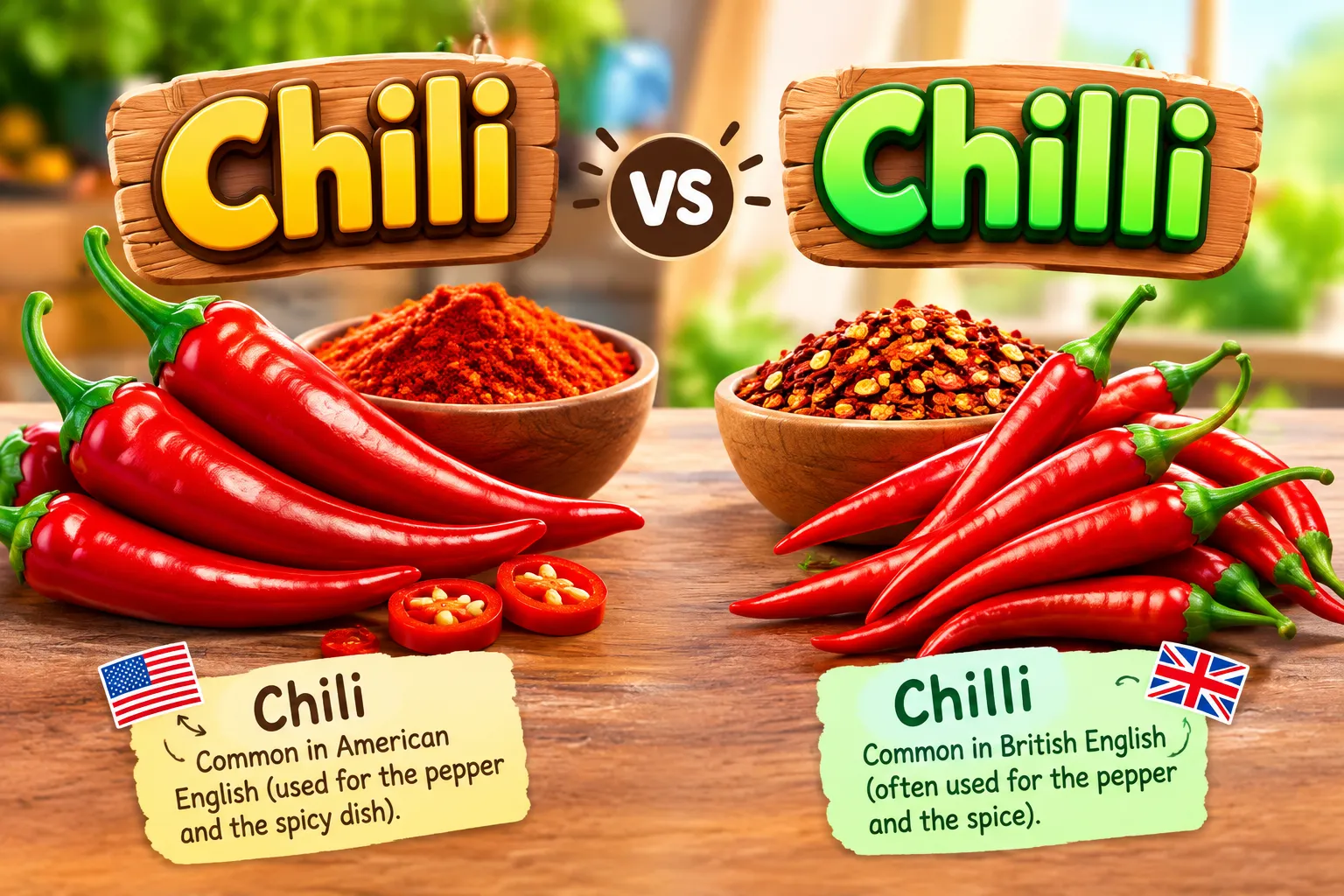
Chili and chilli are both correct spellings for the hot pepper, but chili is standard in American English and chilli is standard in British English.
I’ve often stopped while writing a recipe or food article and wondered whether I should type chili or chilli. Both forms look familiar, and both sound the same when spoken. That makes the extra l easy to overlook.
I have noticed this small spelling difference most often when reading recipes from different countries. One recipe may ask for chopped chilli, while another calls for the same ingredient chili. At first, it can look like one writer has made a spelling mistake.
The interesting part is that neither writer has to be wrong.
The difference is mainly based on regional English. British English normally uses chilli, while American English normally uses chili. Cambridge Dictionary confirms this distinction by listing chilli as the UK spelling and chili as the US spelling.
In this guide, I’ll explain where these spellings come from, when to use each one, how their plural forms work, and which version fits different types of writing.
Chili or Chilli Quick Answer
If you are writing in British English, choose chilli.
If you are writing in American English, choose chili.
Both words refer to the hot fruit of certain pepper plants. Cambridge defines chilli as the small red or green seed case from particular pepper plants that is used to make food spicy. Its US entry uses chili for the same meaning.
For example:
- British English: Add two chopped chillies to the sauce.
- American English: Add two chopped chilies to the sauce.
The pronunciation does not change simply because the spelling changes.
You may also see chile, especially in names for specific peppers or in US contexts. That spelling can have a more specific use, so it should not automatically be treated as another spelling of every use of chili.
The Origin and Background of Chili and Chilli
The history of chili g
| Point | Explanation |
|---|---|
| Origin | The word goes much further back than modern English spelling. |
| Entered English | According to Etymonline, chili, also recorded as chilli and chile, entered English in the 1640s. |
| Original Language | The word comes from Nahuatl, the language associated with the Aztec people, where chilli was a native name for the pepper. |
| Why the spelling varies | Because the word was borrowed from another language, it did not follow a simple English spelling pattern. Over time, different English-speaking regions developed their own spelling conventions. |
| US English | Chili is the common spelling in American English. |
| UK English | Chilli is the common spelling in British English. |
| Another form | Chile is also recorded as a variant of the pepper word. |
| Connection to the dish | Etymonline notes that chili later became associated with the spicy dish chile con carne, with this shortened food use recorded from the 19th century. |
| Chile the country | The pepper word and the country Chile are not simply two spellings of the same word. Their histories are treated separately. |
| Key takeaway | Chili and chilli are regional English spellings of the pepper, while Chile can refer to another historical form or to the country, depending on context. |
Chili or Chilli Explained Key Differences
The main difference is spelling convention, not meaning.
| Term | Meaning | When to Use | Region/Context |
| chilli | A hot pepper or related food | Use in standard British English | UK and other contexts following British spelling |
| chili | A hot pepper or related food | Use in standard American English | US and contexts following American spelling |
| chile | A spelling also used for certain peppers and dishes | Depends on regional or culinary context | Especially common in some US contexts |
| chilli powder | Powder made from dried chillies | British English | UK-style writing |
| chili powder | Powder made from dried chilies | American English | US-style writing |
Cambridge lists chilli as the UK form and chili as the US form. It also gives chillies and chilies as their respective plural forms.
Examples of British English
You might write:
- I bought three red chillies.
- Add one teaspoon of chilli powder.
- The recipe uses fresh green chilli.
- This sauce contains dried chillies.
Examples of American English
An American writer might write:
- I bought three red chilies.
- Add one teaspoon of chili powder.
- The recipe uses fresh green chili.
- This sauce contains dried chilies.
The meaning stays the same. The spelling changes with the variety of English.
Which Version Should You Use?
The best choice depends on your audience and writing style.
For British English
Use chilli if your writing follows British English spelling.
This is a good choice for:
- UK schoolwork
- British publications
- UK-based websites
- British recipe books
- Writing that follows British dictionary conventions
Cambridge identifies chilli as the UK spelling.
For American English
Use chili when you are writing for an American audience.
It is suitable for:
- US schoolwork
- American websites
- US newspapers
- American recipes
- Writing that follows US spelling
Cambridge identifies chili as the US spelling.
For International or Global Writing
There is no single spelling that is universally required.
Instead, choose one English variety and stay consistent.
If the rest of your article uses color, favorite, and center, chili will usually fit better.
If you use colour, favourite, and centre, chilli will usually fit better.
Consistency matters more than trying to mix both forms in the same article.
Common Mistakes with Chili or Chilli
1. Treating one spelling as completely wrong
Mistake: “Chilli is always incorrect.”
Correction: Chilli is the standard British spelling.
Why: English has regional spelling differences. This is similar to pairs such as color/colour and favorite/favourite.
2. Mixing regional spellings
Less consistent: The recipe uses colour, favourite, and chili.
More consistent: The recipe uses colour, favourite, and chilli.
The problem is not that chili is wrong. It is that the spelling may not match the rest of the text.
3. Using the wrong plural
British English normally uses:
chilli → chillies
American English normally uses:
chili → chilies
Cambridge gives these plural forms in its dictionary entries.
4. Confusing “chili” with “chilly”
These words look and sound similar, but they have different meanings.
Chili refers to a hot pepper or a related dish.
Chilly means slightly cold.
For example:
- The soup contains chili.
- It feels chilly outside.
This is a spelling and meaning issue rather than a British-versus-American difference.
5. Confusing “chili” with “Chile”
Capitalization matters.
Chile is the name of a country in South America.
chili is a word for a pepper or related food.
They are not interchangeable. Their histories are also distinct.
Chili or Chilli in Real-World Examples
The word appears in many kinds of writing. The spelling should match the English variety being used.
Professional Email
“Please confirm whether the catering menu should include chilli sauce with the main course.”
This version fits a document using British English.
News Headline
New Study Examines How People Use Chili Peppers in Everyday Meals
An American publication may naturally use chili.
Social Media Post
“I added fresh chilies to tonight’s noodles, and the result was much hotter than expected!”
The plural chilies matches American spelling.
Formal Report
“The sample contained dried chilli powder collected from several food suppliers.”
Here, chilli is appropriate when the report follows British English conventions.
Recipe
“Slice the green chillies and add them to the pan with the onions.”
Again, the spelling fits British English.
The important point is not the type of document. Regional spelling determines the usual form.
Chili or Chilli Data, Trends & Usage
The search intent for “chili or chilli” is mainly informational. People usually want to know which spelling is correct, whether the two words have different meanings, or which form matches British or American English.
Exact monthly search-volume figures for this specific comparison require access to paid SEO platforms such as Ahrefs or Semrush. Rather than inventing a number, it is safer to describe the available evidence.
Google explains that Google Trends can compare exact search terms, which makes it useful for studying spelling variants such as chili and chilli. However, Trends measures relative search interest rather than giving a direct monthly search-volume count.
The dictionary evidence gives a clear linguistic pattern:
- Chilli is identified as the UK spelling by Cambridge.
- Chili is identified as the US spelling by Cambridge.
- Both forms have the same basic food-related meaning.
- Chili, chilli, and chile have historical connections to the Nahuatl word chilli.
Why This Matters for SEO
Spelling variation matters when you are writing online.
A reader searching for chilli powder may expect British-style content. Another reader searching for chili powder may use American spelling.
For SEO writing, you can naturally mention both forms without stuffing them into every paragraph. A useful approach is to explain the regional difference once and then follow the spelling used by your target audience.
Standalone Comparison: Chili, Chilli, and Chile
| Term/Variant | Meaning | Region/Context | Best Used When |
| chilli | Hot pepper; also used for related foods | British English | Your content follows UK spelling |
| chili | Hot pepper; also used for related foods | American English | Your content follows US spelling |
| chile | A form used for certain peppers and dishes | Often seen in US culinary contexts | A specific food name or regional convention calls for it |
| chilly | Slightly cold | All English varieties | You are describing cool weather or temperature |
| Chile | Country in South America | Proper noun | You are referring to the country |
This comparison helps separate four words that can cause confusion because of their similar spelling or pronunciation.
Frequently Asked Questions
Q: What does “chili” mean?
A: Chili is the standard American spelling for a hot pepper and can also refer to certain spicy dishes. Cambridge lists chilli as the British form.
Q: Is “chilli” or “chili” correct?
A: Both are correct. Chilli is standard in British English, while chili is standard in American English.
Q: What is the plural of “chili”?
A: In American English, the plural is generally chilies. In British English, the plural of chilli is chillies. Cambridge gives both forms in its dictionary entries.
Q: Is “chilli” acceptable in formal writing?
A: Yes. Chilli is a standard spelling in British English and is suitable for formal writing when that variety of English is being used.
Q: Is “chili” only an American spelling?
A: It is the standard US spelling, but you may see it in international writing as well. If your goal is consistent British English, chilli is normally the better choice.
Q: Where does the word “chili” come from?
A: Etymonline traces the word to Nahuatl chilli, a native name for the pepper, and records the English word from the 1640s.
Q: Are “chili” and “Chile” the same word?
A: No. Chili refers to a pepper or related food, while Chile is the name of a South American country. Their word histories are treated separately.
Conclusion: Chili or Chilli?
Choosing between chili or chilli is much easier once you know the regional rule.
If you write American English, use chili. If you write British English, use chilli. Neither spelling is simply a misspelling of the other. They are established regional forms of the same word. Cambridge Dictionary clearly identifies this US-versus-UK distinction.
The plural forms follow the same pattern. American English commonly uses chilies, while British English uses chillies. Your choice should match the spelling system used throughout your writing.
It also helps to keep related words separate. Chilly means slightly cold, while Chile is the name of a country. Chile can also appear in the names of particular peppers and dishes, so context matters.
The word itself has an interesting history. Etymonline traces it to Nahuatl chilli, showing how English has absorbed food words from other languages over time.
So, before you change one spelling to the other, check your audience first. Match the regional variety, stay consistent, and you will be on safe ground.
Bookmark this guide so you never second-guess “chili or chilli” again.
Read More:
Sneek or Sneak: Which Spelling Is Correct?

I’m **Rubab Naaz**, an English language content writer with over 10 years of experience creating educational and SEO-focused articles. I specialize in spelling comparisons, grammar, vocabulary, synonyms, commonly confused words, and English usage. My passion is helping students, writers, and professionals improve their language skills through accurate, well-researched, and easy-to-understand content. Every article I write is designed to make learning English simple, practical, and engaging.