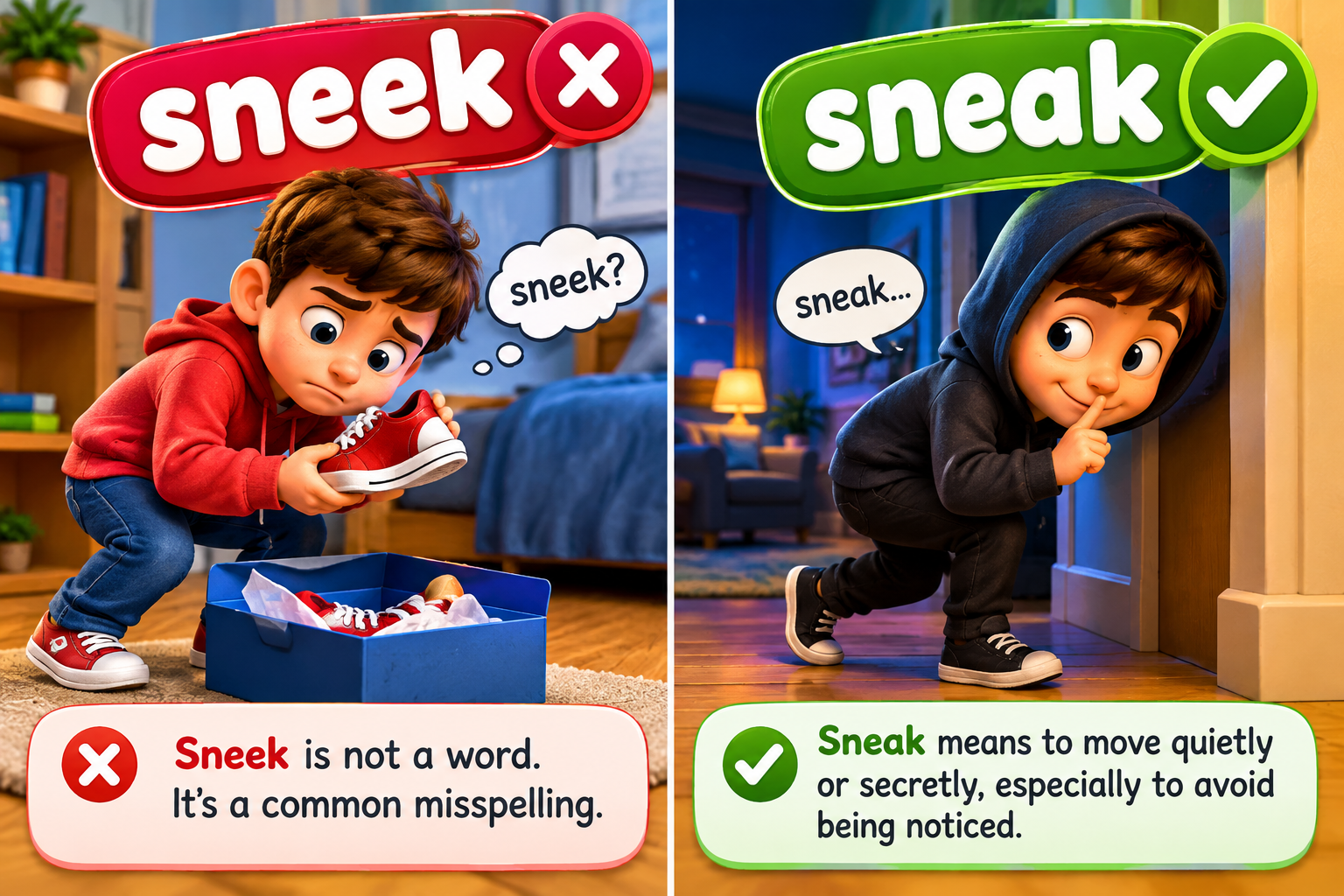
Sneak is the correct spelling when you mean to move, act, or do something quietly or secretly. Sneek is normally a misspelling in standard English, although Sneek is also the name of a city in the Netherlands.
I’ve noticed that sneak is one of those words that can look wrong even when you spell it correctly. The first time I stopped to think about it, the spelling sneek seemed almost natural. After all, we write seek, peek, and week with ee, and they all have the same long “e” sound.
That small spelling doubt can easily show up when you are writing an email, checking a school assignment, or typing quickly online. You may know exactly what you want to say, yet still pause over one vowel.
I’ve also seen another problem: people sometimes think sneek could be a British English version of sneak. It is not. Both British and American English use sneak for the ordinary English word.
The good news is that the rule is simple. Sneak is the standard spelling for the verb and related noun. Sneek is usually an error when you mean secret or quiet movement.
Let’s look at the meaning, history, grammar, common mistakes, and a few easy ways to remember the correct spelling.
Sneek or Sneak Quick Answer
When you want to describe moving quietly, acting secretly, or d
| Point | Explanation |
|---|---|
| Correct spelling | Sneak is the correct spelling when you mean doing something quietly or without being noticed. |
| Example 1 | Correct: The child tried to sneak downstairs. |
| Example 2 | Correct: I wanted to sneak a quick look at the schedule. |
| Incorrect spelling | Incorrect: The child tried to sneek downstairs. |
| Meaning | According to Cambridge Dictionary, sneak means to go somewhere secretly or to take someone or something somewhere secretly. |
| Common expressions | You can use sneak in phrases such as sneak in, sneak out, and sneak up on someone. |
| Easy rule | Sneak = correct English spelling. |
| Common mistake | Sneek = normally a spelling mistake when you mean the English verb sneak. |
| Special exception | Sneek can be correct as a proper name because it is the name of a city in the Netherlands. |
| Key difference | Sneak is the standard English word, while Sneek has a separate use as a place name. |
The Origin and Background of Sneak
The history of sneak makes the word even more interesting.
According to Etymonline, the verb sneak is recorded from the 1550s. It may be connected with Middle English sniken, meaning “to creep” or “crawl,” and ultimately with Old English snican, meaning to creep or crawl.
That gives the word a long history connected with quiet or hidden movement.
Over time, sneak developed several related meanings. It can describe someone moving secretly, doing something without being noticed, or taking something somewhere discreetly.
The noun developed from the verb as well. In modern English, calling someone a sneak can suggest that the person behaves secretly or tells an authority figure about someone else’s actions. Cambridge lists this noun use, especially in informal British English.
Why Does “Sneek” Look So Believable?
The main problem is pronunciation.
Sneak is pronounced /sniːk/. The vowel sound is the long e sound. That same sound appears in words such as:
- seek
- peek
- week
- green
- feel
But English spelling does not always use the same letters for the same sound.
In sneak, the letters ea produce the long “e” sound. The same spelling pattern appears in words such as speak, clean, and dream.
This is a good example of why English spelling cannot always be predicted from pronunciation alone.
Sneek or Sneak Explained Key Differences
The difference becomes easy once you separate the ordinary English word from the proper name.
| Term | Meaning | When to Use | Region/Context |
| sneak | Move or act secretly | Use for quiet or hidden actions | Standard English |
| sneak | A secretive or dishonest person | Use as a noun | Especially informal English |
| sneek | Usually a misspelling of sneak | Avoid it in ordinary English writing | Not a standard spelling for the verb |
| Sneek | Name of a city in the Netherlands | Use only when referring to that place | Proper noun |
The key point is that sneek does not become correct because it sounds like sneak.
For example:
- The students tried to sneak out after lunch.
- She sneaked a look at the clock.
- The dog snuck into the garden.
- He was called a sneak after revealing the secret.
Cambridge lists sneaked and snuck as past forms of sneak, with snuck especially noted in US English.
Common Forms of Sneak
The word can appear in several grammatical forms:
| Form | Function | Example |
| sneak | Base verb | They want to sneak inside. |
| sneaks | Third-person singular | She sneaks away quietly. |
| sneaked | Past form | We sneaked through the side door. |
| snuck | Past form, especially US informal | He snuck out early. |
| sneaking | -ing form | They were sneaking around. |
| sneaky | Adjective | That was a sneaky move. |
| sneak | Noun | Nobody likes a sneak. |
Notice that none of these forms uses sneek as the ordinary base spelling.
Which Version Should You Use?
The practical choice is simple.
For students
Use sneak in essays, homework, exams, and other school writing.
If you are unsure, do not spell the word from its sound. Remember the ea pattern.
For professional writers
Use sneak in emails, reports, articles, and business documents when the meaning fits.
For example, a marketing team might write about a sneak preview of a new product.
For English learners
Learn the word as a complete spelling pattern:
s-n-e-a-k
Do not try to build the spelling from pronunciation alone.
For global English
Choose sneak.
Unlike spelling pairs such as color/colour or center/centre, there is no standard British-versus-American difference between sneak and sneek.
Both major varieties use sneak for the ordinary English word. Cambridge gives the same base spelling in its British and American entries.
Common Mistakes with Sneek or Sneak
Here are some errors worth watching for.
1. Writing “sneek” instead of “sneak”
Mistake: We tried to sneek into the building.
Correction: We tried to sneak into the building.
The error usually comes from the long “e” sound.
2. Writing “sneeky” instead of “sneaky”
Mistake: That was a sneeky plan.
Correction: That was a sneaky plan.
The adjective is spelled sneaky, with ea in the first part.
3. Confusing “sneak peek” with “sneak peak”
A very common related error is sneak peak.
The correct phrase is sneak peek when you mean a quick or early look.
- Correct: Here is a sneak peek at the new design.
- Incorrect: Here is a sneak peak at the new design.
Peek means a quick look. Peak means the highest point of something.
4. Thinking “snuck” is unrelated
You may see:
She snuck out before sunrise.
That does not mean the base word is sneek. Snuck is a past form of sneak. Cambridge recognizes both sneaked and snuck.
5. Treating “sneek” as a British spelling
It is not a British alternative.
British English and American English both use sneak for the standard verb.
Sneak in Real-World Examples
The word sneak appears in many types of writing. Here are fresh examples for different situations.
Professional Email
“We plan to sneak the updated draft into the shared folder before the client meeting.”
Here, sneak means to put something somewhere quietly or without drawing attention to it.
News Headline
Local Team Sneaks Into Final After Late Victory
Here, sneaks into is used figuratively. It suggests that the team reaches the final in a narrow or unexpected way.
Social Media Post
“Here’s a sneak peek at what we’ve been working on this week!”
The phrase means an early or brief look at something that has not been fully revealed.
Formal Report
“The software should prevent unauthorized users from attempting to sneak into restricted areas of the system.”
The verb works in formal writing when the meaning is suitable. However, a technical report may sometimes use a more precise term such as enter without authorization.
Everyday Conversation
“I tried to sneak past the kitchen, but the dog heard me.”
This is a natural everyday use of the verb.
Sneek or Sneak Data, Trends & Usage
The search intent behind “sneek or sneak” is mainly informational. People are usually checking spelling, meaning, or correct usage rather than looking for a product or service.
There is a problem with exact search-volume claims, though. Public web sources do not provide a reliable, current monthly search-volume figure for this exact spelling pair. I therefore would not present an invented Ahrefs, Semrush, or Google search number as fact.
The available evidence does show a clear usage pattern:
- Major learner and general dictionaries list sneak as the standard English word.
- Sneek commonly appears online as a spelling error when writers intend sneak.
- Sneak has several established grammatical forms, including sneaks, sneaked, snuck, and sneaking.
- Sneek also has a separate proper-name use as a city in the Netherlands, so not every appearance of the capitalized form is an English spelling error.
This topic also matters for students and ESL learners because spell-check tools can identify a misspelling without always explaining why it is wrong. Understanding the sound-to-spelling pattern helps you remember the word instead of simply correcting it.
Sneak or Sneek: A Simple Comparison
| Term/Variant | Meaning | Region/Context | Best Used When |
| sneak | Move or act secretly | All standard English varieties | Talking about quiet or hidden action |
| sneak peek | An early or quick look | Common English expression | Introducing a preview |
| sneaked | Past form of sneak | Standard English | Formal or regular past-tense use |
| snuck | Past form of sneak | Especially US English, informal | Conversational writing and speech |
| sneaky | Secretive or dishonest | Standard English | Describing a person, action, or plan |
| Sneek | A place name | Netherlands | Referring to the Dutch city |
This table shows an important detail: sneek is not simply the “other spelling” of sneak. The capitalized form can have a completely different function as a proper noun.
Frequently Asked Questions
Q: What does “sneak” mean?
A: Sneak usually means to move, go, or do something secretly or without being noticed. It can also describe taking or putting something somewhere quietly. Cambridge lists several common uses, including sneak in, sneak out, and sneak up on.
Q: Is “sneek” the correct spelling?
A: No, not when you mean the ordinary English verb sneak. In standard English writing, use sneak rather than sneek.
Q: Why do people spell “sneak” as “sneek”?
A: The main reason is pronunciation. Sneak has the long “e” sound, so writers may connect it with words such as seek and peek, which use ee instead of ea.
Q: Is “sneak” acceptable in formal writing?
A: Yes. Sneak is a standard English word and can appear in formal writing when its meaning suits the context. In very technical writing, a more precise phrase may sometimes be preferable.
Q: Should I write “sneaked” or “snuck”?
A: Both forms are used. Cambridge lists sneaked and also snuck, with the latter especially associated with US English. Choose the form that fits your audience and style.
Q: Where does the word “sneak” come from?
A: Etymonline traces the verb to the 16th century and connects it with earlier Middle English and Old English words related to creeping or crawling. The history explains why secret or quiet movement became central to the word.
Q: Can “Sneek” ever be correct?
A: Yes, but not as the normal spelling of the English verb. Sneek is also the name of a city in the Netherlands, so the capitalized proper noun can be correct in a geographical context.
Conclusion: Sneek or Sneak?
When you are deciding between sneek or sneak, the ordinary English choice is easy: use sneak.
The word describes quiet, secret, or unnoticed action. It works as a verb and can also be used as a noun. Its common forms include sneaks, sneaked, snuck, and sneaking. Cambridge confirms these standard uses and forms.
The spelling mistake happens because sneak sounds as if it could be written with ee. English has many spelling patterns for the same sound, so that confusion is understandable. The useful pattern to remember is sneak = ea, just as in words such as speak and clean.
Also remember the related phrase sneak peek, not sneak peak. And do not assume that sneek is a British spelling. It is not.
One final exception is worth keeping in mind: Sneek can be correct when it is the proper name of the Dutch city.
So, for everyday English writing, keep this simple rule in mind: when you mean quiet or secret movement, spell it sneak.
Bookmark this guide so you never second-guess “sneek or sneak” again.
Read More:
Humour or Humor: Easy Spelling and Usage Guide

I’m an English language educator and SEO content writer having experience creating clear, accurate, and engaging English learning content. I specialize in spelling differences, grammar, vocabulary, synonyms, commonly confused words, and English usage. My goal is to publish well-researched, easy-to-understand articles that help students, writers, educators, and professionals improve their English with confidence through practical explanations and real-world examples.










