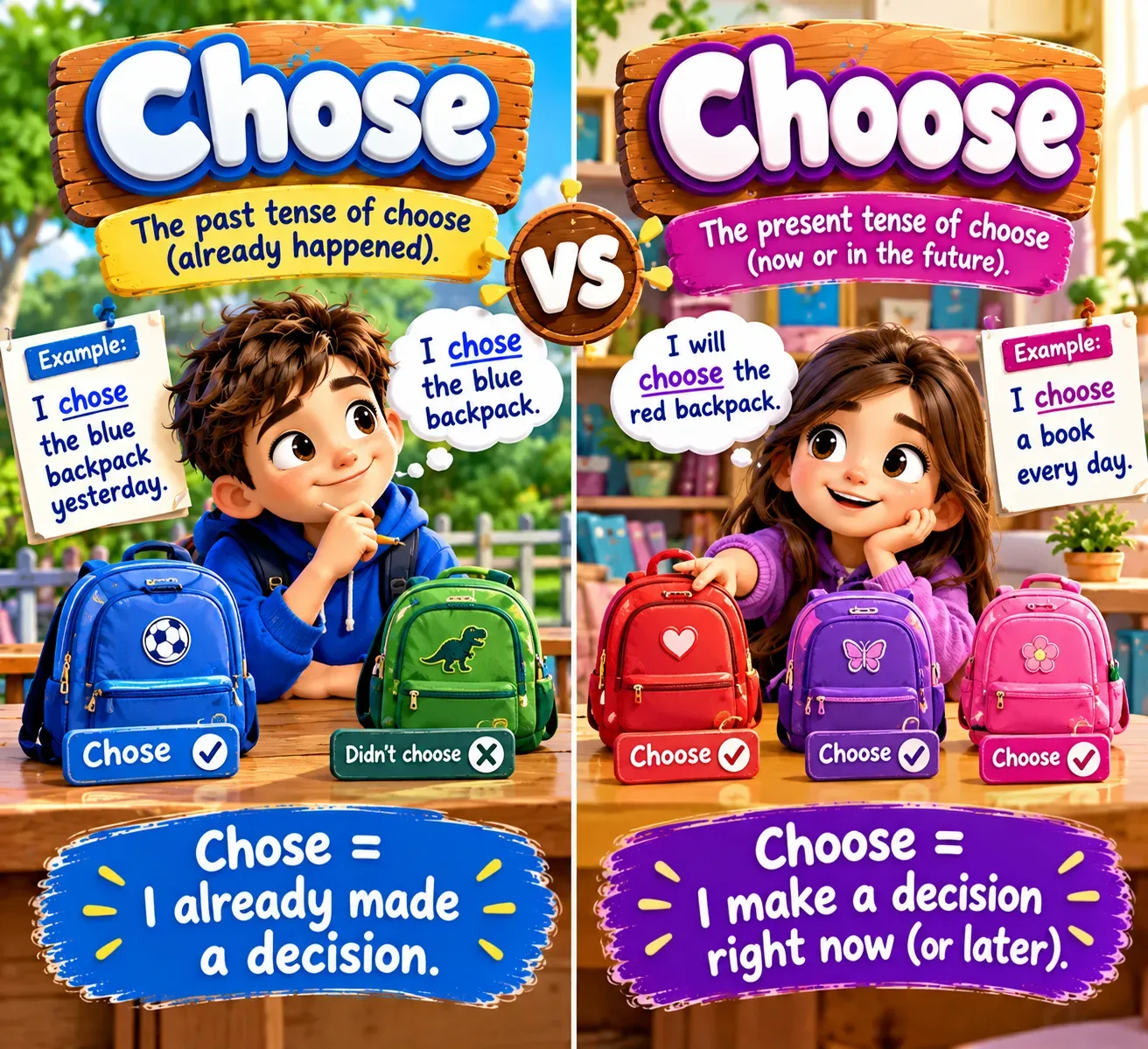
Choose is the present or base form of the verb, while chose is its simple past form. Use choose for a current or future decision and chose for a decision already made.
I often come across a simple question when helping English learners with their writing: Should I use choose or chose? At first, the two words can look almost identical, so it is easy to use the wrong one without noticing. I have seen this small spelling difference cause confusion in emails, school assignments, and everyday sentences.
The key is to think about time. Choose is used for a present or future decision, while chose tells us that the decision happened in the past. There is also chosen, which is the past participle and follows words such as have, has, and had.
For example, if I am deciding now, I might say, “I need to choose a topic today.” If the decision was made yesterday, I would say, “I chose a topic yesterday.”
Once you understand this simple pattern, choose, chose, and chosen become much easier to use correctly. Let’s look at the differences, common mistakes, and practical examples.
Choose or Chose Quick Answer
Choose and chose are forms of the same irregular verb.
Use choose when the action is happening now, happens regularly, or is still ahead:
- I choose the blue folder.
- We will choose a new design tomorrow.
- You can choose any seat.
Use chose when the selection happened in the past:
- I chose the blue folder yesterday.
- We chose a new design last week.
- She chose the window seat.
Cambridge Dictionary lists choose as a verb meaning to decide what you want from two or more possibilities. It gives chose as its past form and chosen as its past participle.
So the basic pattern is:
choose → chose → chosen
Think of the three forms as a small timeline:
Now / base form: choose
Past: chose
Past participle: chosen
That simple timeline solves most choose or chose questions.
The Origin and Background of Choose
The history of choose is much older than modern English.
Etymonline traces the verb to Old English ceosan, which could mean to choose, select, seek out, decide, test, or approve. The word is linked to a much older Proto-Germanic root.
This makes choose an example of an old irregular English verb. Its history helps explain why its past form does not simply add -ed.
Many regular verbs follow a pattern such as:
- walk → walked
- talk → talked
- select → selected
But choose follows a different pattern:
- choose → chose → chosen
The older form also helps explain why English learners cannot reliably create the past tense by adding letters to the base word.
Etymonline records the Old English form ceosan and notes that the older past tense was ceas. Over time, the modern forms developed into choose, chose, and chosen.
The verb is also related to several familiar words. Choice, for example, refers to the act, possibility, or result of choosing. Cambridge Dictionary treats choice as a noun, while choose is a verb.
This gives you another useful distinction:
choose = verb
choice = noun
English has many irregular verbs with forms that must be learned as a group. Think of go → went → gone or write → wrote → written. Choose → chose → chosen works in much the same way.
Choose vs. Chose Key Differences
The biggest difference is verb tense.
| Term | Meaning | When to Use | Region/Context |
| choose | Select or decide | Present, base form, or future-related situations | Standard English |
| chose | Selected or decided | Simple past | Standard English |
| chosen | Selected or decided | After have, has, had, or in passive structures | Standard English |
1. Choose
Choose is the base form of the verb.
It can appear after to:
- I want to choose a new laptop.
- They decided to choose another route.
It can also appear in present-tense sentences:
- I usually choose tea.
- We choose our topics carefully.
It can describe a future decision as well:
- You can choose your seat when you arrive.
- I will choose the final design tomorrow.
2. Chose
Chose is the simple past form.
Use it when the decision happened and finished in the past.
- She chose the red dress for the event.
- They chose a smaller apartment last year.
- He chose to study abroad after graduation.
Words such as yesterday, last week, earlier, in 2024, and when I was younger often make the past meaning clear.
3. Chosen
This is where many learners make another mistake.
Chosen is the past participle, not the simple past.
It normally works with an auxiliary verb such as have, has, or had:
- I have chosen my topic.
- She has chosen a new career.
- They had chosen the location before the meeting.
It also appears in passive constructions:
- Maya was chosen as team leader.
- Three finalists were chosen for the award.
Cambridge Dictionary and Collins Dictionary both list chosen as the past participle of choose.
Which Form Should You Use?
A simple time test can help.
If the choice is current or general → choose
Use it when the decision is happening now or describes a normal action.
I usually choose the cheapest option.
If the choice happened before now → chose
Use it for a completed action in the past.
I chose the cheapest option yesterday.
If you use have, has, or had → chosen
Check the verb after the helping verb.
I have chosen the cheapest option.
A useful memory trick is:
Today = choose
Yesterday = chose
Have/has/had = chosen
This is not a rule for every possible use of English tense, but it is an excellent quick check for ordinary sentences.
Common Mistakes With Choose or Chose
Mistake 1: Using chose for a present decision
❌ I chose this option because it is better for me.
If the decision is being made now, choose is usually the better form.
✅ I choose this option because it is better for me.
Mistake 2: Using choose for a finished past action
❌ Last night, I choose the seafood dish.
The phrase last night places the action in the past.
✅ Last night, I chose the seafood dish.
Mistake 3: Using chose after have or has
❌ She has chose a new course.
After has, you need the past participle.
✅ She has chosen a new course.
Mistake 4: Treating chosen as the simple past
❌ Yesterday, we chosen the winner.
A completed past event without an auxiliary normally needs chose.
✅ Yesterday, we chose the winner.
Mistake 5: Confusing choose with choice
❌ I made a difficult choose.
Here you need a noun.
✅ I made a difficult choice.
Remember:
choose = action
choice = noun
Choose or Chose in Real-World Examples
Seeing the words in different settings makes the grammar easier to remember.
Professional email
Please choose your preferred meeting time from the options below.
The recipient has not made the decision yet, so choose fits.
News headline
Local voters chose a new mayor after a closely watched election.
The election has already happened, so chose describes a completed past action.
Social media post
I finally chose a name for my new project!
The writer has already made the decision.
Formal report
The research team chose three locations for the initial study.
The report describes a completed selection.
Everyday conversation
You can choose whichever movie you want.
The decision is still open.
Workplace discussion
After reviewing the proposals, the board chose the second plan.
The board has already reached its decision.
Notice how the form changes with the time of the action. The meaning of the verb stays related to selecting or deciding, but the tense changes.
Choose or Chose Data, Trends & Usage
The confusion around choose or chose is not surprising. Both forms are common English verbs, and they appear in everyday speech, writing, education, business communication, and online content.
A recent word-frequency comparison based on Wordfreq data reports approximately 81 occurrences per million words for choose and 35 occurrences per million words for chose in its written-English dataset. That makes choose about 2.3 times as frequent as chose in that particular dataset.
These figures should not be treated as universal language statistics. Different corpora contain different types of writing, and frequency changes by genre and context.
Search interest also shows that people actively look for the distinction. One recent keyword-data analysis estimates roughly 40,500 monthly U.S. Google searches for the combined comparison query “choose vs chose”, including close variants, for an average period from September 2025 through August 2026.
Because this is third-party keyword data rather than a direct Google Trends report, treat the figure as an approximate SEO indicator, not an exact count of every search.
Google Books’ Ngram Viewer also provides a useful way to explore the historical frequency of words such as choose and chose across published books. Its results can help researchers study long-term patterns, although Ngram data does not represent everyday conversation.
The search intent behind choose or chose is mainly informational. People usually want to know:
- Which word is grammatically correct?
- Is chose the past tense of choose?
- Should I write choose or chose?
- Is chosen different from both?
- How do I use each form in a sentence?
This matters even more for students, ESL learners, job applicants, and professionals who write emails or reports in English. A small tense error can make an otherwise clear sentence sound incorrect.
Choose or Chose: Standalone Comparison Table
| Term/Variant | Meaning | Region/Context | Best Used When |
| choose | Select or decide | All major varieties of English | The action is current, general, or still to come |
| chose | Selected or decided | All major varieties of English | The action happened in the past |
| chosen | Selected or decided | All major varieties of English | Used with perfect or passive structures |
| choice | An act, option, or result of choosing | All major varieties of English | You need a noun rather than a verb |
This table gives you one extra clue: choice belongs to a different grammatical category.
That distinction is useful because learners sometimes focus only on spelling. Grammar matters just as much.
Frequently Asked Questions
Q: What does choose mean?
A: Choose means to select or decide between two or more possibilities. It is the base form of the verb and is also used for present-tense situations.
Q: What does chose mean?
A: Chose is the simple past form of choose. Use it when the selection or decision happened in the past.
Q: Is chose the past tense of choose?
A: Yes. Cambridge Dictionary identifies chose as the past form of choose. The complete basic pattern is choose → chose → chosen.
Q: Should I write “I choose” or “I chose”?
A: It depends on the time. Write I choose for a present or current decision and I chose when you are talking about a completed past decision.
Q: Is “I have chose” correct?
A: No. After have or has, use chosen. The correct sentence is “I have chosen.”
Q: What is the difference between choose and choice?
A: Choose is a verb, while choice is normally a noun. You choose something, but you make or have a choice.
Q: Where does choose come from?
A: Etymonline traces choose to Old English ceosan, meaning to choose, select, or decide. The verb has a long history in Germanic languages.
Q: Is choose acceptable in formal writing?
A: Yes. Choose is a standard English verb and is completely suitable for formal writing, academic work, reports, emails, and professional documents.
Q: Can chose be used in formal writing?
A: Yes. Chose is the standard simple past form of choose. It is not informal or incorrect.
Q: How do I remember choose and chose?
A: Link them to time: choose for the current or open decision, chose for a completed past decision, and chosen after have, has, or had.
Conclusion
The difference between choose or chose becomes much easier once you stop treating them as competing spellings. They are different forms of the same irregular verb.
Use choose when the decision is current, general, or still ahead. Use chose when the decision has already happened. When have, has, or had appears before the verb, use chosen instead.
The pronunciation also changes. Choose has the long vowel sound heard in words such as “blue,” while chose has the vowel sound found in “go.” Learning the sound difference can help reinforce the spelling difference.
Remember the simple pattern:
choose → chose → chosen
Also keep choice separate. It is normally a noun, not another tense of the verb.
Once you connect each form with its grammatical role and time, this common English problem becomes much easier.
Bookmark this guide so you never have to second-guess choose, chose, and chosen again.
Read More:
There or Their: The Easy Way to Choose

I specialize in English grammar, spelling, word choice, and language usage. My content is based on research from grammar references, style guides, dictionaries, and real-world usage to ensure it is accurate and practical.
At Spelling Comparison, I write guides that explain why words are confused, how they are used, and which form is correct in context. I also include proofreading tips, examples, and writing advice readers can apply immediately.
My goal is to publish clear, reliable content that helps readers make better writing decisions. Each guide is written for accuracy, clarity, and usefulness in school, work, business, and everyday communication.










