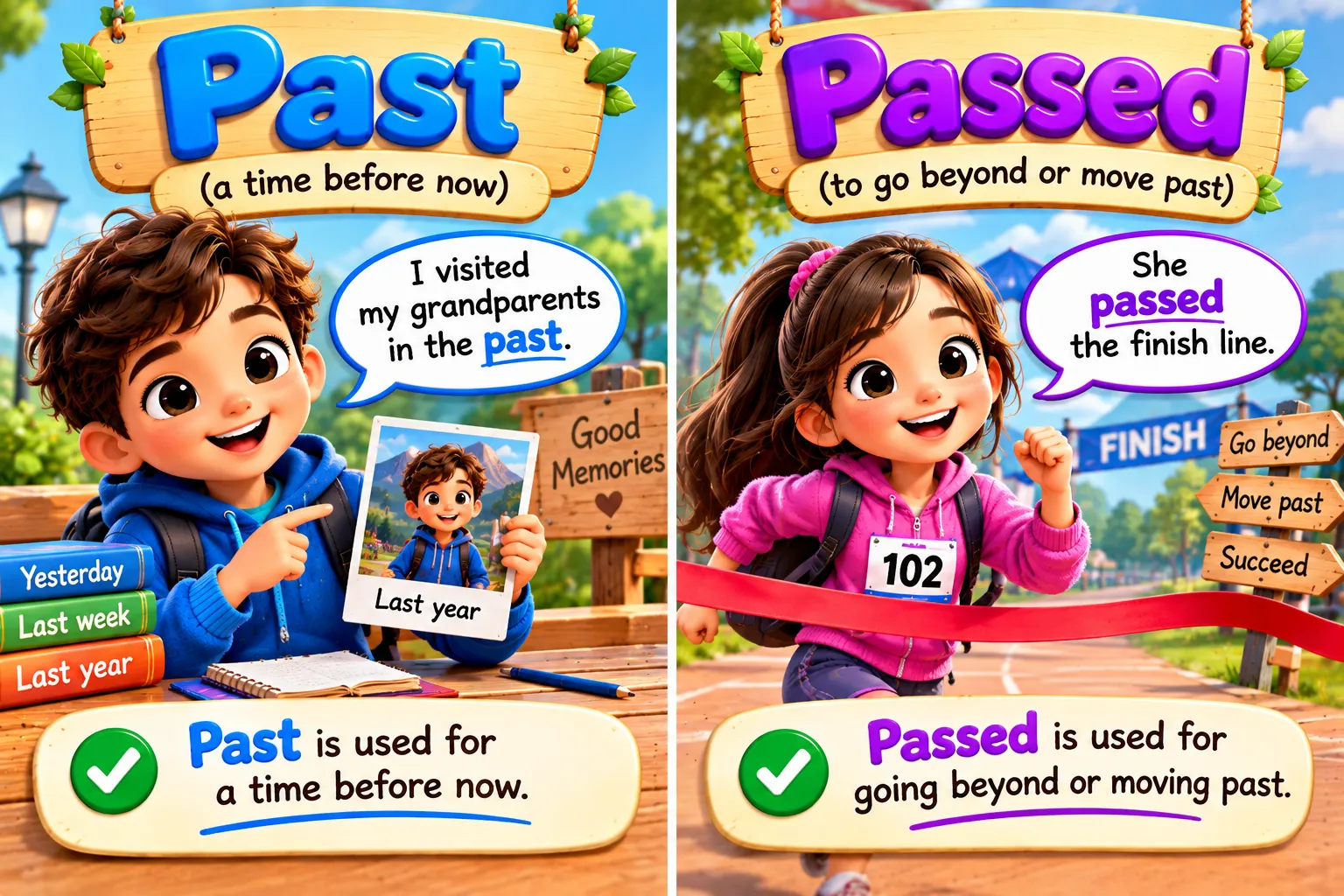
Past refers to an earlier time, position, or experience, while passed is the past tense and past participle of the verb pass.
I have seen past and passed cause confusion even in otherwise strong English writing. The problem is easy to understand. They sound almost the same, but they do different jobs in a sentence.
When I help learners edit emails, essays, and everyday messages, I often find sentences such as “She past the test” or “We walked passed the store.” These mistakes usually happen because the two words are homophones. They sound alike in many varieties of English, but their meanings and grammar are different.
The good news is that you do not need to memorize a long list of rules. You only need to understand what each word does.
Past can describe an earlier time, a position beyond something, or a previous experience. Passed is a form of the verb pass. It tells us that someone or something moved, went beyond a point, succeeded, or completed an action.
Once you learn this simple difference, choosing the right word becomes much easier. Let’s look at the meanings, grammar, pronunciation, common mistakes, and practical examples.
Past or Passed Quick Answer
The easiest way to remember the difference is this:
- Past = earlier time, beyond a point, or previous experience.
- Passed = an action completed by the verb pass.
Consider these examples:
- The museum is past the library.
- She passed the library without stopping.
- We talked about our past.
- He passed his driving test.
In the first and third examples, past describes time, position, or experience.
In the second and fourth examples, passed describes an action.
According to Cambridge Dictionary, passed is the simple past and past participle of pass. Cambridge also lists past as a preposition and adverb in uses involving position and being beyond a particular point.
That grammatical difference is the key to using these words correctly.
The Origin and Background of Past and Passed
The connection between these words goes back to the history of pass.
Etymonline traces pass to Middle English passen, from Old French passer, with roots connected to Vulgar Latin passare and Latin passus, meaning a step or pace. The English verb developed meanings related to going by, crossing, moving forward, and experiencing something.
The word past has a closely related history. Etymonline records past from the early 14th century as a variant of passed, the past participle of the older verb passen. Its meaning later developed to refer to something gone by or belonging to an earlier time.
This history helps explain why the words look and sound so similar.
But modern English gives them different grammatical jobs.
Passed remains a verb form:
The train passed the station.
Past can work as several parts of speech, including a noun, adjective, preposition, and adverb:
We left our past behind.
The car drove past the house.
You do not need to study historical linguistics to use these words well. Still, knowing that they share a historical connection makes their similarity easier to understand.
Past Explained
Past usually refers to something that happened before now.
It can also describe a position beyond something or movement from one side of a point to another.
Common uses of past
1. Earlier time
I learned a lot from my past.
2. A previous experience
Her past shaped the way she thinks today.
3. Beyond a place
The pharmacy is past the bank.
4. Beyond a time
It is past midnight.
5. Moving beyond something
The runner went past the finish line.
Cambridge gives past as a word used for position and for being beyond a particular point or limit.
So, when you are talking about time, position, or something that lies beyond a point, past is often the correct choice.
Passed Explained
Passed is the simple past and past participle form of pass.
It normally describes an action.
For example:
The bus passed our house.
Here, passed tells us what the bus did.
It can also describe several other actions:
- She passed the exam.
- He passed me the keys.
- Time passed quickly.
- The message was passed to the manager.
- They passed through the security gate.
Etymonline records several historical meanings of pass, including going by something, moving forward, experiencing something, and successfully completing an examination.
A useful test is to ask:
Is someone or something doing the action of passing?
If yes, passed may be the word you need.
Past vs Passed: Key Differences
| Term | Meaning | When to Use | Region/Context |
| Past | Earlier time or beyond a point | Talk about time, position, or previous events | Standard English |
| Passed | Completed form of pass | Describe an action that happened | Standard English |
| Pass | Move by, succeed, give, or go through | Present/base form of the verb | Standard English |
Compare them
Past:
The hotel is past the bridge.
Here, past tells you where the hotel is.
Passed:
We passed the bridge at noon.
Here, passed tells you what we did.
Another useful comparison is:
The deadline is past.
The deadline passed yesterday.
The first sentence describes the deadline as being beyond the present time. The second describes the event as something that happened.
An Easy Trick to Remember Past or Passed
Try replacing the word with went by or moved by.
If the sentence needs an action, passed may work.
For example:
The car passed my house.
You could say:
The car went by my house.
That makes sense.
Now consider:
The car is past my house.
Here, past describes the car’s position. You are not using it as the main action verb.
Another memory trick is:
Passed = pass + ed
The -ed ending can remind you that passed is a verb form describing a completed action.
Past = time or position
Think of phrases such as:
- the past year
- the past month
- the past few days
- past the school
- past the deadline
This simple association can prevent many mistakes.
Which One Should You Use?
For beginners and English learners, focus on the grammar first.
If you mean earlier time
Use past.
We discussed the past during the meeting.
If you mean beyond a place
Use past.
Walk past the main entrance.
If you mean an action
Use passed.
She passed the main entrance without stopping.
If someone succeeded
Use passed.
Daniel passed his final exam.
For neutral or formal writing
Use the word that matches the grammar. Neither word is more formal than the other.
The real issue is not style. It is meaning and sentence structure.
Common Mistakes with Past and Passed
1. “She past the exam.”
Wrong: She past the exam.
Correct: She passed the exam.
Why? Passed is the verb describing the action of succeeding.
2. “Walk passed the school.”
Wrong: Walk passed the school.
Correct: Walk past the school.
Why? Past shows position or movement beyond the school. It is not the past-tense verb pass.
3. “In the passed few years”
Wrong: In the passed few years
Correct: In the past few years
Why? You are talking about an earlier period of time. Use past.
4. “The car past me.”
Wrong: The car past me.
Correct: The car passed me.
Why? The sentence needs a verb. Passed tells us what the car did.
5. “My passed experiences”
Wrong: My passed experiences
Correct: My past experiences
Why? Past describes experiences that happened earlier in your life.
Past or Passed in Real-World Examples
Seeing these words in different types of writing can make the distinction easier to remember.
Professional email
I have reviewed the past project reports and noticed a few areas that need attention.
Here, past refers to reports from an earlier period.
News headline
Local Team Passed Major Test With Strong Performance
Here, passed describes an action or achievement.
Social media post
Looking back at the past year, I am proud of how much I have learned.
Here, past refers to an earlier period.
Formal report
The proposal passed the review stage after several revisions.
Here, passed is the verb describing what happened to the proposal.
These examples show why context matters. The two words may sound alike, but the grammar around them gives you the answer.
Past or Passed: Pronunciation and Grammar
One reason this pair causes so many mistakes is pronunciation.
In many varieties of English, past and passed are pronounced the same or very similarly.
Cambridge gives the US pronunciation of past as /pæst/ and lists passed as the past form of pass, whose US pronunciation is /pæs/. In connected speech, the final sounds can make the words sound extremely similar.
That means pronunciation alone is not always enough.
When writing, look at the job of the word.
Ask:
- Am I talking about earlier time?
- Am I describing a position beyond something?
- Am I describing an action?
- Could I replace the word with went by or moved by?
These questions usually make the answer clear.
Past vs Passed Data, Trends & Usage
The confusion between these words is not surprising because both forms appear naturally in written English.
Google Books Ngram Viewer allows researchers to compare word and phrase frequencies across large collections of books. Its current documentation explains that the tool tracks how words and phrases occur in book corpora and supports different English corpora, including British and American English.
A Google Books comparison also shows that both forms occur across long periods of English language publishing. For example, Ngram Viewer can compare phrases such as “years past” and “years passed”, demonstrating that each form has established uses depending on context.
The important SEO and learning insight is this: past and passed are not competing spellings of the same word. They represent different grammatical functions.
Search intent around past or passed is therefore mainly informational. Readers usually want to know which spelling fits a sentence, why the words sound alike, and how to avoid mistakes.
This matters in emails, school assignments, reports, applications, and online writing. A spelling checker may flag an error, but understanding the grammar helps you make the correct choice yourself.
Standalone Past vs Passed Comparison
| Term/Variant | Meaning | Region/Context | Best Used When |
| Past | Earlier time or beyond a point | All major varieties of English | Referring to time, position, or previous experience |
| Passed | Past form of pass | All major varieties of English | Describing an action completed in the past |
| Pass | Move by, succeed, give, or go through | All major varieties of English | Present or base-form verb |
| Passing | Moving by or occurring | All major varieties of English | Describing an ongoing action |
The third form, pass, is especially useful when checking whether passed is acting as a verb.
For example:
I pass the store every morning.
I passed the store yesterday.
I am passing the store now.
But:
The store is past the library.
The pattern becomes much easier when you compare the verb forms side by side.
FAQs About Past or Passed
Q: What does past mean?
A: Past can refer to an earlier time or something beyond a particular point or place. It can function as a noun, adjective, preposition, or adverb depending on the sentence.
Q: What does passed mean?
A: Passed is the simple past and past participle of pass. It describes actions such as moving by something, succeeding in a test, or going through a place.
Q: Is “passed” always a verb?
A: In standard uses, passed is a verb form of pass. If you are describing earlier time or a position beyond something, past is usually the correct choice.
Q: Is “walk past” or “walk passed” correct?
A: Walk past is correct when past shows movement beyond a place or person. For example, “Walk past the reception desk.”
Q: Is “passed the deadline” correct?
A: Yes. Passed is correct when you mean that the deadline went by. For example, “The deadline passed without an extension.”
Q: Where do past and passed come from?
A: They are historically connected with the verb pass. Etymonline traces pass through Old French passer and Vulgar Latin passare, while past developed as a form related to the past participle of the earlier verb.
Q: Are past and passed homophones?
A: They are commonly treated as homophones because they have the same or nearly the same pronunciation in many English varieties. Their spelling and grammatical roles are different.
Q: Which is correct: “past experience” or “passed experience”?
A: Past experience is correct when you mean experience from an earlier time. Passed does not normally work as an adjective in this expression.
Final Takeaway: Past or Passed?
The difference between past and passed becomes simple once you focus on grammar.
Use past when you are talking about an earlier time, a previous experience, or a position beyond something. Use passed when you need the past form of the verb pass.
Remember these two questions:
- Is it about time or position? → past
- Is it an action performed by someone or something? → passed
For example, you can talk about your past, walk past a building, or say that a car passed you.
The words may sound alike, but they do not have the same job. That is why relying only on pronunciation can lead to mistakes.
Once you train yourself to check the sentence’s meaning and grammar, the choice becomes much faster. This is especially useful in formal writing, schoolwork, professional emails, and everyday messages.
Bookmark this guide and use the simple time-or-action test whenever you are unsure about past or passed.
Read More:
Choose or Chose: The Easy Grammar Guide

I’m **Rubab Naaz**, an English language content writer with over 10 years of experience creating educational and SEO-focused articles. I specialize in spelling comparisons, grammar, vocabulary, synonyms, commonly confused words, and English usage. My passion is helping students, writers, and professionals improve their language skills through accurate, well-researched, and easy-to-understand content. Every article I write is designed to make learning English simple, practical, and engaging.










