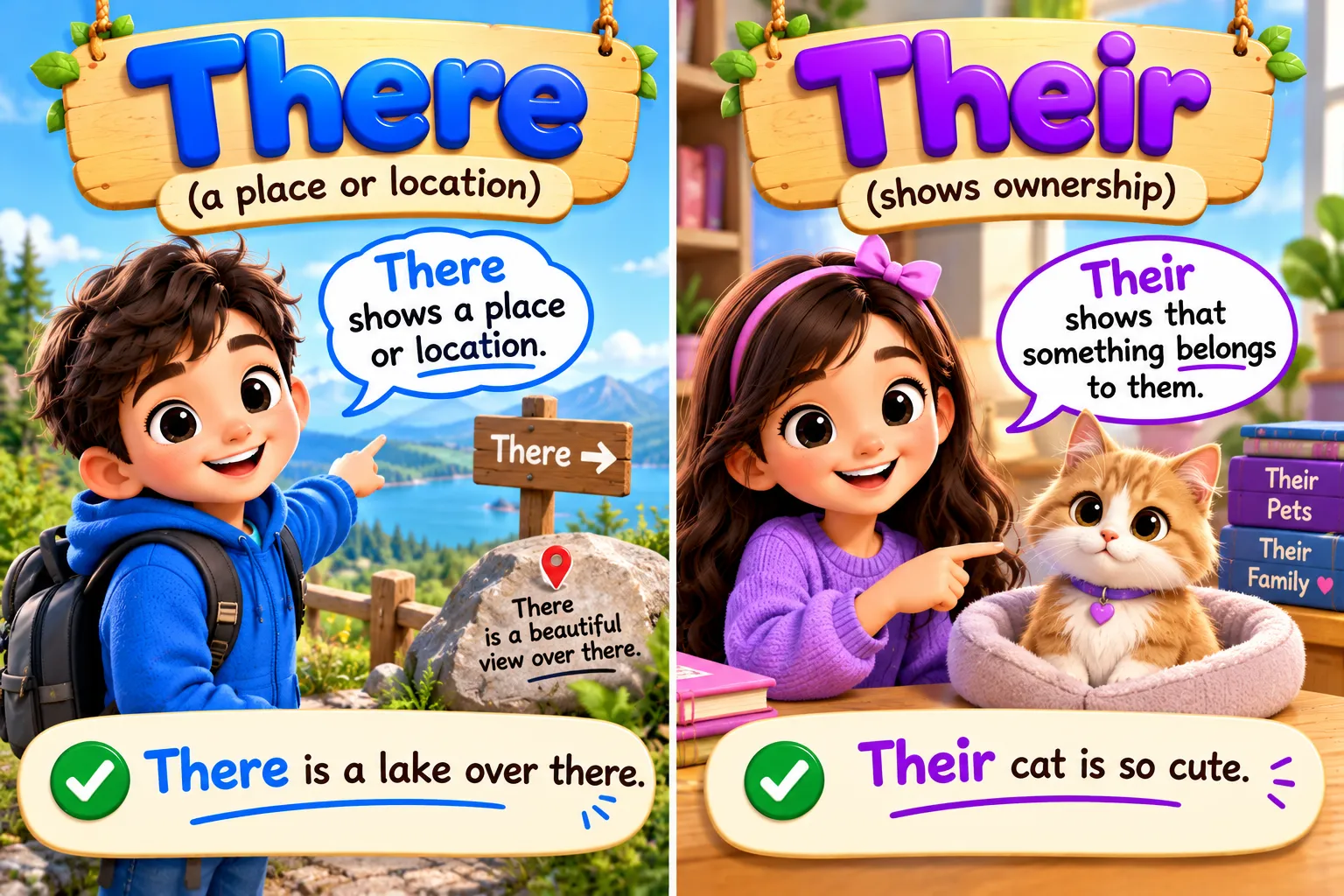
There refers to a place or shows that something exists, while their shows that something belongs to or is connected with them.
I have seen there and their mixed up countless times, even in writing that is otherwise clear and polished. The reason is simple: when you say them aloud, they can sound the same.
That makes this pair tricky for English learners. You may know what you want to say, but your fingers can still choose the wrong spelling.
I remember noticing this kind of mistake most often when someone was writing quickly. A sentence would look perfectly natural until one small word changed the meaning. A phrase about someone’s belongings suddenly looked like a phrase about a place.
The good news is that there and their have very different jobs. Once you learn what each word does, the choice becomes much easier.
There can point to a place or introduce the existence of something. Their shows possession or connection.
In this guide, I will break down the difference, explain the history of both words, show common mistakes, and give you simple tricks for choosing the right one.
There or Their Quick Answer
There and their are both common English words, but they serve different grammatical roles.
Use there when you are talking about a place:
The keys are over there.
Use their when something belongs to a person or group:
The students packed their books.
Cambridge explains that there can refer to a place and can also be used to say that something exists. Their is a possessive determiner meaning “belonging to them.”
The fastest way to remember
Ask yourself:
Does it mean a place? → there
Does it mean belonging to them? → their
For example:
- Put the bags over there. → place
- The children grabbed their bags. → possession
There is also a third word that sounds like these two: they’re.
They’re means they are.
They’re waiting over there with their bags.
That one sentence shows all three forms together.
The Origin and Background of There and Their
The history of these words is surprisingly interesting.
Where does “there” come from?
Etymonline traces there to Old English þær, meaning “in or at that definite place.” It came from an older Germanic word related to forms found in several other Germanic languages.
Over time, there developed several grammatical uses.
Today, it can work as an adverb when it refers to a place:
Your shoes are over there.
It can also introduce a sentence that tells us something exists:
There is a problem with the printer.
Cambridge describes this second use as a dummy or empty subject in structures such as there is and there are.
Where does “their” come from?
Their has a different history.
Oxford traces it to Middle English and ultimately to Old Norse their(r)a, meaning “of them.”
This Scandinavian influence is connected with the history of they, them, and their in English.
Etymonline explains that they entered English from a Scandinavian source and eventually replaced older English forms. The related forms them and their became part of the modern English pronoun system.
So although there and their sound alike in many varieties of English, their histories are not the same.
That is one reason pronunciation cannot help you much when choosing between them.
There vs. Their: Key Differences
| Term | Meaning | When to Use | Grammar / Context |
| There | In, at, or to a place | When referring to location | Adverb |
| There | Shows that something exists | With is, are, was, were, etc. | Dummy subject |
| Their | Belonging to them | Before a noun | Possessive determiner |
| They’re | They are | As a contraction of they are | Pronoun + verb |
1. There = a place
Use there when you can point to a location.
The restaurant is over there.
Please leave the package there.
A useful mental test is to replace there with that place.
Leave the package in that place.
If the meaning still works, there is probably the correct word.
2. There = existence
There also appears in structures such as:
- there is
- there are
- there was
- there were
- there will be
Examples:
There is a new message in your inbox.
There are several questions on the test.
Here, there does not mean a physical location. Instead, it helps introduce the fact that something exists or is present. Cambridge specifically identifies this grammatical use of there.
3. Their = belonging to them
Use their to show possession or association.
The players changed their uniforms.
The company updated their website.
The children finished their homework.
Cambridge defines their as a possessive determiner meaning “of or belonging to them.”
4. They’re = they are
Although your focus keyword is there or their, you should also know they’re.
They’re is a contraction of they are. Cambridge confirms this directly.
Try expanding the sentence:
They’re ready.
becomes:
They are ready.
If the expanded version makes sense, they’re is correct.
Which Version Should You Use?
There is no single “better” word.
Your choice depends on what you mean.
Use “there” for a location
Choose there when you are talking about a place.
Your coat is over there.
Think place.
Use “their” for possession
Choose their when something belongs to or is connected with them.
The workers returned to their office.
Think ownership or connection.
Use “there” with existence
Choose there in structures such as:
There is a problem.
There are two seats available.
Think something exists.
Use “they’re” for “they are”
Choose they’re when you can replace it with they are.
They’re late.
→ They are late.
This simple test can prevent many mistakes.
Common Mistakes With There or Their
Mistake 1: Using “their” for a place
❌ The books are over their.
✅ The books are over there.
Why? The sentence refers to a location.
Mistake 2: Using “there” for possession
❌ The students opened there notebooks.
✅ The students opened their notebooks.
Why? The notebooks belong to the students.
Mistake 3: Confusing “their” with “they’re”
❌ Their going to arrive soon.
✅ They’re going to arrive soon.
Why? They’re means they are.
Mistake 4: Writing “there” when you mean “they’re”
❌ There planning a trip.
✅ They’re planning a trip.
Try the expansion:
They are planning a trip.
It works, so they’re is correct.
Mistake 5: Choosing by sound
This is perhaps the biggest problem.
There, their, and they’re can sound the same, so listening alone is not enough. Cambridge specifically identifies these three words as commonly confused because they sound the same.
Instead, look at the meaning and grammar.
Ask what role the word plays in the sentence.
There or Their in Real-World Examples
Seeing these words in realistic situations can make the difference easier to remember.
Professional email
Please send the signed documents to the finance team. Their office is on the second floor.
Here, their refers to the finance team’s office.
News headline
There Are New Safety Rules for Drivers
Here, there introduces the existence of new rules.
Social media post
They’re finally opening their new café, and the entrance is over there!
This example uses all three forms naturally.
Formal report
The researchers placed their findings in a separate appendix.
Here, their shows that the findings belong to or are associated with the researchers.
Everyday conversation
Your friends are waiting over there.
The word refers to a location.
There or Their: Data, Trends & Usage
The confusion between there, their, and they’re is a classic English usage problem because the words are homophones in many accents.
Homophones are words that sound alike but have different meanings and spellings. Oxford notes that its dictionary usage notes identify words that have the same pronunciation but different spelling and meaning.
Why does this matter?
These words are extremely common in everyday English. That means even a small spelling error can appear in:
- Emails
- School assignments
- Websites
- Business documents
- Social media
- Professional reports
The issue is especially important for English learners because pronunciation does not provide a reliable clue.
Search intent
The search intent behind there or their is mainly informational.
People searching this phrase usually want to:
- Learn the difference
- Check a sentence
- Improve grammar
- Avoid spelling mistakes
- Understand they’re as well
Corpus and frequency insight
Because there and their are both high-frequency function words, a simple frequency comparison does not tell you which spelling is “correct.” They are both correct words.
The real question is which grammatical role your sentence requires.
That is a useful distinction between this topic and spelling pairs such as canceling/cancelling. With there and their, the issue is not American versus British spelling. It is meaning and grammar.
Why the topic still matters
Grammar tools and spell checkers can catch many errors, but context remains important. A sentence can contain a correctly spelled word that is still the wrong word.
For example:
The children left there bags outside.
Both words are spelled correctly in isolation. The sentence is still wrong because there does not show possession.
Understanding the grammar is more useful than relying only on automatic correction.
There vs. Their: Standalone Comparison Table
| Term | Core Meaning | Grammar Role | Best Used When |
| There | A place | Adverb | You mean a location |
| There | Existence or presence | Dummy subject | You use structures like “there is” |
| Their | Belonging to them | Possessive determiner | You describe ownership or association |
| They’re | They are | Contraction | You can expand it to “they are” |
| Theirs | Belonging to them | Possessive pronoun | You use it without a following noun |
Notice the difference between their and theirs:
That is their car.
That car is theirs.
Their normally comes before a noun. Theirs can stand on its own.
A Simple Trick to Remember There and Their
Try these three memory links:
There = place
Both there and where contain -here-like location thinking.
Where is it?
It is there.
Their = possession
Think:
Their = belonging to them
They brought their books.
They’re = they are
Always test the contraction:
They’re happy.
→ They are happy.
If they are works, use they’re.
If you practice these three checks, you will catch most mistakes quickly.
FAQs About There or Their
Q: What does “there” mean?
A: There can refer to a particular place. It can also introduce the existence or presence of something, as in there is or there are.
Q: What does “their” mean?
A: Their is a possessive determiner. It shows that something belongs to, relates to, or is associated with them.
Q: What is the difference between there and their?
A: There is mainly used for location or existence. Their expresses possession or connection with people, animals, or things already identified.
Q: Is “there” a pronoun or an adverb?
A: When there refers to a location, it functions as an adverb. It also has a grammatical use in structures such as there is and there are.
Q: Is “their” always about ownership?
A: It usually expresses possession or association, but it does not always mean literal ownership. For example, their teacher identifies a relationship rather than something they own.
Q: Can “their” refer to one person?
A: Yes. Their can be used with singular they when a person’s gender is unknown, unspecified, or when that person uses they/them pronouns. Cambridge and Oxford both document this use.
Q: What is the difference between there, their, and they’re?
A: There refers to a place or introduces existence. Their shows possession or association. They’re is short for they are.
Conclusion
The difference between there and their becomes much easier when you stop relying on sound and focus on meaning.
Use there when you mean a place, such as a location you can point to. You can also use it in structures such as there is and there are to introduce something that exists.
Use their when you want to show possession, connection, or association. It normally appears before a noun, as in their house, their ideas, or their teacher.
Then remember the third member of this confusing group: they’re. It is simply the shortened form of they are.
A quick test can solve most cases. If you mean a place, choose there. If you mean belonging to them, choose their. If you mean they are, choose they’re.
These words may sound alike, but their jobs are different. Once you learn those jobs, choosing the correct spelling becomes much more natural.
Bookmark this guide and share it with someone who still mixes up there, their, and they’re.
Read More:
Canceling or Cancelling: The Easy Spelling Guide

I’m **Rubab Naaz**, an English language content writer with over 10 years of experience creating educational and SEO-focused articles. I specialize in spelling comparisons, grammar, vocabulary, synonyms, commonly confused words, and English usage. My passion is helping students, writers, and professionals improve their language skills through accurate, well-researched, and easy-to-understand content. Every article I write is designed to make learning English simple, practical, and engaging.










