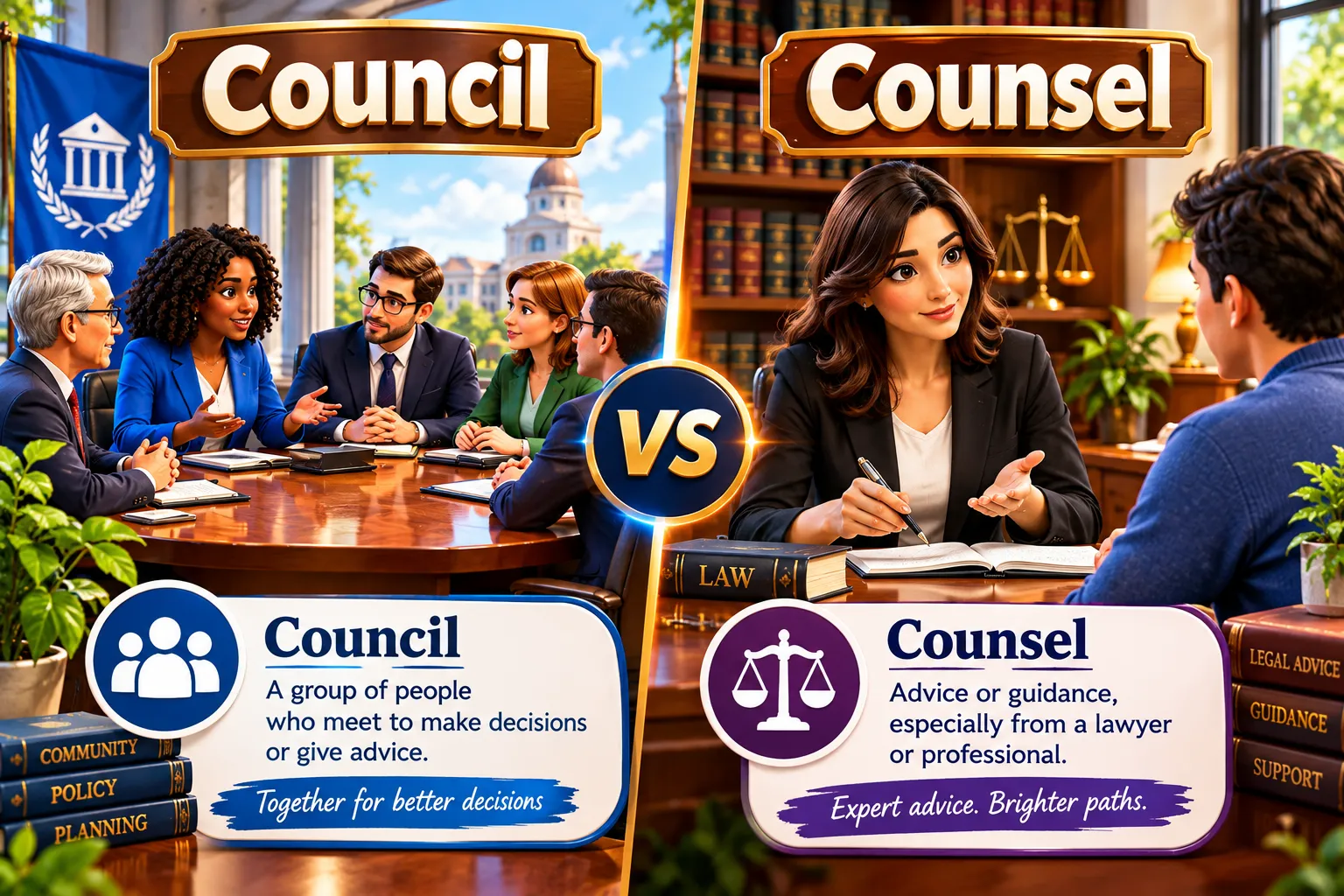
Council is a group that makes decisions or gives advice, while counsel means advice or the act of giving advice. Counsel can also mean a lawyer in a legal case.
I often find myself pausing when I write council because counsel sounds almost exactly the same. I have come across this confusion many times while checking English writing, and I understand why these two words are so easy to mix up. Their pronunciation is similar, but their meanings are quite different.
I use council when I am talking about a group, such as a city government, committee, or official body. When I mean advice, guidance, or a lawyer, I use counsel. Choosing the wrong word can change the meaning of the entire sentence.
I have also noticed that the confusion becomes stronger in phrases such as city council and legal counsel, where both words sound natural when spoken aloud. The spelling is what helps me tell them apart.
In this guide, I’ll explain council vs. counsel with clear meanings, examples, common mistakes, and simple rules. By the end, you’ll know exactly which word to use in your writing.
Council or Counsel Quick Answer
| Word | Part of Speech | Meaning | When to Use | Example |
|---|---|---|---|---|
| Council | Noun | A group of people chosen or elected to make decisions, give advice, or manage an organization or area. | Use it for a government body, committee, or official group. | The council approved a plan for the new library. |
| Counsel | Noun | Advice or guidance. It can also mean a lawyer or lawyers involved in a legal case. | Use it when referring to advice, guidance, or legal representation. | She asked her mentor for counsel before accepting the offer. |
| Counsel | Verb | To advise, guide, or give someone advice. | Use it when someone provides advice or guidance. | The teacher counseled the student about the problem. |
Counsel = advice or a lawyer.
The Origin and Background of Council and Counsel
The confusion between these words is not new.
According to the Online Etymology Dictionary, council dates to the early 12th century. It came through Anglo-French and Old French from Latin concilium, meaning a meeting or gathering. The word developed around the idea of people being called together.
Counsel has a different historical path. Etymonline traces the noun to around 1200, through Old French counseil and Latin consilium, connected with ideas such as advice, plans, and opinions. Its verb form developed around the idea of giving advice or instruction.
The two forms have been confused for centuries. Etymonline specifically notes that the tendency to mix council and counsel in form and meaning has existed since at least the 16th century.
That history helps explain why modern writers still hesitate over them.
They also belong to different grammatical roles:
- Council → mainly a noun
- Counsel → noun and verb
- Councilor/councillor → a person who belongs to a council
- Counselor/counsellor → a person who gives counsel or advice
Cambridge Dictionary defines a councilor as an elected member of local government and lists counsellor as the British spelling of counselor, a person who provides advice or help.
Council vs. Counsel: Key Differences
The easiest way to separate the words is to focus on the meaning rather than the sound.
| Term | Meaning | When to Use | Region/Context |
| Council | A group that makes decisions or gives advice | Government, organizations, committees | General English |
| Counsel | Advice, guidance, or professional advice | Personal, professional, and legal contexts | General English |
| Counsel | A lawyer or legal team | Court and legal writing | Especially legal English |
| Councilor | A member of a council | Local government | US spelling |
| Councillor | A member of a council | Local government | UK spelling |
| Counselor | A person who gives advice or support | Guidance, counseling, professional settings | US spelling |
| Counsellor | A person who gives advice or support | Guidance and professional settings | UK spelling |
Council in a sentence
The council discussed the proposed changes to the park.
Here, council refers to a group of people.
Counsel as advice
He sought legal counsel before signing the agreement.
Here, counsel refers to legal advice or assistance.
Counsel as a verb
The teacher counseled the student about the problem.
In this sentence, counseled means advised or guided. Cambridge lists counsel as a verb meaning to give advice, especially about social or personal problems.
Counsel in law
The judge asked counsel to address the court.
In this legal use, counsel refers to the lawyer or lawyers involved in the case.
Which Word Should You Use?
Your choice depends on what you mean.
If you mean a group, use council
Choose council when you are talking about:
- a city or town government
- an official committee
- an organization that makes decisions
- a group created to advise or represent people
Examples include city council, local council, student council, and security council.
If you mean advice, use counsel
Use counsel when someone gives or receives advice.
For example:
- seek counsel
- offer counsel
- wise counsel
- professional counsel
- legal counsel
Cambridge describes the noun counsel as formal language for advice and also recognizes its specialized legal meaning.
If you mean a lawyer, use counsel
Legal writing often uses counsel to refer to a lawyer or legal team.
For example:
Counsel presented new evidence during the hearing.
This is different from council, which refers to a group or governing body.
Common Mistakes With Council and Counsel
1. Mistake: The city counsel approved the budget.
Correct: The city council approved the budget.
A city government body is a council.
2. Mistake: She asked her friend for council.
Correct: She asked her friend for counsel.
Here, the meaning is advice.
3. Mistake: The lawyer joined the city counsel.
Correct: The lawyer joined the city council.
If the person joined a governing group, council is the right word.
4. Mistake: He gave me good council.
Correct: He gave me good counsel.
The sentence means he gave useful advice.
5. Mistake: The judge spoke with the city counsel.
Correct: The judge spoke with legal counsel.
In a legal setting, counsel can refer to a lawyer or lawyers.
Council and Counsel in Real-World Examples
Seeing the words in different types of writing makes the distinction easier to remember.
Professional email
Subject: Council Meeting Update
The council will review the proposal during its next meeting. Please send any comments before the scheduled discussion.
Here, council refers to the decision-making group.
News headline
Council Approves New Public Transport Plan
A news headline may use council to identify the local governing body that made the decision.
Social media post
I attended the student council meeting today and learned a lot about how campus decisions are made.
The phrase student council names an organized group.
Formal document
The organization recommends that members seek independent legal counsel before entering into the agreement.
Here, counsel refers to legal advice or assistance.
Council or Counsel: Data, Trends and Usage
The main search intent behind council or counsel is informational. People who search the pair are usually trying to understand the difference, choose the correct spelling, or check a sentence.
Exact monthly search-volume figures for these two terms can vary by country, keyword tool, date, and database. Because no live Ahrefs, Semrush, or Google Trends dataset is supplied here, it would be misleading to present an invented monthly search number as fact.
The same caution applies to regional search-interest percentages. Search interest can change over time, and a global English-language comparison may produce different results from one focused on the United States, United Kingdom, or another country.
What can be verified from dictionary and etymological sources is the usage distinction:
- Council is associated with groups, organizations, and government bodies.
- Counsel is associated with advice, advising, and legal representation.
- Counsel can function as both a noun and a verb.
- Councilor/councillor and counselor/counsellor form related but separate word families.
This distinction matters today because short professional messages, online forms, reports, and AI-assisted writing tools leave little room for a spelling mistake that changes meaning.
Council vs. Counsel: Comparison Table
| Term/Variant | Meaning | Region/Context | Best Used When |
| Council | Decision-making or advisory group | Government and organizations | Referring to a group |
| Counsel | Advice or guidance | Formal and general contexts | Talking about advice |
| Counsel | Lawyer or legal team | Legal context | Referring to legal representation |
| Councilor | Member of a council | Mainly US English | Referring to a local government member |
| Councillor | Member of a council | Mainly UK English | Referring to a local government member |
| Counselor | Person who provides advice | US English | Guidance or support roles |
| Counsellor | Person who provides advice | UK English | Guidance or support roles |
The key point is that council and counsel are not simply two spellings of the same word. They have different meanings.
Frequently Asked Questions
Q: What does council mean?
A: Council means a group of people chosen or elected to make decisions, give advice, represent others, or manage an area or organization. A city council is a common example.
Q: What does counsel mean?
A: Counsel can mean advice or guidance. In legal English, it can also mean a lawyer or group of lawyers involved in a case.
Q: Is council a verb?
A: In standard modern English, council is primarily used as a noun. If you mean “to advise,” use the verb counsel.
Q: Is counsel a verb?
A: Yes. Counsel can mean to advise, guide, or give someone advice. Cambridge lists patterns such as counsel someone on something and counsel someone about something.
Q: Is council or counsel used for a lawyer?
A: Use counsel in the legal sense. A lawyer or group of lawyers taking part in a case may be called counsel.
Q: Are council and counsel homophones?
A: Yes, they are generally pronounced alike, although pronunciation can vary slightly across accents. Their different meanings and spellings make them a common source of confusion.
Q: What is the difference between counselor and councilor?
A: A councilor is a member of a council. A counselor is someone who gives advice or support. Cambridge identifies councilor as the US spelling, with councillor used in the UK, and counselor as the US spelling of counsellor.
Conclusion
The difference between council and counsel becomes much easier once you connect each word with its main meaning.
Think of council as a group. A city council, school council, or security council is made up of people who make decisions or provide advice.
Think of counsel as advice. In legal writing, it can also refer to a lawyer or legal team. As a verb, counsel means to advise or guide someone.
The words look and sound similar because they have related historical roots, which helps explain why writers have confused them for centuries.
When you are unsure, ask yourself one simple question:
Am I talking about a group, or am I talking about advice or a lawyer?
If it is a group, choose council. If it is advice or legal representation, choose counsel.
Bookmark this guide so you can check the difference quickly the next time these two words cause doubt.
Read More:
Jewelry or Jewellery: The Easy Spelling Guide

I’m an English language educator and content writer with more than 10 years of experience helping learners improve their English skills. I specialize in spelling differences, grammar, vocabulary, synonyms, commonly confused words, and English usage. My goal is to create accurate, easy-to-understand articles that make learning English simple, practical, and enjoyable for students, writers, and professionals around the world.










