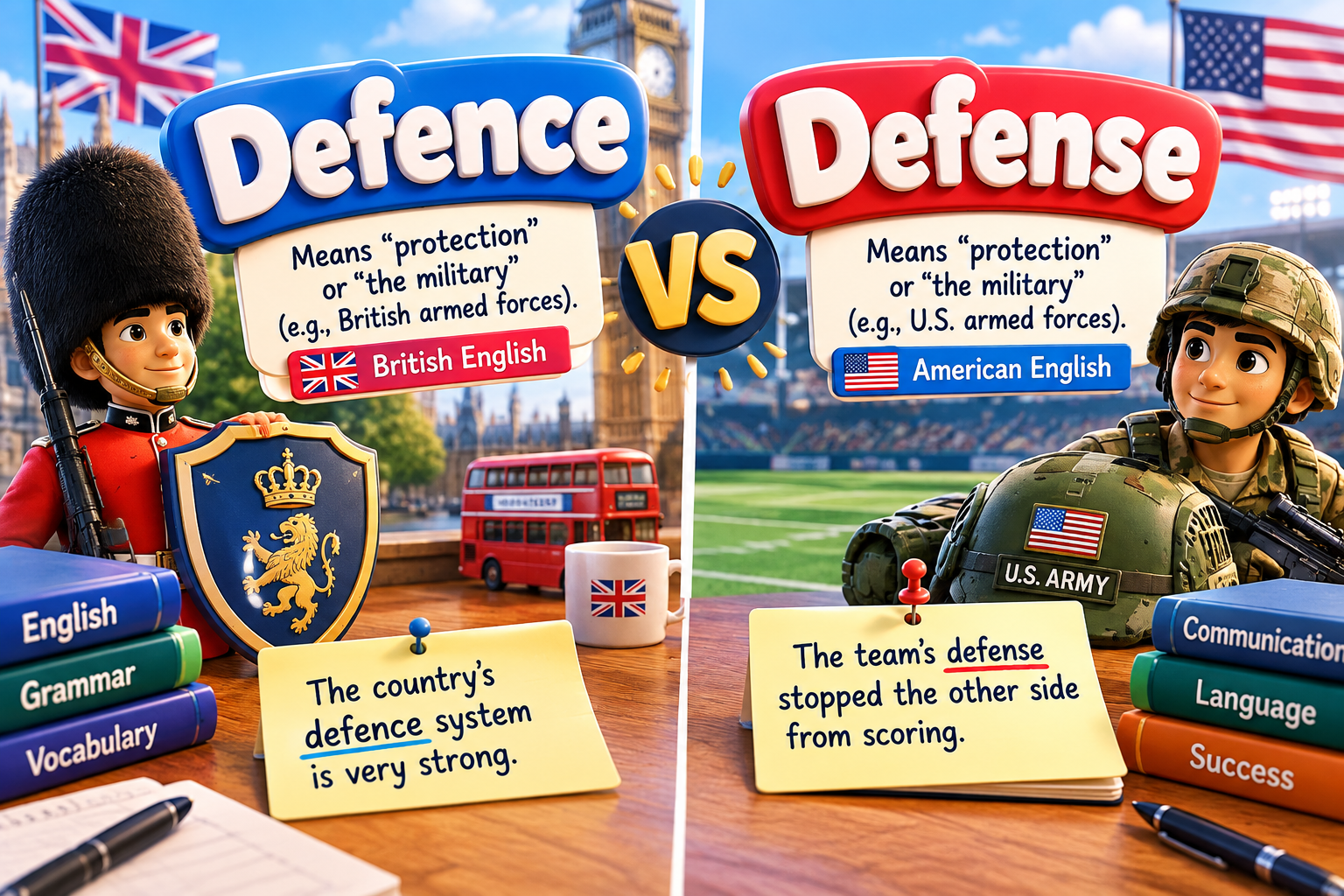
Defence or defense means the same thing: protection or the act of defending. “Defence” is standard in British English, while “defense” is standard in American English.
I’ve caught myself more than once writing defence and then stopping for a second to ask, “Should that actually be defense?”
It usually happens when I’m writing for an audience that uses a different variety of English from the one I’m used to. Both spellings look completely natural to me, and when I say them aloud, I can’t hear any difference. Yet when I put them on the page, that one letter—c or s—suddenly makes me question which version I should use.
Over time, I’ve noticed that this is less about knowing the meaning and more about knowing which English spelling style I’m following. British English uses defence, while American English uses defense. The meaning stays the same, but the spelling changes.
I’ve also made the mistake of switching between the two without noticing. I might use defence in one paragraph and then type defense a few lines later. When I go back and read my work, that inconsistency stands out immediately.
That experience taught me a simple rule: before choosing between defence or defense, I first think about my audience and the type of English I’m using.
In this guide, I’ll share what I’ve learned about these two spellings, where they come from, when to use each one, and how to keep your writing consistent.
Defence or Defense Quick Answer
Defence and defense are two spellings of the same noun. They refer to protection, resistance, or an argument made to support someone or something.
The main difference is regional spelling:
- Defence → British English
- Defense → American English
For example:
The country increased its defence budget.
This spelling fits British English.
The country increased its defense budget.
This spelling fits American English.
The meaning does not change. Cambridge Dictionary lists defence as the UK spelling of defense, while its American entry identifies defense as the US form of the word.
So, if you are wondering which one is “correct,” the answer is both. Your choice depends on the English variety you are following.
The Origin and Background of Defence or Defense
The difference between defence and defense is not a difference in meaning. It comes from the history of English spelling.
According to Etymonline, defense dates to around the early 14th century. The word came into English through Old French and ultimately traces back to Latin defendere, meaning “to ward off” or “protect.”
Over time, English developed different spelling preferences.
The spelling defence became strongly associated with British English. Defense, with -se, became the standard American form. Etymonline notes that the American spelling was standardized through Webster’s influence, while British usage retained defence.
This is part of a larger pattern in English.
You may already know some similar pairs:
- offence / offense
- pretence / pretense
- licence / license as a noun
- defence / defense
These differences are examples of British and American spelling conventions, not differences in grammar.
So if you see defence in a British newspaper and defense in an American newspaper, neither writer has necessarily made a spelling mistake.
Defence or Defense Explained: Key Differences
The easiest way to understand defence or defense is to separate meaning from spelling.
The meaning stays the same. The spelling changes with the variety of English.
| Term | Meaning | When to Use | Region/Context |
| defence | Protection or the act of defending | When following British spelling | UK and many Commonwealth varieties |
| defense | Protection or the act of defending | When following American spelling | United States |
| defensive | Protecting against attack or criticism | When you need an adjective | Both British and American English |
| defend | To protect or support | When you need a verb | Both British and American English |
1. Defence
Use defence when your writing follows British English.
Examples include:
- The minister discussed national defence.
- The team needs to improve its defence.
- She spoke in defence of her colleague.
Cambridge gives examples of defence in military, legal, sports, and general contexts.
2. Defense
Use defense when your writing follows American English.
For example:
- The government announced a new defense policy.
- The team’s defense was strong.
- He gave a defense of the proposal.
Cambridge identifies defense as the American spelling and gives the same broad range of meanings, including protection, law, and sports.
The important point
You do not choose between them because of the meaning.
You choose based on the English style you are using.
Which Version Should You Use?
The best choice depends on your audience.
If you write in British English
Choose defence.
This is usually the right choice for writing intended for readers in the UK and many Commonwealth settings.
For example:
The report examines national defence spending.
If you write in American English
Choose defense.
This is the standard form in US English.
For example:
The report examines national defense spending.
If you write for an international audience
The most useful rule is consistency.
Choose the spelling that matches your chosen style guide or publication. Do not switch between defence and defense simply because both forms look familiar.
If the rest of your article uses British spellings such as colour, centre, and organisation, then defence will usually fit naturally.
If you use American spellings such as color, center, and organization, then defense is the natural choice.
Common Mistakes with Defence or Defense
Because the two forms mean the same thing, most mistakes happen when writers mix spelling systems.
Mistake 1: Treating one spelling as completely wrong
Incorrect assumption:
“Defense is wrong.”
Better understanding:
Defense is the standard American spelling, while defence is the standard British spelling.
Mistake 2: Mixing both forms
You might write:
The country’s defence policy was discussed in the first section. The defense budget was covered later.
If you are following one English variety, this creates unnecessary inconsistency.
Better: Choose one spelling and use it throughout.
Mistake 3: Changing the spelling in related words unnecessarily
Not every word related to defence or defense changes in the same way.
For example, defensive is spelled the same in both major varieties of English.
So:
- British: defence, defensive
- American: defense, defensive
Mistake 4: Assuming pronunciation will help
In standard pronunciation, defence and defense are pronounced the same.
That means you cannot usually hear which spelling someone has chosen.
The difference appears mainly when you write the word.
Defence or Defense in Real-World Examples
Seeing the words in different types of writing can make the rule easier to remember.
Professional Email
British English:
Please review the attached report on national defence planning.
American English:
Please review the attached report on national defense planning.
News Writing
British style:
The government announced changes to its defence strategy.
American style:
The government announced changes to its defense strategy.
Social Media
A British English user might write:
Our team’s defence was incredible today.
An American English user could write:
Our team’s defense was incredible today.
Formal Report
British English:
The study examines the country’s approach to cyber defence.
American English:
The study examines the country’s approach to cyber defense.
The important thing is that the meaning stays the same across these examples.
Defence or Defense: Data, Trends & Usage
Searchers often look up defence or defense because they want to know which spelling is correct. The search intent is therefore mainly informational.
Reliable public sources clearly show a strong regional pattern. Cambridge labels defence as the UK form and defense as the US form.
Historical corpus research also shows the same regional split. A 418-million-word corpus study found defense was much more frequent in American subcorpora, while defence was more common in British and Australian material. For example, the study reported 84.6 occurrences per million words for defense in its NPR subcorpus, compared with 2.0 per million in its British-books subcorpus.
More recent frequency data also shows defense ranking higher than defence in one English word-frequency dataset analyzed in September 2026. That dataset places defense at #1,247 and defence at #2,940. These figures should be treated as dataset-specific frequency rankings, not universal measures of everyday English.
Exact monthly Google search volumes and current regional Google Trends figures can change by country, date range, and keyword settings. I would not present an unsupported number as a fixed global search volume.
What does the data tell us?
The useful takeaway is simple:
The two spellings are both established, but their use is strongly connected to regional English conventions.
That matters for:
- ESL learners
- students
- international businesses
- bloggers
- editors
- academic writers
- SEO writers targeting specific countries
For SEO, using the spelling that matches your target audience can make your content feel more natural and relevant.
Defence vs Defense: A Quick Comparison
| Term/Variant | Meaning | Region/Context | Best Used When |
| Defence | Protection or support | British English | Writing for UK/Commonwealth audiences |
| Defense | Protection or support | American English | Writing for US audiences |
| Defensive | Intended to protect | Both varieties | Describing a protective action or attitude |
| Defend | To protect or support | Both varieties | Using the word as a verb |
| Defenceless / Defenseless | Without protection | British / American | Describing someone or something lacking protection |
Notice something useful here: defence and defense are the regional variants, while words such as defensive and defend do not create the same spelling choice.
Frequently Asked Questions
Q: What does defence mean?
A: Defence means protection or the act of protecting against attack, harm, or criticism. It can also refer to a legal argument, a sports team’s protective play, or support for a person or idea.
Q: What does defense mean?
A: Defense has the same basic meanings as defence. It is the standard spelling used in American English.
Q: Is defence or defense correct?
A: Both are correct. Use defence for British English and defense for American English.
Q: Is defence British English?
A: Yes. Defence is the standard British spelling. It is also used in many other English varieties influenced by British English.
Q: Is defense American English?
A: Yes. Defense is the standard American spelling. Cambridge specifically identifies it as the US spelling of defence.
Q: Do defence and defense have different meanings?
A: No. The two spellings generally have the same meanings. The main difference is the regional spelling convention.
Q: Why do British and American English spell the word differently?
A: The difference developed through the history of English spelling. Defence remained preferred in British English, while defense became the standard American form. Etymonline connects both forms to the same historical word family.
Conclusion: Defence or Defense?
The choice between defence or defense is much simpler once you know that the two words have the same meaning.
The real difference is spelling style.
Use defence when you are following British English. Use defense when you are following American English. Neither spelling is automatically wrong.
The bigger lesson is consistency. If your article, report, website, or assignment follows British English, stay with defence. If it follows American English, choose defense. Avoid switching between the two without a reason.
It also helps to remember that this is not an isolated spelling difference. English has several regional pairs, such as offence/offense and pretence/pretense.
So the next time you hesitate over defence or defense, do not ask which spelling looks more familiar. First ask which English variety you are writing in.
Once you know your audience, the choice is easy.
Bookmark this guide if you often switch between British and American English, and use it whenever you need to check the spelling.
Read More:
Beside or Besides: The Easy Way to Get It Rig

I’m Daniel sultan, an English language writer and SEO content specialist with experience researching spelling, grammar, vocabulary, and English usage. Through SpellComparison.com, I create clear, accurate, and well-researched guides that help readers understand commonly confused words, spelling differences, and grammar rules with confidence.
Every article I write is based on trusted language references, established style guides, and real-world usage to ensure it is accurate, practical, and easy to understand. My goal is to make learning English simple and reliable by providing fact-checked content, clear explanations, and real-life examples that students, writers, educators, and professionals can trust.










