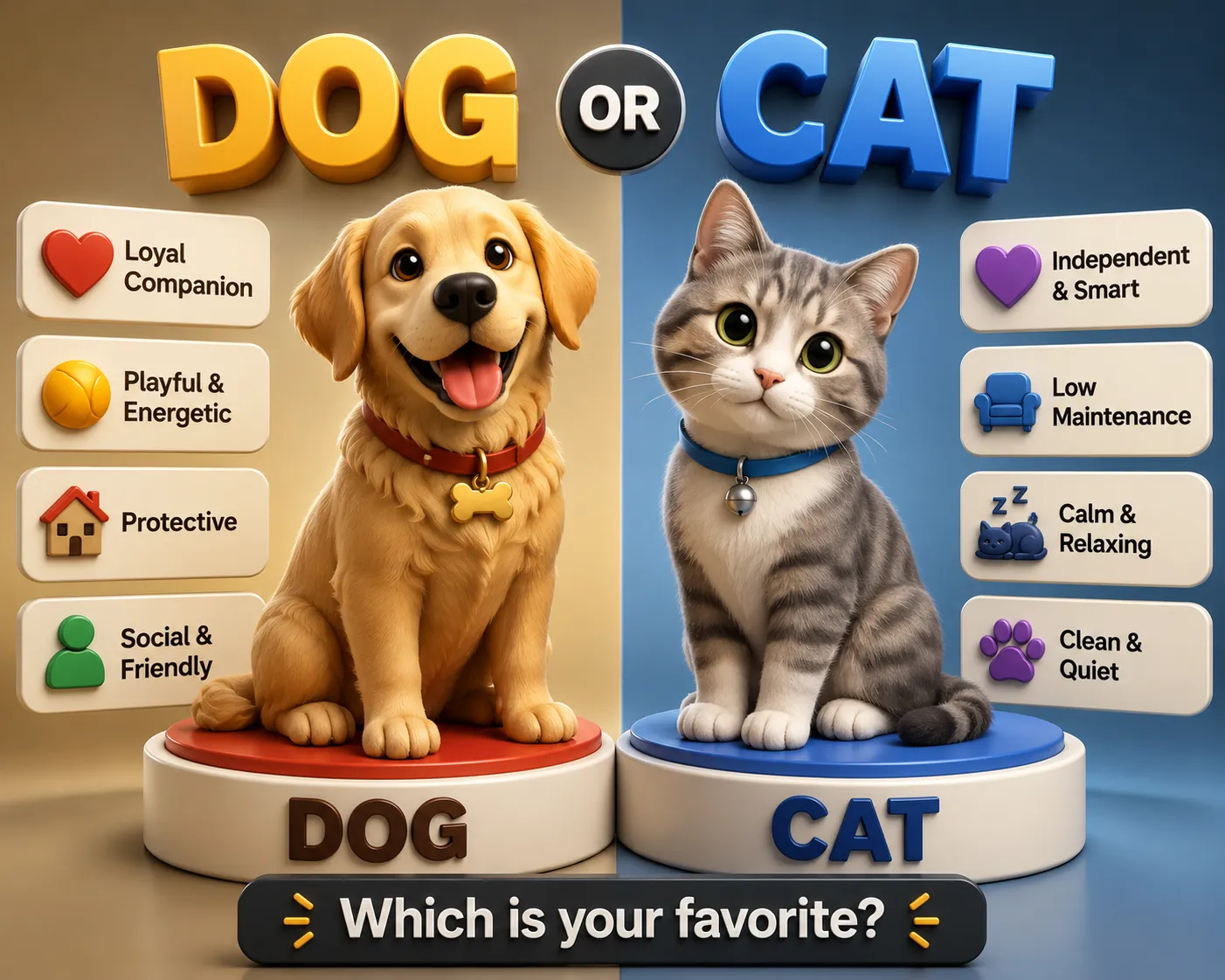
Dog or cat depends on personality and lifestyle. Dogs are loyal, social, and active pets, while cats are independent, calm, and low-maintenance companions.
Have you ever asked yourself: Should I get a dog or a cat?
You are not alone. This is one of the most common questions for first-time pet owners. Both animals are loving, intelligent, and capable of forming strong bonds with humans—but they offer very different experiences.
A dog usually brings energy, loyalty, and companionship that requires time and attention. A cat offers independence, calmness, and affection on its own terms.
In this guide, you will learn the key differences between dogs and cats, their behavior, care needs, pros and cons, and how to decide which one fits your lifestyle best.
Dog or Cat Quick Answer
Think of it this way:
- Dog = active, social, loyal
- Cat = independent, calm, low-maintenance
Examples:
A dog will greet you at the door every day.
A cat will decide when it wants attention.
So, if you want a high-energy companion, choose a dog.
If you prefer a quiet, independent pet, choose a cat.
The Background of Dog or Cat
Dogs were among the first animals domesticated by humans, dating back tens of thousands of years. They evolved from wolves and became working partners for hunting, protection, and companionship.
Cats were domesticated later, primarily in ancient Egypt, where they were valued for controlling pests like mice and rats. Over time, they became household companions known for their independence and grace.
Despite their different origins, both dogs and cats have become the most popular pets worldwide due to their ability to bond with humans in unique ways.
Dog or Cat Explained Key Differences
The easiest way to understand the difference is by behavior, care, and personality.
| Trait | Dog | Cat |
| Personality | Loyal, social, energetic | Independent, calm, curious |
| Attention needs | High | Low to moderate |
| Training | Easier to train | More independent-minded |
| Exercise needs | High (walks, playtime) | Low (self-exercise indoors) |
| Social behavior | Loves people and groups | Selective with affection |
| Maintenance | Higher (time, grooming, care) | Lower (self-grooming, easy care) |
When to Choose a Dog
Choose a dog if you want:
- A loyal companion
- A reason to stay active
- A social, interactive pet
- A structured daily routine
Examples:
My dog waits for me every morning.
We go for walks together every evening.
Dogs thrive on attention, training, and companionship.
When to Choose a Cat
Choose a cat if you want:
- A low-maintenance pet
- A quiet home environment
- An independent companion
- Flexible care routines
Examples:
My cat sleeps most of the day but comes to me when she wants attention.
I don’t need to walk my cat every day.
Cats are ideal for busy people or smaller living spaces.
A Simple Memory Trick
Remember this:
- Dog = “Do Go” (needs activity and movement)
- Cat = “Calm At Home” (independent and relaxed)
If you want structure and activity → choose a dog.
If you want peace and independence → choose a cat.
Which Pet Should You Choose?
There is no universal “better” pet. The right choice depends on your lifestyle.
For active people
A dog is ideal if you enjoy outdoor activities, exercise, and social interaction.
For busy individuals
A cat is better if you have limited time and prefer a low-maintenance companion.
For families
Dogs are often more interactive with children, while cats can be great for quieter households.
For apartment living
Cats are usually easier to manage in small spaces, though small dog breeds can also adapt well.
Common Mistakes When Choosing Dog or Cat
Many people choose a pet based only on appearance or trends. Here are common mistakes:
| Mistake | Better Approach | Why |
| Choosing a dog for cuteness only | Consider time and energy needs | Dogs require daily care and exercise |
| Choosing a cat for “no effort” | Understand emotional needs | Cats still need attention and care |
| Ignoring lifestyle compatibility | Match pet to routine | Prevents stress for both owner and pet |
| Underestimating training needs | Research breed behavior | Some dogs need more training than others |
Mistake 1: Thinking Dogs Are Always Better Companions
Wrong assumption:
Dogs are always more loving than cats.
Reality:
Cats can be affectionate too, but they express it differently and on their own terms.
Mistake 2: Thinking Cats Require No Care
Wrong assumption:
Cats take care of themselves completely.
Reality:
Cats still need food, vet care, grooming, and emotional interaction.
Mistake 3: Choosing Based on Trends
Wrong approach:
Everyone has a dog, so I should get one too.
Better approach:
Choose based on your lifestyle, not popularity.
Dog or Cat in Real-World Examples
Active Lifestyle
I chose a dog because I love running and outdoor activities.
Busy Work Schedule
I chose a cat because I travel often and need a low-maintenance pet.
Family Home
Our dog plays with the kids every day.
Small Apartment
My cat is perfect for my quiet studio apartment.
Emotional Support
My dog helps me stay active and feel less lonely.
Dog or Cat Trends & Insights
Exact global search volumes for “dog or cat” vary depending on tools like Google Keyword Planner, Semrush, or Ahrefs. These estimates change by region and time.
However, search intent is clear: decision-making and comparison.
People searching this phrase usually want to know:
- Which pet is better
- Differences in care and behavior
- Lifestyle compatibility
- Pros and cons of each animal
General Trend Insight
- Dogs are more popular in households with active lifestyles
- Cats are more popular in urban and apartment living
- Both pets remain among the most searched and adopted animals worldwide
This reflects a simple truth: people choose pets based on lifestyle fit, not just preference.
Standalone Comparison Table
| Category | Dog | Cat |
| Energy level | High | Low to moderate |
| Independence | Low | High |
| Training ease | Easier | More independent |
| Social needs | High | Moderate |
| Care effort | High | Low to moderate |
| Best for | Active owners, families | Busy individuals, small spaces |
FAQ: Dog or Cat
Q: Which is better, dog or cat?
A: Neither is universally better. Dogs are more social and active, while cats are more independent and low-maintenance.
Q: Are dogs more loyal than cats?
A: Dogs are generally more openly loyal, but cats can also form strong bonds in their own way.
Q: Which pet is easier to take care of?
A: Cats are usually easier to care for because they require less daily attention and no walks.
Q: Which is better for apartments, dog or cat?
A: Cats are often better for apartments, but small dog breeds can also adapt well.
Q: Do cats need less attention than dogs?
A: Yes, cats are more independent, but they still need care and interaction.
Q: Why do people prefer dogs over cats?
A: Many people prefer dogs for their loyalty, energy, and social behavior.
Q: Can dogs and cats live together?
A: Yes, with proper introduction and training, many dogs and cats can coexist peacefully.
Conclusion
Choosing between a dog or cat is not about which animal is better—it is about which one fits your lifestyle.
If you want energy, loyalty, and daily interaction, a dog is a great choice.
If you prefer independence, calmness, and low maintenance, a cat may be perfect for you.
The best pet is the one that matches your time, personality, and living situation.
Remember this simple rule:
Dog = active companionship. Cat = independent comfort.
Choose wisely, and you will gain a lifelong companion that fits naturally into your life.

I specialize in English grammar, spelling, word choice, and language usage. My content is based on research from grammar references, style guides, dictionaries, and real-world usage to ensure it is accurate and practical.
At Spelling Comparison, I write guides that explain why words are confused, how they are used, and which form is correct in context. I also include proofreading tips, examples, and writing advice readers can apply immediately.
My goal is to publish clear, reliable content that helps readers make better writing decisions. Each guide is written for accuracy, clarity, and usefulness in school, work, business, and everyday communication.