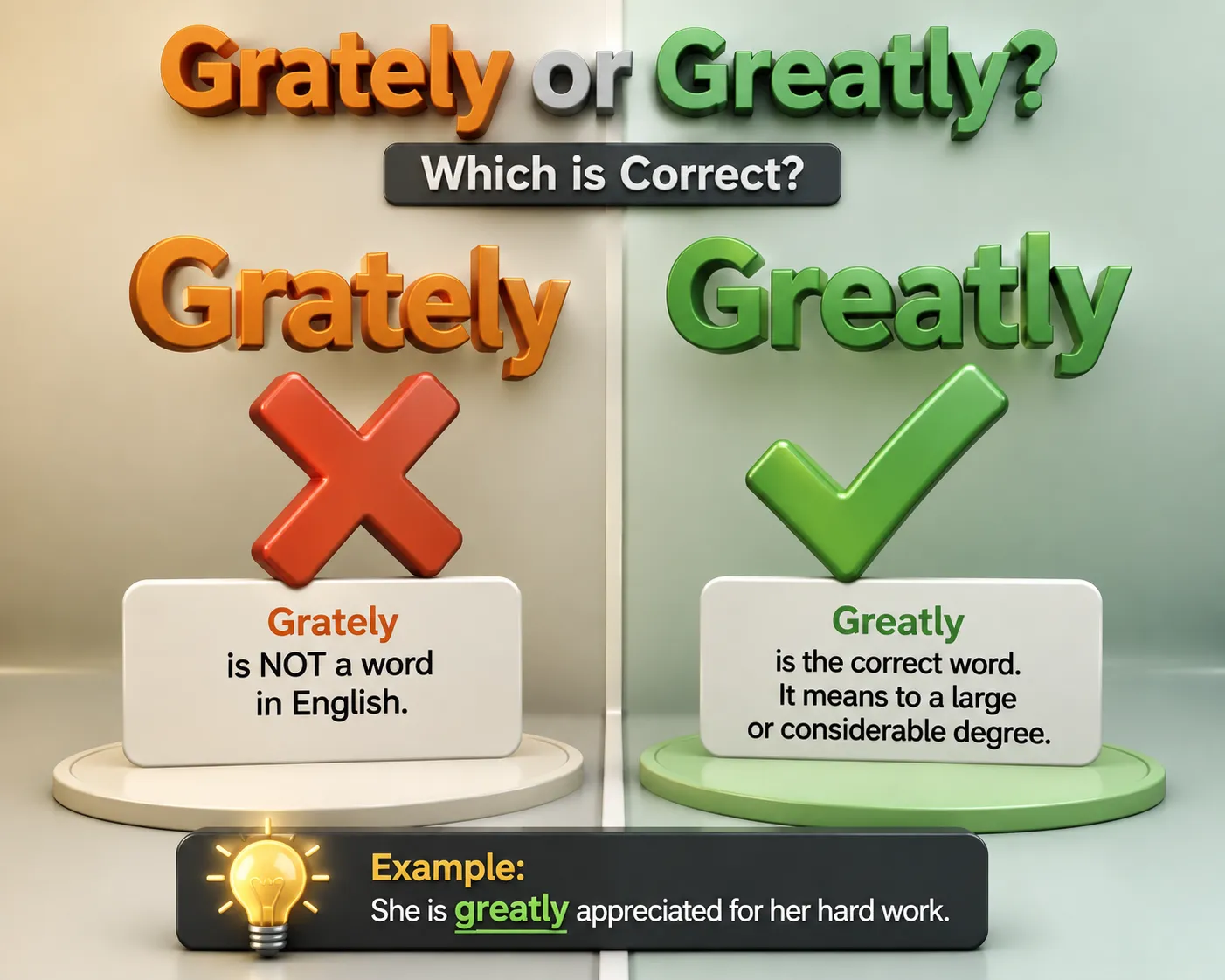
Greatly or gratefully are often confused, but they have completely different meanings. “Greatly” means to a large extent or very much, while “gratefully” means with gratitude or thankfulness.
Have you ever paused while writing and wondered: Should I use greatly or gratefully?
You are not alone. Many English learners mix up these two words because they look similar and both are adverbs ending in “-ly.” However, they express very different ideas.
One describes degree or intensity, while the other expresses emotion and gratitude.
In this guide, you will learn the difference between greatly and gratefully, when to use each word, common mistakes, and simple examples that make everything clear. By the end, you will never confuse them again.
Greatly or Gratefully Quick Answer
Think of it this way:
- Greatly = to a large extent, very much
- Gratefully = with gratitude, thankfully
Examples:
I was greatly impressed by her performance.
I gratefully accepted the help.
So, if you are talking about intensity or degree, use greatly.
If you are talking about thankfulness or appreciation, use gratefully.
The Background of Greatly or Gratefully
The word greatly comes from the adjective great, which has Old English roots meaning “large, powerful, or important.” The adverb form developed to express intensity or extent.
The word gratefully comes from grateful, which is derived from Latin gratus, meaning “pleasing” or “thankful.” The adverb form describes actions done with gratitude.
Over time, English developed both words with very different emotional and grammatical roles, even though they look similar.
Linguists often note that confusion happens because both words end in -ly, a common adverb suffix in English.
Greatly or Gratefully Explained Key Differences
The easiest way to understand the difference is by meaning and usage.
| Term | Meaning | When to Use | Common Context |
| Greatly | To a large extent, very much | Describing intensity or degree | Emotions, impact, change |
| Gratefully | With gratitude or thankfulness | Expressing appreciation | Thanks, acceptance, responses |
| Great (root) | Large, important, intense | Adjective form | General description |
| Grateful (root) | Thankful, appreciative | Emotional state | Polite expressions |
When to Use Greatly
Use greatly when you want to show intensity or a strong degree of something.
Examples:
I was greatly surprised by the results.
The project was greatly improved after feedback.
She was greatly affected by the news.
It is commonly used in formal and academic writing.
When to Use Gratefully
Use gratefully when expressing thanks or appreciation.
Examples:
I gratefully accepted the invitation.
She smiled gratefully at the kind gesture.
We gratefully acknowledge your support.
It is often used in polite, emotional, or formal thank-you contexts.
A Simple Memory Trick
Remember this:
- Greatly = degree (how much)
- Gratefully = gratitude (how thankful)
If you can replace it with “very much,” use greatly.
If you can replace it with “thankfully,” use gratefully.
Which Version Should You Use?
In most real-world writing, the choice is simple:
For everyday English
Use greatly for intensity:
I was greatly relieved.
Use gratefully for thanks:
I gratefully accepted the help.
For formal writing
Both words are correct, but context matters:
- greatly = impact, change, importance
- gratefully = acknowledgment, appreciation
For academic or professional writing
Be precise:
- greatly influenced, greatly improved
- gratefully acknowledged, gratefully received
For learners
If you are unsure, ask:
- Am I describing how much? → use greatly
- Am I expressing thanks? → use gratefully
Common Mistakes with Greatly or Gratefully
Many learners confuse these words in predictable ways.
| Mistake | Correction | Why |
| I was gratefully surprised. | I was greatly surprised. | “Surprised” needs intensity, not gratitude |
| She greatly accepted the gift. | She gratefully accepted the gift. | Acceptance involves gratitude |
| He was gratefully affected. | He was greatly affected. | “Affected” describes degree |
| I greatly thank you. | I gratefully thank you. | Thanking expresses gratitude |
| We gratefully improved the system. | We greatly improved the system. | Improvement is about extent |
Mistake 1: Using “Gratefully” for Emotions Without Gratitude
Wrong:
I was gratefully shocked.
Correct:
I was greatly shocked.
Mistake 2: Using “Greatly” in Thank-You Expressions
Wrong:
I greatly appreciate your help.
Correct (also acceptable but less natural in some contexts):
I gratefully appreciate your help.
OR
I greatly appreciate your help. (both can work, but “greatly appreciate” is more common)
Mistake 3: Confusing Emotion vs Degree
Always check:
- Emotion of thanks → gratefully
- Strength or level → greatly
Greatly or Gratefully in Real-World Examples
Professional Email
I greatly appreciate your prompt response.
Formal Thank You
We gratefully acknowledge your support.
Academic Writing
The results were greatly influenced by external factors.
Customer Service
We gratefully received your feedback.
Casual Use
I was greatly relieved when I passed the exam.
Greatly or Gratefully Trends & Usage Insights
Exact monthly search volumes for “greatly or gratefully” vary depending on tools like Google Keyword Planner, Semrush, or Ahrefs. These provide estimates that change by region and time.
However, search intent is clear: grammar confusion and usage clarification.
People searching this phrase usually want to know:
- Which word is correct
- Difference in meaning
- How to use them in sentences
- Examples of proper usage
Language Usage Insight
Modern English shows:
- greatly is more common in academic and professional writing
- gratefully is more common in polite communication and formal thanks
This reflects a broader pattern in English:
- “greatly” = analytical, descriptive
- “gratefully” = emotional, expressive
Standalone Comparison Table
| Word | Meaning | Usage Type | Best For |
| Greatly | To a large extent | Degree/Intensity | Impact, change, emotions |
| Gratefully | With gratitude | Emotional expression | Thanks, appreciation |
| Great (root) | Large or important | Adjective | General description |
| Grateful (root) | Thankful | Emotional state | Polite communication |
FAQ: Greatly or Gratefully
Q: What is the correct word, greatly or gratefully?
A: Both are correct, but they have different meanings. Greatly means “very much,” while gratefully means “with gratitude.”
Q: What does greatly mean?
A: It means to a large extent or very much.
Q: What does gratefully mean?
A: It means in a thankful or appreciative way.
Q: Can I use gratefully instead of greatly?
A: No. They are not interchangeable.
Q: Is “I greatly thank you” correct?
A: It is understandable but not natural. “I gratefully thank you” or “I greatly appreciate you” is better.
Q: Why do people confuse greatly and gratefully?
A: Because they look similar and both end in “-ly,” but they come from different root words.
Q: Which is more common in writing?
A: “Greatly” is more common in academic and descriptive writing, while “gratefully” is used in expressions of thanks.
Q: Can both be used in formal writing?
A: Yes, but in different contexts depending on meaning.
Conclusion
Understanding greatly or gratefully becomes simple once you focus on meaning rather than spelling.
Use greatly when describing intensity, degree, or impact. Use gratefully when expressing thanks or appreciation.
If you remember one rule, make it this:
Greatly describes how much. Gratefully describes how thankful.
With this distinction, you can write more clearly, confidently, and naturally in any context.
Read More:
Unkempt or Unkept: Which Spelling Is Correct?

I’m **Rubab Naaz**, an English language content writer with over 10 years of experience creating educational and SEO-focused articles. I specialize in spelling comparisons, grammar, vocabulary, synonyms, commonly confused words, and English usage. My passion is helping students, writers, and professionals improve their language skills through accurate, well-researched, and easy-to-understand content. Every article I write is designed to make learning English simple, practical, and engaging.