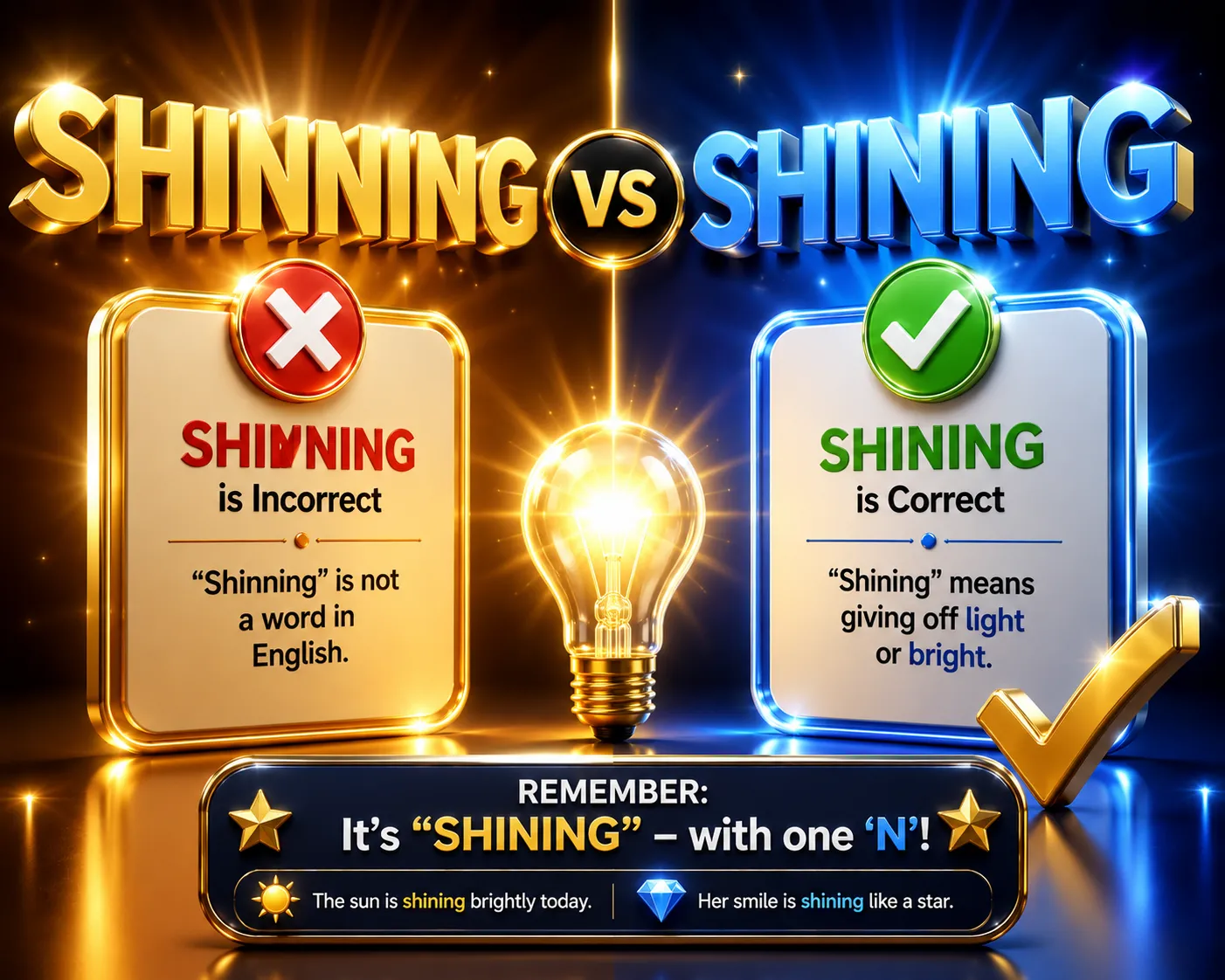
“shining” is the correct standard spelling. “shinning” is a different word that means climbing or hitting with the shins and is rarely used in modern writing. For light or brightness, always use shining.
I remember the first time I came across the phrase “shinning light.” It looked almost right, but something about the spelling made me pause. That small hesitation led me to check the difference between shining and shinning—and the distinction is surprisingly simple.
The confusion happens because these two words look nearly identical, but they have completely different meanings. Shining is the correct word when you are talking about light, brightness, or something that glows. Shinning, on the other hand, comes from the word shin and refers to climbing by gripping a person’s legs or moving up something using the legs.
This difference is important in everyday writing, from emails and social media captions to stories, academic assignments, and professional content. One extra n can completely change the meaning of a sentence.
In this guide, I’ll explain exactly when to use shining and when shinning is correct. We’ll also look at their meanings, origins, common mistakes, and easy examples to help you remember the difference.
By the end, you’ll have a simple rule that makes it easy to choose the right spelling every time.
Shinning or Shining Quick Answer
Use shining when you are talking about light, brightness, reflection, or something glowing.
Use shinning only when referring to the action of climbing or striking with the shins (for example, climbing a pole using your legs).
For example:
- The sun is shining brightly today.
- He was shinning up the tree trunk (rare usage).
So the easiest rule is:
Shining = light or brightness
Shinning = climbing or using the shins (rare)
The Origin and Background of Shine
The word shine has been part of English for centuries. According to Etymonline, shine comes from Old English scīnan, meaning “to emit light, glow, or be bright.” It has been used in English since before the 12th century.
Over time, it developed many related forms:
- shine (base verb)
- shining (present participle/adjective)
- shone (past tense in modern usage)
The word shinning, however, comes from a completely different root. It is related to shin, meaning the front part of the lower leg. In older or specialized usage, to shin can mean to climb something using the legs and feet, especially a vertical object like a pole or tree.
This is why shinning is not a spelling variation of shining—it is a different word entirely.
Shinning or Shining Explained
The difference is both spelling and meaning.
1. Shining
Shining is the present participle of shine.
It is used to describe:
- light or brightness
- something reflecting light
- something impressive or outstanding (figurative use)
Examples:
The stars are shining in the night sky.
She has a shining smile.
The metal surface is shining after polishing.
Notice that shining always relates to light or brilliance, either literal or metaphorical.
2. Shinning
Shinning comes from the verb to shin.
It means:
- climbing something using your legs and shins
- moving upward in a rough or physical way
Examples (rare in modern English):
He was shinning up the pole to fix the flag.
The child was shinning up the tree.
This usage is uncommon today and often replaced with simpler verbs like climbing.
Comparison Table
| Term | Meaning | When to Use | Commonality |
| shining | Emitting or reflecting light | Light, brightness, metaphorical use | Very common |
| shinning | Climbing using the shins | Physical climbing action | Rare |
Which Version Should You Use?
The correct choice depends on meaning.
For light or brightness
Use:
shining
Examples:
The shining sun warmed the beach.
Her eyes were shining with excitement.
For figurative praise or excellence
Use:
shining
Examples:
He is a shining example of leadership.
That was a shining performance.
For climbing actions (rare)
Use:
shinning
Example:
The boy was shinning up the tree trunk.
In most modern writing, you would simply say:
The boy was climbing the tree.
Common Mistakes with Shinning and Shining
Mistake 1: Using “shinning” for light
❌ The sun is shinning brightly.
✅ The sun is shining brightly.
Mistake 2: Assuming double “n” is correct for emphasis
❌ The stars are shinning in the sky.
✅ The stars are shining in the sky.
Mistake 3: Confusing spelling patterns
Many English verbs double consonants in certain forms (like running or hopping), but shine → shining does NOT double the “n.”
Mistake 4: Overusing “shinning” instead of “climbing”
❌ He was shinning the ladder.
✅ He was climbing the ladder.
Shinning or Shining in Real-World Examples
Everyday sentence
The lake was shining under the morning sun.
Poetic or descriptive writing
Her shining personality lit up the room.
News or formal writing
The athlete delivered a shining performance at the championship.
Rare physical action
The scout was shinning up the pole during training.
Social media caption
Feeling shining and confident today ✨
Shinning or Shining Usage Insights
People often search this pair because English spelling rules can be confusing, especially when words look like they should follow a pattern (like doubling consonants).
However, shining is overwhelmingly the standard form in modern English. It appears in literature, journalism, academic writing, and everyday communication.
The form shinning is rare and mostly limited to specific physical descriptions involving climbing.
From a usage perspective:
- Shining dominates modern English
- Shinning is specialized and uncommon
- Most confusion comes from spelling assumptions, not actual usage overlap
A helpful insight is that English does not always follow consistent doubling rules. Even if a word looks like it should double the consonant, it often does not.
Standalone Comparison: Shinning vs Shining at a Glance
| Term | Meaning | Context | Best Used When |
| shine | To emit light | General English | Base verb |
| shining | Bright, glowing, excellent | Everyday writing | Describing light or quality |
| shinning | Climbing using shins | Rare physical action | Describing climbing (rare usage) |
Frequently Asked Questions
Q: What does “shining” mean?
A: Shining means giving off or reflecting light. It can also describe something excellent or impressive.
Q: What does “shinning” mean?
A: Shinning comes from the verb to shin and means climbing using the legs or shins, usually on a vertical surface.
Q: Is “shinning” correct for light?
A: No. The correct spelling for light or brightness is shining.
Q: Why do people confuse shining and shinning?
A: Because many English verbs double consonants in -ing forms, but shine is an exception.
Q: Is “shinning” commonly used today?
A: No. It is rare and usually replaced with climbing in modern English.
Q: Can “shining” be used figuratively?
A: Yes. It can describe excellence, success, or outstanding qualities.
Conclusion
The difference between shinning and shining is simple once you know the meaning behind each word.
Use shining for light, brightness, reflection, and figurative excellence. It is the standard and most widely used form in English.
Use shinning only when referring to the physical action of climbing using the shins—a rare usage in modern writing.
If you are ever unsure, remember this rule:
If it involves light or brilliance, it is always “shining.”
The confusion usually comes from spelling patterns, but English often breaks its own rules. Once you learn this distinction, you will avoid one of the most common spelling mistakes in everyday writing.
Bookmark this guide so you never confuse “shinning” and “shining” again.
Read More:
Valentines or Valentine’s: The Easy Guide

I specialize in English grammar, spelling, word choice, and language usage. My content is based on research from grammar references, style guides, dictionaries, and real-world usage to ensure it is accurate and practical.
At Spelling Comparison, I write guides that explain why words are confused, how they are used, and which form is correct in context. I also include proofreading tips, examples, and writing advice readers can apply immediately.
My goal is to publish clear, reliable content that helps readers make better writing decisions. Each guide is written for accuracy, clarity, and usefulness in school, work, business, and everyday communication.