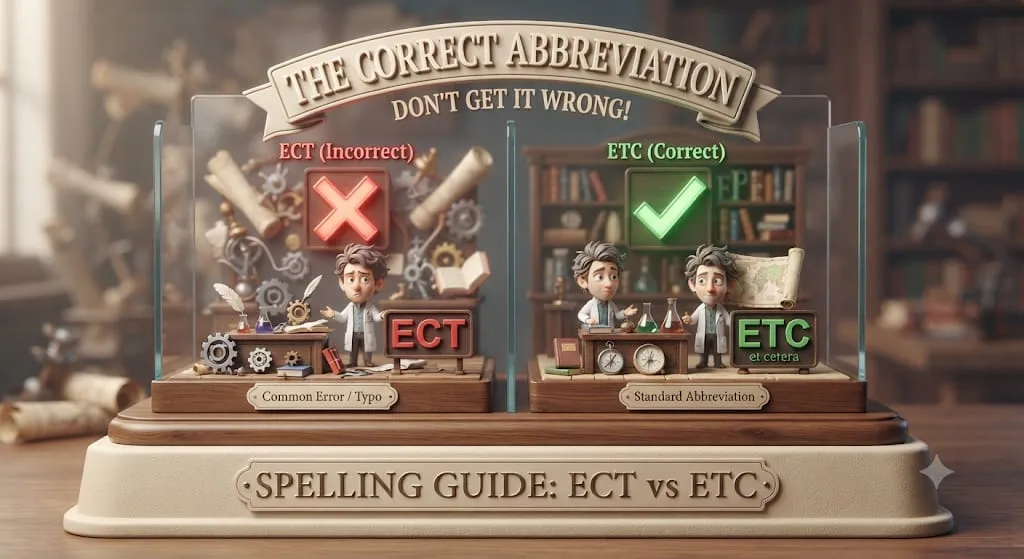
etc is the correct abbreviation of the Latin phrase et cetera, which means “and other similar things.” ect is usually a spelling mistake and should not be used in formal or professional writing.
A few years ago, I was reviewing student assignments when I noticed the same mistake again and again. Many students wrote “ect” instead of “etc.” Some even believed both were correct.
If you have ever paused while typing and wondered, “Is it etc or ect?”, you are not alone. This is one of the most common spelling mistakes in English. The confusion happens because people often hear the phrase more than they see it written.
A small spelling error may seem harmless. Yet it can make emails, reports, assignments, and social media posts look less polished. In school and professional settings, details matter.
The good news is that the answer is simple. Once you understand where etc. comes from and what it means, you will probably never make this mistake again.
Let’s clear up the confusion once and for all.
etc or ect Quick Answer
The correct form is etc.
It is short for the Latin phrase et cetera, which means “and so on” or “and other similar things.”
The spelling ect is generally incorrect and is considered a typo or spelling mistake.
Examples
✅ Apples, oranges, bananas, etc.
✅ Pens, pencils, markers, etc.
❌ Apples, oranges, bananas, ect
❌ Pens, pencils, markers, ect
If you want to write correctly in English, always use etc.
The Origin / Background of etc
The abbreviation etc. comes from the Latin phrase et cetera.
- Et means “and.”
- Cetera means “the rest” or “other things.”
Together, et cetera means:
“And the other things.”
Over time, English speakers adopted the phrase because it provided a quick way to end a list without naming every item.
Why Does the Confusion Exist?
Most people learn the word by hearing it.
When spoken quickly, et cetera can sound like:
- et-set-ra
- et-cet-ra
- et-ket-ra
As a result, some people mistakenly rearrange the letters and write ect instead of etc.
The mistake is very common among students, writers, and even native English speakers.
etc Explained Key Differences or Variations
The confusion usually involves two forms:
- etc. (correct)
- ect (incorrect)
Comparison Table
| Term | Meaning | When to Use | Region/Context |
| etc. | Abbreviation of et cetera | Formal and informal writing | Worldwide |
| ect | Misspelling of etc. | Avoid using | None |
| et cetera | Full Latin phrase | Very formal writing | Academic and professional |
| and so on | English alternative | Informal writing | Global English |
Examples
Correct:
- Bring notebooks, folders, calculators, etc.
- We studied math, science, English, etc.
Incorrect:
- Bring notebooks, folders, calculators, ect.
- We studied math, science, English, ect.
Which Version Should You Use?
The answer depends on your audience and purpose.
For Students
Use etc.
Teachers and examiners expect the standard spelling.
Example:
The lab contains beakers, test tubes, flasks, etc.
For Professionals
Use etc. carefully.
In business writing, listing important items is often better than relying on etc.
Example:
The package includes training materials, user guides, and support documents.
This is stronger than ending with etc.
For Academic Writing
Use etc. only when appropriate.
Many academic style guides encourage precise lists instead of vague endings.
For Global English Users
Use etc.
It is understood almost everywhere English is used.
Recommendation
Use “etc.” whenever you need the abbreviation. Never use “ect.”
Common Mistakes with etc
Here are some mistakes people make regularly.
| Mistake | Correction |
| ect | etc. |
| etc etc | etc. |
| and etc. | etc. |
| etc without period | etc. |
| Repeating long lists then etc. | Use a complete list if possible |
1. Writing “ect”
❌ We bought fruits, vegetables, ect.
✅ We bought fruits, vegetables, etc.
Why?
The letters are reversed.
2. Writing “and etc.”
❌ Pens, pencils, and etc.
✅ Pens, pencils, etc.
Why?
The word et already means and.
Using “and etc.” repeats the same idea.
3. Using etc. Too Often
❌ The report covers sales, marketing, operations, finance, HR, logistics, etc.
Sometimes a complete list is clearer.
4. Forgetting the Period
❌ etc
✅ etc.
The period shows that it is an abbreviation.
5. Using etc. After “Such As”
❌ Sports such as football, cricket, tennis, etc.
Many style guides prefer ending the example list without etc.
etc in Real-World Examples
Professional Email
Please submit attendance records, examination reports, meeting minutes, etc., before Friday.
News Headline
Rising Prices Affect Food, Fuel, Transport, etc.
Social Media Post
Weekend essentials: coffee, books, snacks, etc. ☕
Formal Report
The laboratory contains microscopes, measuring instruments, safety equipment, etc.
Classroom Assignment
Physical quantities include length, mass, time, temperature, etc.
Notice how etc. naturally means “other similar items.”
etc Data, Trends & Usage
People search for “etc or ect” because spelling uncertainty is common.
Who Searches Most?
- Students
- Teachers
- Job seekers
- Business professionals
- Non-native English learners
Search Intent
Informational
Users want to know:
- Which spelling is correct
- What etc. means
- Whether ect is acceptable
- How to use etc. properly
Why This Topic Matters Today
Most communication now happens through:
- Messaging apps
- Social media
- Online assignments
A small spelling mistake can be copied repeatedly. Learning the correct form once helps improve your writing everywhere.
Standalone Comparison Table
| Term/Variant | Meaning | Region/Context | Best Used When |
| etc. | Abbreviation of et cetera | Universal English | Ending a list of similar items |
| et cetera | Full Latin phrase | Formal writing | Academic or professional documents |
| and so on | English equivalent | Informal English | Conversation and casual writing |
| and others | Alternative phrase | Formal communication | Referring to people |
| ect | Misspelling | None | Never recommended |
Frequently Asked Questions
Q: What does etc mean?
A: etc. stands for et cetera, a Latin phrase meaning “and other similar things” or “and so on.”
Q: How do you use etc correctly?
A: Use etc. at the end of a list when additional similar items could be included. Example: Books, magazines, newspapers, etc.
Q: etc vs ect : what’s the difference?
A: etc. is correct. ect is a spelling mistake caused by reversing the letters.
Q: Is etc acceptable in formal writing?
A: Yes. However, many formal documents prefer complete and specific lists whenever possible.
Q: Which version is correct : etc or ect?
A: etc. is the correct form. ect should be avoided in all professional, academic, and formal writing.
Q: Where does etc come from?
A: It comes from the Latin phrase et cetera, meaning “and the rest” or “and other things.”
Q: Can etc be used in emails?
A: Yes. It is commonly used in emails when referring to similar items within a list. Just make sure the meaning remains clear.
Conclusion
The debate between etc or ect has a simple answer. etc. is correct, while ect is a spelling mistake.
Remember these key points:
- etc. comes from the Latin phrase et cetera.
- It means “and so on” or “and other similar things.”
- ect is not considered correct English.
- Avoid writing “and etc.”
- Use etc. carefully in formal writing and prefer complete lists when clarity matters.
English contains many confusing words, but this one is easy to master once you know the origin. The next time you write an email, report, assignment, or social media post, you’ll know exactly which version to choose.
Bookmark this guide so you never second-guess “etc.” again, and share it with someone who still writes “ect.”
Read More:
Nosey or Nosy: Which Spelling Is Correct?

I’m an English language educator and SEO content writer having experience creating clear, accurate, and engaging English learning content. I specialize in spelling differences, grammar, vocabulary, synonyms, commonly confused words, and English usage. My goal is to publish well-researched, easy-to-understand articles that help students, writers, educators, and professionals improve their English with confidence through practical explanations and real-world examples.