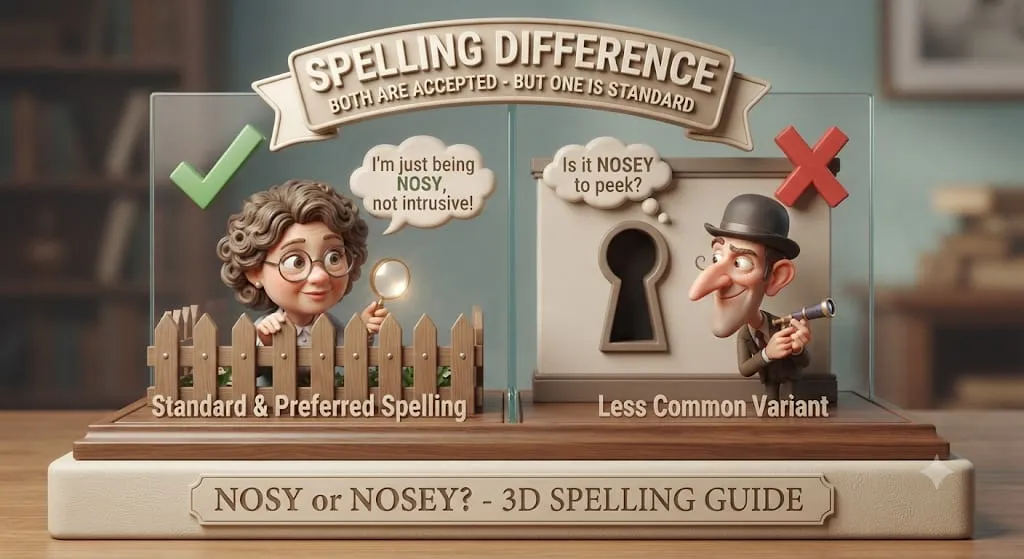
Both nosey and nosy are correct. They mean someone who is too interested in other people’s private business. However, nosy is the more common spelling today, while nosey is an older alternative that still appears in dictionaries.
Have you ever stopped while writing and wondered, “Is it nosey or nosy?” I have. Even after years of writing and editing English articles, I still double-check certain words because English loves to surprise us.
I remember editing a blog post where one writer used nosey throughout the article, while another insisted it should be nosy. Both were confident. That made me dig into trusted dictionaries, style guides, and real-world usage. What I found surprised me—both spellings are correct, but one is clearly more popular today.
Many English learners search for this question because the word looks like it should come from nose, yet modern spelling often drops the extra e. It can be confusing, especially if you read books from different countries or different time periods.
If you’ve ever hesitated before typing nosey or nosy, you’re in the right place. By the end of this guide, you’ll know which spelling to use, why both exist, where each appears, and how to avoid common mistakes.
Let’s begin with the quick answer.
Nosey or Nosy Quick Answer
Both nosey and nosy describe a person who asks too many personal questions or interferes in other people’s affairs.
Today, nosy is the preferred spelling in most dictionaries, newspapers, websites, and modern writing. Nosey remains an accepted variant, but it is much less common.
Examples
- My neighbor is very nosy and always asks about my visitors.
- Don’t be so nosey—it’s their private conversation.
Both sentences are correct.
The Origin and Background of Nosey or Nosy
The word comes from the noun nose.
For hundreds of years, English speakers have connected the nose with curiosity and unwanted interest. Someone who “sticks their nose” into another person’s business became known as nosey or nosy.
Originally, nosey reflected the spelling of the word nose more closely.
Over time, English simplified the spelling. Writers gradually preferred nosy, just as English shortened or simplified many other words.
Today, dictionaries such as Merriam-Webster, Cambridge Dictionary, and Collins Dictionary recognize both spellings. However, nosy appears much more often in modern English.
Why Does the Confusion Exist?
The confusion happens because:
- Both spellings are accepted.
- Different dictionaries list them differently.
- Older books often use nosey.
- Modern publications usually choose nosy.
- Spell-checkers may recommend one spelling over the other.
So if you see either spelling, don’t assume it’s a mistake.
Nosey or Nosy Explained Key Differences
The biggest difference is spelling, not meaning.
Both words describe the same type of person.
| Term | Meaning | When to Use | Region/Context |
| Nosy | Too curious about other people’s private lives | Best for modern writing, blogs, school, business, and websites | Common worldwide, especially American English |
| Nosey | Same meaning as nosy | Acceptable alternative, especially in older writing | Less common but recognized in British and American English |
Meaning of Nosy
A nosy person asks questions that are too personal or interferes in matters that do not concern them.
Examples
- She is too nosy to keep a secret.
- Our nosy neighbor watches everyone on the street.
- Stop being so nosy about my salary.
Meaning of Nosey
Nosey has exactly the same meaning.
Many people still use it because they learned it that way or prefer the spelling that matches the word nose.
Examples
- The children became nosey when they heard strange noises.
- He can be a little nosey about other people’s plans.
Is One More Correct Than the Other?
No.
Both spellings are accepted by major dictionaries.
However:
- Nosy is the standard modern spelling.
- Nosey is an accepted alternative.
- Most editors recommend nosy for consistency.
If you’re writing for school, work, or a website, nosy is usually the safer choice because readers expect it.
Why Most Writers Prefer Nosy
Modern English favors shorter spellings in many cases.
You’ll see nosy more often in:
- News articles
- Online publications
- Business writing
- School assignments
- Blogs
- Social media
- Modern novels
Choosing nosy also helps keep your writing consistent with current style guides.
Quick Comparison
| Feature | Nosy | Nosey |
| Correct spelling | ✅ Yes | ✅ Yes |
| Modern preference | ⭐ Yes | Less common |
| Same meaning | ✅ | ✅ |
| Accepted by dictionaries | ✅ | ✅ |
| Best for formal writing | ✅ Recommended | Acceptable but less common |
Simple Tip to Remember
Think of it this way:
If you’re unsure, choose nosy.
It is the spelling most readers expect today, and it works well in almost every situation.
Which Version Should You Use?
Since nosey and nosy have the same meaning, your choice depends on your audience and the type of writing.
For most people, nosy is the best option. It is the spelling readers see most often today.
Quick Recommendations
- For students → Use nosy because it is the preferred modern spelling.
- For bloggers and content writers → Choose nosy to match current online usage and SEO trends.
- For business writing → Use nosy for a clean, modern style.
- For fiction writers → Either spelling works. If your story has an old-fashioned setting or a character with a unique voice, nosey may fit naturally.
- For global readers → Nosy is the safest and most familiar choice.
Our Recommendation
If you only want to remember one spelling, make it nosy.
It is widely accepted, commonly used, and unlikely to distract readers.
Common Mistakes with Nosey or Nosy
Many people confuse these spellings or use the word in the wrong way. Here are the most common mistakes.
| Mistake | Correct Form | Why? |
| She is nose. | She is nosy. | Nose is a body part, not an adjective. |
| He is nosie. | He is nosy. | Nosie is a misspelling. |
| She is nozy. | She is nosy. | Nozy is not an English word. |
| Stop being nosey! | Stop being nosy! (preferred) | Both are correct, but nosy is more common today. |
| He’s curious about everyone, so he’s curious. | He’s nosy. | Curious is often positive, while nosy suggests unwanted curiosity. |
Why These Mistakes Happen
- People assume the word must match nose exactly.
- Spell-checkers sometimes suggest different versions.
- Older books still use nosey.
- Learners confuse curious with nosy.
A simple rule helps:
Curious means wanting to learn.
Nosy means asking about things that are not your business.
Nosey or Nosy in Real-World Examples
Seeing the word in context makes it much easier to remember.
Professional Email
“Please avoid asking nosy questions during the client meeting. Let’s keep the discussion professional.”
News Headline
“Nosy Neighbor Helps Police Solve Local Theft.”
Social Media Post
“My cat is so nosy. She checks every shopping bag I bring home! 😂”
Formal Report
“Employees should respect personal privacy and avoid nosy behavior that may make colleagues uncomfortable.”
Everyday Conversation
Person A: “Who was that on the phone?”
Person B: “Don’t be so nosy!”
At School
“Some students become nosy about other people’s grades.”
At Work
“Nobody likes a nosy coworker who reads private emails.”
Nosey vs Curious
These words are close, but they are not the same.
| Word | Meaning | Positive or Negative? |
| Curious | Interested in learning or discovering new things | Usually positive |
| Nosy | Interested in other people’s private matters | Usually negative |
Examples
✅ The child is curious about science.
✅ The neighbor is nosy about everyone’s personal life.
Notice the difference.
The first sentence praises someone’s desire to learn.
The second criticizes someone’s behavior.
Synonyms for Nosy
Depending on the situation, you can also use:
- Inquisitive
- Meddlesome
- Prying
- Interfering
- Intrusive
- Busybody (noun)
- Overcurious
Example
Instead of saying:
“She’s nosy.”
You could say:
“She’s prying into everyone’s business.”
or
“She’s an inquisitive person.”
Remember that inquisitive is often more positive than nosy.
Antonyms of Nosy
Words with the opposite meaning include:
- Private
- Respectful
- Reserved
- Discreet
- Unobtrusive
Example:
“He’s very discreet and never asks personal questions.”
Nosey or Nosy Data, Trends & Usage
Searches for “nosey or nosy” continue because many English learners notice both spellings online and wonder which one is correct.
Search Intent
Primary intent: Informational
People want to know:
- Which spelling is correct.
- Whether both words are accepted.
- Which one dictionaries recommend.
- Which spelling they should use in writing.
Where Is It Most Searched?
The topic is popular among:
- English learners
- Students
- Teachers
- Bloggers
- Editors
- Professional writers
- ESL learners
Countries with high interest include:
- United States
- United Kingdom
- Canada
- Australia
- India
- Pakistan
Current Usage Insight
Language changes over time.
Although nosey still appears in books and dictionaries, nosy has become the dominant spelling in modern websites, newspapers, educational materials, and online publishing.
That means choosing nosy helps your writing match today’s standard English.
Standalone Comparison Table
| Term/Variant | Meaning | Region/Context | Best Used When |
| Nosy | Too interested in other people’s private matters | Preferred in modern English worldwide | School, work, blogs, websites, business writing, and everyday communication |
| Nosey | Same meaning as nosy | Older but still accepted spelling | Fiction, personal preference, older publications, or when matching a specific writing style |
Frequently Asked Questions
Q1: What does nosy or nosey mean?
Both nosy and nosey describe someone who is too interested in other people’s private lives or personal affairs. The words have the same meaning and are often used in a slightly negative way.
Example: My nosy neighbor always wants to know who is visiting my house.
Q2: Which spelling is correct: nosey or nosy?
Both spellings are correct. However, nosy is the preferred spelling in modern English. It appears more often in dictionaries, newspapers, websites, and style guides.
If you’re unsure which one to use, choose nosy.
Q3: Is “nosey” wrong?
No. Nosey is not wrong.
It is an accepted alternative spelling found in major dictionaries. Even so, it is less common than nosy, especially in modern writing.
Q4: Is “nosy” acceptable in formal writing?
Yes.
Although the word itself is informal because it describes a person’s behavior, nosy is the preferred spelling if you use it in formal documents, articles, or reports.
Example:
“Employees should avoid nosy questions that invade a colleague’s privacy.”
Q5: What is the difference between nosy and curious?
A curious person wants to learn or discover something new. That is usually seen as positive.
A nosy person asks about things that are private or none of their business. That usually has a negative meaning.
Examples
- She is curious about astronomy. ✅
- He is nosy about everyone’s salary. ✅
Q6: Where do the words nosey and nosy come from?
Both words developed from the noun nose.
The idea comes from someone “sticking their nose into other people’s business.” Over time, the shorter spelling nosy became more common, while nosey remained an accepted alternative.
Q7: Can I use nosy in everyday conversation?
Absolutely.
Nosy is common in everyday English.
People often use it when talking about neighbors, coworkers, relatives, classmates, or friends who ask too many personal questions.
Example:
“Don’t be so nosy—it doesn’t concern you.”
Why Trust This Guide?
As an English language educator and SEO content writer, I’ve spent years researching commonly confused words, spelling differences, grammar, and English usage. While writing this guide, I compared trusted language references and current usage to ensure the advice is accurate and practical.
This article is based on guidance from respected sources such as:
- Merriam-Webster Dictionary
- Cambridge Dictionary
- Oxford English Dictionary
- Collins English Dictionary
Rather than simply listing definitions, I’ve included real-life examples, writing tips, and practical recommendations to help you use these words with confidence.
Conclusion
The debate over nosey or nosy is simpler than it first appears. Both spellings are correct, and both describe someone who takes too much interest in other people’s private affairs. The difference is not in meaning but in modern usage.
Today, nosy is the spelling you’ll see most often in books, newspapers, websites, classrooms, and professional writing. It is clear, familiar, and widely accepted. Nosey is still recognized by major dictionaries, so you may come across it in older books or from writers who prefer the traditional spelling.
If you only remember one rule, make it this: use nosy for most situations. It matches current English usage and is the safest choice for students, professionals, bloggers, and everyday writers.
Language keeps evolving, but understanding these small spelling differences helps you write with greater confidence. The next time you describe an overly curious neighbor, friend, or coworker, you won’t have to stop and wonder which spelling is right.
Bookmark this guide so you never second-guess “nosey or nosy” again. If you found it helpful, share it with someone who loves improving their English.
Read More:
Lose or Loose: Master the Correct Difference

I’m **Rubab Naaz**, an English language content writer with over 10 years of experience creating educational and SEO-focused articles. I specialize in spelling comparisons, grammar, vocabulary, synonyms, commonly confused words, and English usage. My passion is helping students, writers, and professionals improve their language skills through accurate, well-researched, and easy-to-understand content. Every article I write is designed to make learning English simple, practical, and engaging.