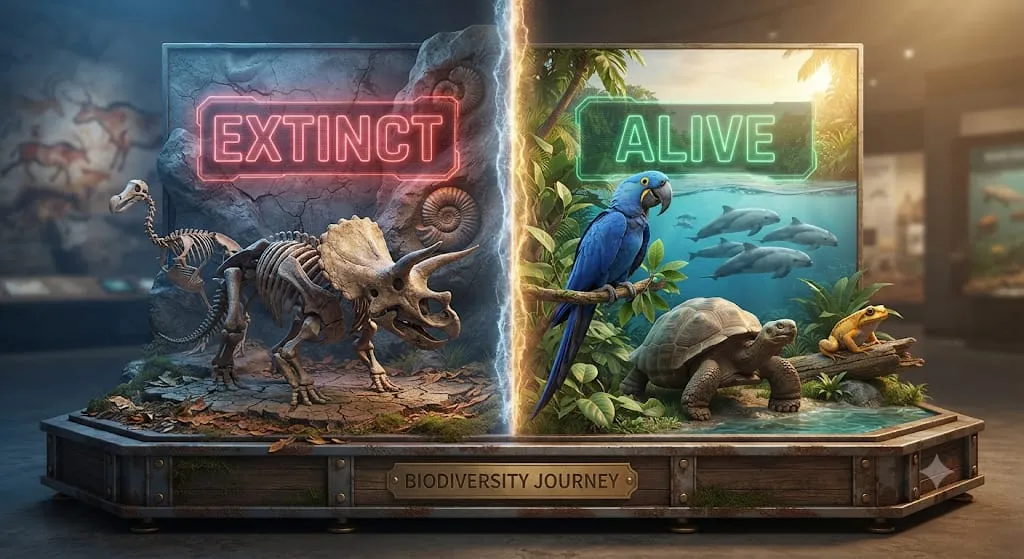
Extinct means a species no longer exists because every member has died. Alive means a person, animal, or plant is still living. If a species has living members today, it is alive, not extinct.
A few years ago, I was helping a student write about dinosaurs. She confidently wrote, “Dinosaurs are still alive.” She meant that birds are related to dinosaurs, but her wording changed the meaning completely. That small mistake started a great discussion about what extinct and alive really mean.
Many people wonder if an animal is extinct or alive. Others hear news about endangered species and become confused. Does endangered mean extinct? Does extinct mean there are only a few left? These questions are very common.
Understanding these words is important. You may see them in school, news reports, documentaries, or everyday conversations. Using the wrong word can completely change what you mean.
In this guide, you’ll learn the meanings of extinct and alive, how they differ, common mistakes to avoid, and plenty of real-world examples. By the end, you’ll know exactly when to use each word with confidence.
Why Trust This Guide?
As an English language educator and writer, I regularly explain confusing vocabulary in simple, beginner-friendly ways. This guide is based on standard English usage and information from trusted references, including Cambridge Dictionary, Merriam-Webster, Oxford English Dictionary, and scientific organizations such as the International Union for Conservation of Nature (IUCN).
Extinct or Alive – Quick Answer
An extinct species has no living members anywhere on Earth.
An alive species still has living individuals.
Examples
- Dinosaurs are extinct.
- Elephants are alive.
- The dodo is extinct.
- Pandas are alive but endangered.
The key question is simple:
Are any members still living?
If yes, the species is alive.
If no, it is extinct.
The Origin and Meaning of Extinct or Alive
What Does “Extinct” Mean?
The word extinct comes from the Latin word extinguere, meaning to put out, to destroy, or to extinguish.
Today, scientists use extinct when every individual of a species has died.
Once a species becomes extinct, it cannot reproduce naturally.
Examples include:
- Woolly mammoth
- Dodo
- Tasmanian tiger (thylacine)
- Passenger pigeon
What Does “Alive” Mean?
The word alive comes from Old English and simply means living.
A living thing:
- grows
- breathes
- reproduces
- responds to its environment
Humans, dogs, oak trees, whales, and butterflies are all alive.
Extinct or Alive Explained
Although these words seem like opposites, people often confuse them with other conservation terms.
| Term | Meaning | When to Use | Context |
| Extinct | No living members remain | Species has completely disappeared | Biology, science |
| Alive | Living now | Individual or species still exists | Everyday English |
| Endangered | At high risk of extinction | Population is shrinking | Conservation |
| Critically Endangered | Extremely close to extinction | Urgent protection needed | Wildlife |
| Extinct in the Wild | Survives only in captivity | Zoos or breeding programs | Conservation |
Example
❌ Tigers are extinct.
✅ Tigers are alive but endangered in many areas.
Extinct, Endangered, and Alive
Many people think endangered means extinct.
It does not.
Alive
The species still exists.
Example:
- Giraffes
- Polar bears
- Sea turtles
Endangered
The species is alive but could disappear without protection.
Example:
- Orangutans
- African forest elephants
Extinct
Every member has died.
Example:
- Dodo
- Great auk
Think of it like this:
Alive → Endangered → Critically Endangered → Extinct
Which Word Should You Use?
Your choice depends on the situation.
For students
Use extinct only when discussing species that no longer exist.
For writers
Use alive for anything currently living.
For journalists
Be careful not to confuse endangered with extinct.
For everyday conversations
Ask yourself one question:
Are there still living members?
If yes, use alive.
If no, use extinct.
Common Mistakes
Here are mistakes people make most often.
| ❌ Mistake | ✅ Correct |
| Pandas are extinct. | Pandas are alive but vulnerable. |
| Tigers are extinct. | Tigers are alive but endangered. |
| Dinosaurs are alive. | Non-avian dinosaurs are extinct. |
| Extinct means almost gone. | Extinct means completely gone. |
| Alive means healthy. | Alive simply means living. |
Why These Mistakes Happen
People often hear news about endangered animals and assume they have already disappeared.
Scientists use very specific definitions.
Extinct or Alive in Real-World Examples
Professional Email
“Our research confirms that the species is still alive, although its population has become much smaller.”
News Headline
“Scientists Discover Rare Frog Thought to Be Extinct.”
Social Media Post
“I just learned that giant pandas are still alive. They are protected because their numbers remain low.”
Scientific Report
“The bird was officially declared extinct after decades without confirmed sightings.”
Famous Examples
Extinct Animals
- Dodo
- Woolly mammoth
- Passenger pigeon
- Great auk
- Tasmanian tiger
- Caribbean monk seal
Animals Still Alive
- Giant panda
- Blue whale
- Tiger
- Elephant
- Snow leopard
- Gorilla
Some of these species are endangered, but they are not extinct.
Can Extinct Animals Come Back?
This is a fascinating question.
Some scientists are studying de-extinction, which aims to recreate extinct species using advanced genetics.
However, no extinct species has been fully restored to its natural population.
For now, once a species becomes officially extinct, it remains extinct.
That is why conservation matters so much.
Why Species Become Extinct
Several factors can cause extinction.
- Habitat destruction
- Climate change
- Hunting
- Pollution
- Disease
- Invasive species
- Natural disasters
Many extinctions today happen because of human activity.
Protecting habitats helps keep species alive.
Extinct or Alive — Data, Trends & Usage
Search interest in extinct or alive remains strong because people frequently look up animals after seeing documentaries, movies, museum exhibits, or news stories.
Search Intent
Primary Intent: Informational
Readers usually want to know:
- Is an animal extinct?
- What does extinct mean?
- What’s the difference between extinct and endangered?
- Which animals are still alive?
Who Searches Most?
- Students
- Teachers
- Parents
- Wildlife enthusiasts
- General readers
Why It Matters Today
Climate change, habitat loss, and conservation efforts have increased public interest in endangered wildlife. More people want reliable information about whether a species is extinct, endangered, or still alive.
Comparison Table
| Term | Meaning | Region/Context | Best Used When |
| Extinct | No living members remain | Science, education | Species has disappeared completely |
| Alive | Living now | Everyday English | Person, animal, or plant exists |
| Endangered | Facing extinction | Wildlife conservation | Species needs protection |
| Critically Endangered | Extremely high extinction risk | Scientific reports | Species is close to extinction |
| Extinct in the Wild | Exists only in captivity | Conservation | Survives only in zoos or breeding centers |
Frequently Asked Questions
Q: What does extinct mean?
A: Extinct means every member of a species has died. The species no longer exists anywhere in the wild or in captivity.
Q: What does alive mean?
A: Alive means living. A living organism can grow, reproduce, and carry out life processes.
Q: Is endangered the same as extinct?
A: No. Endangered species are still alive but face a high risk of extinction. Extinct species no longer have any living members.
Q: Can a species come back after becoming extinct?
A: Not naturally. Scientists are researching de-extinction, but no extinct species has been successfully restored to a self-sustaining wild population.
Q: Are dinosaurs extinct?
A: Non-avian dinosaurs are extinct. Modern birds are descendants of ancient dinosaurs, which is why this topic often causes confusion.
Q: Is “extinct” used only for animals?
A: No. The word also applies to plants, fungi, and any species that no longer has living members.
Q: Is it correct to say a person is extinct?
A: No. We use dead for an individual person. Extinct refers to an entire species or sometimes a family line, language, or tradition that no longer exists.
Conclusion
Understanding the difference between extinct and alive is easier than it first seems. An alive species still has living members somewhere in the world. An extinct species has disappeared completely. The confusion often comes from mixing up extinct with endangered, but they are not the same. Endangered species are still alive and can often recover with proper protection.
Whenever you’re unsure, ask yourself one simple question: Does this species still have living members? If the answer is yes, it’s alive. If the answer is no, it’s extinct.
Using these words correctly will make your writing clearer, whether you’re talking about wildlife, science, school projects, or everyday conversations.
Bookmark this guide so you never confuse extinct, endangered, and alive again. If you found it helpful, share it with someone who loves animals or wants to improve their English.
References
- Cambridge Dictionary
- Merriam-Webster Dictionary
- Oxford English Dictionary
- International Union for Conservation of Nature (IUCN) Red List
- National Geographic
- Smithsonian Institution
Read More:
Anyway or Anyways: Which One Should You Use?

I’m **James Whitmore**, a professional editor and English language content writer with more than 10 years of experience creating educational content. I specialize in spelling comparisons, grammar, vocabulary, synonyms, commonly confused words, proofreading, and English usage. My goal is to help readers write with confidence by providing clear, accurate, and well-researched articles that make complex language topics easy to understand.