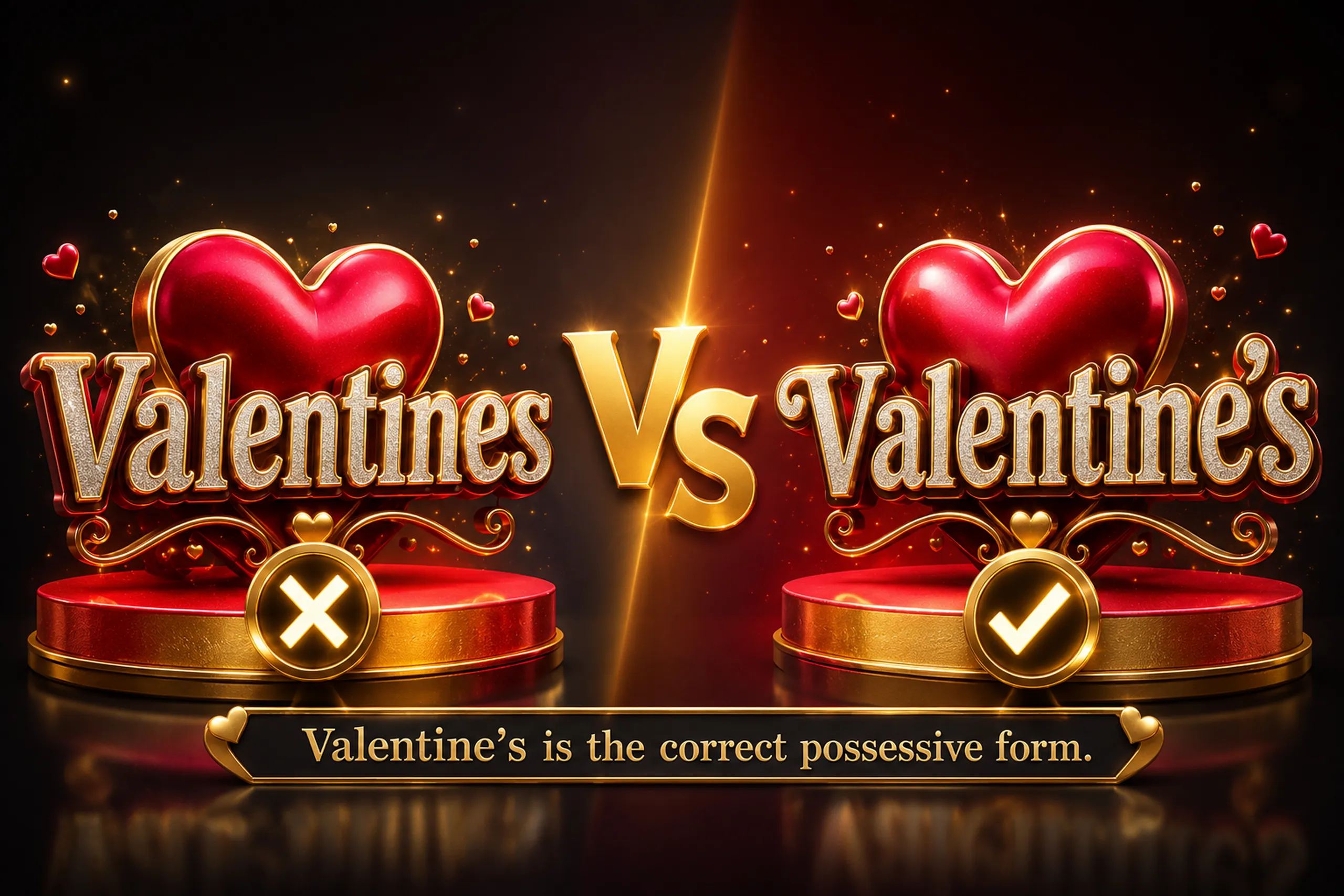
Valentine’s is correct when you mean Valentine’s Day, while valentines is correct as the plural of valentine for people, cards, or gifts.
I remember the first time I stopped while writing “Happy Valentines Day” and wondered, “Does Valentine need an apostrophe?” It looked like such a small detail, but I soon realized that the apostrophe actually changes the meaning of the phrase.
Since then, I have noticed the same mistake in greeting cards, social media captions, emails, and everyday messages. It is easy to leave out the apostrophe because we do not hear it when we say Valentine’s Day. When we write it, however, that tiny mark has an important grammatical role.
Through my own experience with English writing, I learned that Valentine’s is the possessive form of Valentine, while valentines is simply the plural form of the noun valentine. Once I understood this simple rule, I stopped second-guessing the spelling.
In this guide, I will explain the difference between Valentine’s, valentines, and Valentine using clear examples. I will also cover the history of the phrase, common mistakes, and an easy trick I use to remember the correct spelling.
Valentines or Valentine’s Quick Answer
Use Valentine’s when referring to the holiday:
- Valentine’s Day is on February 14.
- We are planning a Valentine’s Day dinner.
Use valentines when you mean more than one valentine:
- The students exchanged valentines.
- She received several valentines at school.
So, if you are writing the name of the holiday, the standard form is Valentine’s Day.
Cambridge Dictionary defines Valentine’s Day as February 14, a day associated with giving cards or gifts to someone you love or admire.
The easiest rule
Think of it this way:
Holiday → Valentine’s Day
More than one card, person, or message → valentines
That simple distinction solves most spelling questions.
The Origin and Background of Valentine’s
The story behind Valentine is older than the modern holiday cards and chocolates we know today.
According to Etymonline, Valentine as a noun appeared in English around the mid-15th century. It came from the Late Latin name Valentinus, connected with early Italian saints named Valentine.
The word later developed a romantic meaning. Etymonline records the sense of a sweetheart chosen on St. Valentine’s Day and notes that choosing a sweetheart on this day was a custom in English and French court circles by the 14th century.
The word eventually gained another useful meaning. By 1824, valentine could mean a letter or card sent to a sweetheart.
That history helps explain today’s two forms:
- Valentine → a person or a card
- valentines → more than one person or card
- Valentine’s Day → the holiday associated with Saint Valentine
The apostrophe in Valentine’s therefore has a grammatical job. It marks the possessive form of the proper noun Valentine.
Valentine’s Explained Key Differences
The three forms may look almost identical, but they do different jobs.
| Term | Meaning | When to Use | Region/Context |
| Valentine | A person loved or admired, or a Valentine card | One person or card | General English |
| valentines | More than one valentine | Several cards or people | General English |
| Valentine’s | Possessive form used in the holiday name | Before “Day” | Standard English |
| Valentine’s Day | The February 14 holiday | Naming the holiday | Formal and informal English |
| Valentines Day | Missing possessive apostrophe | Avoid in standard writing | Common spelling error |
Cambridge Dictionary gives valentine two main everyday meanings: someone you love or want a romantic relationship with, and a decorative card sent on February 14.
Example: Valentine
Daniel is my Valentine.
Here, Valentine refers to a person.
Example: valentines
The children made colorful valentines for their classmates.
Here, valentines means multiple cards.
Example: Valentine’s Day
We booked a table for Valentine’s Day.
Here, Valentine’s is part of the holiday’s name.
Why Does Valentine’s Have an Apostrophe?
This is the grammar point that causes the most confusion.
The apostrophe in Valentine’s Day indicates a possessive relationship.
Compare:
- John’s car
- Sarah’s notebook
- Valentine’s Day
In each case, ‘s connects a noun with something associated with it.
The holiday name is traditionally understood as the day associated with Saint Valentine.
That is why standard English uses:
Valentine’s Day
rather than:
Valentines Day
The second version removes the apostrophe and makes Valentines look like a plural noun.
What about Valentines’ Day?
That is not the standard spelling either.
Valentines’ would suggest possession by multiple people named Valentines. That is not what the holiday name means.
The standard form is:
Valentine’s Day ✅
Which Version Should You Use?
Your choice depends on what you mean.
For students and ESL learners
Use Valentine’s Day when talking about the holiday.
It is the safest form for schoolwork, exams, and general English writing.
For professional writers
Use Valentine’s Day in articles, emails, reports, advertisements, and other polished content when naming the holiday.
For example:
Our office will close early on Valentine’s Day.
For cards and gifts
Use valentine or valentines when talking about the objects or people.
For example:
The teacher asked the class to bring valentines.
For global or neutral writing
Write the full phrase Valentine’s Day when there is any chance of confusion.
It is clear and widely understood.
Common Mistakes With Valentines and Valentine’s
Here are five errors worth avoiding.
| Mistake | Correction | Why? |
| Valentines Day | Valentine’s Day | The holiday uses the possessive form. |
| Valentines’ Day | Valentine’s Day | The apostrophe should not show plural possession. |
| Happy Valentines Day! | Happy Valentine’s Day! | The holiday name needs the apostrophe. |
| She received three Valentine’s. | She received three valentines. | Multiple cards or people require the plural form. |
| We celebrate Valentines Day every year. | We celebrate Valentine’s Day every year. | The holiday’s standard spelling includes ‘s. |
Mistake 1: Dropping the apostrophe
Wrong: We went out on Valentines Day.
Right: We went out on Valentine’s Day.
The missing apostrophe changes the grammatical form.
Mistake 2: Adding an apostrophe to a plural
Wrong: She received five valentine’s.
Right: She received five valentines.
A plural noun does not normally need an apostrophe.
Mistake 3: Using plural possession
Wrong: Valentines’ Day
Right: Valentine’s Day
The holiday name refers to Valentine in the singular possessive form.
Mistake 4: Confusing Valentine with Valentine’s
Wrong: Will you be my Valentine’s?
Better: Will you be my Valentine?
Here, Valentine is the noun naming the person.
Mistake 5: Treating every use as a holiday reference
Not every sentence about February 14 needs Valentine’s.
She bought several valentines for her friends.
Here, valentines refers to cards, not the holiday.
Valentine’s in Real-World Examples
Seeing the forms in different settings makes the rule easier to remember.
Professional email
Subject: Valentine’s Day Office Schedule
Please note that the office will close at 3 p.m. on Valentine’s Day.
News headline
Local Businesses Prepare for Valentine’s Day Shopping Rush
The apostrophe remains part of the holiday name.
Social media post
Happy Valentine’s Day! Wishing everyone a day filled with kindness and love.
This is the standard form for the holiday.
Formal document
The company will launch its seasonal promotion ahead of Valentine’s Day.
Again, the holiday takes the possessive form.
Everyday conversation
I received two lovely valentines from my friends.
Here, valentines is plural.
Valentine’s Data, Trends & Usage
This spelling question has a strong seasonal search pattern.
Exact monthly search-volume figures for “valentines” versus “valentine’s” vary by country, search platform, and date. Google Trends is especially useful here because it measures relative search interest, rather than giving a fixed worldwide monthly search count.
Google’s own published Valentine’s Day trend reports show that interest in Valentine’s-related searches rises sharply around February. For example, Google reported a 400% increase in U.S. searches for “what to write in valentines day card” during one Valentine’s season.
Google has also reported seasonal increases in searches for Valentine’s flowers, chocolates, restaurants, and related products. In one U.S. report, flower-shop searches on Google Maps rose by nearly 120% leading up to February 14.
What does that mean for this keyword?
The search intent is mainly informational.
People searching for “valentines or valentine’s” usually want to know:
- Which spelling is correct?
- Does Valentine’s need an apostrophe?
- Is valentines a plural?
- How do you write Valentine’s Day?
- Is “Valentines Day” wrong?
The topic also has strong seasonal relevance. Search interest naturally becomes more noticeable in January and February.
Recent 2026 reporting based on Google search trends also shows that Valentine’s-related searches continue to expand beyond traditional gifts into experiences, friendship celebrations, personalized dates, and other forms of celebration.
This makes correct spelling useful for SEO content, social media, email marketing, school writing, and everyday communication.
Standalone Comparison: Valentine, Valentine’s, and Valentines
| Term/Variant | Meaning | Region/Context | Best Used When |
| Valentine | A loved person or a card | General English | Referring to one person or card |
| valentines | Plural of valentine | General English | Referring to multiple people or cards |
| Valentine’s | Possessive form | Holiday name | Before Day |
| Valentine’s Day | February 14 celebration | Global English | Naming the holiday |
| Valentines Day | Nonstandard spelling of the holiday | Informal/error | Avoid in edited writing |
One useful edge case is Valentine’s without Day.
You may see sentences such as:
We are making plans for Valentine’s.
This can appear as an informal shortened form of Valentine’s Day, but the full name is clearer in formal writing.
FAQs About Valentines or Valentine’s
Q: Is it Valentine’s or Valentines?
A: It depends on the meaning. Use Valentine’s in Valentine’s Day, but use valentines as the plural of valentine.
Q: Is “Valentines Day” correct?
A: In standard English, the holiday is written Valentine’s Day. The apostrophe is part of the conventional possessive form.
Q: Why does Valentine’s Day have an apostrophe?
A: Valentine’s is a possessive form of the name Valentine. The apostrophe and s connect Valentine with the day associated with him.
Q: Is “valentines” ever correct?
A: Yes. Valentines is the plural of valentine. It can refer to several people or several cards sent on Valentine’s Day. Cambridge Dictionary recognizes both meanings of valentine.
Q: Should Valentine be capitalized?
A: Capitalize Valentine when it is part of a proper name, such as Saint Valentine or Valentine’s Day. The common noun valentine is normally lowercase when it means a loved person or card.
Q: Is “Happy Valentine’s Day” correct?
A: Yes. Happy Valentine’s Day! is the standard spelling of the greeting. The apostrophe belongs between Valentine and s.
Q: Can I say “my Valentine”?
A: Yes. My Valentine means the person you love or admire romantically. No apostrophe is needed because Valentine is being used as a noun, not a possessive form.
Q: Where does the word Valentine come from?
A: Etymonline traces the noun Valentine to the Late Latin name Valentinus. The romantic sense developed in connection with Valentine’s Day and medieval courtly customs.
Conclusion
The difference between valentines and Valentine’s is small but important.
Use Valentine’s Day when you mean the holiday celebrated on February 14. The apostrophe marks the possessive form. Use valentines when you mean two or more valentines, such as cards or people.
There is also a third form worth remembering: Valentine. It can name one person you love or one card given on the occasion.
A simple memory trick can help:
One card or person → Valentine
Several cards or people → valentines
The holiday → Valentine’s Day
Cambridge Dictionary confirms the meanings of both valentine and Valentine’s Day, while Etymonline provides useful historical background on the word.
So, when you write your next greeting, blog post, email, or social caption, remember the apostrophe in Valentine’s Day.
Bookmark this guide so you never second-guess valentines or Valentine’s again.
Read More:
Dog or Cat: The Easy Guide to Choosing the Right Pet

I specialize in English grammar, spelling, word choice, and language usage. My content is based on research from grammar references, style guides, dictionaries, and real-world usage to ensure it is accurate and practical.
At Spelling Comparison, I write guides that explain why words are confused, how they are used, and which form is correct in context. I also include proofreading tips, examples, and writing advice readers can apply immediately.
My goal is to publish clear, reliable content that helps readers make better writing decisions. Each guide is written for accuracy, clarity, and usefulness in school, work, business, and everyday communication.