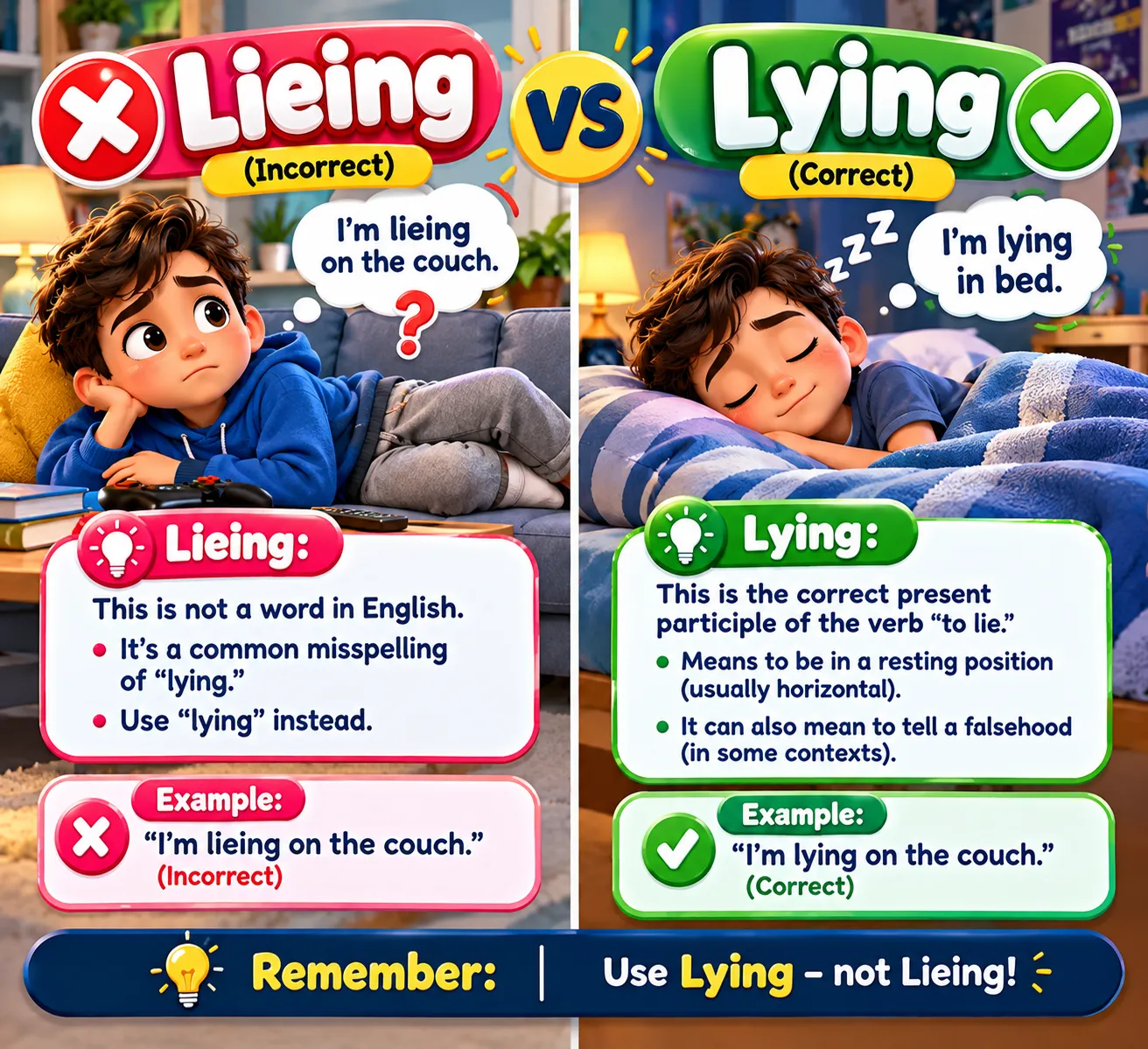
Lying is the correct spelling when you mean telling an untruth or resting in a flat position. Lieing is a common misspelling of lying.
I have often come across people who pause while writing because they are unsure whether to use lieing or lying. Have you ever typed a sentence, looked at the word twice, and wondered if it looked right? This is a common spelling problem, even for people who use English every day.
The confusion makes sense. Many English verbs form their -ing form by keeping the main word and adding -ing. For example, help becomes helping, and walk becomes walking. So, writing lieing may seem like a natural choice.
However, the correct spelling is lying. The final -ie changes to -y before -ing is added. The same pattern appears in words such as die → dying and tie → tying.
There is another reason to learn this word. Lying can describe telling an untruth or resting in a flat position. Both meanings use the same spelling, but their meanings depend on the sentence.
In this guide, I will explain the spelling rule, word history, grammar, common mistakes, and easy examples. By the end, you will know how to use lying correctly in everyday and professional writing.
Lieing or Lying: The Correct Spelling
The correct spelling is lying. The word lieing is not the standard spelling of the -ing form of lie.
For example:
- Correct: The child is lying on the sofa.
- Incorrect: The child is lieing on the sofa.
The spelling rule is simple. When a verb ends in -ie, change those letters to -y before adding -ing.
| Base word | Correct -ing form |
| Lie | Lying |
| Die | Dying |
| Tie | Tying |
| Vie | Vying |
This rule explains why lying is correct, even though lieing may look logical.
The Origin and Background of Lying
The word lying comes from the verb lie, but this verb has two common meanings:
- To rest in a flat position: For example, resting on a bed or lying on the ground.
- To tell an untruth: For example, saying something that is not true on purpose.
These meanings share the same spelling in the present participle, but their past-tense forms differ.
According to the Cambridge Dictionary, the verb lie meaning to rest in a horizontal position has the forms lie, lay, and lain. The verb meaning to tell an untruth has the forms lie, lied, and lied. Both use lying for the -ing form.
The word’s history also helps explain its modern form. English spelling developed over many centuries, from Old English through Middle English to modern English. The spelling rule for lie → lying is a present-day grammar pattern, not a new word or a regional spelling choice.
The confusion often happens because people apply the usual rule of adding -ing directly to a verb. Words such as read → reading follow that pattern, but lie follows the -ie to -y pattern instead.
For more background, you can consult the Cambridge Dictionary entry for lie and its grammar guide to lay and lie.
Lying Explained: Key Differences and Uses
Although lying has one correct spelling, it can have different meanings in a sentence. The context tells you which meaning the writer intends.
1. Lying means telling an untruth
Use lying when someone is saying something they know is false or trying to mislead another person.
Examples:
- He is lying about where he went.
- I knew she was lying to me.
- They were lying to avoid trouble.
In these sentences, lying describes an action related to honesty and truth.
2. Lying means resting in a flat position
Use lying when a person or animal is resting horizontally, or when an object is placed in a particular position.
Examples:
- The dog is lying beside the fireplace.
- My keys are lying under the chair.
- She spent the afternoon lying on the grass.
Here, lying has nothing to do with telling an untruth. It describes a position or state.
3. Lying as a gerund
A gerund is a verb form ending in -ing that acts as a noun.
For example:
- Lying can damage trust.
- Lying in the sun makes him feel relaxed.
In the first sentence, lying refers to the act of telling untruths. In the second, it refers to the activity of resting in the sun.
Comparison table
| Term | Meaning | When to Use | Region/Context |
| Lying | Telling an untruth | When someone is being dishonest | Standard English |
| Lying | Resting in a flat position | When describing a person, animal, or object | Standard English |
| Lieing | Nonstandard spelling | Avoid in ordinary writing | Common spelling error |
| Laying | Putting something down or placing eggs | When the verb lay has an object | Standard English |
| Lied | Told an untruth in the past | When describing past dishonesty | Standard English |
| Lay | Rested in a flat position in the past | When describing a past action of lie meaning recline | Standard English |
Which Version Should You Use?
For almost all standard English writing, choose lying, never lieing.
- For students: Use lying in essays, exams, and homework. Remember the -ie to -y spelling rule.
- For professional writers: Use lying in reports, articles, emails, and business documents.
- For English learners: Learn the pattern through lie → lying, die → dying, and tie → tying.
- For formal writing: Choose lying regardless of whether you mean dishonesty or a flat position.
- For global English: Use lying in both British and American English. The spelling is the same in both varieties.
One extra point is worth remembering: lying and laying are different words. If you mean that someone is resting, write “She is lying down.” If you mean that someone is putting an item somewhere, write “She is laying the book on the desk.”
This distinction is about meaning and grammar, not just spelling.
Common Mistakes with Lieing or Lying
Here are five errors to avoid when using lying.
Mistake 1: Adding -ing without changing the spelling
Incorrect: He is lieing to his parents.
Correct: He is lying to his parents.
Why? The final -ie changes to -y before -ing is added.
Mistake 2: Confusing lying with laying
Incorrect: The baby is laying on the bed.
Correct: The baby is lying on the bed.
Why? Lie describes being in a resting position. Lay means to put something down and usually needs an object.
Mistake 3: Using lying for a past action of dishonesty
Incorrect: She was lied about her age yesterday.
Correct: She was lying about her age yesterday.
Why? Use was lying for an action in progress in the past. Use lied for a completed statement, as in “She lied about her age.”
Mistake 4: Using lied for a past resting position
Incorrect: I lied on the sofa all afternoon.
Correct: I lay on the sofa all afternoon.
Why? The past tense of lie meaning to rest is lay. The past tense of lie meaning to tell an untruth is lied.
Mistake 5: Thinking the two meanings need different spellings
Incorrect: He is lieing about the facts.
Correct: He is lying about the facts.
Also correct: He is lying on the floor.
Why? Both meanings use the same -ing form. The surrounding words tell you which meaning applies.
Lying in Real-World Examples
The following examples show how lying works in different types of writing.
1. Professional email
Dear Team,
I noticed that some details in the report may be inaccurate. Could you please review the information and confirm that all statements are correct?
Accurate information helps us maintain trust and avoid misunderstandings.
Best regards,
[Your Name]
2. News headline
Witness Accused of Lying During Official Investigation
Here, lying refers to making statements that are believed to be untrue.
3. Social media post
Honesty builds trust, but lying can break it. 💬 Think before you speak, and remember that the truth matters!
4. Formal report
The inspection team found several documents lying on the floor near the storage area.
In this sentence, lying describes where the documents were found. It does not refer to dishonesty.
Lying Data, Trends, and Usage
People often search for lieing or lying because they want a quick spelling answer. The search intent is mainly informational readers want to know which form is correct and how to use it.
What does search data tell us?
Google Trends provides relative search interest based on a sample of searches. Its figures are normalized on a scale from 0 to 100, rather than showing exact monthly search counts. Very low-volume searches may also appear as zero.
I have not verified exact monthly search volumes for lieing and lying, so I will not present unverified numbers as facts. A keyword tool such as Semrush or Ahrefs can provide estimates for a specified country and date range.
| Usage factor | Finding |
| Main search intent | Informational |
| Correct spelling | Lying |
| Incorrect standard form | Lieing |
| Main grammar issue | The -ie to -y spelling change |
| Related searches | Lying vs. laying; lie vs. lay; lied vs. lay |
| Regional spelling | The same standard spelling in British and American English |
Why does this topic matter?
Spelling errors can affect how readers understand and judge your writing. This matters in school assignments, professional emails, website content, and online posts.
Grammar checkers can help identify lieing, but it is useful to know the rule yourself. That way, you can also recognize the difference between lying, laying, lied, and lay when a sentence needs more than a spelling correction.
Standalone Comparison Table: Lie, Lying, Lay, and Lied
This table focuses on verb forms and tense, so you can choose the right word for the meaning you want.
| Term/Variant | Meaning | Region/Context | Best Used When |
| Lie | To rest in a flat position | Standard English | Describing the present or general state |
| Lying | Resting or telling an untruth | Standard English | Describing an ongoing action |
| Lieing | Nonstandard spelling | Spelling error | Do not use as the standard -ing form |
| Lay | Rested in a flat position; also means to put something down | Standard English | Use for the past of reclining lie, or as the base form of lay |
| Lain | Past participle of lie meaning rest | Standard English | Use with a helping verb, as in “has lain” |
| Lied | Told an untruth in the past | Standard English | Describing a past act of dishonesty |
| Laying | Putting something down or producing eggs | Standard English | Describing an action involving the verb lay |
Quick memory tip: Lie → lying → lay → lain describes resting or being in a position. Lie → lying → lied describes telling an untruth.
Frequently Asked Questions
Q1: Is it lieing or lying?
A: Lying is the correct spelling in standard English. Lieing is a common spelling mistake because the final -ie changes to -y before adding -ing.
Q2: What does lying mean?
A: Lying has two main meanings. It can mean saying something untrue, or it can describe resting in a flat position.
Q3: Why is lieing incorrect?
A: English uses a special spelling pattern for verbs ending in -ie. The letters change to -y before -ing is added, giving lying.
Q4: Is lying acceptable in formal writing?
A: Yes. Lying is the standard spelling in formal and informal English. You can use it in essays, reports, business emails, and academic work.
Q5: What is the difference between lying and laying?
A: Lying means resting in a flat position or telling an untruth. Laying usually means putting something down or, in the case of some animals, producing eggs.
Q6: What is the past tense of lying?
A: It depends on the meaning. For dishonesty, the past tense is lied. For resting in a flat position, the past tense is lay.
Q7: Is lying spelled the same in British and American English?
A: Yes. Both British and American English use lying. There is no standard regional spelling difference between them.
Conclusion: Remember the Correct Spelling
Choosing between lieing and lying is simple once you know the spelling rule. Lying is correct, while lieing is a nonstandard spelling error.
Remember that lying can describe two different actions. Someone may be lying when they tell an untruth, or a person may be lying down to rest. The spelling stays the same, even though the meanings differ.
Keep these useful points in mind:
- Change -ie to -y before adding -ing.
- Use lying for both dishonesty and a resting position.
- Use lied for past dishonesty and lay for a past resting position.
- Do not confuse lying with laying, which usually means putting something down.
You do not need to memorize every English spelling rule at once. A few clear examples and regular practice can help you write with greater confidence.
Bookmark this guide for future reference, and share it with anyone who often gets confused by lieing and lying.
Read More:
Flies or Flys: Easy Spelling and Grammar Guide

I’m an English language educator and content writer with more than 10 years of experience helping learners improve their English skills. I specialize in spelling differences, grammar, vocabulary, synonyms, commonly confused words, and English usage. My goal is to create accurate, easy-to-understand articles that make learning English simple, practical, and enjoyable for students, writers, and professionals around the world.