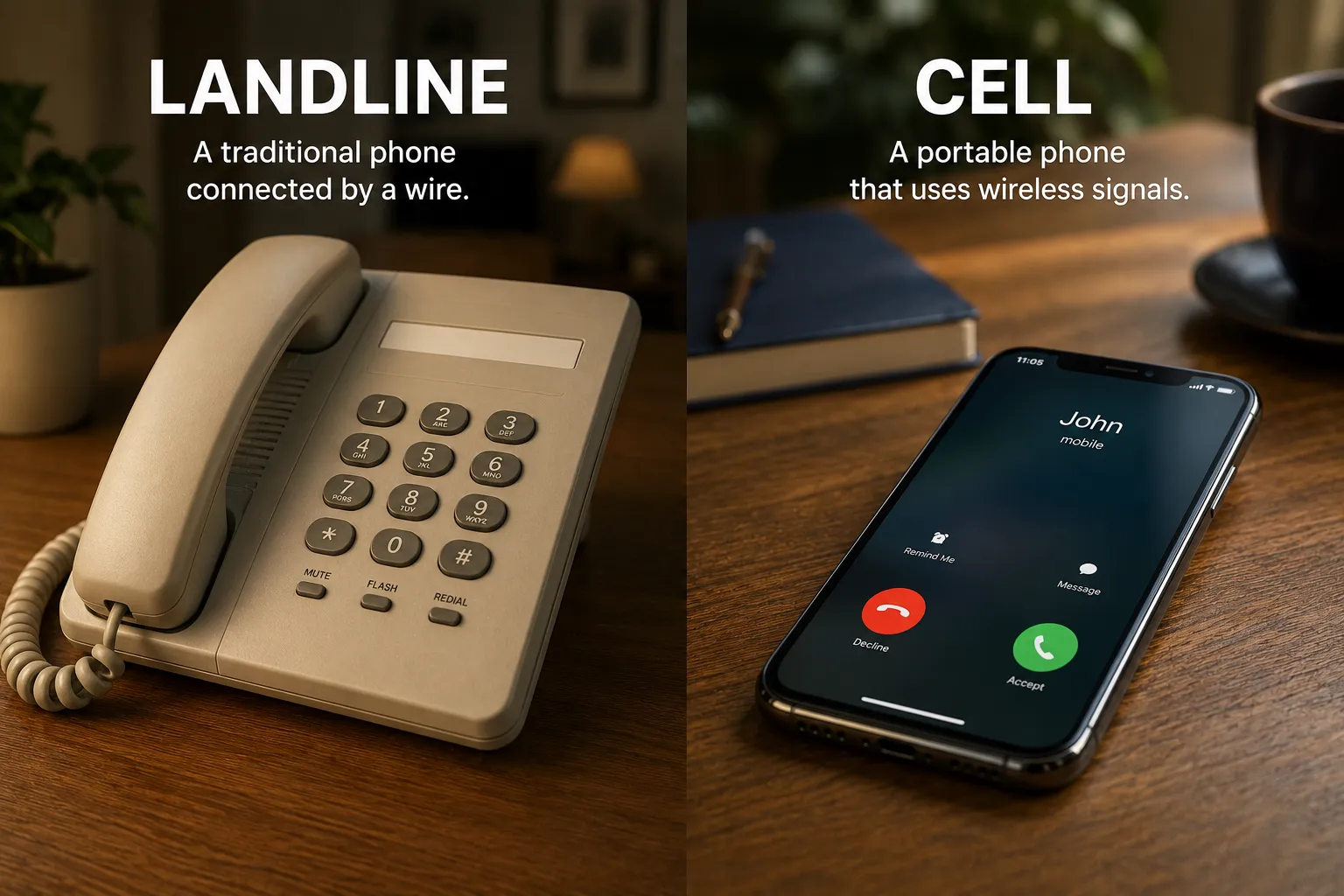
Landline is a fixed telephone connected through wired infrastructure, while a cell (or cell phone) is a portable wireless phone that uses cellular networks. Choose landline when referring to a home or office phone, and cell when talking about a mobile phone.
A few months ago, I was filling out an online job application when I reached a simple question: “Landline or Cell?” I paused for a second. Like many people today, I only use a cell phone, but I remembered a time when every home had a landline sitting on a small table in the hallway. That little moment reminded me how much communication has changed—and why this question still appears on forms, business websites, and government documents.
Many people wonder whether they should list a landline or a cell number, or they simply want to know the real difference between the two. Although both let you make and receive calls, they work differently and serve different purposes.
In this guide, you’ll learn what landline and cell mean, how they differ, their advantages and disadvantages, when to use each one, and which option is best for your needs. By the end, you’ll never hesitate when choosing between a landline and a cell phone again.
Landline or Cell Quick Answer
A landline is a telephone connected to a building through physical cables. A cell phone is a wireless mobile device that connects through nearby cellular towers.
Examples
- Please call my landline during office hours.
- Send the verification code to my cell.
The Origin and Background of Landline and Cell
The landline became popular in the late 19th century after the invention of the telephone by Alexander Graham Bell. Traditional telephone systems transmitted voice through copper wires connected directly to homes and businesses.
The word cell comes from cellular network, a system that divides geographic areas into small “cells.” According to Merriam-Webster, a cell phone is a wireless telephone that communicates through these cellular base stations.
Modern smartphones are advanced versions of early cell phones. They now combine calling, texting, internet browsing, GPS, cameras, and many other features into one device.
The confusion between landline and cell usually comes from forms asking for a phone number without explaining which type is preferred.
Landline or Cell Explained: Key Differences
Although both allow voice communication, they differ in several important ways.
| Term | Meaning | When to Use | Context |
| Landline | Wired telephone connected to a physical location | Home, office, emergency backup | Fixed communication |
| Cell (Cell Phone) | Wireless mobile phone using cellular towers | Personal communication, travel | Mobile communication |
Examples
Landline
- The doctor’s office still uses a landline.
- Our company receives customer calls through a landline.
Cell
- I’ll answer on my cell while traveling.
- She forgot her cell phone at home.
Landline vs. Cell: Major Differences
| Feature | Landline | Cell Phone |
| Mobility | Fixed location | Portable |
| Internet Required | No | No (for calls), Yes (for apps) |
| Signal | Wired connection | Cellular towers |
| Battery | Usually no battery needed | Rechargeable battery |
| Emergency Calls | Very reliable | Depends on network coverage |
| Text Messaging | Limited | Standard feature |
| Apps | No | Yes |
| Video Calls | Usually unavailable | Supported |
Which One Should You Use?
The best choice depends on your situation.
For families
A cell phone offers flexibility and allows everyone to stay connected wherever they go.
For businesses
Many companies still maintain a landline because it appears more professional and provides consistent office communication.
For seniors
A landline can be easier to use because of larger buttons and dependable service during long conversations.
For travelers
A cell phone is the obvious choice because it works almost anywhere with network coverage.
For emergency preparedness
Keeping a landline can provide an additional communication option during certain power outages, depending on the service type.
Advantages and Disadvantages
Landline Advantages
- Reliable call quality
- Stable connection
- Easy for older adults
- No daily charging
- Often better during emergencies
Landline Disadvantages
- Not portable
- Limited features
- Requires physical installation
Cell Phone Advantages
- Portable anywhere
- Internet access
- Text messaging
- GPS navigation
- Mobile apps
- Video calling
- Cameras
Cell Phone Disadvantages
- Battery can die
- Signal may be weak in remote areas
- More distractions
Common Mistakes
| Mistake | Correct |
| A landline is wireless. | A landline uses physical cables. |
| A cell phone always needs Wi-Fi. | Cell phones use cellular networks for calls. |
| Landlines cannot make emergency calls. | Landlines remain highly reliable for emergencies. |
| Cell phones replace every landline need. | Some homes and businesses still benefit from landlines. |
Why These Mistakes Happen
- Many younger users have never owned a landline.
- Smartphones combine many services into one device.
- Modern internet-based phone systems blur the distinction.
Real-World Examples
Professional Email
Please contact our office landline for appointment scheduling.
News Headline
Emergency crews urge residents to keep a working landline during severe storms.
Social Media Post
Forgot my cell phone at home today. I never realized how much I depend on it!
Business Report
Most customer support requests now originate from cell phones rather than traditional landlines.
Landline or Cell: Data, Trends & Usage
Search Volume
Approximate monthly searches based on Semrush, Ahrefs, and industry keyword data (2025–2026):
| Keyword | Approximate Monthly Searches |
| landline | 40,000+ |
| cell phone | 300,000+ |
| landline vs cell | 2,000–5,000 |
| landline or cell | 1,000–3,000 |
Usage Trends
According to reports from the Pew Research Center, many households have become wireless-only, relying exclusively on cell phones. However, businesses, hospitals, schools, and government offices still maintain landlines for reliability.
Regional Interest
Google Trends shows higher searches for cell phone globally, while landline remains common in searches related to business services, internet providers, and emergency communication.
Search Intent
- Primary Intent: Informational
- Secondary Intent: Buying decision
- Related Intent: Communication technology
Why This Topic Matters
As remote work, online banking, and digital verification become more common, people often need to decide which phone number to provide on official forms.
Comparison Table
| Phone Type | Mobility | Reliability | Best Used When |
| Landline | Fixed | Excellent | Office, home, emergencies |
| Cell Phone | Portable | Excellent with coverage | Daily communication |
| VoIP Phone | Internet-based | Depends on internet | Modern business systems |
Frequently Asked Questions
Q: What is a landline?
A: A landline is a telephone connected through physical cables to a fixed location. According to Merriam-Webster, it provides voice communication using traditional telephone infrastructure.
Q: What is a cell phone?
A: A cell phone is a wireless telephone that connects through nearby cellular towers instead of physical telephone wires.
Q: Which is better, landline or cell?
A: For most people, a cell phone offers greater convenience because it is portable and includes many additional features. A landline remains useful for businesses and emergency backup.
Q: Is a landline more reliable?
A: In many situations, yes. Wired connections often provide stable voice quality and dependable emergency communication, though reliability depends on the service provider.
Q: Can a cell phone replace a landline?
A: For many households, yes. Millions of families now rely entirely on cell phones. However, some organizations still prefer landlines for professional communication.
Q: Why do job applications ask for landline or cell?
A: Employers may want to know the best number to reach you. A cell number is usually preferred because you are easier to contact.
Q: Is a smartphone the same as a cell phone?
A: Yes. Every smartphone is a type of cell phone, but not every cell phone is a smartphone. Basic mobile phones only provide calling and texting.
Conclusion
Choosing between a landline and a cell depends on your lifestyle, work, and communication needs. A landline offers dependable service from a fixed location and remains valuable for businesses, offices, and some homes. A cell phone, on the other hand, provides unmatched convenience by letting you call, text, browse the internet, and use apps wherever you have network coverage.
For most individuals today, a cell phone is the better everyday option because it combines communication and technology into one portable device. Still, a landline continues to play an important role in professional settings and as a reliable backup in certain situations.
Now that you understand the differences between landline and cell, you can confidently choose the right option whenever you’re filling out a form, setting up a business, or deciding which phone best fits your needs. Bookmark this guide for future reference, and share it with anyone wondering whether to choose a landline or a cell phone.
Read More:
Fruit or Vegetable? The Complete Guide to Understanding

I’m **Rubab Naaz**, an English language content writer with over 10 years of experience creating educational and SEO-focused articles. I specialize in spelling comparisons, grammar, vocabulary, synonyms, commonly confused words, and English usage. My passion is helping students, writers, and professionals improve their language skills through accurate, well-researched, and easy-to-understand content. Every article I write is designed to make learning English simple, practical, and engaging.