Gases or Gasses: Easy Guide to the Correct Spelling
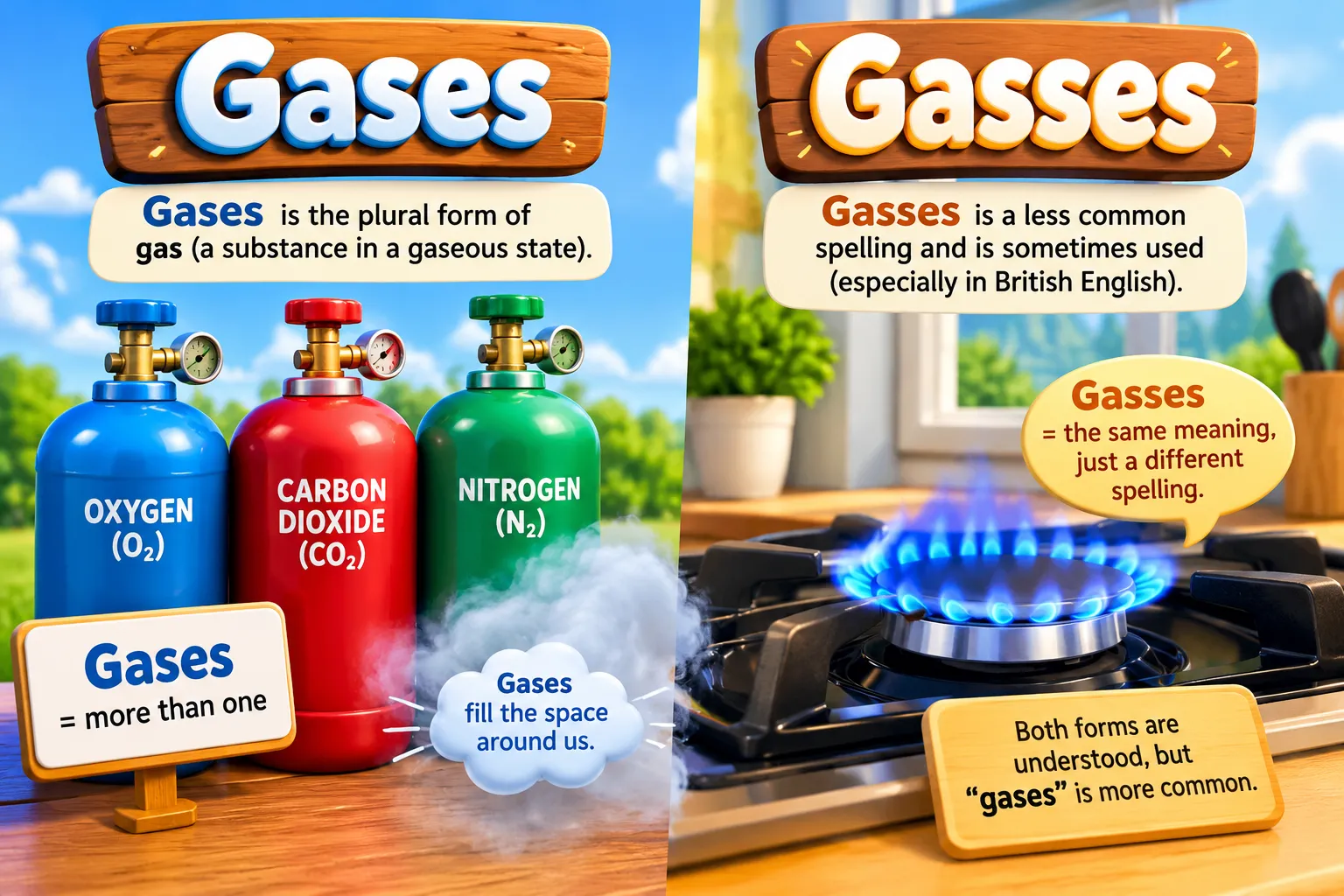
Gases and gasses are both accepted plurals of gas, but gases is the standard spelling for the noun, especially in scientific writing. Gasses is also used, while gasses can be the verb form of gas
I have often seen writers stop when they need the plural of gas. Should it be gases or gasses? The extra s looks small, but it can make you question which spelling is correct.
This confusion is common because English has many words that form plurals in different ways. Some words simply add -s. Others need -es. The word gas creates an extra problem because gasses is also a real English word.
The good news is that both gases and gasses can be correct. The choice depends on how you are using the word.
When gas means a substance such as oxygen, nitrogen, or carbon dioxide, gases is the standard plural spelling. Cambridge Dictionary lists gases and gasses as plurals of gas.
There is another important detail. Gasses can also be the third-person singular form of the verb gas.
So, if you have ever wondered why you see both spellings, you are not alone. Let’s make the difference simple.
Gases or Gasses Quick Answer
Use gases when you are talking about more than one gas.
Oxygen and hydrogen are different gases.
Gasses can also be used as a plural of gas, but gases is the safer and more common choice in general and scientific writing.
There is also a verb gas:
The machine gasses the chamber.
Here, gasses does not mean several gases. It means that the machine treats or fills the chamber with gas.
This gives you a simple rule:
- gases → plural noun
- gasses → accepted plural noun, or present-tense verb
- gas → singular noun or base-form verb
Cambridge Dictionary specifically lists gasses as a plural of gas and also gives examples of its use in scientific contexts.
The Origin and Background of Gas
The word gas has an unusual history.
Etymonline dates the noun gas to the 1650s. It traces the word to Dutch gas, probably influenced by Greek khaos, meaning “empty space.” The term was introduced by the Flemish chemist J. B. van Helmont.
The modern scientific meaning developed over time. Etymonline notes that the modern scientific sense began in the late 18th century. Other meanings later developed, including references to fuel, anesthetics, and intestinal vapors.
This history is interesting because gas is not an old English word in the same way as many everyday terms. It entered English as a scientific term and later became common in everyday speech.
Today, gas has several meanings.
It can refer to:
- A state of matter
- A particular gaseous substance
- Fuel
- Gasoline in American English
- Intestinal gas
- A substance used to harm or affect someone
The plural depends on the meaning, but gases is the standard choice when you mean multiple gaseous substances.
Gases Explained
Gases is the regular plural noun form of gas in standard modern English.
For example:
Oxygen and nitrogen are gases.
Several gases were detected in the sample.
Greenhouse gases can affect Earth’s climate.
The laboratory stores different gases in separate containers.
Here, gases means more than one type or amount of gas.
Cambridge Dictionary defines gas as a substance that is like air and is neither solid nor liquid. It lists gases and gasses as plural forms.
For science, schoolwork, technical writing, and most general writing, gases is usually the best choice.
Why does gas become gases?
The spelling follows a common English plural pattern.
The singular form is:
gas
The usual plural form is:
gases
The added -es also helps preserve the pronunciation of the word.
You will see the same general pattern in words such as:
- class → classes
- glass → glasses
- bus → buses
- gas → gases
That makes gases easy to recognize as a plural noun.
Gasses Explained
Gasses is also an accepted spelling.
Cambridge Dictionary lists gasses as a plural of gas and provides examples from scientific and technical contexts.
For example:
Toxic gasses escaped from the damaged equipment.
Several gasses were present in the chamber.
So it would be incorrect to say that gasses is always wrong.
However, there is an important distinction.
Gasses is also a verb.
For example:
The technician gasses the chamber before the test.
Here, gasses means that someone or something applies, fills, or treats with gas.
Etymonline also records gasses as the third-person singular form of the verb gas.
This is one reason the spelling can feel confusing.
Gases vs Gasses: Key Differences
| Term | Meaning | When to Use | Region/Context |
| Gases | Plural of gas | When referring to multiple gases | Standard and preferred in most writing |
| Gasses | Alternative plural of gas | When referring to multiple gases | Accepted, but less common |
| Gasses | Third-person singular verb | When someone or something gases something | Verb use |
| Gas | One gas or the base verb | Singular noun or verb | Standard English |
Compare the noun uses
The scientist studied several gases.
The scientist studied several gasses.
Both can be understood as plural nouns.
But gases is generally the clearer choice for formal and scientific writing.
Compare the verb use
The system gasses the container.
Here, gasses is a verb.
It does not mean “more than one gas.”
That difference is worth remembering.
Which Version Should You Use?
If you are unsure, choose gases when you mean multiple gaseous substances.
For students
Use gases in essays, homework, and science assignments.
It is clear and widely recognized.
For scientific writing
Use gases unless your style guide or field specifically prefers another form.
For example:
The experiment measured three different gases.
For professional writing
Gases is usually the safest choice.
It looks familiar and avoids unnecessary confusion.
When can you use gasses?
You can use gasses when your dictionary or style guide accepts it. It also appears in technical and scientific writing.
However, if your goal is simple, standard English, gases is the better default.
For the verb
Use gasses when you need the verb form of gas:
The machine gasses the chamber.
The key is to check the word’s part of speech.
Common Mistakes with Gases and Gasses
Mistake 1: Assuming gasses is always wrong
❌ “Gasses is never a correct word.”
✅ Gasses is an accepted plural of gas.
Cambridge Dictionary lists it as a plural form.
However, gases is usually the safer choice.
Mistake 2: Using gases as a verb
❌ The machine gases the chamber.
If you mean that the machine treats the chamber with gas, the verb can be:
✅ The machine gasses the chamber.
Here, gasses is the verb form.
Mistake 3: Using gasses when gases is clearer
❌ The atmosphere contains several different gasses.
✅ The atmosphere contains several different gases.
The first version can be accepted, but the second is the more standard choice for general and scientific writing.
Mistake 4: Adding only “s”
❌ Two gass were detected.
✅ Two gases were detected.
The plural needs the correct spelling.
Mistake 5: Confusing gas with gasoline
In American English, gas can also mean gasoline.
For example:
We need to buy more gas.
In British English, petrol is normally used for this meaning.
This meaning is different from the scientific meaning of gas.
Gases or Gasses in Real-World Examples
Professional email
The laboratory has ordered new equipment for storing compressed gases.
Here, gases is a plural noun.
News headline
Scientists Detect New Gases in Distant Planet’s Atmosphere
The word refers to multiple substances.
Social media post
Air contains several gases, including oxygen and nitrogen.
Again, gases is a plural noun.
Formal report
The test identified three gases in the sample.
This is the standard choice for a formal scientific context.
Verb example
The system gasses the chamber before the process begins.
Here, gasses is a verb.
These examples show why context matters more than the number of letters in the word.
Gases or Gasses: Pronunciation
The plural noun gases is pronounced differently from the singular gas.
Cambridge gives gasses as /ˈɡæs.ɪz/.
The plural forms gases and gasses are generally pronounced alike when they are used as plural nouns.
The spelling changes, but the pronunciation does not normally give you a useful clue.
That is why you should focus on meaning and grammar when choosing the spelling.
A useful question is:
Am I talking about more than one gas, or am I using gas as a verb?
If you mean multiple gaseous substances, gases is usually your best choice.
Gases or Gasses: Data, Trends and Usage
Dictionary evidence gives us an important clue about usage.
Cambridge lists gases and gasses as plural forms of gas, which confirms that both spellings have a place in English.
At the same time, dictionary examples show gases frequently in standard scientific and environmental contexts. Cambridge, for example, uses gases in examples involving oxygen, hydrogen, nitrogen, and greenhouse gases.
This makes gases the strongest default for most readers.
The search intent behind gases or gasses is mainly informational. People are usually trying to settle a spelling question before using the word in an essay, report, article, or professional document.
The topic also connects with scientific vocabulary such as:
- atmosphere
- oxygen
- hydrogen
- nitrogen
- carbon dioxide
- greenhouse gases
- chemical compounds
- state of matter
If you are writing for a broad audience, gases is the simplest choice.
Standalone Gases vs Gasses Comparison
| Term/Variant | Meaning | Region/Context | Best Used When |
| Gases | Standard plural of gas | General and scientific English | You mean more than one gas |
| Gasses | Alternative plural of gas | Accepted English | Your dictionary or style guide allows it |
| Gasses | Verb form of gas | Technical or general contexts | A subject acts on something using gas |
| Gas | Singular noun | All major English varieties | You mean one gas |
| Gas | Base verb | Standard English | You need the verb in its base form |
The table shows why gases and gasses cannot always be treated as simple spelling variants.
The context can change the grammatical role.
FAQs About Gases or Gasses
Q: Is gases or gasses correct?
A: Both gases and gasses are accepted plural forms of gas. Gases is generally the safer and more common choice, especially in formal and scientific writing.
Q: What is the plural of gas?
A: The standard plural is gases. Gasses is also listed as an accepted plural by Cambridge Dictionary.
Q: Is gasses a real word?
A: Yes. Gasses is a real English word. It can be a plural noun and can also be the third person singular form of the verb gas.
Q: Should I use gases in scientific writing?
A: Yes. Gases is the best default for scientific writing. It is clear, familiar, and widely used in scientific and environmental contexts.
Q: Is gasses acceptable in formal writing?
A: Yes, when it is being used correctly. However, gases is usually the more natural choice when you simply mean multiple gases.
Q: Are gases and gasses pronounced the same?
A: As plural nouns, they are generally pronounced the same. The main difference is their spelling and usage.
Q: What is the difference between gases and gasses?
A: Gases is the standard plural noun form. Gasses is an accepted alternative plural and can also be a verb meaning that someone or something applies gas.
Q: Where does the word gas come from?
A: Etymonline dates gas to the 1650s and traces it to Dutch gas, probably influenced by Greek khaos, meaning “empty space.”
Final Takeaway: Gases or Gasses?
Choosing between gases and gasses is easier once you look at the grammar.
When you mean more than one gas, gases is the best default. It is clear, familiar, and especially common in scientific writing.
Gasses is not automatically wrong. Dictionaries such as Cambridge recognize it as an alternative plural.
There is also a second use to remember. Gasses can be a verb.
For example:
The machine gasses the chamber.
Here, the word describes an action.
So, keep this simple rule in mind:
Gases = plural noun
Gasses = alternative plural or verb
If you are writing an essay, report, website, or science assignment and you simply need the plural of gas, choose gases. It is the clearest option for most readers.
You do not need to worry about the extra s once you understand the word’s role in the sentence.
Save this guide so you can quickly check gases or gasses whenever you need the correct spelling.
Read More:
Past or Passed: Easy Guide to Use Them Correctly

I’m Daniel sultan, an English language writer and SEO content specialist with experience researching spelling, grammar, vocabulary, and English usage. Through SpellComparison.com, I create clear, accurate, and well-researched guides that help readers understand commonly confused words, spelling differences, and grammar rules with confidence.
Every article I write is based on trusted language references, established style guides, and real-world usage to ensure it is accurate, practical, and easy to understand. My goal is to make learning English simple and reliable by providing fact-checked content, clear explanations, and real-life examples that students, writers, educators, and professionals can trust.










