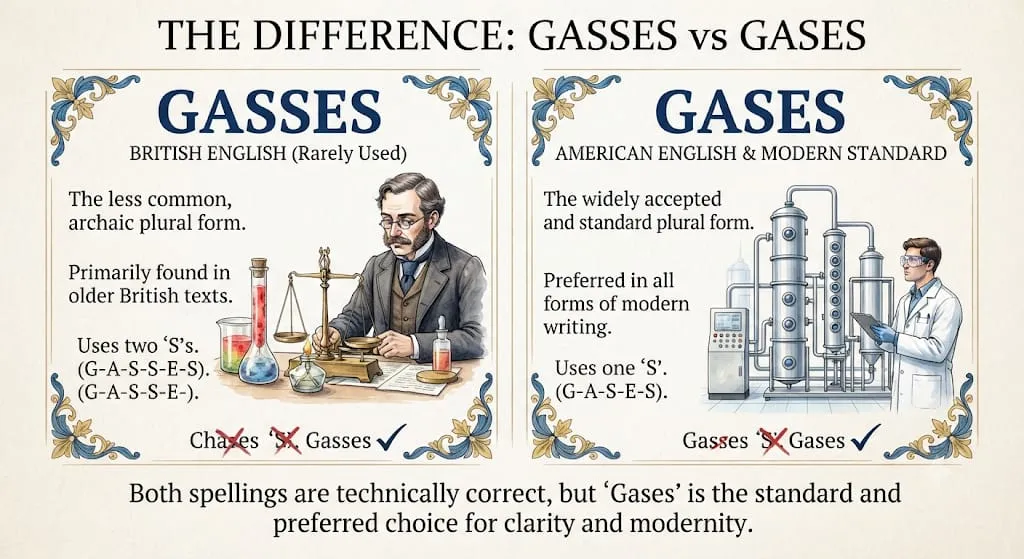
Gases is the correct plural form of gas. Gasses is the correct verb form of to gas. Both words are correct, but they have different meanings and are used in different situations.
I once edited a science article that explained climate change in simple language. The writer did a great job, but one word kept appearing throughout the article: gasses. At first glance, it looked fine. After all, many English words add -es to become plural.
But in this case, the correct word was gases.
This is one of those English spelling questions that surprises many learners. The confusion happens because gases and gasses are both real words. The problem is that they do not mean the same thing.
If you’ve searched for gases or gasses, you’re probably wondering which spelling is correct. The answer depends on whether you’re talking about more than one gas or using the verb “to gas.”
In this guide, I’ll explain the difference in simple language. You’ll learn when to use each word, why both spellings exist, common mistakes to avoid, and easy tricks to remember the correct form every time.
Gases or Gasses Quick Answer
The answer is simple.
- Gases = the plural noun of gas.
- Gasses = the third-person singular verb of to gas.
Examples
✅ The atmosphere contains many gases.
✅ The technician gasses the equipment before testing.
Although both spellings are correct, gases is far more common because people usually use gas as a noun rather than a verb.
The Origin and Background of Gases or Gasses
The word gas first appeared in the 1600s. It was created by the Flemish scientist Jan Baptist van Helmont, who used it to describe substances like air that were difficult to see.
As English developed, the noun followed the usual plural rule.
- gas → gases
The verb to gas later developed several meanings, including:
- filling something with gas
- exposing someone to poisonous gas
- supplying fuel
- talking continuously (informal slang)
Like many English verbs ending in -s, the third-person singular becomes:
- gas → gasses
This is why both spellings exist today.
Gases or Gasses Explained
Although the words differ by only one letter, their grammar is completely different.
| Term | Meaning | When to Use | Region/Context |
| Gases | More than one gas | Plural noun | Used worldwide |
| Gasses | Adds gas or exposes to gas | Verb | Used worldwide |
Gases
Use gases whenever you’re talking about two or more gases.
Examples:
- Greenhouse gases trap heat.
- Several gases make up Earth’s atmosphere.
- Scientists measured the gases inside the laboratory.
Gasses
Use gasses only as a verb.
Examples:
- The engineer gasses the machine before testing.
- The driver gasses the engine.
- The laboratory gasses the chamber with nitrogen.
Notice that gasses describes an action, while gases names a thing.
Which Version Should You Use?
Choosing the correct spelling depends on your sentence.
For students
Use gases when writing science assignments or school reports because you’ll almost always be referring to the plural noun.
For scientists and researchers
Use gases when discussing chemistry, biology, physics, medicine, or environmental science.
For mechanics or engineers
Use gasses only if you’re describing the action of filling something with gas or operating equipment.
For most writers
You’ll probably need gases far more often than gasses.
When in doubt, ask yourself:
Am I talking about substances or an action?
- Substance → gases
- Action → gasses
Common Mistakes with Gases or Gasses
Many writers confuse these words because they look almost identical.
| Mistake | Correct Version | Why It Happens |
| Greenhouse gasses | Greenhouse gases | Plural noun needed |
| Atmospheric gasses | Atmospheric gases | Talking about substances |
| Toxic gasses leaked | Toxic gases leaked | Plural noun required |
| He gases the engine | He gasses the engine | Verb requires double s |
| The mechanic gases the tank | The mechanic gasses the tank | Verb spelling mistake |
Easy Memory Trick
Think about the job each word does.
- Gases = things
- Gasses = actions
If the word can be replaced with air, oxygen, or carbon dioxide, you almost certainly need gases.
Gases or Gasses in Real-World Examples
Professional Email
The laboratory detected several harmful gases during the inspection.
News Headline
Scientists Discover New Gases in Distant Planet’s Atmosphere
Social Media Post
Greenhouse gases affect our climate. Small changes today can make a big difference tomorrow.
Formal Report
The technician gasses the testing chamber before each experiment to ensure accurate results.
These examples show why understanding the grammar behind these two words matters. One names substances, while the other describes an action.
Gases or Gasses Data, Trends & Usage
The spelling question “gases or gasses” is searched by thousands of English learners, students, and writers each year. Unlike many spelling questions, both words are correct. The challenge is knowing which grammar role each word plays.
Many people accidentally write greenhouse gasses or toxic gasses because they assume adding -es always creates the plural. In reality, gases is the plural noun, while gasses is a verb.
Who Searches This Topic?
This topic is popular among:
- English learners
- Students
- Science teachers
- Chemistry students
- Bloggers
- Technical writers
- Editors
- Business professionals
Where Is It Most Searched?
Interest is high in countries where English is spoken or widely studied, including:
- United States
- United Kingdom
- Canada
- Australia
- India
- Pakistan
- Philippines
Search Intent
Primary Search Intent: Informational
Most readers want answers to questions like:
- Is gases or gasses correct?
- What is the plural of gas?
- Why are both words in the dictionary?
- Which spelling should I use in science writing?
Why This Matters
Using the correct word improves clarity. In science, engineering, medicine, and environmental writing, choosing gases instead of gasses helps readers understand your meaning immediately.
A small spelling difference can completely change the grammar of your sentence.
Standalone Comparison Table
| Term/Variant | Meaning | Region/Context | Best Used When |
| Gases | Plural form of gas | Standard English worldwide | Referring to two or more gases |
| Gasses | Third-person singular verb of gas | Standard English worldwide | Describing the action of adding or exposing something to gas |
Quick Reminder
- ✅ Greenhouse gases
- ✅ Natural gases
- ✅ Industrial gases
- ✅ He gasses the engine.
- ✅ The laboratory gasses the chamber.
Tips to Remember the Difference
These simple tricks make the choice much easier.
Think About the Job
Ask yourself:
Is the word naming something or describing an action?
- Noun → gases
- Verb → gasses
Replace the Word
If you can replace it with oxygen, nitrogen, or carbon dioxide, you need gases.
Example:
The atmosphere contains many gases.
Look for an Action
If someone is doing something, you probably need gasses.
Example:
The mechanic gasses the vehicle before testing.
Remember This Rule
Gases are things. Gasses are actions.
This one sentence helps many learners remember the difference.
Frequently Asked Questions
Q: Is gases or gasses correct?
A: Both are correct. Gases is the plural noun of gas, while gasses is the third-person singular verb form of to gas.
Q: What is the plural of gas?
A: The correct plural is gases.
Example:
- Oxygen and helium are different gases.
Q: Why is greenhouse gases correct instead of greenhouse gasses?
A: Because greenhouse gases refers to several types of gas. Here, gas is a noun, so its plural form is gases.
Q: What does gasses mean?
A: Gasses is the verb form of to gas. It means to supply gas, expose something to gas, or, in informal English, to talk at length.
Example:
- The technician gasses the chamber before the experiment.
Q: Can I use gasses in formal writing?
A: Yes, but only when it is the correct verb. In scientific or technical writing, gasses is acceptable if it describes an action.
Q: Is there a British and American spelling difference?
A: No. Both American and British English use gases as the plural noun and gasses as the verb.
Q: Which word is more common?
A: Gases is much more common because people usually talk about substances such as oxygen, hydrogen, or greenhouse gases. The verb gasses appears mainly in technical, mechanical, or medical contexts.
Conclusion
The difference between gases and gasses is easier than it first appears. Both words are correct, but they have different jobs in a sentence.
Here are the key points to remember:
- Gases is the plural form of gas.
- Gasses is the third-person singular form of the verb to gas.
- Most science, environmental, and academic writing uses gases.
- Use gasses only when describing an action, such as filling something with gas or exposing it to gas.
- When you’re unsure, ask whether the word is naming a thing or describing an action.
Learning this simple grammar rule will help you avoid a common mistake and make your writing clearer. Whether you’re writing a science report, a blog post, or a professional document, choosing the correct form shows attention to detail and builds confidence with your readers.
Now you know exactly when to use gases and gasses. Bookmark this guide for future reference, and share it with anyone who has ever wondered which spelling is correct.
Read More:
Cancelled or Canceled: Which Spelling Is Correct?

I’m Daniel sultan, an English language writer and SEO content specialist with experience researching spelling, grammar, vocabulary, and English usage. Through SpellComparison.com, I create clear, accurate, and well-researched guides that help readers understand commonly confused words, spelling differences, and grammar rules with confidence.
Every article I write is based on trusted language references, established style guides, and real-world usage to ensure it is accurate, practical, and easy to understand. My goal is to make learning English simple and reliable by providing fact-checked content, clear explanations, and real-life examples that students, writers, educators, and professionals can trust.