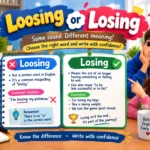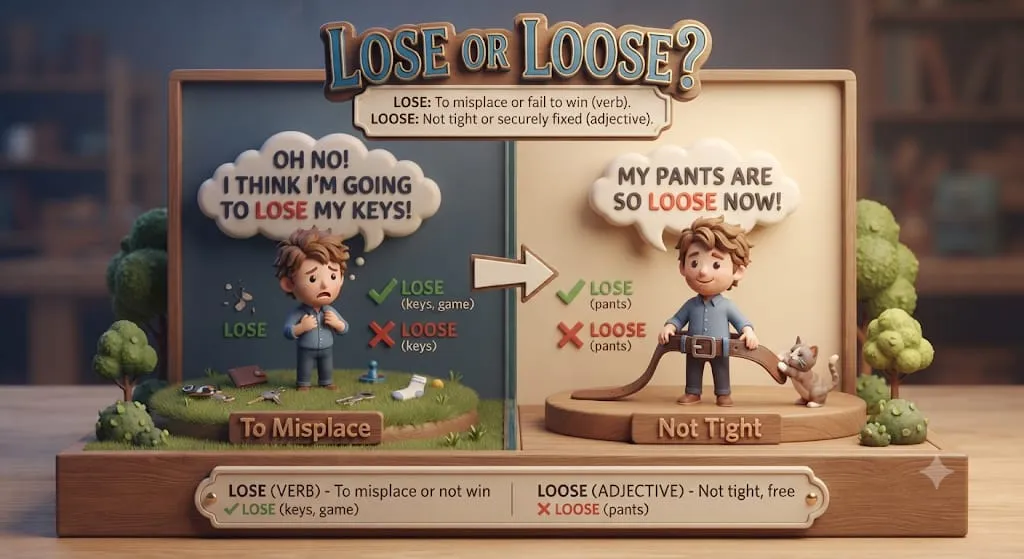
Lose means to fail to keep, win, or find something. Loose means not tight or not firmly attached. Although they look similar, they have different meanings and pronunciations.
One of the most common spelling mistakes I see while editing English articles is loose instead of lose. I’ve even found it in business emails, blog posts, and social media captions written by experienced writers. At first, the mistake seems small, but it can quickly change the meaning of an entire sentence.
Many English learners struggle with these two words because they differ by only one letter. They also sound similar, which makes the confusion even more common. If you’ve ever paused before writing lose or loose, you’re certainly not alone.
The good news is that learning the difference is much easier than most people think. Once you understand each word’s meaning, pronunciation, and grammar, you’ll rarely make this mistake again.
In this guide, I’ll explain the difference between lose and loose using simple language, real-life examples, comparison tables, and memory tricks. By the end, you’ll know exactly which word to choose in every situation.
Lose or Loose Quick Answer
The difference is simple.
- Lose is a verb. It means to misplace something, fail to win, or no longer have something.
- Loose is usually an adjective. It means not tight, not fixed, or free to move.
Examples
- I don’t want to lose my keys.
- My jacket feels loose after losing weight.
The meanings are completely different, so they cannot replace each other.
The Origin and Background of Lose or Loose
Although lose and loose look alike, they come from different Old English words.
Lose comes from the Old English word losian, meaning to perish, disappear, or be destroyed. Over time, its meaning expanded to include failing to win, misplacing something, or no longer having something.
Loose comes from the Old Norse word lauss, meaning free, unattached, or untied. Its meaning has remained almost the same for hundreds of years.
The confusion happens because both words are spelled similarly, but they have different histories, meanings, and pronunciations.
Lose or Loose Explained
Here is the easiest way to remember them.
| Term | Meaning | Part of Speech | When to Use |
| Lose | To no longer have, fail to win, or misplace | Verb | Describing an action |
| Loose | Not tight, free, or not attached | Adjective | Describing something |
Lose
Use lose when something happens.
Examples:
- Don’t lose your wallet.
- We might lose the game.
- She doesn’t want to lose her job.
- If you don’t study, you could lose marks on the exam.
Loose
Use loose when describing something.
Examples:
- These shoes are too loose.
- The dog is loose in the park.
- I prefer loose clothing in summer.
- There is a loose screw on the chair.
Which Version Should You Use?
The correct choice depends on what you’re trying to say.
For students
Use lose when talking about exams, games, or forgetting something.
Use loose when describing clothing, objects, or anything that is not tight.
For professionals
Business emails often use lose.
Example:
- We cannot afford to lose this client.
Product descriptions often use loose.
Example:
- The handle became loose after several months.
For everyday writing
Ask yourself one question.
Is it an action or a description?
- Action → lose
- Description → loose
Common Mistakes with Lose or Loose
Many writers accidentally swap these words.
| Mistake | Correct Version | Why It Happens |
| I don’t want to loose my phone. | I don’t want to lose my phone. | Wrong verb |
| We might loose the match. | We might lose the match. | Similar spelling |
| My shirt is lose. | My shirt is loose. | Wrong adjective |
| Don’t loose your passport. | Don’t lose your passport. | Very common typo |
| His belt is lose. | His belt is loose. | Missing adjective spelling |
Easy Memory Trick
Think about the number of O’s.
- Loose has two O’s, just like a pair of loose pants has extra room.
- Lose has one O because when you lose something, one thing is gone.
Lose or Loose in Real-World Examples
Professional Email
We don’t want to lose valuable customer feedback.
News Headline
Local Team Refuses to Lose Championship Final
Social Media Post
My new jeans are too loose after losing ten pounds!
Formal Report
The inspection found several loose bolts that required immediate replacement.
These examples show that lose usually expresses an action, while loose describes a condition or appearance.
Great — here’s Part 2, continuing directly from Part 1.
Lose or Loose — Data, Trends & Usage
The spelling question “lose or loose” is one of the most searched English grammar topics. It appears frequently in school assignments, business emails, social media posts, and online articles.
Unlike many spelling mistakes, this one can completely change the meaning of a sentence.
Quick check
Very common
Why people search this topic
They know one spelling is wrong in their sentence, but both words look familiar.
Who searches it?
StudentsEnglish learnersTeachersBloggersContent writersProfessionals
Popular in
United StatesUnited KingdomCanadaAustraliaIndiaPakistan
Why it matters
Using the wrong word can make writing look less polished and may confuse readers.
Try It Yourself: Choose the Correct Word
Mini quiz
1. I don’t want to my passport.
lose
loose
Correct answer: lose
Lose is a verb meaning “to no longer have something.”
2. These shoes are too .
lose
loose
Correct answer: loose
Loose describes something that is not tight.
3. Our team might the final.
lose
loose
Correct answer: lose
Lose means “fail to win.”
4. The screw is .
lose
loose
Correct answer: loose
Loose describes the condition of the screw.
Standalone Comparison Table
| Term | Meaning | Best Used When |
| Lose | To no longer have something or fail to win | Describing an action |
| Loose | Not tight or firmly attached | Describing something |
Frequently Asked Questions
Q: Is it lose or loose weight?
Lose weight is correct because lose is the verb meaning “to reduce” or “no longer have.”
Q: What does loose mean?
Loose means not tight, not fixed, or free to move.
Q: What does lose mean?
Lose means to misplace something, fail to win, or no longer have something.
Q: Which spelling is correct in “I don’t want to lose you”?
The correct spelling is lose because it describes an action.
Q: Is loose acceptable in formal writing?
Yes, when you are describing something that is not tight or firmly attached.
Q: Why do people confuse lose and loose?
They look similar and sound somewhat alike, but they have different meanings and pronunciations.
Q: Can lose and loose ever mean the same thing?
No. Lose is mainly a verb, while loose is mainly an adjective.
Conclusion
The difference between lose and loose becomes simple once you remember their roles in a sentence.
Here are the key takeaways:
- Lose = an action (misplace, fail to win, no longer have).
- Loose = a description (not tight, free, or unattached).
- Use lose for games, keys, jobs, weight, and opportunities.
- Use loose for clothing, screws, ropes, teeth, and anything that is not tight.
A simple memory trick helps many learners: Loose has two O’s, like extra room in loose pants. Lose has one O because something is gone.
Now you know exactly when to use lose and loose. Bookmark this guide so you never mix them up again, and share it with anyone who still writes “I don’t want to loose my keys.”
Read More:
Greatful or Grateful: Know the Correct Spelling

I am an English language specialist with over 10 years of experience writing about grammar, spelling differences, and language usage. Dedicated to helping writers communicate with confidence, my detailed guides break down complex rules into clear, real-world advice. At Spelling Comparison, my focus is on providing actionable proofreading tips and vocabulary deep-dives to ensure your writing is always accurate, clear, and impactful.