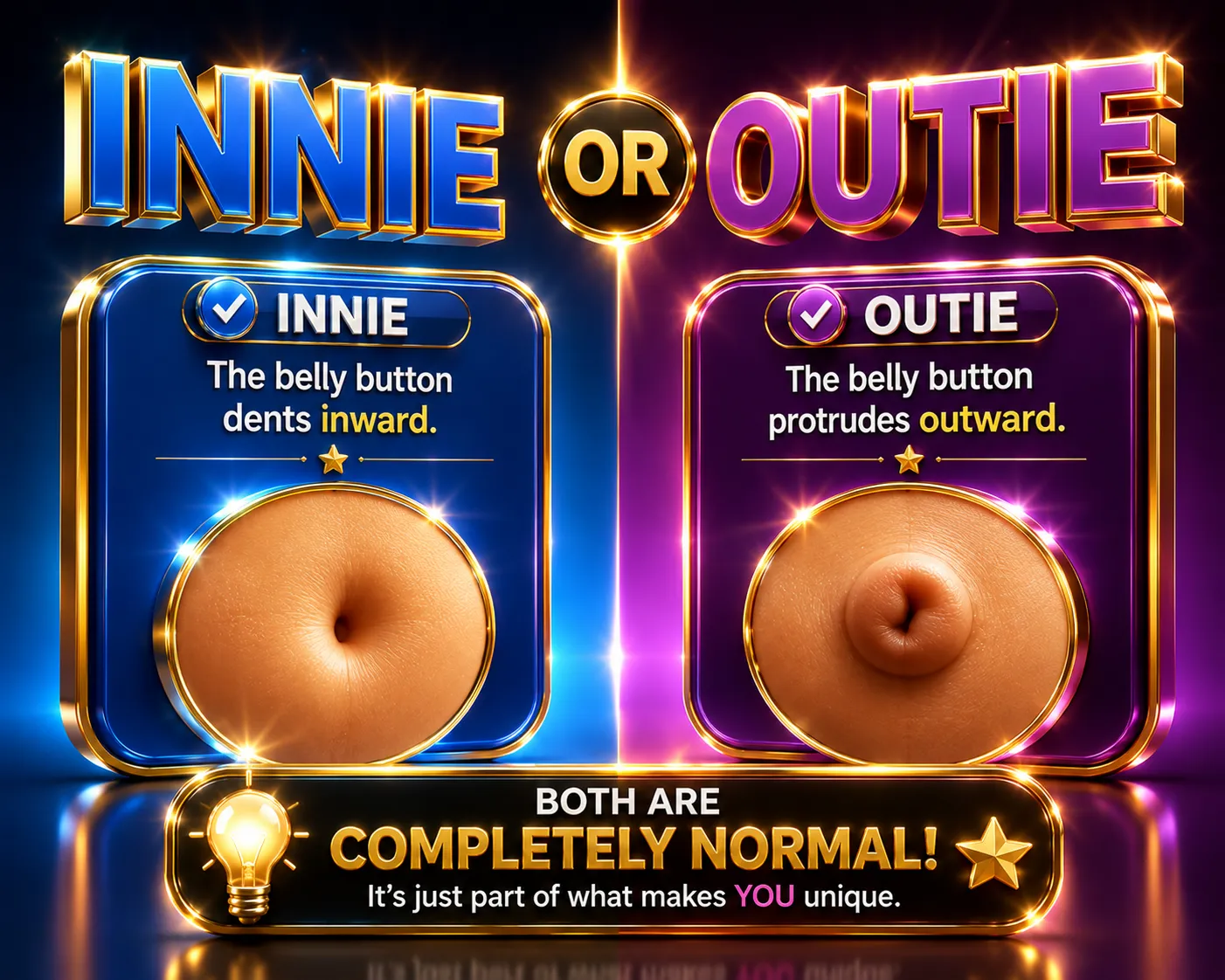
An innie is a belly button that sits inward, while an outie is a belly button that sticks outward. Both are normal variations of human anatomy.
I remember noticing as a child that belly buttons did not all look the same. Some people had a small dip in the middle of their stomach, while others had a little bump that seemed to stick outward. Like many people, I wondered why this happened and whether one type was more normal than the other.
These two common belly button shapes are usually called innies and outies. An innie dips inward, while an outie protrudes slightly outward. Both are natural variations and are usually determined by how the umbilical cord heals after birth and how the surrounding skin and tissue develop.
The difference is not generally caused by hygiene, body weight, or personal habits. It also does not mean that one type is healthier or more normal than the other. In most cases, an innie and an outie are simply two different ways the same body part can look.
In this guide, I’ll explain what innies and outies are, why they form, how common they are, and some of the most common myths surrounding them.
By the end, you’ll have a clear understanding of why belly buttons can look different from person to person.
Innie or Outie Quick Answer
An innie is a belly button that goes inward toward the stomach.
An outie is a belly button that sticks outward from the stomach.
For example:
- Most people have an innie belly button.
- Some people naturally have an outie belly button.
So the simplest rule is:
Innie = inward belly button
Outie = outward belly button
The Origin and Background of Belly Buttons
The belly button, also called the navel, is a small scar left after the umbilical cord is cut at birth. The umbilical cord is what connects a baby to the placenta during pregnancy, providing oxygen and nutrients.
After birth, the cord is clamped and cut, leaving a small stump. This stump dries out and falls off within a few weeks. What remains is the scar we call the belly button.
The final shape innie or outie depends on how the skin and tissue heal during this process. It is not something that is chosen or controlled.
Medical sources explain that belly button shape is influenced by factors such as:
- how the umbilical stump heals
- how much scar tissue forms
- how the surrounding abdominal wall develops
There is no single cause that determines the shape in every case.
Innie or Outie Explained
The difference is purely physical and cosmetic. Both types function the same way and have no impact on health.
1. Innie
An innie is a belly button that curves inward.
It is the most common type.
Characteristics:
- Sits inside a small depression
- Can be deep or shallow
- Usually forms as the skin heals inward after the umbilical cord falls off
Examples:
Most adults have an innie belly button.
Her belly button is a small innie.
2. Outie
An outie is a belly button that protrudes outward.
It is less common but still completely normal.
Characteristics:
- Sticks out slightly from the abdomen
- May look like a small bump or button
- Can result from how the scar tissue forms or how the skin heals
Examples:
He was born with an outie belly button.
Some babies naturally develop an outie.
Comparison Table
| Term | Shape | Appearance | Commonality |
| Innie | Inward dip | Sunken navel | More common |
| Outie | Outward bump | Protruding navel | Less common |
Which Version Should You Use?
The correct term depends on what you are describing.
For most people
Use:
innie
Example:
She has an innie belly button.
For outward belly buttons
Use:
outie
Example:
He has an outie belly button.
In general conversation
Both terms are informal but widely understood in everyday English.
Common Myths About Innies and Outies
Myth 1: Outies are caused by how the cord is cut
❌ This is not true.
The way the umbilical cord is cut does not determine belly button shape.
Myth 2: Outies are unhealthy
❌ Outies are not a medical problem.
They are simply a normal variation.
Myth 3: You can “train” your belly button shape
❌ The shape is fixed after healing and cannot be changed naturally.
Myth 4: Innies are more common because they are better
❌ Innies are more common, but neither type is better or worse.
Innie or Outie in Real-World Context
Casual conversation
“Do you have an innie or an outie?”
Childhood curiosity
Children often notice whether their friends have an innie or outie.
Medical explanation
Doctors explain that both innies and outies are normal variations of the navel.
Descriptive writing
The baby had a small outie belly button.
Innie or Outie Usage Insights
From a language perspective, innie and outie are informal descriptive terms derived from “in” and “out.” They are not medical classifications but everyday vocabulary used to describe appearance.
A helpful way to remember the difference is:
- Innie = in the body
- Outie = out of the body
This simple visual association makes the distinction easy to recall.
Standalone Comparison: Innie vs Outie at a Glance
| Term | Meaning | Appearance | Best Used When |
| innie | Belly button inward | Sunken navel | Describing most navels |
| outie | Belly button outward | Protruding navel | Describing visible bump |
Frequently Asked Questions
Q: What is an innie?
A: An innie is a belly button that sits inward toward the stomach.
Q: What is an outie?
A: An outie is a belly button that sticks outward from the stomach.
Q: Is an outie normal?
A: Yes. Both innies and outies are completely normal variations of the belly button.
Q: What causes an outie belly button?
A: It is usually caused by how the skin and scar tissue heal after the umbilical cord falls off.
Q: Can you change an innie to an outie?
A: No. Belly button shape is determined early in life and does not naturally change.
Q: Which is more common, innie or outie?
A: Innies are more common, but outies are still a normal variation.
Conclusion
The difference between an innie and an outie is simple and completely natural.
An innie belly button curves inward and is the most common type. An outie belly button sticks outward and is less common, but still perfectly normal.
Neither type affects health, appearance, or body function. They are simply different ways the body heals after birth.
If you remember one simple idea, make it this:
Innies go in. Outies go out.
Once you understand that, the difference becomes easy to recognize and remember.
Bookmark this guide so you never wonder about “innie or outie” again.
Read More:
Sowing or Sewing: Easy Guide to the Difference

I specialize in English grammar, spelling, word choice, and language usage. My content is based on research from grammar references, style guides, dictionaries, and real-world usage to ensure it is accurate and practical.
At Spelling Comparison, I write guides that explain why words are confused, how they are used, and which form is correct in context. I also include proofreading tips, examples, and writing advice readers can apply immediately.
My goal is to publish clear, reliable content that helps readers make better writing decisions. Each guide is written for accuracy, clarity, and usefulness in school, work, business, and everyday communication.