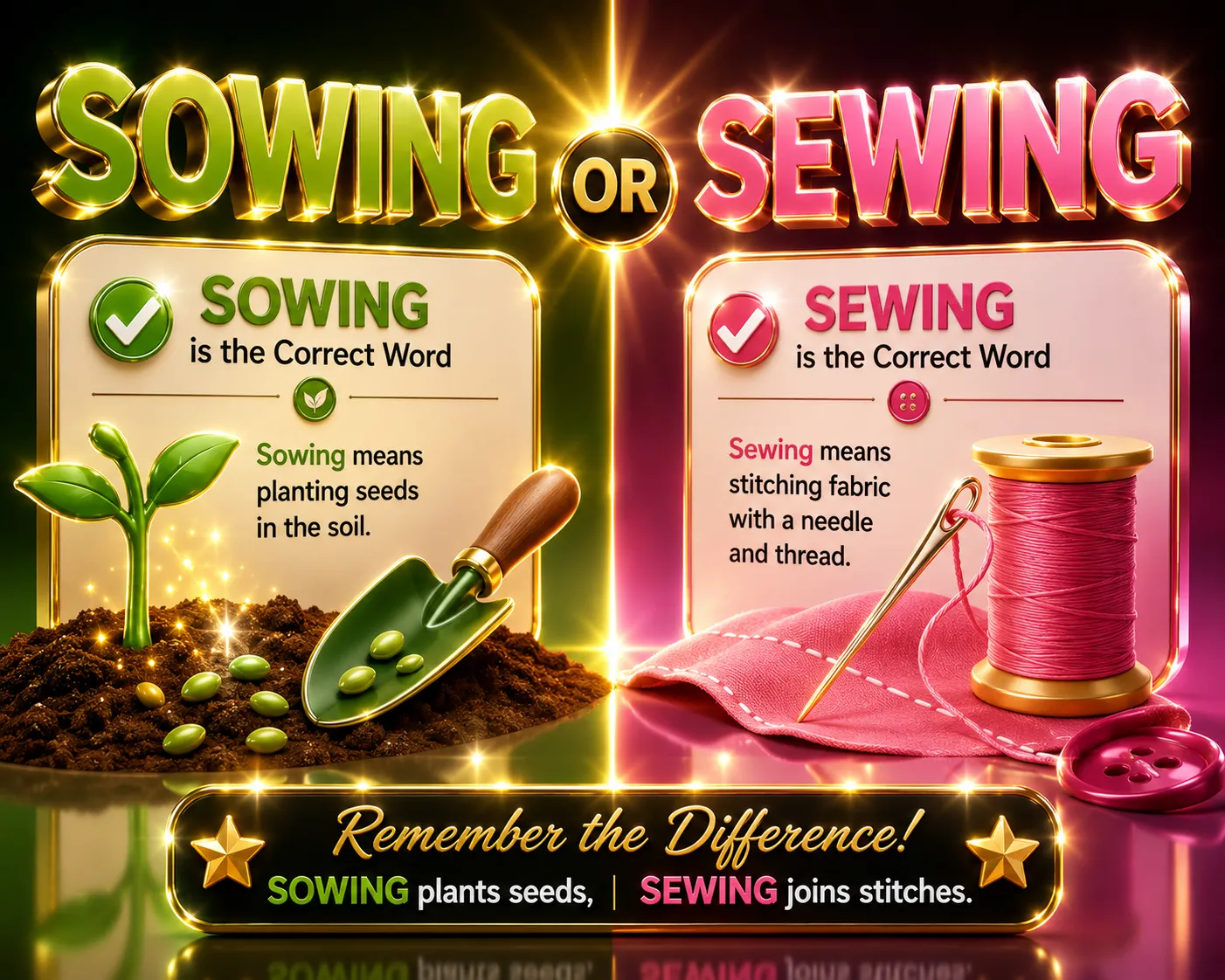
Sowing means planting or scattering seeds, while sewing means joining fabric with a needle and thread.
I remember helping an English learner with a sentence about a farmer planting wheat when we came across a surprisingly common mistake: “sewing wheat.” At first, the sentence looked almost right because sowing and sewing sound so similar. But the meaning was completely different.
This mix-up happens often because the two words are pronounced alike in many varieties of English, yet they describe two very different actions. Sowing is connected to farming and gardening it means planting seeds in the ground. Sewing, on the other hand, is related to clothes, fabric, and stitching with a needle and thread.
A small spelling difference can create a completely different picture in the reader’s mind. If you say a farmer is “sewing wheat,” it may sound as though the farmer is stitching fabric instead of planting a crop. Likewise, saying someone is “sowing a dress” would suggest planting a dress in the ground.
The good news is that the difference is easy to remember once you connect each word with its meaning. In this guide, you’ll learn the definitions, origins, grammar, common mistakes, real-world examples, and a simple memory trick to help you choose the right word with confidence.
Let’s start with the basic difference between sowing and sewing.
Sowing or Sewing Quick Answer
Sowing is the act of putting seeds into or onto the ground so plants can grow. It comes from the verb sow.
Sewing is the activity of joining or repairing fabric with stitches. It comes from the verb sew.
For example:
- The farmer is sowing wheat in the field.
- My sister enjoys sewing clothes.
A quick way to remember the difference is:
Sowing = seeds.
Sewing = stitches.
Cambridge Dictionary defines sow as putting seeds in or on the ground so plants can grow. Merriam-Webster gives a similar meaning and also lists figurative uses such as spreading or setting something in motion.
For sewing, Merriam-Webster defines it as the act, method, or occupation of someone who sews. Cambridge also describes it as the skill or activity of making or repairing things from cloth.
The Origin and Background of Sowing and Sewing
These two words look and sound alike today, but they come from different linguistic roots.
The verb sow has a very old history. Etymonline traces it through Middle English souen to Old English sawan, meaning to scatter seed on the ground or plant it in the earth. Its deeper history is connected with a Proto-Indo-European root meaning “to sow.”
The verb sew has a separate history. Etymonline traces it through Middle English seuen to Old English siwian, meaning to stitch, mend, patch, or fasten by sewing. Its deeper root is associated with binding or sewing.
So, although sowing and sewing are pronounced alike in standard English, they are not related words.
This is a classic example of homophones. Homophones are words that sound the same but have different meanings and spellings.
Other familiar examples include:
- flower / flour
- pair / pear
- right / write
- there / their
- brake / break
Context tells you which word belongs in the sentence.
Sowing or Sewing Explained Key Differences
The easiest way to understand the difference is to focus on the action.
| Term | Meaning | When to Use | Region/Context |
| Sowing | Planting or scattering seeds | Farming, gardening, agriculture | Standard English |
| Sewing | Joining or repairing material with stitches | Clothes, fabric, crafts | Standard English |
| Sow | Planting seeds or spreading something | Farming or figurative writing | Standard English |
| Sew | Joining things with stitches | Clothing, textiles, repairs | Standard English |
What Does Sowing Mean?
Sowing is the -ing form of sow.
It normally refers to putting seeds into soil so they can grow.
Examples:
- The gardener is sowing flower seeds.
- Spring is a good time for sowing many crops.
- Careful sowing can help farmers manage their fields.
The word can also have a figurative meaning. You can “sow” something such as doubt, fear, or confusion. In this sense, you are not planting a physical seed. You are causing an idea or feeling to spread. Cambridge and Merriam-Webster both recognize this broader use.
What Does Sewing Mean?
Sewing is the -ing form of sew.
It means joining, making, or repairing material with stitches.
Examples:
- She learned sewing from her grandmother.
- He is sewing a button onto his jacket.
- The class teaches basic sewing skills.
Merriam-Webster records sewing as both an activity and material that has been or is to be sewn.
The Simple Rule
If you are working with seeds, use sowing.
If you are working with stitches, use sewing.
That one rule solves most spelling problems.
Which Version Should You Use?
Your choice depends entirely on what you are describing.
For farming and gardening
Use sowing.
- sowing seeds
- sowing wheat
- sowing crops
- sowing flowers
- sowing a field
For clothes and fabric
Use sewing.
- sewing a shirt
- sewing a dress
- sewing a button
- sewing fabric
- sewing by hand
For figurative writing
Use sowing when you mean creating or spreading something, especially an idea or feeling.
For example:
The rumor was responsible for sowing doubt among the workers.
For global or formal English
Both spellings are correct. Neither is an American-versus-British spelling issue.
The important point is meaning, not region.
Common Mistakes with Sowing and Sewing
These errors often happen because the words sound the same.
| Mistake | Correction | Why? |
| She is sowing a dress. | She is sewing a dress. | Dresses are stitched. |
| The farmer is sewing corn. | The farmer is sowing corn. | Corn seeds are planted. |
| He enjoys sowing clothes. | He enjoys sewing clothes. | Clothes are made with stitches. |
| They are sewing seeds. | They are sowing seeds. | Seeds are planted. |
| The speech was sewing fear. | The speech was sowing fear. | Fear can be figuratively spread. |
Why Does This Error Happen?
The main reason is pronunciation.
In standard English, sowing and sewing are homophones. They can sound the same even though their spellings and meanings differ.
There is also a familiarity problem. Many people see or hear sewing more often than sowing, especially if they live far from farming communities. A recent discussion of the pair notes that Google Books Ngram data show sow and sew have changed in relative frequency over time, with sow once more common and the two much closer in recent usage.
Sowing or Sewing in Real-World Examples
Here are fresh examples from different writing situations.
Professional email
Subject: Spring Field Preparation
The team will begin sowing the selected crop varieties next Monday.
This is sowing because the email concerns agriculture.
News headline
Local Farmers Begin Sowing Rice After Early Rainfall
The headline uses sowing because farmers are planting a crop.
Social media post
I spent Saturday sewing a simple tote bag from leftover fabric.
Here, sewing is correct because the activity involves fabric.
Formal report
The workshop provided basic training in sewing, garment repair, and fabric handling.
Again, sewing refers to textile work.
Another everyday example
The community garden is preparing the soil before sowing its summer vegetables.
The word points to planting seeds, so sowing is the correct choice.
Sowing or Sewing Data, Trends & Usage
There is an important limitation when discussing search data for this word pair: exact monthly search volumes for “sowing” and “sewing” depend on the SEO platform, country, language, and date.
I would not present an invented number as a fact.
What does corpus data show?
Google Books Ngram Viewer is useful for studying word frequency in books. A July 2026 analysis citing Google Books Ngram found that sow was much more common than sew roughly a century ago, while their frequencies have become much closer in more recent periods.
That makes sense historically. Farming was once a larger part of everyday life and written culture. At the same time, sew and related textile terms remain common in modern writing about clothing, crafts, fashion, and manufacturing.
Search intent
The search intent behind “sowing or sewing” is strongly informational.
People usually want to know:
- Which spelling is correct?
- What does each word mean?
- How are they pronounced?
- Should I write sowing seeds or sewing seeds?
- Why do the words sound the same?
This makes the topic especially useful for English learners, students, teachers, writers, and anyone checking a sentence.
Why does the distinction still matter?
Spell-checkers can catch many errors, but homophones can be harder to detect because both words are correctly spelled.
A grammar tool may not flag “The farmer is sewing wheat” as a spelling error. The problem is that the wrong word has been selected for the meaning.
That is why understanding context and vocabulary remains important.
Standalone Sowing vs. Sewing Comparison Table
| Term/Variant | Meaning | Region/Context | Best Used When |
| Sow | Plant seeds or spread something | Farming and figurative English | You need the base verb |
| Sowing | The act of planting or spreading | Agriculture and figurative writing | Describing an ongoing activity |
| Sew | Join material with stitches | Clothing and textiles | You need the base verb |
| Sewing | The act or skill of stitching material | Crafts, fashion, repairs | Describing the activity |
| Sown | Planted with seeds | Farming; also figurative | Used as a past participle/adjective |
| Sewn | Joined with stitches | Clothing, fabric, medical stitching | Used as a past participle/adjective |
One useful distinction is between sown and sewn.
For example, a field may be sown, while a torn shirt may be sewn.
Merriam-Webster lists sowed and sown as forms of the verb sow, while sew has the forms sewed and sewn.
Frequently Asked Questions
Q: What does sowing mean?
A: Sowing means planting or scattering seeds so that plants can grow. It can also describe spreading something figuratively, such as doubt or fear.
Q: What does sewing mean?
A: Sewing means joining or repairing material with stitches. It can also refer to the general skill or activity of working with fabric.
Q: Is it sowing or sewing seeds?
A: The correct phrase is sowing seeds. Seeds are planted in the ground, so the word comes from sow, not sew.
Q: Is it sowing or sewing clothes?
A: The correct phrase is sewing clothes. Clothes are made or repaired with stitches, needles, and thread.
Q: Are sowing and sewing homophones?
A: Yes. They have the same or nearly the same standard pronunciation but different spellings and meanings. This makes them a common type of English homophone pair.
Q: Is sowing acceptable in formal writing?
A: Yes. Sowing is a standard English word and is perfectly suitable for formal writing about agriculture or figurative subjects. It appears in major dictionaries such as Cambridge and Merriam-Webster.
Q: Where does the word sow come from?
A: The verb sow comes through Middle English from Old English sawan, meaning to scatter or plant seed. Etymonline traces it further to an ancient Indo-European root associated with sowing.
Q: Where does sew come from?
A: Sew comes through Middle English from Old English siwian, meaning to stitch, mend, patch, or fasten by sewing.
Q: Can sowing have a meaning beyond farming?
A: Yes. English often uses sowing figuratively. Someone can “sow doubt,” for example, meaning they cause doubt to spread or develop.
Conclusion: Sowing or Sewing?
The difference between sowing and sewing is much easier once you connect each spelling with an image.
Think of sowing as putting seeds into the soil. Think of sewing as putting stitches into fabric.
There is no American-versus-British spelling rule deciding between them. Both are standard words. The correct choice depends on what you mean.
Remember these three points:
- Sowing relates to seeds, crops, gardens, and figurative spreading.
- Sewing relates to clothes, fabric, stitches, and textile work.
- They sound alike, so context helps you choose the right spelling.
When you are unsure, ask yourself one quick question: Am I working with seeds or stitches? Seeds point to sowing. Stitches point to sewing.
Once that mental link becomes automatic, this spelling pair becomes much easier. Bookmark this guide so you never second-guess sowing or sewing again.
Read More:
Shinning or Shining: Which Is Correct?

I’m an English language educator and content writer with more than 10 years of experience helping learners improve their English skills. I specialize in spelling differences, grammar, vocabulary, synonyms, commonly confused words, and English usage. My goal is to create accurate, easy-to-understand articles that make learning English simple, practical, and enjoyable for students, writers, and professionals around the world.