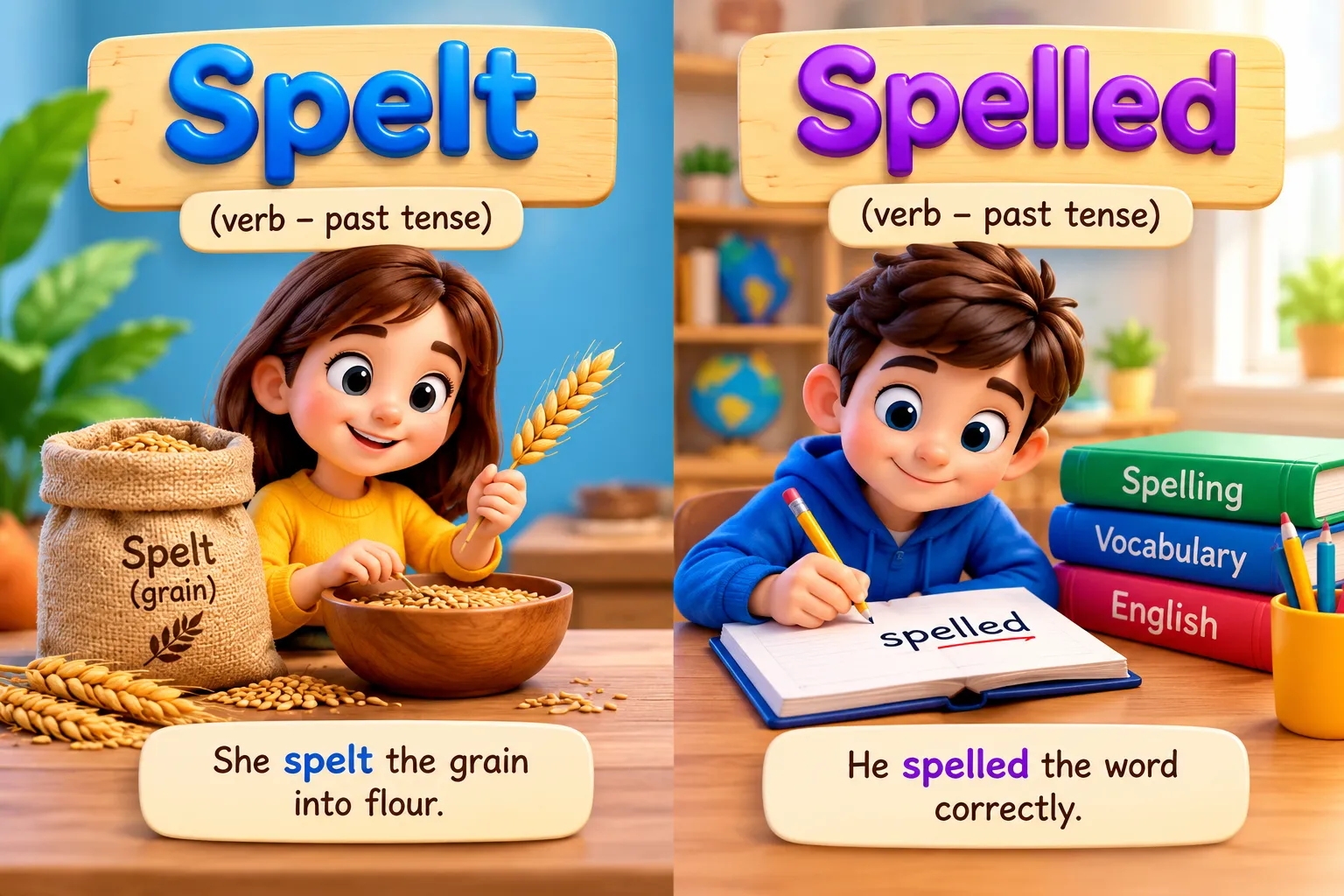
Spelt and spelled are both correct past tense and past participle forms of spell. Spelt is more common in British English, while spelled is strongly preferred in American English.
I have often seen writers pause over a very small choice: spelt or spelled? It usually happens when someone is checking a sentence such as, “She ___ my name correctly.” Both forms look right, yet many people have been taught to use only one.
That confusion is understandable.
English has many regional differences, and verb forms are one of them. You may read spelt in a British novel and then see spelled in an American article. Neither writer has made a spelling mistake. The difference is mainly about variety of English and writing style.
I have noticed this especially when editing writing for an international audience. A word that feels completely normal to one reader can look unusual to another. Spelt is a good example because it is less common in American English but remains a standard form in British English.
So, which should you choose?
In this guide, I will explain spelt vs. spelled, their meanings, grammar, history, regional use, common mistakes, and practical examples. By the end, you will know which form fits your audience and when you can safely use either one.
Spelt or Spelled Quick Answer
Spelt and spelled are the past tense and past participle of the verb spell.
The main difference is regional:
- British English: both spelt and spelled are used.
- American English: spelled is the usual choice.
- International writing: either can be correct, but consistency matters.
Cambridge Dictionary lists spelt as the past simple and past participle of spell. Collins gives the same basic distinction and notes that American English uses spelled, while British English uses either form.
For example:
- British: “She spelt the word correctly.”
- American: “She spelled the word correctly.”
Both sentences mean the same thing.
The important point is that spelt is not a misspelling of spelled.
The Origin and Background of Spelt and Spelled
The story begins with the verb spell.
Etymonline traces the verb to Middle English forms such as spellen, with connections to Anglo-French and Old French. It also records the older Germanic background of the word. The modern meaning involving forming words with letters developed later, with the sense recorded from the 16th century.
That history helps explain why spell has developed different past forms.
English has many verbs with competing -ed and -t forms. Similar pairs include:
- dreamed / dreamt
- learned / learnt
- burned / burnt
- smelled / smelt
- spilled / spilt
- spelled / spelt
These differences are part of English morphology, which is the study of how words change to express grammatical information.
In this case, spelled follows the regular -ed pattern:
spell → spelled
Spelt follows the shorter -t pattern:
spell → spelt
Neither form is a modern invention. Both belong to established English usage.
A 2026 corpus-based study of verbs such as spell, dream, and burn found that American English generally favors the regular -ed forms, while British and Commonwealth varieties more often favor the -t forms.
So the difference is not simply about “correct” versus “incorrect.” It is a good example of regional variation in English.
Spelt vs. Spelled: Key Differences
The meaning does not change.
Both forms describe the act of writing or saying the letters of a word in the correct order.
Comparison table
| Term | Meaning | When to Use | Region/Context |
| spelt | Past tense/past participle of spell | Use when following British-style usage | British and Commonwealth English |
| spelled | Past tense/past participle of spell | Use when following American-style usage | American English |
| spell | Present/base form | Use for present tense and infinitive structures | All major varieties |
Consider these examples:
Present:
“Can you spell your surname?”
Past:
“He spelt his surname for me.”
Or:
“He spelled his surname for me.”
Past participle:
“Her name was spelt incorrectly.”
Or:
“Her name was spelled incorrectly.”
The grammar remains the same. Only the preferred form changes.
What does “past participle” mean?
A past participle is a verb form used in structures such as the present perfect and passive voice.
For example:
“I have spelled the word correctly.”
Here, spelled is a past participle.
With the British form:
“I have spelt the word correctly.”
Again, the grammar works.
Which Version Should You Use?
The easiest rule is to match your audience.
If you write for an American audience
Choose spelled.
For example:
“The student spelled the difficult word correctly.”
This is the form most natural to American readers.
If you write for a British audience
You can use spelt or spelled.
However, spelt is a familiar and widely used British form. Collins specifically identifies spelt as mainly British when used as the past form of spell.
For example:
“The student spelt the difficult word correctly.”
If you write for an international audience
Either form can work.
If your website follows British English, use spelt consistently. If it follows American English, choose spelled.
The biggest mistake is not choosing the “wrong” regional form. It is switching between styles without a reason.
For example, if an article uses British spellings such as colour, centre, and organise, using spelled is not necessarily wrong, but spelt may create a more consistent style.
Common Mistakes with Spelt and Spelled
1. Treating spelt as incorrect
Mistake:
“Spelt is wrong. The correct word is spelled.”
Correction:
“Spelt and spelled are both accepted forms.”
British English accepts both forms. American English strongly favors spelled.
2. Using “spelled” only because it looks more familiar
Some learners assume the longer form must be more correct.
That is not how English works.
Spelt is a standard past form, not a shortened spelling error.
3. Mixing regional styles
You might write:
“The colour was changed, and the word was spelled incorrectly.”
This is not automatically grammatically wrong. But if you are deliberately following British English, spelt may provide better style consistency.
4. Using “spelt” as the present tense
Incorrect:
“She spelt every difficult word.”
This sentence is actually past tense, so it is fine.
But:
“She spelt difficult words every day.”
is not present tense.
For present tense, use:
“She spells difficult words every day.”
5. Confusing spelt with the grain
There is another interesting twist.
Spelt can also be a noun. It refers to a type of wheat. Collins lists this as a separate meaning from the verb form.
For example:
“The bakery sells bread made with spelt.”
Here, spelt has nothing to do with spelling.
Spelt or Spelled in Real-World Examples
Seeing both forms in different contexts makes the distinction much easier.
Professional email
“I noticed that the client’s surname was spelled differently on the latest document.”
This works well in an American-style business setting.
News article
“The minister’s name was spelt incorrectly in the printed report.”
This fits naturally with British English.
Social media post
“I finally learned how to spell that name correctly!”
Notice that the present form spell works naturally when you are talking about something happening now.
Formal report
“The participant’s name was spelled consistently throughout the database.”
This is a clear passive construction.
Everyday conversation
“I think I spelt your name wrong.”
A British speaker may naturally choose spelt.
An American speaker would more likely say:
“I think I spelled your name wrong.”
Both communicate the same idea.
Spelt vs. Spelled: A Second Comparison Table
| Term/Variant | Meaning | Region/Context | Best Used When |
| spelt | Past form of spell | British/Commonwealth | Writing in British English |
| spelled | Past form of spell | American and widely understood internationally | Writing in American English |
| spell | Base form of the verb | All English varieties | Present tense or infinitive |
| spelling | The act or form of writing words correctly | All English varieties | Talking about orthography or word forms |
| spelt | A type of wheat | Food/agriculture contexts | Discussing the grain rather than spelling |
This last meaning is worth remembering. Context tells you whether spelt is functioning as a verb or a noun.
Spelt and Spelled: Data, Trends & Usage
Exact monthly search volumes for “spelt” and “spelled” change by country, search engine, and SEO platform. Without a current Ahrefs or Semrush account dataset, it would be misleading to give an exact monthly search number.
There is, however, strong evidence for the regional difference.
Corpus evidence
A recent corpus-based study examined the competing -ed and -t forms of several English verbs, including spell. It used the ARCHER historical corpus and the News on the Web (NOW) corpus, which contains more than 19 billion words across multiple varieties of English.
The study found a broad pattern:
- American English tends to favor spelled.
- British English shows much stronger use of spelt.
- Other English varieties can fall between these patterns.
- The choice can also vary by tense and context.
That last point matters. Language is not always split into two perfect boxes.
Google Books Ngram
Google Books Ngram Viewer also allows researchers to compare forms such as spelled and spelt across published books over time. Its database can show long-term changes in written usage rather than current search behavior.
This makes Ngram useful for studying language trends, but it should not be treated as a live Google search-volume tool.
Why this matters for writers
You may encounter both forms online because English is used across many regions.
A student in the UK may learn spelt at school. An American reader may expect spelled. A writer targeting both audiences needs to understand that both forms are legitimate.
This is one reason regional English matters in SEO writing, education, publishing, and international communication.
Spelt or Spelled: What About Other Forms?
The verb spell has several useful forms.
| Verb Form | Example |
| Base form | spell |
| Third-person singular | spells |
| Present participle | spelling |
| Past tense | spelt / spelled |
| Past participle | spelt / spelled |
For example:
“She spells her name carefully.”
“She is spelling her name for the receptionist.”
“She spelt her name yesterday.”
“She has spelled her name correctly.”
The forms spelt and spelled can therefore occupy the same grammatical positions.
Frequently Asked Questions
Q: Is spelt a correct word?
A: Yes. Spelt is a correct past tense and past participle of spell. Cambridge lists it as a standard form, while Collins describes it as mainly British in this use.
Q: Is spelled or spelt more correct?
A: Neither is universally more correct. Spelled is preferred in American English, while British English uses both spelled and spelt.
Q: Do Americans use spelt?
A: Spelled is the normal choice in American English. You may still encounter spelt, especially in writing influenced by British or other varieties of English.
Q: Do British people use spelled?
A: Yes. British English allows both spelled and spelt. The shorter spelt form is especially familiar in British usage.
Q: Is spelt the past tense of spell?
A: Yes. Spelt can function as both the past tense and past participle of spell. Spelled can perform the same grammatical roles.
Q: What is the difference between spell and spelling?
A: Spell is usually a verb when you mean to write or say the letters of a word correctly. Spelling can refer to the act of forming words with letters or to the particular letter pattern of a word.
Q: Can I use spelt in formal writing?
A: Yes. Spelt is suitable for formal writing when it matches the English variety and style you are using. It is not an informal or incorrect version of spelled.
Final Thoughts
The choice between spelt and spelled is much easier once you stop treating it as a simple right-or-wrong spelling question. Both forms belong to standard English. The main difference is regional preference.
If you write in American English, spelled is the safest choice. If you write in British English, spelt and spelled are both available, with spelt being a familiar British form.
Your choice should also stay consistent with the style of your writing. A British-style article can naturally use spelt, while an American publication will usually prefer spelled.
Remember the simple pattern:
spell → spelt / spelled → spelling
And do not forget the other meaning of spelt. In a food article, it may refer to a type of wheat rather than a past-tense verb.
Once you know the regional difference, there is little reason to second-guess yourself. Choose the form that fits your audience, keep your style consistent, and move on with confidence.
Bookmark this guide so you never have to stop and wonder about “spelt or spelled” again.
Read More:
Grateful or Greatful: Which Spelling Is Correct?

I specialize in English grammar, spelling, word choice, and language usage. My content is based on research from grammar references, style guides, dictionaries, and real-world usage to ensure it is accurate and practical.
At Spelling Comparison, I write guides that explain why words are confused, how they are used, and which form is correct in context. I also include proofreading tips, examples, and writing advice readers can apply immediately.
My goal is to publish clear, reliable content that helps readers make better writing decisions. Each guide is written for accuracy, clarity, and usefulness in school, work, business, and everyday communication.










