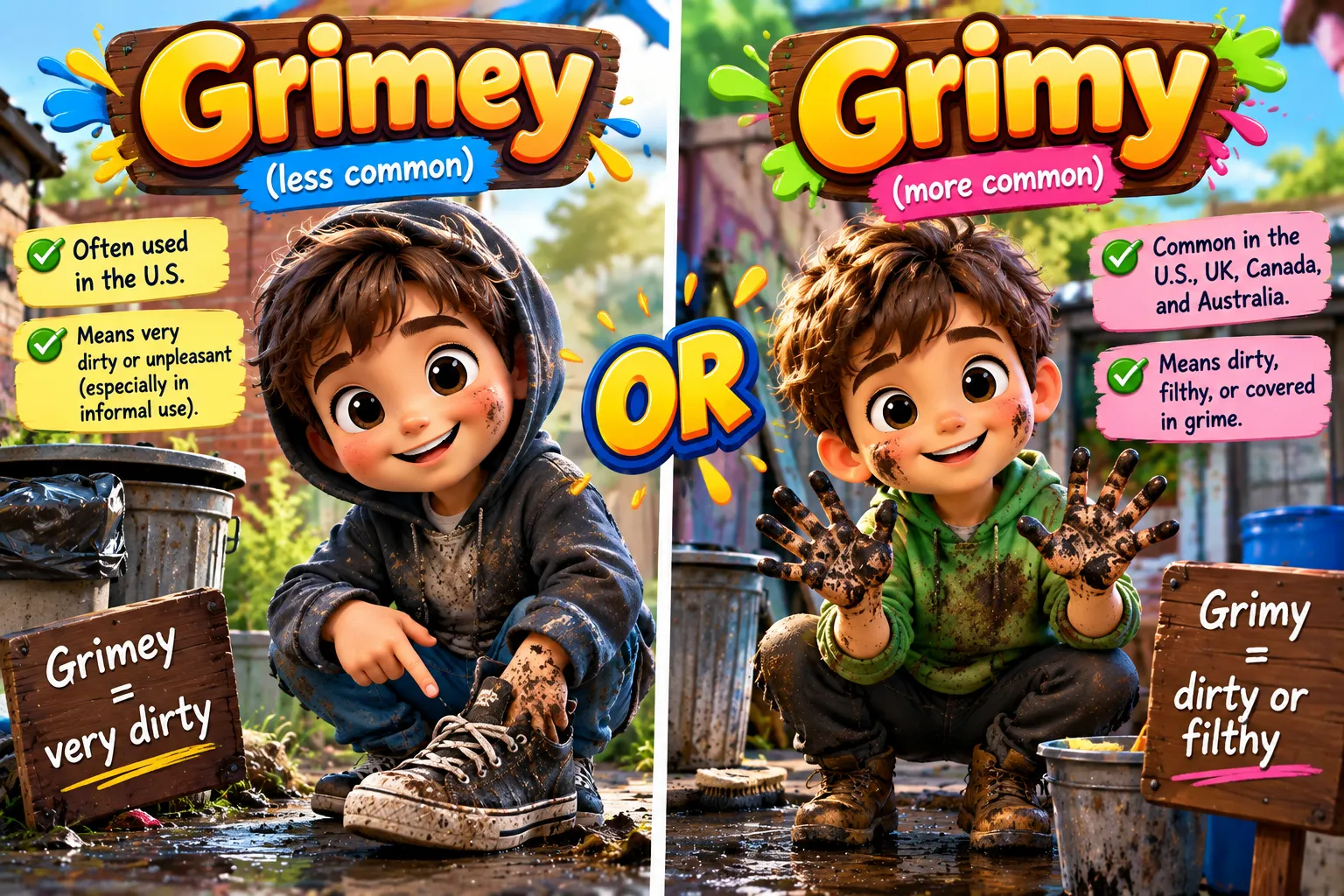
Grimey and grimy refer to something dirty or covered with grime, but grimy is the standard spelling in modern English.
I have noticed that grimey often looks right at first glance. The word seems like it should follow the same pattern as words such as shiny or smoky. Yet when I write it, I still pause and wonder whether that extra e belongs there.
That small spelling choice can be surprisingly confusing. You may see grimey in casual writing, online posts, or older texts, while dictionaries generally list grimy as the standard form. Both spellings are easy to understand because they point to the same basic idea: something dirty, greasy, or covered with grime.
The tricky part is knowing which spelling to choose when you are writing an email, school assignment, article, or formal report. A spell checker may also flag grimey, which can make the choice even less clear.
The good news is simple: grimy is the spelling you should normally use. Let’s look at why, where the word comes from, and how to avoid this common spelling mistake.
Grimey or Grimy Quick Answer
Grimy is the standard spelling. It is an adjective used to describe something covered with grime, dirt, or greasy material.
For example:
- The mechanic wiped his grimy hands.
- The old window looked grimy after years without cleaning.
Grimey is sometimes seen as a variant spelling, but it is much less common. For standard modern English, grimy is the safer choice.
The Origin and Background of Grimy
The word grimy comes from the noun grime, meaning dirt or soot that sticks to a surface.
According to Merriam-Webster, grimy means covered with grime. Cambridge Dictionary likewise defines grimy in connection with something that is dirty or covered with grime.
The noun grime has a much older history. Etymonline traces it to Middle English and earlier Germanic forms associated with dirt or dirtiness. Over time, grime became the familiar English word for a layer of dirt, soot, or greasy material.
The ending -y is also important. English often adds -y to a noun to create an adjective meaning “characterized by” or “covered with” something.
Examples include:
- cloud → cloudy
- dust → dusty
- mud → muddy
- grime → grimy
This pattern helps explain why grimy is the expected spelling.
The spelling grimey can seem logical because the base word is grime. However, English spelling does not always keep the full base word before adding a suffix. In grimy, the final e is dropped before -y.
Grimey vs. Grimy Explained Key Difference
The main difference is standard spelling versus a less common variant.
| Term | Meaning | When to Use | Region/Context |
| grimy | Dirty or covered with grime | Standard English writing | General English |
| grimey | Same basic meaning as grimy | Usually avoid in formal writing | Informal or variant usage |
1. Grimy
Grimy is the normal spelling used in dictionaries and standard writing.
You can use it for people, objects, places, or surfaces.
Examples:
- His grimy boots were covered in mud.
- She found an old grimy towel behind the machine.
- The kitchen wall had become grimy over time.
2. Grimey
Grimey is understandable, but it is not the spelling you should normally choose in careful writing.
It may appear because writers naturally connect the adjective to the full spelling of grime. Informal online writing can also preserve less common spellings.
If your goal is correct, polished English, choose grimy.
Why Does the E Disappear?
This is a useful spelling pattern.
When some English words ending in silent e take a suffix beginning with a vowel, the e may disappear.
With grime + y, the standard adjective becomes:
grime → grimy
That does not mean every word follows the same rule in every situation. English spelling has many exceptions. Still, this pattern explains why grimy looks different from the noun grime.
Which Version Should You Use?
For most readers, the choice is straightforward.
For students
Use grimy. It is the standard spelling and is the safest form for schoolwork, exams, and assignments.
For professional writing
Choose grimy in emails, reports, articles, and business documents. It looks standard and avoids distracting readers with an unusual spelling.
For casual writing
You may encounter grimey online or in informal text. Readers will usually understand it, but grimy remains the better standard choice.
For global English
Use grimy when writing for an international audience. It is clear and widely recognized.
Simple rule: When you mean “covered with grime,” spell it grimy.
Common Mistakes With Grimey or Grimy
Here are some mistakes that often cause confusion.
| Mistake | Correction | Why |
| The floor was grimey. | The floor was grimy. | Grimy is the standard spelling. |
| He wore a grimey jacket. | He wore a grimy jacket. | The adjective drops the final e. |
| Her hands became grimey. | Her hands became grimy. | Use the dictionary-standard form. |
| The walls looked grimey. | The walls looked grimy. | Grimy is preferred in standard writing. |
| A grimey window blocked the light. | A grimy window blocked the light. | The standard adjective is grimy. |
Mistake 1: Keeping the Final E
A common assumption is:
grime + y = grimey
That looks logical, but standard English uses grimy.
Mistake 2: Treating Both Forms as Equally Standard
The two spellings may be understood in context, but that does not make them equally common or equally suitable for formal writing.
Mistake 3: Confusing Grimy With Grimy-Looking Words
Words such as grimy, grimy-looking, dirty, filthy, and sooty overlap in meaning but are not always interchangeable.
For example, sooty specifically suggests soot, while grimy has a broader meaning.
Grimy in Real-World Examples
Seeing the word in different contexts makes its meaning easier to remember.
Professional email
The maintenance team found a grimy filter that needs to be replaced.
News headline
Workers Remove Grimy Build-Up From Historic Station
Social media post
Finally cleaned the grimy kitchen tiles after months of neglect!
Formal report
The inspection found several grimy surfaces in the storage area.
Everyday conversation
I had to wash my hands because they were grimy after fixing the bike.
These examples show that grimy can describe surfaces, clothing, hands, equipment, buildings, and other things that have accumulated dirt.
Grimy Data, Trends & Usage
Exact monthly search-volume figures for grimey and grimy vary by country, search tool, and date. Public search-interest tools such as Google Trends can show relative interest, but they do not provide the same type of exact monthly volume that paid SEO platforms such as Ahrefs or Semrush may provide.
The useful linguistic pattern is clearer than the raw search numbers:
- Grimy is the established standard spelling.
- Grimey appears as a less common spelling.
- Searchers may look up both because the connection between grime and grimy is not obvious to everyone.
- The question is mainly informational, since people usually want to know which spelling is correct.
Corpus and dictionary evidence also support treating grimy as the normal written form. Major learner dictionaries list grimy, making it the practical choice for students and general writers.
The spelling question matters because small differences like this occur throughout English. Similar searches include shiny or shiney, dirty or dirtie, and other words where writers wonder whether a suffix changes the base spelling.
Grimey or Grimy: Comparison Table
| Term/Variant | Meaning | Region/Context | Best Used When |
| Grimy | Dirty or covered with grime | Standard modern English | Formal and informal writing |
| Grimey | Same intended meaning | Less common variant spelling | Usually avoid in careful writing |
| Dirty | Not clean | General English | When grime is not the specific focus |
| Sooty | Covered with soot | Specific dirt or smoke context | When soot is involved |
| Filthy | Extremely dirty | Informal and general English | When emphasizing severe dirt |
This wider comparison shows that grimy is not always the only possible word. Sometimes dirty, sooty, or filthy may express the idea more precisely.
FAQ About Grimey or Grimy
Q: What does grimy mean?
A: Grimy means dirty or covered with grime. It commonly describes hands, clothing, walls, floors, tools, and other surfaces.
Q: Is grimy or grimey correct?
A: Grimy is the standard spelling used in modern English dictionaries. Grimey may be encountered as a variant, but grimy is the better choice for normal writing.
Q: Why is grimy spelled without the e?
A: The adjective is formed from grime with the suffix -y, producing grimy. The final e is removed in the standard spelling.
Q: Is grimey a misspelling?
A: It is generally treated as a nonstandard or less common spelling. If you are writing for school, work, or publication, grimy is the safer form.
Q: Can I use grimy in formal writing?
A: Yes. Grimy is a standard adjective and can appear in formal writing when the meaning fits the context.
Q: What is the difference between grimy and dirty?
A: Both describe a lack of cleanliness, but grimy often suggests a layer of dirt, grease, or sticky residue. Dirty is broader and can describe many types of unclean conditions.
Q: Where does grimy come from?
A: Grimy is derived from grime, an older English word associated with dirt and soiling. Etymological sources trace grime through Middle English and older Germanic forms.
Conclusion
The choice between grimey or grimy becomes much easier once you remember one simple rule: grimy is the standard spelling.
The word describes something covered with grime, dirt, grease, or a similar dirty layer. It is an adjective formed from the noun grime, and the standard spelling drops the final e before -y.
You may still come across grimey, especially in casual online writing. However, using it can make your writing look less polished. For school assignments, professional documents, websites, and everyday standard English, grimy is the form to choose.
It also helps to separate grimy from related words. Dirty is broader, while sooty points specifically to soot. Choosing the most precise word can make your writing clearer.
So, when you hesitate between grimey and grimy, go with grimy.
Bookmark this guide so you never have to second-guess the spelling again.
Read More:
Pyjamas or Pajamas: Easy Spelling Guide

I’m Daniel sultan, an English language writer and SEO content specialist with experience researching spelling, grammar, vocabulary, and English usage. Through SpellComparison.com, I create clear, accurate, and well-researched guides that help readers understand commonly confused words, spelling differences, and grammar rules with confidence.
Every article I write is based on trusted language references, established style guides, and real-world usage to ensure it is accurate, practical, and easy to understand. My goal is to make learning English simple and reliable by providing fact-checked content, clear explanations, and real-life examples that students, writers, educators, and professionals can trust.










