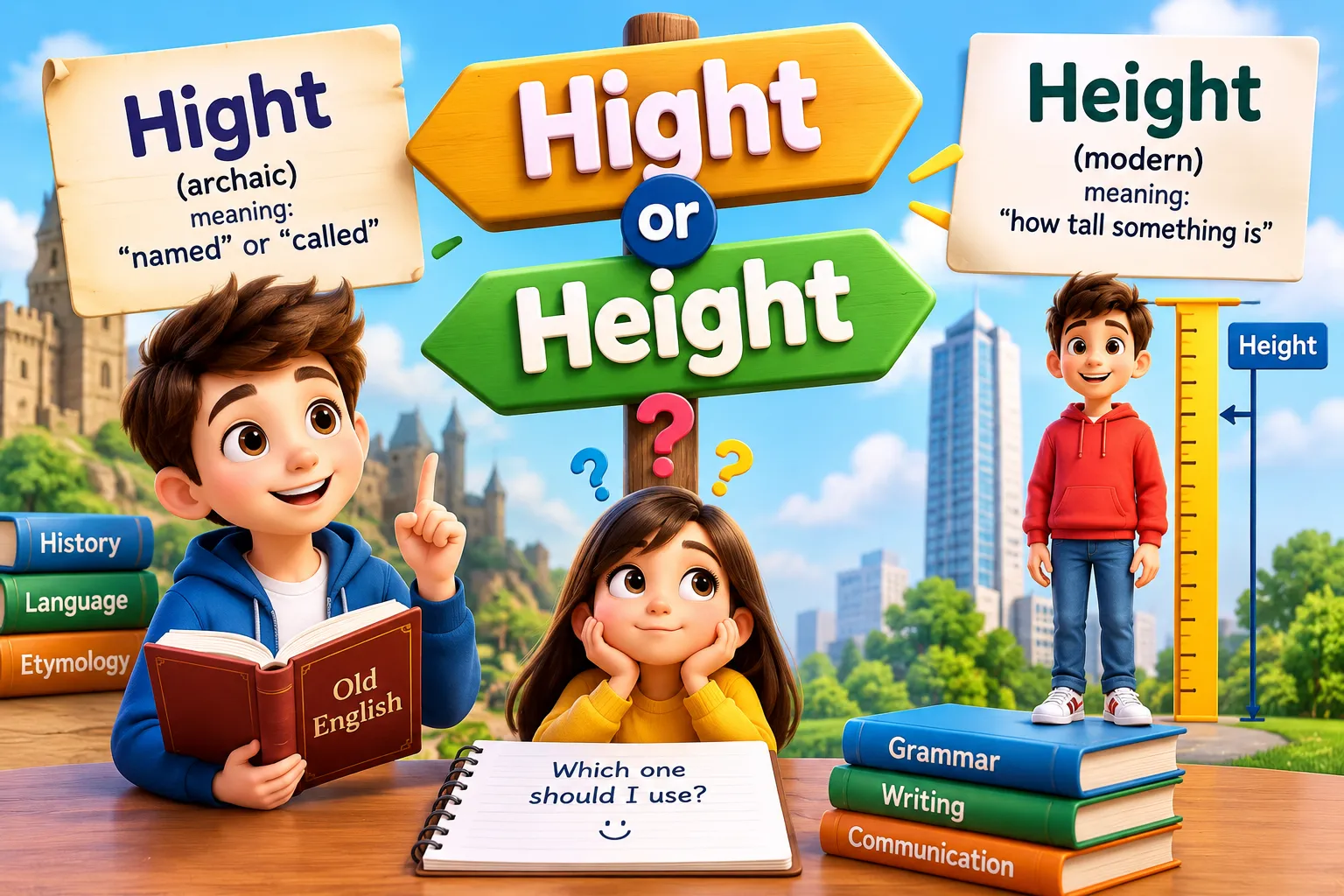
Height is the standard modern English spelling for the measurement of how tall someone or something is; hight is an archaic word that can mean “called” or “named.”
Have you ever typed a word, looked at it, and suddenly thought, “Wait… is that really how it is spelled?” Height is one of those words.
I remember checking the spelling of height while writing a simple sentence about a person’s size. The word looked strange on the screen. It sounds like “hite,” so writing hight seems almost logical. After all, English has words such as light, night, and right. Why should height be different?
That small spelling doubt can cause trouble in school assignments, emails, forms, reports, and online writing. The confusion is even stronger because hight is a real English word. However, it has a very different and very old meaning.
According to Cambridge Dictionary, height is a noun for the distance from the bottom to the top of something, or the quality of being tall. Collins also records hight as an archaic form connected with being named or called.
So, which spelling should you use today? The answer becomes simple once you understand the meaning, history, and grammar behind these two words.
Hight or Height Quick Answer
For modern English, use height when you mean how tall a person or thing is.
- Correct: What is your height?
- Correct: The height of the building is 40 meters.
- Incorrect for modern measurement: What is your hight?
Cambridge Dictionary defines height as the distance from the top to the bottom of something, as well as the quality of being tall. It can also describe how far something is above a surface.
The word hight is different. Collins lists it as an archaic or poetic word meaning “to name” or “call.”
For everyday writing, schoolwork, business communication, and most online content, height is the spelling you want.
The Origin and Background of Height
The spelling of height makes more sense when you look at the history of English.
Collins traces height to Old English hīehthu, with related forms in other Germanic languages. Its modern meaning developed around the idea of being high or elevated.
The related adjective high also has deep roots in Old English. Etymonline traces high to Old English forms such as heh and heah, meaning something of great height or something elevated.
English spelling changed greatly over time. Words passed through Old English, Middle English, and later forms before reaching the spellings used today.
That history helps explain why you cannot always create a noun simply by changing the ending of an adjective.
For example:
- high → height
- wide → width
- deep → depth
- long → length
The spelling of height is therefore not something you can reliably guess from pronunciation alone.
Where Does Hight Come From?
This is where the story gets more interesting.
Hight is not merely a modern typo. Historical dictionaries record it as an old English word. Collins gives the archaic meaning “named; called.”
Etymonline traces hight to Middle English and Old English forms connected with hatan, meaning “to call, name, or command.”
The American Heritage Dictionary also records hight as an archaic adjective meaning “named or called.”
So an old literary sentence might use hight in a way that means someone was called by a particular name.
That is very different from modern height.
Height Explained: Key Differences and Variations
The easiest way to remember the difference is to focus on meaning.
| Term | Meaning | When to Use | Region/Context |
| height | Distance from bottom to top; how tall or high something is | Modern measurement and figurative uses | Standard English |
| hight | Named or called | Historical, archaic, or poetic writing | Mainly literary/historical |
| high | At a great distance above the ground or at a high level | Describing position, level, amount, or degree | Standard English |
| heights | Plural of height; also high places | More than one height or elevated places | Standard English |
Cambridge explains that English uses height as a noun and high as an adjective or adverb. For example, we can say that a statue is three meters high but talk about its height.
This distinction is useful:
The wall is three meters high.
The height of the wall is three meters.
Both sentences are correct.
Height vs. High
These words are related, but they do different jobs.
High is commonly an adjective:
The shelf is high.
Height is a noun:
The height of the shelf is two meters.
Cambridge specifically notes that height is used with nouns such as length, width, and depth when discussing measurements.
Height vs. Hight Pronunciation
Both height and the documented archaic hight can be pronounced /haɪt/ in their relevant dictionary entries. Cambridge gives the pronunciation of height as /haɪt/.
That creates an easy spelling trap.
When you hear:
“What is your height?”
you cannot hear the e in the spelling.
You have to know the word from its meaning and standard spelling.
Which Version Should You Use?
For almost every modern writing situation, choose height.
For students
Use height in:
- Essays
- Homework
- Exams
- School projects
- Science reports
Example:
The experiment measured the height of each plant.
For professionals
Use height in:
- Emails
- Reports
- Forms
- Technical documents
- Business communication
Example:
Please confirm the height of the equipment before installation.
For general online writing
Use height in:
- Blog posts
- Websites
- Social media
- Product descriptions
- Guides
If you are talking about vertical measurement, height is the clear modern choice.
For historical or creative writing
Hight may appear when you are deliberately using archaic English.
For example, an author may use an old-fashioned expression to give a story a medieval or poetic feel.
That is a special literary use, not the normal spelling of height.
Common Mistakes with Hight or Height
1. Writing “hight” because it sounds right
❌ My hight is 170 cm.
✅ My height is 170 cm.
The mistake comes from spelling the word based on its sound.
2. Assuming “high” becomes “hight”
❌ The hight of the mountain is impressive.
✅ The height of the mountain is impressive.
English word formation does not always follow a simple pattern.
3. Using “hight” in formal writing
❌ Please provide your hight and weight.
✅ Please provide your height and weight.
Modern readers normally understand hight in this context as a spelling error.
4. Confusing height with high
❌ The height of the tower is 80 meters high.
This sentence can sound awkward because it mixes two structures.
Better:
✅ The tower is 80 meters high.
Or:
✅ The height of the tower is 80 meters.
5. Treating hight as completely meaningless
This is slightly different.
Although hight is not the standard modern spelling for vertical measurement, dictionaries do record it as an old word. Collins and the American Heritage Dictionary both document its archaic meaning
So it is more accurate to say that hight is archaic, rather than claiming that the word has never existed.
Hight or Height in Real World Examples
Seeing the word in different settings can make the rule easier to remember.
Professional Email
Please confirm the height of the storage unit before we place the order.
News Headline
New Tower Reaches Record Height in the City Center
Social Media Post
I finally faced my fear of heights today!
Formal Report
The survey recorded the height of each structure using standard measurement procedures.
School Assignment
The height of the plant increased during the four-week study.
Notice that none of these modern examples needs hight.
Hight or Height Data, Trends & Usage
There is an important difference between dictionary evidence and search-volume data.
Reliable dictionaries can show whether a word is documented and how it is used. They do not, however, provide a universal monthly Google search-volume figure for every spelling comparison.
For that reason, it would be misleading to invent an exact number such as “height gets 50,000 searches and hight gets 5,000 searches” without access to a specific keyword database.
Current reference evidence does show a clear usage distinction:
- Height is the standard modern noun for vertical measurement.
- Hight is documented mainly as an archaic or poetic word meaning “named” or “called.”
- Search results for height vs hight are strongly tied to spelling questions, which suggests an informational search intent rather than commercial intent. Current spelling guides also frame the query around choosing the correct modern form.
- The two forms can sound alike, so pronunciation alone does not settle the spelling.
The practical SEO insight is simple: people searching “hight or height” are usually looking for a fast spelling answer. A useful page should give that answer immediately and then explain the historical reason behind the confusion.
Why This Matters Today
This question still matters because people write quickly.
Students type assignments. Professionals send emails. Bloggers publish articles. ESL learners use online dictionaries. Spell-check tools can also treat unusual historical words as legitimate dictionary entries.
That means understanding the meaning and context of a word is still useful.
A Second Comparison Table: Height, Hight, High, and Related Terms
| Term/Variant | Meaning | Region/Context | Best Used When |
| height | Vertical measurement or highest point | Modern English | You mean how tall or high something is |
| hight | Named or called; also recorded as an obsolete form of height | Archaic/literary English | You are discussing historical language |
| high | Far above the ground or at a high level | Modern English | You need an adjective or adverb |
| altitude | Distance above a reference level, often sea level | Technical/scientific contexts | Talking about aircraft, geography, or elevation |
| stature | A person’s physical height; sometimes figurative status | Formal English | Describing a person’s build or figurative standing |
| elevation | Height above a particular level | Technical/geographical contexts | Discussing land, buildings, or vertical position |
Cambridge distinguishes height from related measurement words such as altitude and elevation.
Frequently Asked Questions
Q: What does height mean?
A: Height is the distance from the bottom to the top of a person or thing. It can also describe how far something is above a surface or a peak level of activity or success.
Q: How do you spell height correctly?
A: The standard spelling is H-E-I-G-H-T. The word is pronounced /haɪt/, so its spelling cannot always be guessed from its sound.
Q: Is hight a correct word?
A: Hight is a real historical English word, but it is not the normal modern spelling for vertical measurement. Dictionaries describe its archaic use as meaning “named” or “called.”
Q: What is the difference between hight and height?
A: Height refers to vertical measurement in modern English. Hight is mainly an archaic word associated with being named or called, although dictionaries also record historical use as a variant of height.
Q: Is height used in formal writing?
A: Yes. Height is standard English and is suitable for academic, professional, technical, and everyday writing. It is commonly used with measurements such as meters, centimeters, feet, and inches.
Q: Why do people spell height as hight?
A: The main problem is pronunciation. Height sounds like “hite,” so writers may leave out the e when spelling it from memory. Its relationship to the word high can add to the confusion.
Q: Where does hight come from?
A: Historical sources trace hight to Old English and Middle English forms related to the verb meaning “to call” or “name.” Etymonline and Collins both connect it with older Germanic forms.
Q: Can I use hight in a story?
A: Yes, if you are intentionally using archaic or poetic English. It may suit historical fiction, old-style poetry, or a character whose speech is meant to sound old-fashioned. For normal modern writing, use height.
Conclusion
The hight or height question looks small, but it teaches an important lesson about English spelling: pronunciation does not always tell you how a word should be written.
When you mean the measurement from bottom to top, use height. It is the standard modern noun used in everyday, academic, professional, and technical English. Cambridge and Collins both support this modern usage.
Remember three simple points:
- Height = how tall or high something is.
- Hight = an old word mainly meaning “named” or “called.”
- High = the adjective or adverb used to describe something that is far above the ground or at a high level.
The unusual spelling of height becomes easier to remember once you stop trying to spell it only by sound. Think of it as a word with a long history rather than a word that follows a simple spelling pattern.
So, if you are writing an email, essay, report, form, blog post, or social media caption, choose height when you mean vertical measurement.
Bookmark this guide so you never second-guess “hight or height” again.
Readmore

I’m **Rubab Naaz**, an English language content writer with over 10 years of experience creating educational and SEO-focused articles. I specialize in spelling comparisons, grammar, vocabulary, synonyms, commonly confused words, and English usage. My passion is helping students, writers, and professionals improve their language skills through accurate, well-researched, and easy-to-understand content. Every article I write is designed to make learning English simple, practical, and engaging.










