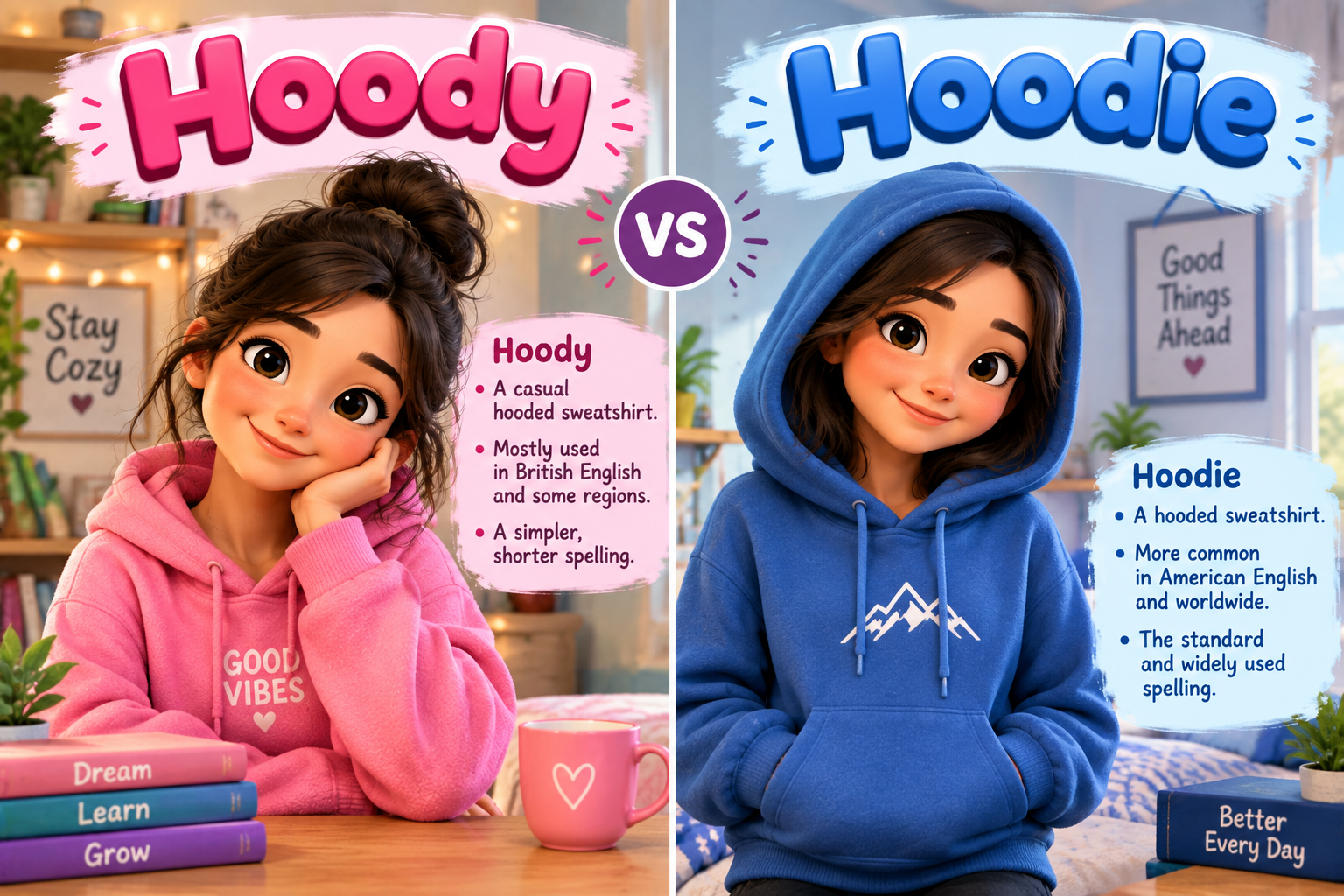
Hoodie is the standard spelling for a sweatshirt or jacket with a hood, while hoody is a recognized alternative spelling, especially in British English.
Have you ever typed hoodie and then stopped to wonder whether hoody might actually be the correct spelling? I have. The two words look almost identical, and when I first noticed both forms, I assumed one had to be a spelling mistake.
That small doubt can be surprisingly common. I have seen hoodie on clothing websites, in articles, and in everyday messages. Then I have come across hoody in British writing and wondered why the spelling had changed. The pronunciation does not really help because both forms are pronounced the same way.
After checking dictionaries and looking at the history of the word, I found that the answer is much simpler than it first appears. Hoodie is the standard and more widely recognized spelling, but hoody is also a legitimate variant.
Cambridge Dictionary defines hoodie as a sweatshirt with a hood and lists hoody as another spelling.
So, which one should you use? That depends mainly on your audience, region, and writing style. In this guide, I’ll explain the difference, show you real examples, look at the word’s history, and help you choose the spelling that feels right for your writing.
Hoody or Hoodie Quick Answer
| Point | Hoodie | Hoody |
|---|---|---|
| Meaning | A piece of clothing with a hood | A piece of clothing with a hood |
| Correct spelling | ✅ Correct | ✅ Correct |
| Commonness | More common in general English | Less common |
| Usage | Widely used in everyday writing, clothing descriptions, and dictionaries | Often associated with British English usage |
| Example | “I bought a new hoodie for the winter.” | “He wore a black hoody to the game.” |
| Difference | The preferred spelling for most readers | An alternative spelling |
| Best choice | ⭐ Hoodie is the safest general-purpose spelling | Use when preferred by a particular style or region |
The Origin and Background of Hoodie
The story of hoodie starts with the much older word hood.
Etymonline traces hood to Old English hod, meaning a hood or soft covering for the head. The word has roots in Proto-Germanic and is related to words found in several Germanic languages.
The modern clothing word hoodie is much newer.
According to the Online Etymology Dictionary, hoodie is a shortened form of hooded sweatshirt. The clothing sense is recorded from 1991. Etymonline also notes that hoodie had an older, unrelated use for a hooded crow dating back to 1789.
That is an interesting detail because it shows that words can develop more than one meaning over time.
The clothing sense comes from a simple process in English. A longer phrase such as hooded sweatshirt can become shortened in everyday speech. Eventually, the shorter form can become a normal dictionary word.
The spelling hoody developed alongside hoodie. Dictionaries now recognize both forms.
So, you do not need to think of hoody as a random misspelling. It is a genuine variant.
Hoodie Explained Meaning, Spelling, and Use
Hoodie is a noun.
It normally refers to a sweatshirt or similar piece of clothing with a hood. Cambridge defines it as a sweatshirt with a hood that can cover the head.
A hoodie may have:
- A hood
- Long sleeves
- A soft fabric body
- A front pocket
- A zipper or pullover design
- Drawstrings around the hood
The word can describe both casual fashion and practical clothing.
For example:
“She packed a warm hoodie for the trip.”
Here, hoodie simply names the item of clothing.
The plural is also straightforward:
Singular: hoodie
Plural: hoodies
The spelling changes from y to ies in the plural, just as it does with many English nouns ending in consonant + y.
What about hoody?
Hoody has the same basic meaning.
Cambridge lists it as an alternative spelling of hoodie.
So these two sentences communicate essentially the same idea:
“He bought a gray hoodie.”
“He bought a gray hoody.”
The first spelling is more familiar to many readers, but the second is not automatically wrong.
Hoody vs. Hoodie: Key Differences
| Term | Meaning | When to Use | Region/Context |
| hoodie | A sweatshirt or similar garment with a hood | General writing and everyday use | Widely used |
| hoody | Same basic clothing item | Informal writing and regional usage | Especially associated with UK usage |
| hooded sweatshirt | A sweatshirt that has a hood | Formal, descriptive, or technical writing | Neutral |
| hooded jacket | A jacket with a hood | When describing a jacket rather than a sweatshirt | General English |
The biggest difference is not meaning. It is spelling preference.
Cambridge gives both hoodie and hoody, while its main entry uses hoodie.
That makes hoodie a useful default when you are writing for a broad audience.
Which Version Should You Use?
I usually choose hoodie unless I have a specific reason to use hoody.
Here is the approach I find easiest.
For American English
Use hoodie.
It is the familiar spelling in American English and works well in casual and general writing.
For British English
Both forms can appear, but hoodie is still a standard and widely recognized choice. Hoody is also listed as an alternative.
If you are following a particular British publication or style guide, match its preferred spelling.
For students
Use hoodie unless your teacher or style guide asks you to follow a particular regional convention.
It is clear, familiar, and unlikely to distract your reader.
For clothing descriptions
I would normally choose hoodie.
For example:
“Black cotton hoodie with a front pocket.”
That wording is short and natural.
For formal writing
If the exact clothing type matters, hooded sweatshirt may be more precise.
For example:
“Participants were provided with a hooded sweatshirt.”
The phrase sounds more formal than hoodie.
Common Mistakes With Hoody or Hoodie
1. Thinking hoody is always wrong
Mistake: “Hoody is just a misspelling.”
Correction: Hoody is a recognized variant.
Cambridge explicitly lists it as another spelling of hoodie.
2. Thinking hoodie and hooded sweatshirt mean different things
Mistake: Assuming the two terms describe completely different garments.
Correction: A hoodie is commonly understood as a sweatshirt with a hood. Cambridge uses this definition directly.
3. Using hoodie’s as the plural
Incorrect: “I bought two hoodie’s.”
Correct: “I bought two hoodies.”
The apostrophe is not needed because hoodies is simply the plural noun.
4. Confusing hood with hoodie
A hood is the part of a garment that covers the head.
A hoodie is the garment that has that hood.
For example:
“The jacket has a large hood.”
But:
“She wore a warm hoodie.”
Cambridge defines hood as the part of clothing that can be pulled up to cover the head.
5. Changing spelling without a reason
If you use hoodie throughout an article, switching randomly to hoody can look like an editing error.
Pick the spelling that suits your audience and stay consistent.
Hoody or Hoodie in Real-World Examples
The best way to understand the difference is to see how the word works in different settings.
Professional email
“Please bring a warm hoodie because the outdoor session may be cold.”
The word is perfectly natural in a friendly workplace message.
News headline
Local Designer Launches New Hoodie Collection
Here, hoodie works well because it is familiar and easy to scan.
Social media post
“My favorite hoodie has finally survived another winter!”
The informal nature of social media makes hoodie a natural choice.
Formal document
“Each participant received a hooded sweatshirt before the outdoor activity.”
Here, hooded sweatshirt sounds more formal and precise.
Product description
“Soft cotton hoodie with a lined hood and front pocket.”
This is the kind of short wording you might see in an online clothing store.
Hoody or Hoodie Data, Trends & Usage
The search intent behind “hoody or hoodie” is mainly informational.
People searching the phrase usually want to know whether the two spellings are different, which one is correct, or which form they should use.
Exact monthly search-volume figures are difficult to verify without direct access to paid SEO platforms such as Ahrefs or Semrush. I would therefore avoid presenting an unverified number as fact.
Dictionary evidence gives us a more reliable picture of the spelling relationship. Cambridge lists hoodie as the main entry and hoody as an alternative.
There is also clear historical evidence for the modern clothing word. Etymonline records the clothing sense of hoodie from 1991 and identifies it as a shortening of hooded sweatshirt.
Why does this topic matter?
Small spelling questions matter because English has many regional variations.
Writers may move between American and British English. Students may read sources from different countries. Online stores may use one spelling while customers search for another.
That makes questions such as color or colour, favorite or favourite, and center or centre common. Hoodie or hoody belongs to the same larger pattern of English spelling variation, although the difference here is not simply a US-versus-UK spelling rule.
One useful lesson is this: a less common spelling is not automatically an incorrect spelling.
Hoodie vs. Hoody: A Second Comparison
| Term/Variant | Meaning | Region/Context | Best Used When |
| Hoodie | Hooded sweatshirt or similar garment | General modern English | You want the most familiar spelling |
| Hoody | Hooded sweatshirt or similar garment | Informal, especially UK usage | Your style or audience uses this variant |
| Hooded sweatshirt | Sweatshirt with an attached hood | Formal or descriptive | You want maximum clarity |
| Hooded top | A top with a hood | General clothing language | The item may not be a traditional sweatshirt |
| Hooded jacket | Jacket with a hood | Clothing descriptions | The garment is a jacket rather than a sweatshirt |
This table shows why hoodie and hoody should not always be treated as the only possible choices. The best word can also depend on the exact garment.
Frequently Asked Questions
Q: What does hoodie mean?
A: A hoodie is generally a sweatshirt or similar garment with a hood. Cambridge Dictionary defines it as a sweatshirt with a hood used to cover the head.
Q: Is hoody a correct spelling?
A: Yes. Hoody is a recognized alternative spelling of hoodie. Cambridge lists both forms in its dictionary entry.
Q: Which is more common, hoodie or hoody?
A: Hoodie is the more widely recognized spelling and is the main form used by Cambridge’s dictionary entry. Hoody is an accepted variant.
Q: Is hoodie American or British English?
A: Hoodie is used in both American and British English. Hoody is also used, with Cambridge specifically identifying it as an alternative form and showing UK usage in its entry.
Q: Where does the word hoodie come from?
A: The modern clothing word is a shortened form of hooded sweatshirt. Etymonline records this clothing sense from 1991. The older word hood comes from Old English hod.
Q: Is hoodie formal English?
A: Hoodie is a normal English noun, but it is associated with informal clothing language. In a highly formal document, hooded sweatshirt may sound more suitable.
Q: What is the plural of hoodie?
A: The plural is hoodies. For example: “The store received several new hoodies.” You do not need an apostrophe.
Final Thoughts on Hoody or Hoodie
After looking closely at hoody and hoodie, I think the difference is much easier to remember than it first appears.
Hoodie is the spelling I would normally choose. It is familiar, clear, and widely recognized. Hoody is also a valid form, so seeing it does not mean that the writer has made a spelling mistake.
The word itself has a fairly modern clothing history. Etymonline traces the clothing sense of hoodie to the early 1990s and explains that it comes from hooded sweatshirt. The much older word hood goes back to Old English hod.
For everyday writing, hoodie is an easy choice. If you are following a particular British style or want to preserve a source’s wording, hoody may also be appropriate.
The most useful rule is simple: use hoodie as your default, but don’t treat hoody as an error.
Once you know that both forms are accepted, this spelling question becomes much less confusing.
Bookmark this guide so you never have to second-guess “hoody or hoodie” again.
Read More:
Mama or Momma: Easy Guide to the Difference

I’m an English language educator and content writer with more than 10 years of experience helping learners improve their English skills. I specialize in spelling differences, grammar, vocabulary, synonyms, commonly confused words, and English usage. My goal is to create accurate, easy-to-understand articles that make learning English simple, practical, and enjoyable for students, writers, and professionals around the world.










