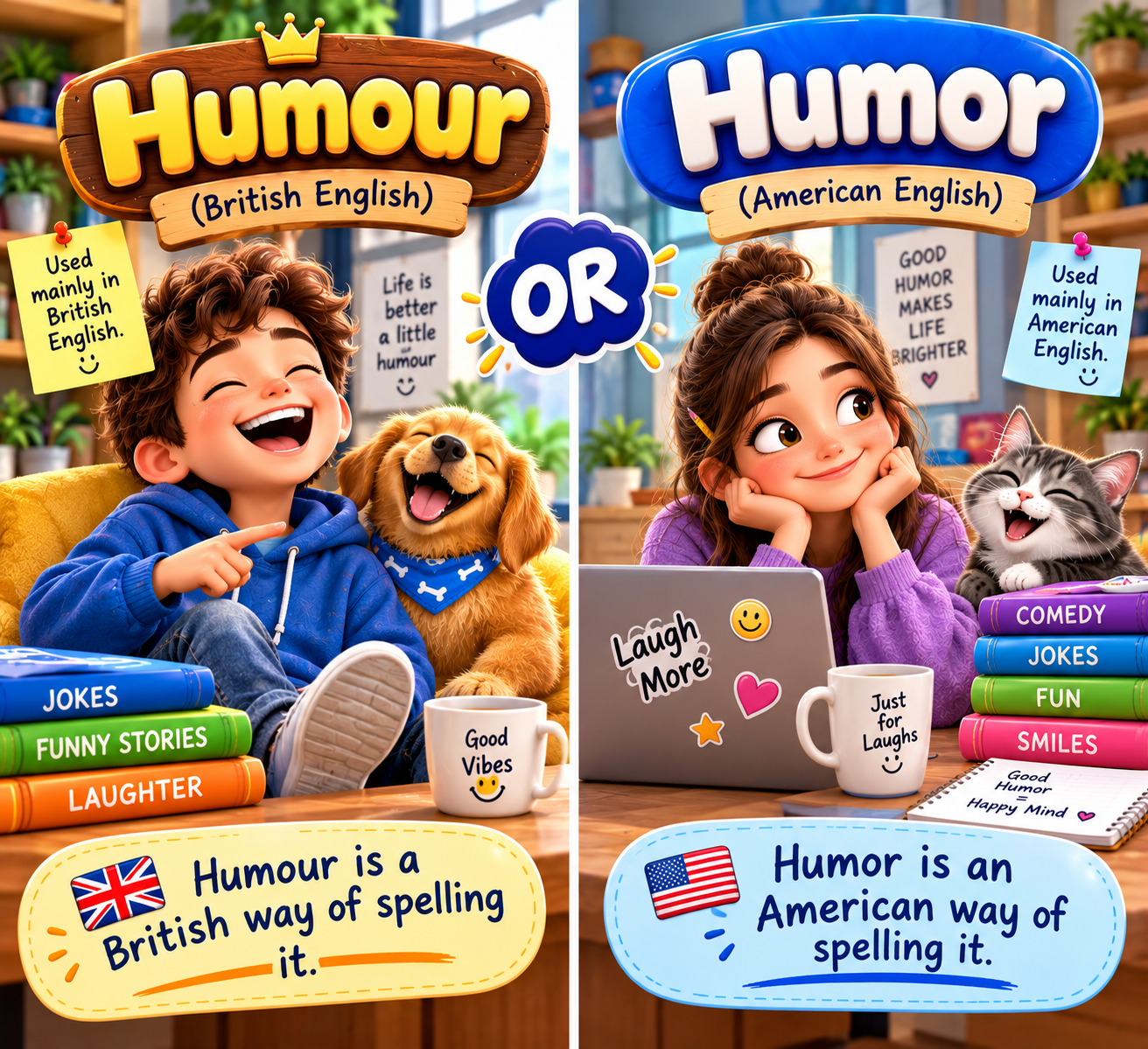
Humour and humor have the same basic meaning, but humour is the standard British spelling while humor is the standard American spelling.
I’ve often paused while writing the word humour and wondered whether I should keep the u or leave it out as humor. I’ve seen both spellings in books, websites, emails, and articles, so it can be easy to wonder whether one is correct and the other is a spelling mistake.
Over time, I’ve learned that the difference is much simpler than it first appears. Humour and humor have the same basic meaning. The main difference is the variety of English being used. British English normally keeps the u, while American English normally drops it.
I’ve also noticed another common problem. Once writers learn that British English uses humour, they sometimes assume that every related word should also contain u. That can lead to spellings such as “humourous,” which is not the standard form.
In this guide, I’ll explain the difference between humour or humor, show where each spelling belongs, explore the word’s interesting etymology, and cover related forms and common mistakes. By the end, choosing the right spelling should feel much easier.
Humour or Humor Quick Answer
Humour and humor are two regional spellings of the same English word. Both can refer to the quality of being funny, the ability to appreciate something funny, or a particular style of comedy. Cambridge lists humour as the UK spelling and humor as the US spelling.
For example:
- British English: She has a great sense of humour.
- American English: She has a great sense of humor.
The meaning does not change.
The spelling changes because English has different regional conventions. The same pattern appears in pairs such as colour/color, favour/favor, and honour/honor.
So the easiest rule is:
Use “humour” for British English and “humor” for American English.
Neither spelling is universally wrong.
The Origin and Background of Humour or Humor
The history of humour or humor is much older than the modern spelling difference.
According to Etymonline, the word entered Middle English in the mid-14th century from Old North French humour, meaning liquid, dampness, or a bodily fluid. The French word came from Latin umor, meaning bodily fluid or moisture.
That may seem strange because we now connect humor with jokes and laughter.
The connection comes from older medical beliefs. Ancient medicine described four bodily fluids, or humors, that were thought to affect a person’s physical condition and state of mind. Over time, the word gained meanings connected with mood, temperament, and disposition.
Later, its meaning moved toward the modern idea of something amusing or funny. Etymonline dates the sense of “amusing quality” to the 1680s.
Oxford’s learner dictionary also traces the word through Middle English, Old French, and Latin, noting how the original meaning of bodily fluid developed into ideas about mood and temperament.
Why do we have “humour” and “humor”?
The difference is mainly a matter of spelling tradition.
American English uses -or in many words where British English uses -our:
- humor / humour
- color / colour
- favor / favour
- honor / honour
- labor / labour
Etymonline explains that the -our form became common in Britain, while American spelling later favored -or in many such words.
This is a good example of how linguistics and language history can explain a spelling difference that otherwise seems random.
Humour or Humor Explained Key Differences
The most important point is simple: the meaning stays the same, but the regional spelling changes.
| Term | Meaning | When to Use | Region/Context |
| humour | Amusing quality or ability to enjoy what is funny | When following British spelling | UK and other varieties using British conventions |
| humor | Same basic meaning as humour | When following American spelling | United States |
| humorous | Funny or amusing | As an adjective | Standard in both varieties |
| humoured | Past tense of the verb | When following British spelling | British English |
| humored | Past tense of the verb | When following American spelling | American English |
Humour in British English
British English normally uses humour.
The novel is full of gentle humour.
Humor in American English
American English normally uses humor.
The novel is full of gentle humor.
The meaning is identical.
What about “humorous”?
This is where many learners make a mistake.
The standard adjective is:
humorous
Not:
humourous
Even when you are writing British English, humorous is the standard spelling. Etymonline dates the modern meaning of humorous as “funny, exciting laughter” to 1705.
So you can write:
The speaker gave a humorous presentation.
Whether the rest of your document uses British or American spelling, humorous normally stays the same.
Which Version Should You Use?
Your choice should depend on your audience and your chosen English variety.
For American English
Use humor.
This is the normal spelling for:
- U.S. school assignments
- American business writing
- U.S. websites
- American publications
- General American English
For example:
The article uses humor to explain a difficult topic.
For British English
Use humour.
This is the normal choice for British-style:
- Academic writing
- Newspapers
- Books
- Websites
- Business documents
- Everyday communication
For example:
The article uses humour to explain a difficult topic.
For international writing
Pick a consistent style.
If your website serves readers from many countries, either spelling can be understood. The key is to avoid switching styles without a reason.
For example, if you write humour, it is better to also follow the British pattern in related words such as colour, favour, and behaviour when those words appear.
If you choose humor, keep the American pattern consistent.
Common Mistakes with Humour or Humor
1. Thinking “humour” is wrong
❌ British English uses the wrong spelling: humour.
✅ Humour is the standard British spelling.
The extra u is not an error. It reflects British spelling conventions. Cambridge explicitly identifies humour as the UK form of humor.
2. Thinking “humor” is always wrong
❌ Humor is incorrect English.
✅ Humor is the standard American spelling.
The spelling is perfectly normal in American English.
3. Writing “humourous”
❌ She gave a humourous speech.
✅ She gave a humorous speech.
The adjective is normally humorous in both major spelling systems.
4. Mixing British and American forms
❌ The colour of his shirt showed his sense of humor.
This is not necessarily grammatically wrong, but it mixes spelling conventions if there is no special reason for doing so.
For a consistent British style:
✅ The colour of his shirt showed his sense of humour.
For a consistent American style:
✅ The color of his shirt showed his sense of humor.
5. Assuming the pronunciation changes because of spelling
The spelling is different, but the two words have essentially the same pronunciation in standard dictionary descriptions.
Cambridge gives /ˈhjuː.mə(r)/ for the British form and /ˈhjuː.mɚ/ for the American form.
So the spelling difference does not mean you need to learn two completely different words.
Humour or Humor in Real-World Examples
Professional email
British English:
Thank you for bringing some humour to what was otherwise a very serious meeting.
American English:
Thank you for bringing some humor to what was otherwise a very serious meeting.
The structure remains the same. Only the regional spelling changes.
News headline
Humour helps readers connect with difficult stories
An American publication could use:
Humor helps readers connect with difficult stories
Both are natural within their respective spelling systems.
Social media post
A little humour can make a long Monday feel much shorter!
For an American audience:
A little humor can make a long Monday feel much shorter!
Formal report
The survey found that participants responded positively to the use of humour during the presentation.
An American report would normally write:
The survey found that participants responded positively to the use of humor during the presentation.
These examples show why the difference is mainly about style and regional convention, not meaning.
Humour or Humor Data, Trends and Usage
The spelling difference has a clear linguistic basis, but exact monthly search numbers for “humour or humor” vary by country, search engine, and date.
Publicly available SEO results do not provide a reliable, universal monthly search figure that can be stated as a current global number without access to a live database such as Ahrefs, Semrush, or Google Keyword Planner. It is better to avoid inventing a figure.
Corpus evidence
Cambridge provides real examples of humour from the Cambridge English Corpus. These examples show the word being used in different settings, including discussions of literature, music, science, and communication.
There is also published linguistic research involving humor. A 2018 study in Behavior Research Methods created humor ratings for 4,997 English words, using responses from 821 participants. The researchers examined how humorous different words were perceived and compared those ratings with other linguistic measures.
That study is not a spelling-frequency study, so it should not be used to claim that humor is more common than humour. It does, however, show that humor is an established topic in modern language research.
Search intent
The search intent behind “humour or humor” is mainly informational.
People searching this phrase are usually trying to discover:
- Which spelling is correct?
- Is humour British?
- Is humor American?
- Is there a difference in meaning?
- Should I write humorous or humourous?
- Which spelling should I use in formal writing?
This makes the topic especially useful for students, ESL learners, editors, bloggers, and professional writers.
Standalone Comparison Table
| Term/Variant | Meaning | Region/Context | Best Used When |
| Humour | Quality of being funny or ability to appreciate comedy | British English | Writing in British English |
| Humor | Same core meaning as humour | American English | Writing in American English |
| Humorous | Funny or amusing | Both major varieties | Describing a person, story, comment, or situation |
| Humoured | Past tense of “humour” | British English | Writing about accommodating someone’s wishes |
| Humored | Past tense of “humor” | American English | Same verb meaning in American spelling |
| Humourless | Without a sense of humour | British English | Following British spelling |
| Humorless | Without a sense of humor | American English | Following American spelling |
This table highlights an important point: the regional spelling pattern can continue into related forms, but humorous is a notable exception.
Frequently Asked Questions
Q: What does “humour or humor” mean?
A: Both words refer to the same basic idea: something funny, the quality of being amusing, or the ability to recognize and enjoy comedy. The difference is mainly spelling by English variety. Cambridge identifies humour as UK English and humor as US English.
Q: Which is correct, humour or humor?
A: Both are correct. Choose humour when using British English and humor when using American English.
Q: Is “humour” more formal than “humor”?
A: No. The extra u does not make the word more formal. It simply marks a British spelling convention.
Q: Is “humorous” or “humourous” correct?
A: Humorous is the standard spelling. It is normally written this way in both British and American English.
Q: Can “humour” be used in American English?
A: Readers in the United States will understand humour, but humor is the standard American spelling. If you are following an American style guide, use humor.
Q: Where does the word humour come from?
A: The word entered English through Middle English from Old French and ultimately Latin. Its earliest English sense was connected with bodily fluids before its meaning developed toward mood, temperament, and amusement.
Q: Does humour have the same pronunciation as humor?
A: They are essentially pronounced alike apart from normal accent differences. Cambridge gives closely related pronunciations for the British and American forms.
Conclusion: Humour or Humor?
I’ve found that the easiest way to remember humour or humor is to stop thinking of them as two different words. They are regional spellings of the same word.
If you are following British English, choose humour. If you are following American English, choose humor. The meaning stays the same, and both forms are standard within their respective varieties.
One extra spelling point is worth remembering: the adjective is humorous, not humourous. That small detail can prevent a common mistake.
The word itself also has a fascinating history. It began with an older sense connected to bodily fluids, then developed through ideas about mood and temperament before gaining its modern connection with amusement and comedy.
So, before choosing a spelling, ask one simple question: Which variety of English am I writing? Once you answer that, the choice becomes easy.
Bookmark this guide so you never second-guess “humour or humor” again.
Read More:
Sooner or Later: Easy Meaning and Correct Usage

I’m Daniel sultan, an English language writer and SEO content specialist with experience researching spelling, grammar, vocabulary, and English usage. Through SpellComparison.com, I create clear, accurate, and well-researched guides that help readers understand commonly confused words, spelling differences, and grammar rules with confidence.
Every article I write is based on trusted language references, established style guides, and real-world usage to ensure it is accurate, practical, and easy to understand. My goal is to make learning English simple and reliable by providing fact-checked content, clear explanations, and real-life examples that students, writers, educators, and professionals can trust.










