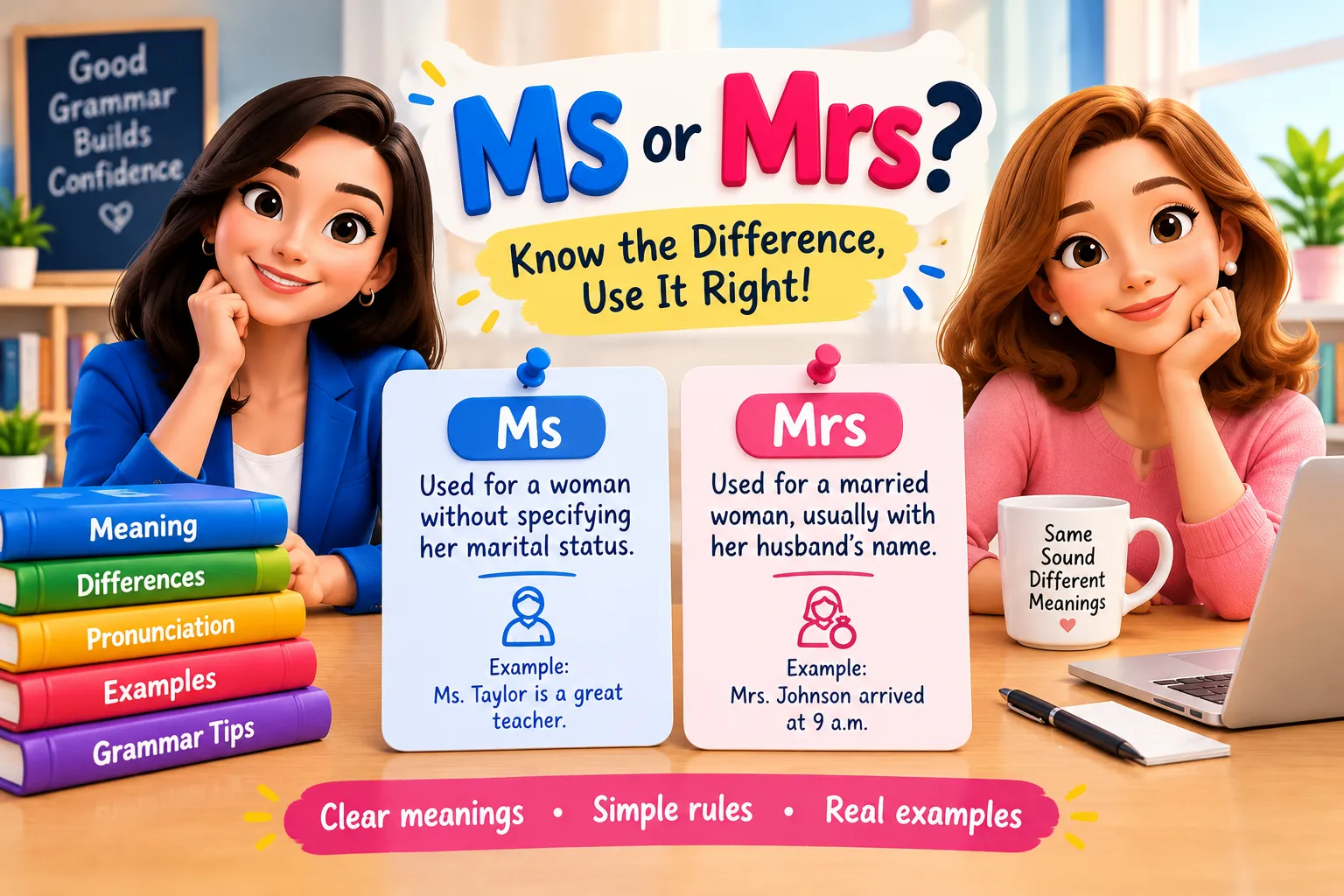
Ms or Mrs depends on whether you want to show a woman’s marital status. Ms. works for a woman regardless of marital status, while Mrs. traditionally refers to a married woman.
Have you ever written an email to a woman and stopped at the greeting? Should you write Ms. Smith or Mrs. Smith? It seems like a small choice, but using the wrong title can feel awkward.
I have often seen English learners pause over these two titles when writing formal emails, filling out forms, or addressing a teacher. The confusion makes sense. Both titles come before a woman’s name, and both show respect. However, they do not always mean the same thing.
The good news is that you do not need to know someone’s personal life to address them politely. You simply need to understand what each title means and when to use it.
In this guide, you will learn the difference between Ms. and Mrs., how to pronounce them, where they came from, and which one works best in professional writing. You will also find real-life examples, common mistakes, and simple rules you can remember.
By the end, you will know how to choose the right title with confidence.
Ms or Mrs Quick Answer
Ms. and Mrs. are titles placed before a woman’s name. The main difference is that Ms. does not tell the reader whether a woman is married, while Mrs. traditionally identifies a married woman.
Here are two simple examples:
- Ms. Sarah Ahmed is the name used on a business letter when her marital status is not relevant.
- Mrs. Sarah Ahmed may be used when Sarah is married and prefers this title.
You can use Ms. in professional emails, job applications, and other formal situations. If a woman tells you that she prefers Mrs., respect her choice.
Easy rule to remember: Use Ms. when marital status does not matter. Use Mrs. when a married woman prefers that title.
The Origin and Background of Ms or Mrs
The history of these titles explains why they look similar but serve different purposes.
Where Does Mrs. Come From?
The title Mrs. developed from mistress, an older English word that once had several meanings, including a woman of authority or a female head of a household.
Over time, the shortened form became a title used before women’s names. Its modern use became closely linked to married women.
According to Collins English Dictionary, Mrs. has a long history as a title of respect for married women. Its spelling and pronunciation changed over time as English developed.
Today, Mrs. is commonly used before a married woman’s surname or full name when she chooses that form of address.
For example:
- Mrs. Khan
- Mrs. Emily Brown
- Mrs. Ayesha Malik
The title does not replace the woman’s name. Instead, it comes before her name as a form of address.
Where Does Ms. Come From?
The history of Ms. is especially interesting.
The title was used as a marriage-neutral alternative to Miss and Mrs. It allows people to address a woman without stating whether she is married.
The Oxford University Press blog discusses historical evidence for Ms. dating back earlier than many people expect. A 1901 newspaper reference shows that the title was suggested for use when the writer did not know a woman’s marital status. The form later became widely associated with the women’s movement of the 1970s.
Ms. is now common in business, education, and other professional settings.
For example:
- Ms. Taylor
- Ms. Fatima Ali
- Ms. Olivia James
According to the Oxford Advanced Learner’s Dictionary, Ms. is a title used before a woman’s name when you do not want to state whether she is married.
This makes Ms. a useful choice when marital status is unknown or has nothing to do with the situation.
Ms or Mrs Explained: Key Differences
Although Ms. and Mrs. look alike, their meanings are different.
1. Ms. Meaning and Usage
Ms. is a title for a woman that does not reveal her marital status.
You can use it for a woman who is single, married, divorced, or widowed. However, her personal preference should guide your choice when you know it.
Examples:
- Ms. Rebecca Green teaches English at our school.
- Please send the documents to Ms. Nadia Hussain.
- Ms. Carter will lead the meeting this afternoon.
Notice that none of these sentences tells you whether the woman is married.
Ms. is particularly helpful in professional settings because it avoids making assumptions about a person’s personal life.
2. Mrs. Meaning and Usage
Mrs. is traditionally used as a title for a married woman.
It is common in formal letters, invitations, school communications, and personal correspondence. Some married women prefer Mrs., while others prefer Ms.
Examples:
- Mrs. Wilson will attend the parents’ meeting.
- We sent the invitation to Mrs. Emma Clarke.
- Mrs. Ahmed has requested a copy of the report.
Remember that marriage does not automatically mean a woman wants to use Mrs. Her preferred title matters.
Comparison Table: Ms. vs. Mrs.
| Term | Meaning | When to Use | Region/Context |
| Ms. | A title that does not indicate marital status | When marital status is unknown or irrelevant | Common in professional English |
| Mrs. | Traditionally a title for a married woman | When she prefers this title | Common in personal and formal communication |
| Miss | Traditionally a title for an unmarried woman or a girl | When appropriate and preferred | Common in schools and personal settings |
How Do You Pronounce Ms. and Mrs.?
These titles can also confuse English learners because their pronunciation differs.
- Ms. is usually pronounced miz.
- Mrs. is usually pronounced miss-iz or miz-iz, depending on the speaker.
- Miss is pronounced miss.
For example, Ms. Brown and Mrs. Brown may look similar on paper, but they sound different when spoken aloud.
Cambridge Dictionary provides pronunciation guides and examples for Ms. and related titles.
Which Title Should You Use?
The right choice depends on the situation and the woman’s preference.
For Students
If you are writing to a teacher, lecturer, or school employee, Ms. is often a safe choice when you do not know the person’s preferred title.
For example:
“Dear Ms. Roberts, I have a question about tomorrow’s assignment.”
If your teacher introduces herself as Mrs. Roberts, use Mrs. instead.
For Business Professionals
When writing to a client, manager, colleague, or job applicant, Ms. is often the most practical option if you do not know the person’s preference.
For example:
“Dear Ms. Johnson, Thank you for your interest in the position.”
This approach keeps your message professional without making assumptions about marital status.
For Invitations and Personal Letters
If you know that a married woman prefers Mrs., using that title is appropriate.
For example:
“Dear Mrs. Thompson, We would be delighted to welcome you to our annual dinner.”
If you are unsure, you can ask politely or use the title she normally uses.
For International Communication
English is used in many countries, and customs may vary. In some settings, titles are common in formal communication. In others, people prefer first names.
For international emails, follow these simple rules:
- Use Ms. when the preferred title is unknown.
- Use Mrs. when the woman prefers it.
- Follow the person’s signature or stated preference.
- Avoid guessing marital status from a surname or appearance.
Best recommendation: When you are unsure, start with Ms. and adjust if the person indicates another preference.
Common Mistakes with Ms or Mrs
Even experienced English writers sometimes confuse these titles. Here are five mistakes to avoid.
Mistake 1: Using Mrs. for Every Woman
Incorrect assumption: Every adult woman should be addressed as Mrs.
Better approach: Use Ms. when you do not know the woman’s preferred title.
Why? Mrs. traditionally indicates a married woman, and not every woman uses it.
Mistake 2: Thinking Ms. Means Unmarried
Incorrect: Ms. is only for single women.
Correct: Ms. can be used regardless of marital status.
The title keeps that personal detail private. It is not another spelling of Miss.
Mistake 3: Ignoring Personal Preference
Incorrect approach: Continuing to use Mrs. after a woman has asked to be called Ms.
Correct approach: Use the title she requests.
Titles are forms of address. Respecting someone’s preference is more important than guessing which traditional label fits.
Mistake 4: Confusing Ms. with Miss
Incorrect assumption: Ms. and Miss have exactly the same meaning.
Correct: Ms. does not reveal marital status, while Miss traditionally refers to an unmarried woman or a girl.
The two titles also have different pronunciations.
Mistake 5: Forgetting the Name Format
Incorrect: Mrs Sarah Ahmed, when the required style guide calls for a period after the abbreviation.
Correct in American English: Mrs. Sarah Ahmed.
In British English, titles are often written without a full stop: Mrs Sarah Ahmed.
Both styles exist. Follow the style used by your school, workplace, or publication.
Ms or Mrs in Real World Examples
Understanding the rule is useful, but seeing these titles in everyday writing makes them easier to remember.
1. Professional Email
Imagine you are contacting a new client whose preferred title you do not know.
Dear Ms. Bennett,
Thank you for your interest in our project proposal. I would be happy to arrange a meeting to discuss the next steps.
Please let me know which day works best for you.
Kind regards,
Alex
Why it works: Ms. keeps the greeting polite and professional without making assumptions about the client’s marital status.
2. News Headline
A news article might use a title when identifying someone in a formal report.
Example: Mrs. Davis Opens a New Community Learning Center
This title may be suitable if Davis prefers Mrs. and the publication’s style permits courtesy titles in headlines.
Many news organizations instead use a person’s full name, depending on their editorial rules.
3. Social Media Post
A school might publish an announcement about a teacher.
Example: Congratulations to Ms. Lewis for completing her advanced teaching certification!
Ms. works well here because the announcement does not need to mention her marital status.
4. Formal Document or Report
A company may list a contact person in an official document.
Example: Project Coordinator: Ms. Hannah Miller
This is a clear, professional format. If Hannah has a different preferred title, the document should reflect it.
Ms or Mrs Data, Trends, and Usage
Are people still confused about Ms. and Mrs.? The continued need for explanations, dictionary entries, and grammar guides shows why these titles remain useful topics for English learners.
However, it is important to separate verified information from guesses about search behavior.
1. Search Volume: Ms. vs. Mrs.
There is no verified monthly search-volume figure available in the sources used for this article. Giving exact numbers without reliable keyword research would be misleading.
You can compare the terms using Google Trends or an SEO platform such as Ahrefs or Semrush.
Google Trends measures relative search interest on a normalized scale rather than reporting the total number of searches. Its results depend on the selected location and time period.
For an SEO article, compare searches such as:
- Ms or Mrs
- Ms vs Mrs
- Difference between Ms and Mrs
- When to use Ms or Mrs
These queries show clear informational intent. People want to understand the difference and choose the right title.
2. Historical Usage
The history of Ms. provides a useful insight into changing English usage.
Oxford University Press documents evidence of Ms. as a marriage-neutral title in 1901, while its later popularity grew during the twentieth century. This history shows how social customs can influence the way people use language.
Mrs. has a much longer history as a title for married women.
3. Regional and Professional Differences
Usage can vary between countries, workplaces, and publications.
American English commonly uses periods in abbreviations such as Ms. and Mrs. British English often omits those periods.
The choice between Ms. and Mrs., however, is not determined only by geography. Personal preference and the purpose of the message are also important.
4. Why This Topic Still Matters
People write emails, complete forms, apply for jobs, and communicate across borders every day.
Choosing an appropriate title helps you sound polite and professional. It can also prevent an awkward greeting when you contact someone for the first time.
Grammar tools can help identify spelling and punctuation issues, but they may not know a person’s preferred title. When possible, check the person’s email signature or ask them directly.
Standalone Comparison Table: Ms., Mrs., Miss, and Mx.
This table includes a fourth title that may be useful in modern professional communication.
| Term/Variant | Meaning | Region/Context | Best Used When |
| Ms. | Does not indicate marital status | Widely used in English | You do not know marital status or it is irrelevant |
| Mrs. | Traditionally indicates a married woman | Formal and personal communication | The woman prefers this title |
| Miss | Traditionally indicates an unmarried woman or a girl | Schools and personal settings | The title is appropriate and preferred |
| Mx. | A gender-neutral title | Some professional and personal settings | A person uses or requests this title |
Note: Mx. is a separate title, not another form of Ms. or Mrs. Use it when the person identifies or requests it as their preferred title.
Frequently Asked Questions About Ms or Mrs
Q1: What does Ms. mean?
A: Ms. is a title placed before a woman’s name without indicating whether she is married. It is useful in professional settings and when marital status is unknown or irrelevant.
Q2: What does Mrs. mean?
A: Mrs. is traditionally used before the name of a married woman. Today, the woman’s personal preference also matters, so marriage alone does not tell you which title she wants to use.
Q3: Is Ms. or Mrs. more professional?
A: Both can be professional when used appropriately. Ms. is often a practical choice when you do not know a woman’s preferred title because it does not reveal marital status.
Q4: Can a married woman use Ms.?
A: Yes. Ms. can be used by married women as well as unmarried women. It does not tell the reader anything about marital status.
Q5: Is Ms. the same as Miss?
A: No. Miss traditionally refers to an unmarried woman or a girl, while Ms. does not indicate marital status. Their pronunciation also differs.
Q6: Should I use Ms. or Mrs. in a formal email?
A: If you do not know the recipient’s preferred title, Ms. is often a suitable starting point. If she has told you that she prefers Mrs., use that title instead.
Q7: Does British English use Ms and Mrs differently?
A: The main meanings are similar in British and American English. One common difference is punctuation: American English usually writes Ms. and Mrs., while British English often writes Ms and Mrs without full stops.
Conclusion: Ms or Mrs Which One Is Correct?
Choosing between Ms. and Mrs. becomes simple when you understand what each title communicates.
Ms. is a useful choice when you want to address a woman without referring to her marital status. Mrs. traditionally identifies a married woman, but the best choice depends on her preference. Miss and Mx. are other titles you may encounter in English, each with its own use.
For students, job seekers, and professionals, learning these differences can make emails, letters, and formal documents clearer and more respectful.
Remember three simple points:
- Ms. does not reveal marital status.
- Mrs. traditionally refers to a married woman.
- Personal preference should guide your choice whenever you know it.
You do not need to guess or worry about getting every greeting perfect. Use the title that fits the situation, follow the person’s preference, and keep your language polite.
Now that you understand Ms. or Mrs., use this guide the next time you write a formal email or address someone by name. Bookmark it for future reference and share it with someone learning English!
Readmore

I’m Daniel sultan, an English language writer and SEO content specialist with experience researching spelling, grammar, vocabulary, and English usage. Through SpellComparison.com, I create clear, accurate, and well-researched guides that help readers understand commonly confused words, spelling differences, and grammar rules with confidence.
Every article I write is based on trusted language references, established style guides, and real-world usage to ensure it is accurate, practical, and easy to understand. My goal is to make learning English simple and reliable by providing fact-checked content, clear explanations, and real-life examples that students, writers, educators, and professionals can trust.










